
Use a business credit card to separate liability and start building a business credit profile; use a personal card only when your business has no credit history yet or you need a short-term bridge. That is the practical answer to the business vs personal credit question for most small business owners, and it holds up whether you run a two-person landscaping crew or a growing retail shop. Experian notes that lenders increasingly rely on blended scoring that pulls from both files, and the Small Business Administration points owners toward financing options that go beyond plastic once a company outgrows card limits. Capital for Business has worked with small business owners across the country since 2009, and the pattern we see most often is simple: businesses that separate their credit early get better financing terms later.
Two things to do this week:
- Open a dedicated business bank account and apply for a business card under your EIN, not your Social Security number.
- Ask the issuer directly whether the card reports to Dun & Bradstreet, Experian Business, or Equifax Business, because not every card does.
Key Takeaways
Business credit protects personal liability and unlocks better financing terms, but personal credit still shapes loan approval until a business builds enough history to stand on its own.
| Point | Details |
|---|---|
| Separate accounts early | Open an EIN-based business card and bank account as soon as the business exists. |
| Confirm reporting | Ask issuers directly whether they report to Dun & Bradstreet, Experian Business, or Equifax Business. |
| Personal guarantees persist | Expect lenders to require them until revenue and business credit history are established. |
| Vendor accounts build history fastest | Net-30 trade accounts often report sooner than cards do. |
| Outgrowing cards means it's time to explore financing | Capital for Business offers working capital, merchant cash advances, and equipment financing for needs beyond card limits. |
Table of Contents
- Business vs Personal Credit: The Differences That Matter Most
- How Business Credit Gets Built and Reported
- Why Personal Credit Still Follows Your Business
- When to Reach for the Business Card vs the Personal One
- Your Step-by-Step Path to Business Credit
- Risks and Consumer Protections You Should Know
- The Capital for Business View on Cards vs Financing
- What the Data Actually Tells Business Owners
- Need Capital Beyond What a Card Can Offer?
- Sources
- FAQ
Business vs Personal Credit: The Differences That Matter Most
The gap between these two types of credit shows up in four places: how much you can borrow, what you earn rewards on, who sees the activity, and how much control you have over employee spending. Get these four right and most of the confusion around business vs personal credit disappears.
Business cards typically carry higher limits than personal cards issued to the same person, because issuers underwrite them partly against business revenue rather than an individual's income alone. Rewards structures diverge too. Business cards lean into categories owners actually spend on: office supplies, shipping, advertising, and telecom. Personal cards are built around groceries, streaming subscriptions, and travel, which do little for a business that spends most of its money on inventory and freight.
Reporting is where things get tricky. Personal cards report to the consumer bureaus, Equifax, Experian, and TransUnion, every time. Business cards are inconsistent. Some issuers report activity to business bureaus, some report to consumer bureaus if you default, and some don't report routine activity to either unless something goes wrong. That inconsistency is exactly why confirming reporting practices before you apply matters more than the sign-up bonus.
Employee cards add another layer. Business cards let you issue cards to staff with individual spending limits, category restrictions, and real-time alerts. Try that with a personal card and you are handing someone your own credit file.
| Factor | Business Credit Card | Personal Credit Card |
|---|---|---|
| Typical credit limits | Higher, often revenue-based | Lower, income-based |
| Reward categories | Supplies, shipping, advertising | Groceries, travel, streaming |
| Where activity reports | Business bureaus (varies by issuer) | Consumer bureaus, always |
| Employee card controls | Individual limits and alerts | None, shared liability |
| Consumer protections | Limited (CARD Act mostly excludes them) | Full CARD Act protections |
How Business Credit Gets Built and Reported
Building business credit starts with paperwork most owners already have: an Employer Identification Number, a business bank account separate from personal checking, and a registered business name. From there, the real work is opening accounts that actually report your payment history to a business bureau.
Vendor accounts, often called trade credit or net-30 accounts, are usually the fastest practical way to start a business credit file. Office supply distributors, packaging vendors, and fuel card providers frequently extend 30-day payment terms and report to Dun & Bradstreet or Experian Business. Pay on time for a handful of cycles and you have the beginnings of a real file.
Three bureaus dominate business credit reporting:
- Dun & Bradstreet PAYDEX scores from 0 to 100, with 80 and above generally considered strong.
- Experian Business uses an Intelliscore Plus model that also runs 0 to 100.
- Equifax Business scores on a different scale and weighs payment trends alongside public records.
Unlike personal credit, business credit reports are not private in the same way. Anyone, including a potential vendor or landlord, can pull your business report, which is one more reason to keep it clean from day one.
Pro Tip: Check your business credit reports directly with each bureau every few months. A tradeline you assumed was reporting sometimes isn't, and you won't know until you pull the file yourself.
Expect three to six months of consistent, on-time payment activity before a business score starts to look meaningful to a lender.
Why Personal Credit Still Follows Your Business
Having a business credit file does not erase your personal credit from the equation, and this is where a lot of owners get caught off guard. Most lenders, especially for newer or lower-revenue businesses, still require a personal guarantee. That means you are personally on the hook if the business defaults, regardless of how the debt is titled.
Experian's research confirms that lenders now commonly use blended commercial scoring models that weigh both personal and business credit attributes in a single underwriting decision. A strong personal score can unlock better rates and terms even on a purely business product, which is why paying down personal debt is never wasted effort just because you are trying to build business credit in parallel.
CFPB research found that a meaningful share of small business owners rely on personal credit for business needs, which underscores how much overlap actually exists in practice, not just in theory.
A few things to expect during the application process:
- Most business card and loan applications trigger a hard inquiry on your personal credit, at least early in your business's life.
- If you personally guarantee a loan and the business defaults, that default can land directly on your personal report.
- Lenders reviewing thin business files often lean harder on personal history to fill in the gaps.
When to Reach for the Business Card vs the Personal One
The right card depends less on preference and more on what stage your business is in and what you are buying.
- Sole proprietors with no employees: Get a business card as soon as you have an EIN, even before revenue is substantial. It starts the credit clock and keeps your bookkeeping clean from the first purchase.
- Early-stage businesses with no credit history: A personal card may be your only option for the first few months. Use it deliberately for business purchases only, and switch to a business card the moment you qualify.
- Businesses with employees: Business cards with individual employee limits are close to mandatory here. Sharing one personal card among staff removes any real spending control.
- Established companies with strong revenue: Lean on business credit for daily operations and consider financing products for larger purchases rather than stacking more card debt.
A few situational notes worth keeping in mind:
- Keeping cards separate makes tax season faster because you are not sorting business receipts out of a personal statement.
- A personal card with a strong 0% intro APR can occasionally make sense for a one-time purchase, even if you generally use business credit, as long as you track it separately.
- A freelance designer, a new retail shop, and a restaurant with a dozen employees all land in different rows of this list, and that's normal.
Your Step-by-Step Path to Business Credit
- Register your business and get an EIN. This is free through the IRS and takes minutes online. It is the foundation every business credit account is built on.
- Open a dedicated business bank account. Keep every business dollar moving through this account, not your personal checking.
- Open two or three vendor trade accounts. Look specifically for suppliers that report to Dun & Bradstreet or Experian Business, and confirm before signing up.
- Apply for a starter business credit card. Confirm with the issuer whether it reports business activity, since not every card does.
- Pay every account on time, every cycle. Keep utilization under 30% where possible. This single habit does more for your score than any other factor.
- Pull your business credit reports quarterly. Confirm your tradelines are actually showing up and dispute anything inaccurate.
- Revisit personal guarantees once your revenue and file are strong. Some lenders will move you to underwriting based on business financials alone after twelve to twenty-four months of solid history, though this varies by lender and product.
Pro Tip: Start with two vendor accounts and one card, not five accounts at once. A short, clean payment history on a few tradelines builds a stronger score than a scattered one on many.
If you're comparing financing options once your credit file matures, understanding how lenders use credit scoring in commercial underwriting will help you time that transition well.
Risks and Consumer Protections You Should Know
Business credit cards generally fall outside the CARD Act's consumer protections, which means issuers can raise rates or change terms with far less notice than they could on a personal card. Dispute rights differ too, since business reports use different data standards than the 30-day cycles consumer bureaus rely on.
The most common mistake is casual mixing: paying a personal bill from the business account "just this once," or using a personal card for a big equipment purchase without tracking it separately. CFPB research shows this kind of overlap is common among small business owners, not rare, which is exactly why it causes so many bookkeeping headaches at tax time.
Three safeguards reduce most of the exposure: keep accounts fully separate, automate payments so nothing slips, and set employee card limits from day one rather than after a problem shows up.

The Capital for Business View on Cards vs Financing
Since 2009, Capital for Business has worked with small business owners across hundreds of industries, and one signal repeats constantly: businesses that outgrow card credit usually know it before their lender does. A solid business credit profile also tends to unlock better rates on those products, since lenders read consistent tradeline history as a sign of manageable risk.
What the Data Actually Tells Business Owners
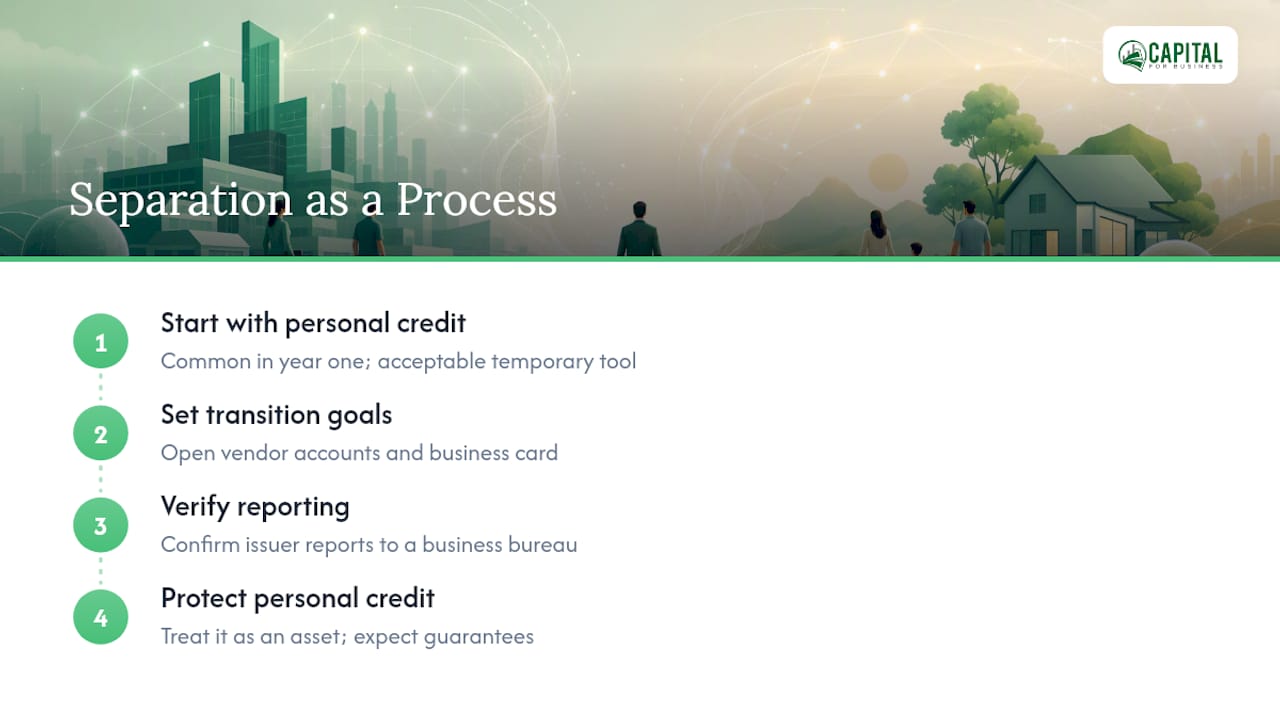
The conventional advice on business vs personal credit stops at "get a business card and separate everything," which is true but incomplete. The more useful lesson is that separation is a process, not a switch you flip on day one. Plenty of businesses spend their first year using personal credit out of necessity, and that's not a failure. It's a phase to move through deliberately, with a plan to open vendor accounts and a business card as soon as the paperwork allows.
Where most owners go wrong is assuming a business card automatically removes them from personal liability. It often doesn't, not with a personal guarantee attached, and not with blended underwriting sitting behind most small business lending decisions. The owners who fare best treat personal credit as an ongoing asset to protect, not a problem to escape once business credit exists.
If there's one priority to take from this: confirm your card issuer actually reports to a business bureau before you assume you're building anything. A card that never reports is just a card, no matter how you use it.
Need Capital Beyond What a Card Can Offer?
Business credit cards handle daily supplies and short-term purchases well, but they run out of runway fast when you're facing a real equipment upgrade, a multi-month cash-flow gap, or an expansion that costs more than a few card cycles can cover. Capital for Business has spent over a decade helping small business owners get past exactly that ceiling, with working capital loans sized for the gap between what a card can absorb and what a bank will approve.

If minimum payments are stretching past what makes sense, or a purchase would take half a year of card payments to clear, that's the signal to look at financing built for the amount you actually need. Capital for Business also offers merchant cash advances and equipment financing for owners who need capital tied to a specific purchase rather than revolving debt. Reach out and a specialist will walk you through prequalification, the documents needed, and a funding timeline, no long forms required to get a first answer.
Sources
- Business Credit vs. Personal Credit - Experian
- 6 Major Differences Between Business and Personal Credit Cards - NerdWallet
- Business Credit vs Personal Credit: Key Differences - Square
- Loans | U.S. Small Business Administration (SBA)
- The financial security of small-business owners — CFPB
FAQ
Is It Better to Have Business Credit or Personal Credit?
Business credit is better for daily operations because it separates liability and builds a profile lenders can evaluate independently, but strong personal credit still matters since most lenders use blended underwriting for small business financing.
Do Business Loans Use Personal Credit?
Many do, especially for newer businesses without an established revenue history, since lenders often require a personal guarantee and check personal credit alongside any business credit file.
How Long Does It Take to Build Business Credit?
Expect roughly three to six months of consistent, on-time payments on reporting accounts before a business score becomes meaningful to lenders.
Can I Use My Personal Credit Card for Business Expenses?
Yes, particularly before your business has an established credit file, but track those purchases separately for tax purposes and switch to a business card once you qualify for one.
What's the Fastest Way to Start Building Business Credit?
Opening two or three vendor trade accounts that report to a business bureau, such as net-30 supplier accounts, typically builds a file faster than waiting on a single credit card.