
TL;DR:
- Maintaining strong business credit is essential for accessing better financing terms, lower interest rates, and faster approval processes.
- It also influences vendor relationships, reduces personal credit dependence, and guards against fraud through regular monitoring.
Business credit is defined as your company's financial reputation, separate from your personal credit, that lenders, vendors, and partners use to judge your reliability before extending money or favorable terms. Maintaining it is the single most direct path to securing financing, protecting your personal assets, and growing your business on your own terms. The U.S. Small Business Administration confirms that poor credit history is one of the main reasons small business loan applications are declined. Agencies like Dun & Bradstreet, Experian, and Equifax track your business credit profile independently, and what they report shapes every financing conversation you will ever have. Understanding why maintain business credit matters is not optional for small business owners. It is a financial priority that pays off in lower rates, better vendor terms, and long-term growth capacity.
Why maintaining business credit determines your financing access
Business credit history is the primary trust signal lenders use when evaluating a loan application. Before a bank, credit union, or alternative lender approves your request, they pull your business credit report to assess how reliably you pay obligations. The SBA states directly that lenders view credit history as a measure of your company's financial reliability and growth potential. A thin or damaged credit file tells lenders you are a risk, and that judgment shows up in denials, higher interest rates, or reduced loan amounts.

The numbers behind this reality are stark. According to the 2025 Small Business Credit Survey published by America's SBDC, 60% of small firms applied for financing in the prior 12 months. Of those applicants, only 42% received full funding, while 58% received partial funding or none at all. That gap between applying and receiving full capital is largely explained by credit position. Businesses with strong, documented credit histories are far more likely to land in the 42% that get what they need.
Strong business credit also changes the terms of the financing you receive, not just whether you receive it. Consider two businesses applying for the same $150,000 equipment loan. The business with a solid credit profile may qualify for a 7% interest rate over five years. The business with a weak profile, if approved at all, might face 15% or higher. Over five years, that difference costs tens of thousands of dollars. Maintaining good credit is not just about access. It directly affects how much financing costs you.
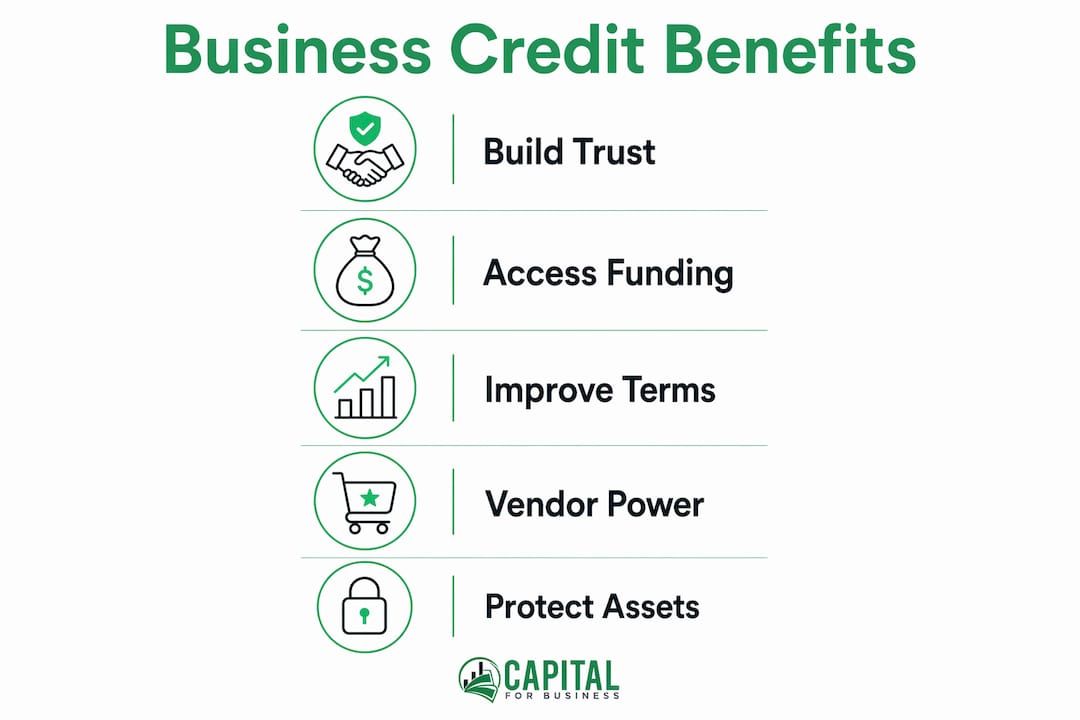
There are three specific financing advantages that come with a well-maintained business credit profile:
- Higher loan amounts. Lenders extend more capital to businesses they trust, based on a documented repayment history.
- Better interest rates. Lower risk scores translate directly to lower borrowing costs across loans, lines of credit, and equipment financing.
- Faster approvals. A clean, current credit file reduces the due diligence burden on lenders, which speeds up the approval process.
For small businesses that need capital quickly to respond to opportunities or manage cash flow, that speed advantage alone is worth the ongoing effort of credit maintenance.
Pro Tip: Review your business credit reports from Dun & Bradstreet, Experian, and Equifax at least once per quarter. Catching a missed payment or reporting error before a loan application can save your approval.
How does business credit affect vendor and supplier relationships?
The impact of credit on business extends well beyond bank loans. Vendors and suppliers check your business credit before agreeing to extended payment terms. Net-30 and net-60 arrangements, where you receive goods or services now and pay within 30 or 60 days, are only offered to businesses that demonstrate creditworthiness. These terms free up working capital that would otherwise be tied up in upfront payments, giving you more flexibility to manage daily operations.
The SBA advises that good credit improves negotiating power with vendors and helps protect against business identity theft through regular monitoring. A supplier who sees a strong credit profile is more likely to offer priority pricing, flexible delivery schedules, and extended terms. One who sees a weak or missing profile will often require payment upfront or impose stricter conditions. Over time, those conditions add up to real operational constraints.
Business identity theft is a less-discussed but serious risk that credit monitoring directly addresses. Criminals can open accounts, take on debt, or establish fraudulent trade lines in your company's name. If you are not reviewing your business credit reports regularly, this activity can go undetected for months. By the time you apply for financing, the damage is already done. The SBA specifically recommends monitoring business credit reports as a proactive defense against this threat.
Here is what consistent credit monitoring protects against:
- Fraudulent accounts opened in your business name
- Incorrect payment records that lower your score without cause
- Outdated business information that creates confusion with lenders
- Unauthorized credit inquiries that signal potential fraud
Treating your business credit file as a live document, one that requires regular review and correction, keeps you protected and positioned for growth.
Personal credit vs. business credit: what changes over time
New business owners face a specific challenge: most early-stage financing decisions are based on the owner's personal credit score, not the company's. Banks and lenders have no business credit history to evaluate, so they fall back on the owner's personal financial record. The SBA confirms that new business loan eligibility typically depends on the owner's personal credit initially, but maintaining business credit builds future financing independence and credibility.
This creates a critical window in the first two to three years of a business. During that period, every business credit account you open, every vendor payment you make on time, and every trade line you establish is building the foundation of an independent credit profile. Ignore this window and you remain personally exposed. Your personal credit score, your mortgage eligibility, and your personal financial health stay tied to every business financing decision you make.
The table below shows how the role of personal versus business credit shifts as a company matures:
| Stage | Personal Credit Role | Business Credit Role |
|---|---|---|
| Startup (Year 1) | Primary basis for loan approvals | Minimal or nonexistent |
| Early Growth (Years 2–3) | Still significant for most lenders | Building through trade lines and vendor accounts |
| Established (Years 4+) | Secondary factor for most lenders | Primary basis for business financing decisions |
| Mature Business | Largely separate from business decisions | Fully independent credit profile with track record |
The SBA notes that building an independent credit profile helps qualify for better terms as the business matures. That independence is the goal. Once your business credit stands on its own, you protect your personal finances and gain access to larger, more favorable financing options.
Credit report errors are another challenge that catches many business owners off guard. Unlike personal credit, business credit reports are not automatically corrected when you dispute an error. You need to contact the reporting bureau directly, provide documentation, and follow up. Errors in payment history, business address, or account status can drag down your score and affect financing chances if left uncorrected.
Pro Tip: Set a calendar reminder to pull your Dun & Bradstreet PAYDEX score and your Experian Business Credit Report every 90 days. Dispute any inaccuracies in writing and keep records of all correspondence.
What are the steps to build and maintain strong business credit?
Building strong business credit requires a deliberate sequence of actions, not a single event. The process starts with legal and financial separation and builds through consistent, documented payment behavior over time. Here are the foundational steps to build and maintain a credit profile that supports your financing goals:
- Incorporate your business. Register as an LLC, S-Corp, or C-Corp to establish your business as a legal entity separate from you personally. Sole proprietorships do not build independent business credit.
- Get a federal Employer Identification Number (EIN). The IRS issues this number free of charge. Lenders and credit bureaus use it to track your business credit file separately from your Social Security number.
- Open a dedicated business bank account. Mixing personal and business finances muddies your credit profile and makes it harder for bureaus to track your business activity accurately.
- Establish trade lines with vendors. Apply for net-30 accounts with suppliers who report payment history to Dun & Bradstreet, Experian, or Equifax. Companies like Uline, Quill, and Grainger are commonly used starting points because they extend credit to newer businesses and report to major bureaus.
- Apply for a business credit card. Cards from issuers like American Express, Chase, or Capital One that report to business credit bureaus help build your payment history quickly. Pay the balance in full each month.
- Pay every bill early or on time. Payment history is the single largest factor in your business credit score. The Dun & Bradstreet PAYDEX score, for example, rewards businesses that pay before the due date with the highest possible score of 100.
- Monitor your credit reports regularly. Pull reports from Dun & Bradstreet, Experian Business, and Equifax Business Credit at least quarterly. Review them for errors, fraud, and outdated information.
Beyond these steps, the importance of business credit maintenance lies in consistency. A single late payment can drop your PAYDEX score significantly. A missed vendor account update can leave your file incomplete. The SBA describes maintaining business credit as an ongoing operational process that requires timely payments, error prevention, and keeping your credit file current.
For businesses looking to go deeper on improving their credit score, a structured approach to each of these steps makes the difference between a credit profile that opens doors and one that closes them. Understanding the 5 Cs of credit that lenders evaluate, including character, capacity, capital, collateral, and conditions, also helps you understand exactly what your credit profile needs to demonstrate.
The benefits of maintaining credit compound over time. Each year of clean payment history adds weight to your profile. Each new trade line adds depth. Each corrected error removes a potential obstacle. Small business owners who treat credit maintenance as a routine part of financial management consistently report better financing outcomes than those who address it only when a loan application is already in progress.
Key takeaways
Maintaining business credit is the most direct way to secure better financing terms, protect personal assets, and build long-term financial independence for your company.
| Point | Details |
|---|---|
| Credit drives financing access | Only 42% of small firms received full funding; a strong credit profile puts you in that group. |
| Vendor terms depend on credit | Net-30 and net-60 arrangements require a documented credit history that suppliers can verify. |
| Personal credit exposure decreases over time | Building an independent business credit profile reduces reliance on personal credit for loan approvals. |
| Errors and fraud require active monitoring | Pull reports from Dun & Bradstreet, Experian, and Equifax quarterly to catch problems before they cost you. |
| Consistency is the core requirement | Timely payments, current business information, and regular monitoring are the foundation of a strong credit file. |
What 15 years of watching small business finances taught me
Most small business owners treat credit as something they think about when they need a loan. That is the wrong approach, and it costs them more than they realize. At Capitalforbusiness, we have worked with business owners across hundreds of industries since 2009, and the pattern is consistent: the businesses that maintain their credit year-round get better terms, faster approvals, and more options when they need capital. The businesses that scramble to fix their credit profile right before applying almost always face delays, higher costs, or outright denials.
The uncomfortable truth is that credit maintenance is not complicated. It is just disciplined. Pay on time. Monitor your reports. Separate your finances. Dispute errors immediately. None of these steps require a financial advisor or a large budget. They require consistency and attention.
What I find most underappreciated is the competitive advantage this creates. When two businesses apply for the same loan in the same week, the one with a clean, current, well-documented credit profile wins. The 2025 Small Business Credit Survey makes clear that demonstrating consistent creditworthiness right at the moment of application is a key edge. You cannot manufacture that track record in a week. You build it over months and years.
My advice to any small business owner reading this: start treating your business credit file the way you treat your business bank account. Check it regularly. Keep it accurate. Protect it from fraud. The payoff is not just a better loan rate. It is the financial flexibility to grow your business on your own terms, without being held back by a credit profile that does not reflect what your business is actually capable of.
— Capital
Ready to put your business credit to work?
Strong business credit opens the door to financing that fits your actual needs. At Capitalforbusiness, we work with small business owners nationwide and in Canada to match them with funding solutions that align with their credit profile and growth goals. Whether you need working capital, equipment financing, or a flexible credit line, we move quickly and efficiently when banks say no.

Explore small business loan options designed for businesses at every credit stage, or check out our business line of credit up to $250,000 for a revolving solution that grows with you. If your credit is still developing, we also offer funding solutions built for businesses that need capital now. Apply today and let your credit work for you.
FAQ
What is business credit and why does it matter?
Business credit is your company's financial reputation, tracked separately from your personal credit by bureaus like Dun & Bradstreet, Experian, and Equifax. Lenders, vendors, and partners use it to decide whether to extend financing or favorable terms.
How does poor business credit affect loan approvals?
The SBA identifies poor credit history as one of the primary reasons small business loan applications are declined. Weak credit also results in higher interest rates and lower approved loan amounts even when applications are not fully denied.
How long does it take to build business credit?
Building a meaningful business credit profile typically takes one to three years of consistent payment activity across multiple trade lines and credit accounts. The timeline shortens when you open accounts with vendors that report to major credit bureaus from the start.
Should i monitor both personal and business credit?
Yes. The SBA recommends monitoring both personal and business credit reports regularly, especially if you suspect identity theft. For early-stage businesses, personal credit still influences financing decisions, so both profiles need to stay clean.
What is the fastest way to improve a business credit score?
Paying all business obligations on time or early is the single most effective step, as payment history carries the most weight in scores like the Dun & Bradstreet PAYDEX. Disputing errors on your credit reports and opening new trade lines with reporting vendors also accelerates improvement.