
TL;DR:
- Most small businesses should start with Capitalforbusiness, which covers all major funding types under one roof. Alternatives like SBA 7(a) loans offer lower long-term costs but take longer to approve. Choosing the right product depends on your cash flow, repayment schedule, and business needs.
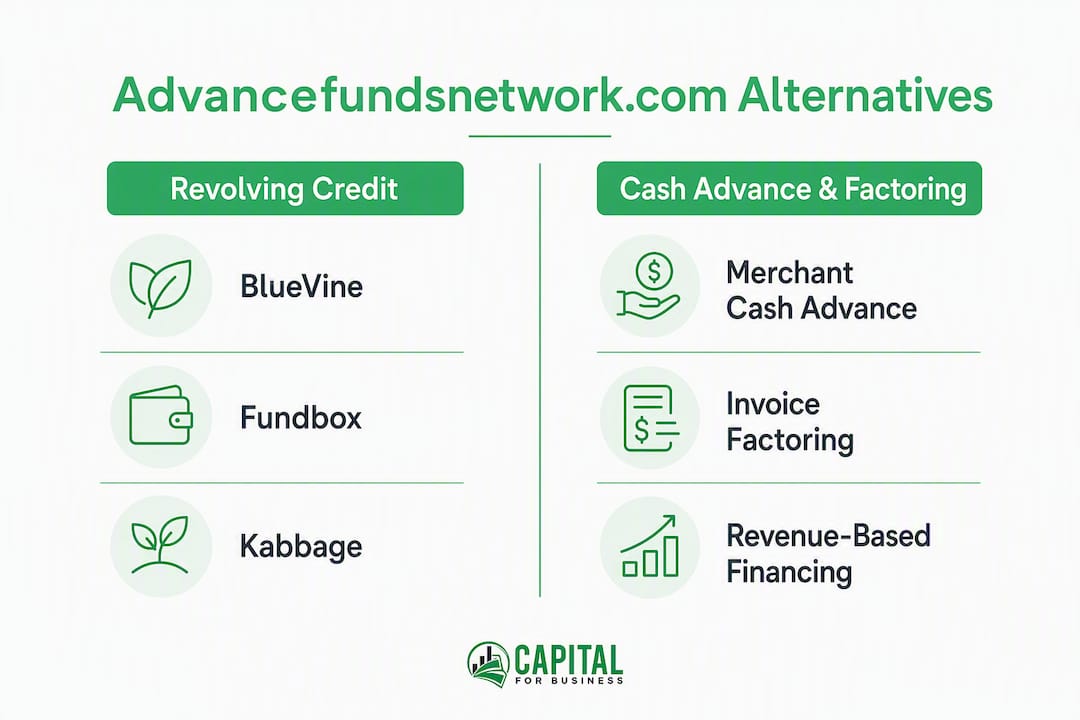
The strongest alternatives to Advance Funds Network fall into five practical categories: merchant cash advances, revolving business lines of credit, invoice factoring, online term loans, and equipment financing. For most small businesses, Capitalforbusiness is the recommended starting point because it covers all five product types under one roof, offering concierge support and transparent fee structures. If you need a longer-term, lower-cost option, SBA 7(a) loans are worth exploring, though approvals often take longer compared to the faster timelines typical of private alternative lenders.
Top funding categories to consider:
- Merchant cash advance (MCA): fastest access, revenue-linked repayment
- Revolving line of credit: reusable capital for recurring gaps
- Invoice factoring: converts unpaid invoices to same-day cash
- Online term loans: fixed payments, predictable cost
- SBA 7(a) loans: lowest long-term cost, highest documentation bar
- Equipment financing: asset-secured, preserves working capital
Table of Contents
- What are the best Advancefundsnetwork.com alternatives to compare?
- How do you evaluate and choose the right lender for your business?
- What financing types will you encounter, and how does each work?
- Which alternative fits your business situation?
- What is Advance Funds Network?
- How do alternative lenders compare on reputation and reviews?
- What does the application process look like, step by step?
- Key Takeaways
- What trustworthy lenders actually look for
- Capitalforbusiness offers a practical path for most small businesses
- Useful sources and further reading
- FAQ
What are the best Advancefundsnetwork.com alternatives to compare?
The table below maps each major funding category to the business profiles, costs, and timelines you can realistically expect. Specific lender names within each category vary, but the structural characteristics hold across the market.
| Product type | Best for | Typical funding speed | Funding amount range | Cost structure | Min. credit / revenue | Repayment frequency | Application timeline |
|---|---|---|---|---|---|---|---|
| Merchant cash advance | High card-volume retail, restaurants | 24–72 hours | — | Factor rate; no fixed APR | No hard minimum; revenue-based | Daily or weekly, revenue-linked | 1–3 days; 3–6 months bank statements |
| Revolving line of credit | Businesses with recurring cash gaps | 1–5 business days | $10,000–$250,000 | APR varies; interest on drawn balance only | 6+ months in business | Weekly or monthly draws | 2–5 days; basic financials |
| Invoice factoring | B2B suppliers with outstanding invoices | 24 hours on approved invoices | Up to 100% of invoice value | 1–5% of invoice; non-recourse options available | Revenue-based; invoice quality matters | Repaid when buyer pays | 1–3 days; invoice documentation |
| Online term loan | Established businesses, predictable revenue | 1–5 business days | $10,000–$500,000 | APR 10–80%+; origination fees common | 6+ months in business; revenue threshold | Fixed weekly or monthly | 2–7 days; tax returns, bank statements |
| SBA 7(a) loan | Creditworthy businesses seeking low rates | Several months | Up to $5 million | Prime + spread; lowest effective APR | 2+ years in business | Monthly | Weeks to months; full financial package |
| Equipment financing | Any business buying hard assets | Same day to 5 days | — | Fixed APR; equipment is collateral | — | Monthly | 1–5 days; equipment quote, basic financials |
A few cost trade-offs worth noting before you choose:
- Fast-funding solutions frequently carry higher effective rates and shorter repayment windows than traditional term loans. Calculate total cost of capital, not just the headline rate.
- Factor rates on MCAs are not APR. A 1.3x factor on a 6-month advance translates to a much higher annualized cost than a 30% APR term loan.
- Revolving lines charge interest only on what you draw, which makes them cheaper than a lump-sum advance for businesses that need capital in bursts rather than all at once.
How do you evaluate and choose the right lender for your business?
Start with your cash flow, not the lender's marketing. The repayment cadence (daily, weekly, or monthly) is often more consequential than the rate itself. A daily withdrawal that outpaces your sales volume creates a cash crisis faster than a high APR on a monthly-payment loan.
Evaluation checklist:
- Revenue fit: does the lender's minimum monthly revenue threshold match your actual deposits?
- Time in business: most alternative lenders require 6+ months; SBA programs often require 2+ years.
- Collateral: MCAs and invoice factoring are typically unsecured; SBA and equipment loans are not.
- Repayment cadence vs. cash flow: map the payment schedule against your slowest revenue weeks.
- Integration needs: does the lender pull from your POS, accounting software, or bank feed automatically?
- Contingency plan: what happens if revenue drops 30%? Ask the lender directly.
Questions to ask any provider:
- What is the total payback amount, not just the factor rate or APR?
- Are there prepayment penalties or origination fees not disclosed upfront?
- What triggers a default, and what recourse does the lender have?
- Is repayment fixed or tied to revenue?
Red flags: opaque fee structures, pressure to sign within 24 hours, daily withdrawals with no revenue-share adjustment, and unclear default terms. Industry reviewers consistently advise prioritizing transparent fee structures over speed, because rapid approvals often come with higher factor rates or frequent repayment schedules.
Pro Tip: Applying to multiple lenders simultaneously can trigger multiple hard credit inquiries and lower your score. Use a curated marketplace or broker-assisted application to match to the best-fit lender with a single pull.

What financing types will you encounter, and how does each work?
Understanding the mechanics of each product type helps you spot whether a lender's offer actually fits your situation.

Merchant cash advance (MCA): Technically a purchase of future receivables, not a loan. The provider advances a lump sum and collects a percentage of daily card sales or bank deposits until the agreed payback amount is reached. Because it is structured as a receivables purchase, recourse and collateral expectations differ from traditional debt.
Revolving line of credit: Draw, repay, and redraw up to your approved limit. Interest accrues only on the outstanding balance, making it the most cost-efficient option for businesses with recurring but unpredictable gaps. Experts point to revolving lines as superior for recurring shortfalls because they avoid accruing interest on a full lump sum from day one.
Invoice factoring: Sell outstanding invoices to a factoring company at a discount. Traditional factoring advances 80–95% of invoice value; modern net-terms platforms can advance up to 100% on approved invoices, often within 24 hours, with non-recourse options that protect you if the buyer defaults. Embedded net-terms financing can also cut day sales outstanding (DSO) by 30–60%.
Online term loan: A fixed principal repaid over a set schedule. Predictable payments suit businesses with steady revenue. Origination fees and APR vary widely, so calculate the full cost before signing.
SBA 7(a) loan: Government-backed, lowest effective rates, longest terms. The trade-off is documentation and time. Approvals commonly span several months, and credit and business-history requirements are stricter than most private alternatives.
Equipment financing: The asset itself serves as collateral, which lowers lender risk and often results in better rates than unsecured products. Same-day funding is available from some providers for straightforward equipment purchases.
| Product | Typical speed | Cost signal | Key documentation |
|---|---|---|---|
| MCA | 24–72 hours | Factor rate | 3–6 months bank statements, card processing records |
| Line of credit | 1–5 days | APR on drawn balance | Bank statements, basic financials |
| Invoice factoring | 24 hours | 1–5% of invoice value | Invoices, accounts receivable aging |
| Online term loan | 1–7 days | APR + origination fee | Tax returns, bank statements, P&L |
| SBA 7(a) | Months | Prime + spread | Full financial package, business plan |
| Equipment financing | Same day to 5 days | Fixed APR | Equipment quote, basic financials |
Which alternative fits your business situation?
Matching the product to your actual cash-flow profile is the single most important decision you will make. Specialists consistently recommend matching financing structure to cash flow, whether revenue-based for seasonality or invoice financing for predictable receivables.
- Seasonal retail or hospitality: A revenue-linked MCA or revolving line works well because repayment scales with sales. Avoid fixed daily withdrawals during your slow season.
- B2B supplier with unpaid invoices: Invoice factoring or a net-terms platform converts receivables to cash without adding traditional debt. Prioritize non-recourse options and check whether the platform is white-labeled so buyer relationships stay intact.
- Equipment purchase: Equipment financing preserves working capital and uses the asset as collateral. Compare the fixed monthly payment against your projected revenue from the equipment itself.
- Established business seeking lower-cost capital: If you have 2+ years in business, strong credit, and time to wait, an SBA 7(a) loan delivers the lowest long-term cost. Use a short-term line to bridge while the SBA application processes.
- Startup or thin credit file: Focus on revenue-based products (MCA or revenue-based financing) that underwrite on cash flow rather than credit score. Build a 6-month track record before applying for term loans.
Pro Tip: Once you have stabilized with a short-term product, phase toward a revolving line of credit. A line lets you draw only what you need, repay it, and redraw, which reduces total interest paid compared to rolling over lump-sum advances repeatedly.
What is Advance Funds Network?
Advance Funds Network (advancefundsnetwork.com) is a U.S.-based alternative lending marketplace that connects small businesses with merchant cash advances, short-term loans, and working capital products. It operates primarily as a broker or marketplace, matching applicants to funding partners rather than originating all loans directly. The platform targets businesses that may not qualify for traditional bank financing, emphasizing speed and accessibility over cost. Typical products include MCAs and short-term business loans with fast approval timelines. As with most marketplace lenders, the actual terms, rates, and underwriting standards depend on the funding partner matched to your application, not a single disclosed standard.
How do alternative lenders compare on reputation and reviews?
Reputation signals worth checking before you commit to any lender include BBB accreditation and complaint history, Trustpilot or Google ratings, and whether the lender discloses APR or factor rates clearly in writing before you sign.
- BlueVine is well-regarded for its revolving line of credit product and transparent fee disclosures. It targets businesses with at least $10,000 in monthly revenue.
- Fundbox focuses on lines of credit and invoice financing for small businesses, with a straightforward online application and generally positive user reviews for speed and clarity.
- OnDeck has a long track record in online term loans and lines of credit. It discloses rates clearly and is accredited with the BBB, though its rates can run higher than bank alternatives.
- PayPal Working Capital is available only to PayPal merchants and repays automatically as a percentage of PayPal sales. Fees are fixed and disclosed upfront, which users consistently rate positively.
- Funding Circle focuses on term loans for established businesses and is known for competitive rates relative to other online lenders, with a more thorough underwriting process.
- Capitalforbusiness has served small businesses since 2009 across hundreds of industries, offering multiple product types with concierge support and a reputation for matching businesses to the right product rather than the most profitable one.
When evaluating any lender, check whether the BBB record shows resolved or unresolved complaints, and read reviews specifically about the repayment experience, not just the approval process.
What does the application process look like, step by step?
The process varies by product type, but the core steps are consistent across most alternative lenders.
- Pre-qualify: Most online lenders offer a soft-pull pre-qualification that does not affect your credit score. Provide basic business details, monthly revenue, and time in business.
- Gather documentation: Bank statements (3–6 months), business tax returns (1–2 years for term loans and SBA), accounts receivable aging (for factoring), and a government-issued ID are standard. SBA applications require a full financial package including a business plan and personal financial statements.
- Submit the application: Online applications typically take 10–20 minutes. Marketplace lenders may route your application to multiple funding partners simultaneously.
- Underwriting review: For MCAs and lines of credit, this can take hours. For term loans, 1–3 business days. SBA loans involve a bank underwriter and an SBA review, which extends the timeline to weeks or months.
- Review the offer carefully: Confirm the total payback amount, repayment frequency, origination fees, and any prepayment terms before signing. Ask for the effective APR in writing.
- Funding: MCAs and lines of credit often fund within 24–72 hours of approval. SBA loans fund after closing, which adds additional time.
Pro Tip: Prepare your last 6 months of bank statements and your most recent business tax return before you start any application. Having documents ready cuts the average approval-to-funding timeline significantly.
Key Takeaways
The right alternative to Advance Funds Network depends on your cash-flow pattern, credit profile, and how quickly you need capital.
| Point | Details |
|---|---|
| Match product to cash flow | Revenue-linked products suit seasonal businesses; invoice factoring suits B2B suppliers with predictable receivables. |
| Calculate total cost of capital | Factor rates, origination fees, and repayment frequency all affect true cost; APR alone is not enough. |
| Revolving lines beat lump sums for recurring gaps | Lines charge interest only on drawn balances, reducing total cost versus rolling over advances. |
| SBA 7(a) is the lowest-cost long-term option | Approvals span several months, so use a short-term bridge while the SBA application processes. |
| Capitalforbusiness covers all major product types | Working capital loans, MCAs, lines of credit, and equipment financing are available with concierge support since 2009. |
What trustworthy lenders actually look for
The funding conversation that matters most is not the one about rates. It is the one about fit. At Capitalforbusiness, the first question is always about cash flow cadence: how does money move through your business, and does the repayment structure of the product you are considering actually match that pattern? A business with lumpy, seasonal revenue that signs up for daily fixed withdrawals is set up to struggle, regardless of the rate.
Transparent underwriting means telling a business owner when a product is not the right fit, even when they are eager to sign. That means asking about collateral expectations upfront, explaining what triggers a default in plain language, and walking through the total payback amount before any paperwork is signed. The businesses that come back for a second or third funding round are the ones who understood exactly what they were agreeing to the first time.
Capitalforbusiness offers a practical path for most small businesses
Capitalforbusiness has matched small businesses to the right funding product since 2009, across hundreds of industries in the U.S. and Canada. Where Advance Funds Network and similar marketplace lenders route your application to a network of third-party partners, Capitalforbusiness works directly with you to identify whether a working capital loan, a merchant cash advance, a line of credit, or equipment financing is the right fit before you apply.
The product range covers the full spectrum: short-term loans up to $500,000, revenue-based advances, invoice factoring, equipment financing up to $250,000, and SBA-backed options for businesses ready for long-term capital. Fees and repayment terms are disclosed clearly before you sign, and the application process starts with a conversation, not a credit pull.
To see which product fits your business, visit Capitalforbusiness funding solutions or go directly to the small business loan types page to compare options and start an inquiry today.
This article is general information, not professional financial advice. Confirm current rates, eligibility requirements, and program terms with the lender or a qualified financial advisor before committing to any funding product.
Useful sources and further reading
The claims in this article draw on the following authoritative sources. Each covers a specific aspect of alternative lending, from cost comparisons to SBA guidance.
- SBA 7(a) loan timelines and requirements: Capitalforbusiness's detailed breakdown of SBA suitability and approval timelines.
- National Funding alternatives analysis (Resolve Pay): Category-level comparison of alternative lending models including net-terms, revolving credit, and MCA structures.
- National Funding review (Finder): Independent review covering cost transparency, repayment cadence, and eligibility thresholds for online lenders.
- Business loans comparison (SmallBusinessChoice): Practitioner guidance on calculating total cost of capital and evaluating origination fees.
- National Funding alternatives and competitors (CB Insights): Industry category matrix segmenting lenders by primary model and core fit.
- Best lending options for small businesses: Capitalforbusiness's overview of lending product selection for 2026.
FAQ
What is Advance Funds Network?
Advance Funds Network is a U.S.-based alternative lending marketplace that connects small businesses with merchant cash advances and short-term working capital products, primarily through a network of funding partners rather than direct origination.
What are the closest alternatives to advancefundsnetwork.com?
The closest alternatives include revolving credit providers like BlueVine and Fundbox, MCA-style lenders, invoice factoring platforms, and multi-product lenders like Capitalforbusiness, which covers MCAs, lines of credit, term loans, and equipment financing under one application.
Who offers cash advances similar to Advance Funds Network?
Merchant cash advance providers and revenue-based financing platforms serve the same use case. Capitalforbusiness offers MCA products up to $500,000 with repayment tied to revenue, making it a direct alternative for businesses that need fast, flexible capital.
What kind of company is Advance Financial?
Advance Financial is a separate consumer financial services company focused on personal loans and consumer lending, not small business funding. It is distinct from Advance Funds Network, which targets small business borrowers.
When should you choose a line of credit over a lump-sum advance?
A revolving line of credit is the better choice when your funding need is recurring rather than one-time, because you pay interest only on what you draw rather than on a full lump sum from day one.