
Manufacturing working capital is the cash left over after subtracting current liabilities from current assets, and for a plant owner it usually shows up as money frozen in raw materials, unfinished goods, and unpaid invoices instead of sitting in the bank. The formula is simple: Working Capital = Current Assets − Current Liabilities, and it draws on JPMorgan's standard definition, treating inventory, accounts receivable, and cash as the assets side and accounts payable, wages, and short-term debt as the liabilities side. If you do one thing after reading this, map your cash conversion cycle (CCC) this week. That single number tells you faster than any balance sheet where your cash is actually trapped.
Key Takeaways
Manufacturing working capital measures the cash trapped between paying suppliers and collecting from customers, and shortening that cycle is usually cheaper than borrowing to cover it.
| Point | Details |
|---|---|
| Core formula | Working Capital = Current Assets minus Current Liabilities, covering inventory, AR, cash, and short-term payables. |
| Watch the CCC | CCC = DIO + DSO − DPO; shortening it by even 15 days can free hundreds of thousands in cash. |
| Healthy ratio range | A current ratio between 1.5 and 2.5 balances liquidity against idle capital for most manufacturers. |
| Segment before you scale | Tag inventory by SKU velocity and reliability before applying reorder or vendor-managed changes plant-wide. |
| Financing as a bridge | Capital for Business offers working capital loans and merchant cash advances when operational fixes need a bridge. |
Table of Contents
- What Is Manufacturing Working Capital and Why Does It Work Differently?
- What Are the Core Components of Manufacturing Working Capital?
- How Do You Calculate Manufacturing Working Capital Requirements?
- What Are the Warning Signs of a Working Capital Problem?
- How Can Manufacturers Improve Working Capital?
- What's a 90-Day Plan to Reduce Working Capital?
- When Does It Make Sense to Use Outside Financing?
- If You Need Working Capital Now, Here's What Capital for Business Offers
- Sources
- FAQ
What Is Manufacturing Working Capital and Why Does It Work Differently?
Working capital behaves differently on a shop floor than it does in a services business, because manufacturers pay for materials and labor long before they collect from customers. A distributor might turn inventory in days. A manufacturer often holds raw materials, work in process, and finished goods simultaneously, each one aging at a different rate before it converts to cash.
That timing mismatch is the real threat, not weak margins. A plant can be profitable on paper and still miss payroll because customer payments lag supplier obligations by 60 or 90 days. Poor working capital management creates concrete risks:
- Production stoppages when cash runs short for materials, even with orders in hand
- Forced discounting to move finished goods and generate emergency cash
- Higher financing costs when a business borrows reactively instead of planning ahead
- Strained supplier relationships when payables stretch past agreed terms
It still needs a bridge loan every fall because seasonal orders require material purchases 45 days before customer payment lands. Profitable and cash-poor are not opposites. They coexist constantly in manufacturing.
What Are the Core Components of Manufacturing Working Capital?
Every dollar of working capital sits in one of four buckets, and each behaves differently on your balance sheet.
- Raw materials inventory: cash converted into inputs waiting for production; ties up money the longest when lead times are unpredictable.
- Work in process (WIP): partially finished goods sitting on the shop floor; often the least visible cash drain because it's not yet sellable and not yet collectible.
- Finished goods: completed products awaiting shipment or sale; cash recovers only after the sale closes.
- Accounts receivable (AR): invoiced revenue not yet collected; slow B2B payment cycles, disputed invoices, and 60 to 90-day customer terms are the usual culprits.
- Accounts payable (AP): what you owe suppliers; a legitimate short-term financing source when trade credit terms are negotiated well.
- Cash and short-term borrowing: the buffer that absorbs timing gaps between the categories above.
Tag each line item on your balance sheet against this list. A breakdown of cost of goods sold helps clarify how inventory costs flow into your margins once goods finally sell, which matters when you're deciding which SKUs are worth carrying at all.
How Do You Calculate Manufacturing Working Capital Requirements?
Start with the basic formula, then layer in the current ratio: Current Assets ÷ Current Liabilities. Many healthy small and mid-size manufacturers target a current ratio between 1.5 and 2.5, where a ratio below 1.0 signals liquidity risk and one well above 2.5 suggests cash sitting idle instead of funding growth.
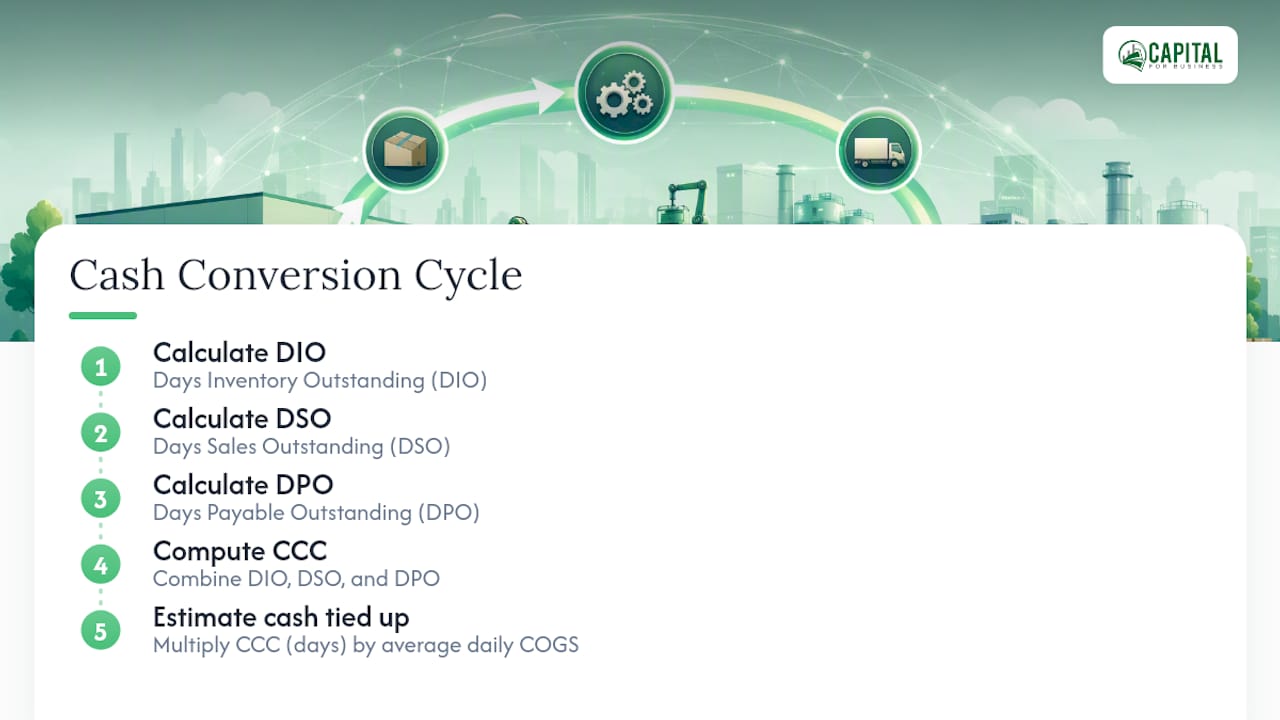
The deeper diagnostic is the cash conversion cycle, and it's the number JMco identifies as the primary tool for manufacturers specifically. It has three components:
- DIO (Days Inventory Outstanding) = (Average Inventory ÷ COGS) × 365. This measures how long cash sits in raw materials, WIP, and finished goods before a sale.
- DSO (Days Sales Outstanding) = (Average Accounts Receivable ÷ Revenue) × 365. This measures how long customers take to pay after invoicing.
- DPO (Days Payable Outstanding) = (Average Accounts Payable ÷ COGS) × 365. This measures how long you take to pay suppliers.
- CCC = DIO + DSO − DPO. Shorter is better; it means less cash trapped between paying suppliers and collecting from customers.
Here's how that translates to dollars. A manufacturer with $10 million in annual COGS, 60 days of DIO, 45 days of DSO, and 30 days of DPO has a CCC of 75 days. At that revenue scale, 75 days of CCC roughly equals $2 million in cash tied up in the operating cycle. Shave a meaningful number of days off DIO through better inventory segmentation, and you free up a significant amount of cash without touching sales or margin.
Check DSO first if collections feel slow, DIO first if warehouses feel full, and DPO first if suppliers are tightening terms. Any one of the three moving the wrong way by even a week or two is worth investigating immediately.
What Are the Warning Signs of a Working Capital Problem?
Working capital problems rarely announce themselves. They show up as a string of small anomalies that finance teams dismiss individually and then can't ignore collectively.
- DSO creeping upward over two or three consecutive months
- WIP inventory growing faster than finished goods shipments
- Credit lines drawn closer to their limit each month
- Actual cash flow diverging from forecast by a widening margin
The escalation speed catches most owners off guard. A two to three week slip in DSO, paired with a supplier suddenly shortening terms from net 30 to net 15, can convert a comfortable cash position into a payroll crisis within a single billing cycle. Root causes tend to repeat: seasonal demand swings, a shift toward slower-moving product mix, supplier shortages forcing early payment, or fast growth funded by generous customer terms that outpace supplier terms.
How Can Manufacturers Improve Working Capital?
Improvement strategies fall into three buckets: receivables, inventory, and payables, and the biggest wins usually come from combining moves across all three rather than optimizing one in isolation.
On accounts receivable, tighten collection terms and automate invoicing so invoices go out the moment goods ship, not days later. Offer early-payment incentives selectively to your largest, most reliable customers rather than across the board. Cash flow guides for manufacturers consistently point to invoicing discipline as one of the fastest, lowest-cost wins available.
On inventory, segment SKUs by velocity and supplier reliability rather than managing every item the same way. Fast-moving, reliable-supply items can run lean with tight reorder points. Slow-moving or high-risk items need buffer stock, but that buffer should be a deliberate decision, not a default. Vendor-managed inventory arrangements, where suppliers monitor and replenish stock based on your actual usage, can shift carrying costs off your balance sheet entirely. Demand-driven replenishment tied to actual sales data, rather than fixed reorder schedules, keeps cash from piling up in items nobody's buying.

On accounts payable, negotiate the longest standard terms a supplier will support, then evaluate early-payment discounts case by case using real numbers.
Pro Tip: *A 2/10 net 30 discount is worth taking only if the effective annualized rate beats your short-term borrowing cost.
On technology, ERP modules with built-in inventory analytics catch slow-moving stock before it becomes dead stock. Automated invoicing and collections platforms shrink DSO by removing manual delays. Modern payment platforms speed up the actual cash transfer once a customer decides to pay. Before rolling any of this out plant-wide, pilot the change on one SKU family or one customer segment for a full cycle, then measure the CCC impact before scaling it.
What's a 90-Day Plan to Reduce Working Capital?
A focused, time-bound plan beats an open-ended initiative every time, because working capital problems compound the longer they sit unaddressed.
- Weeks 1 to 2: Finance maps the full CCC and identifies the top 20 SKUs by cash tied up in inventory.
- Weeks 1 to 2: Sales and finance jointly pull an AR aging report and flag every invoice over 45 days.
- Weeks 3 to 4: Procurement renegotiates payment terms with the top five suppliers by spend volume.
- Weeks 3 to 6: Production pilots tighter reorder points on the highest-cash SKUs identified in week one.
- Weeks 5 to 8: Finance implements automated invoicing and a structured collections follow-up cadence.
- Weeks 7 to 12: Procurement and production jointly evaluate vendor-managed inventory for stable, high-volume parts.
- Weeks 10 to 12: Finance recalculates CCC, measures cash freed, and decides whether external financing is still needed.
Quick wins, like tightening invoicing and negotiating a handful of supplier terms, show results inside a month. Structural changes, like vendor-managed inventory or ERP-driven reorder policies, take the full quarter. If the 90-day plan frees less cash than your seasonal gap requires, that's your signal to escalate to outside financing rather than wait another cycle.
When Does It Make Sense to Use Outside Financing?
Operational fixes should always come first, but they're not always fast enough. Seasonal demand spikes, rapid growth outpacing internal cash generation, or a supplier suddenly demanding prepayment are all legitimate reasons to layer in financing rather than wait three months for a CCC improvement to pay off.
The options differ mainly on speed, cost, and paperwork:
- Working capital loans offer moderate speed and cost, with documentation requirements centered on financial statements and tax returns.
- Business lines of credit provide the most flexibility for recurring seasonal gaps, drawn only when needed.
- Merchant cash advances fund fastest, often within days, at a higher cost, with lighter documentation than a bank loan.
- Supply-chain financing works well for manufacturers with strong supplier relationships and stable volume, converting payables into extended liquidity, though program economics need modeling before signing.
Before applying to any of these, gather your P&L, balance sheet, AR aging report, top SKU list, and outstanding purchase orders. Having that documentation ready cuts approval time significantly regardless of which option you pursue.
A Note From Working With Manufacturers
Helping manufacturers untangle cash flow problems tends to reveal the same pattern: the owner already sensed something was wrong months before the numbers confirmed it. Run the 90-day plan first, and reach out to a financing partner the moment your CCC math shows a gap the plan can't close fast enough on its own.
If You Need Working Capital Now, Here's What Capital for Business Offers
Capital for Business gets manufacturers funded in days, not the weeks a bank typically takes, because approvals lean on your cash flow and receivables rather than requiring years of pristine financials. That speed matters most when a supplier tightens terms or a seasonal order lands before your CCC improvements have time to kick in.

Before applying, gather the same documentation your 90-day plan already calls for: recent financial statements, an AR aging report, outstanding invoices, and a short summary of your business and funding purpose. Manufacturers who've already run the operational checklist in this guide tend to move through underwriting faster, since lenders can see exactly where the cash gap comes from and how it's being addressed. If your CCC math shows a gap that operational fixes alone won't close in time, start with working capital funding up to $500,000 built specifically to support day-to-day manufacturing operations.
Sources
- What is working capital: formula and how to calculate it — JPMorgan
- Working capital management — Investopedia
- Working capital management for manufacturers — James Moore & Co. (JMCo)
This article is general information, not a substitute for advice from a qualified financial advisor. Consult a qualified financial professional about your own circumstances before acting on anything here.
FAQ
What Are the Four Types of Working Capital?
The four common types are permanent working capital (the baseline amount always needed), temporary working capital (seasonal or cyclical spikes), gross working capital (total current assets), and net working capital (current assets minus current liabilities).
What Is a Good Working Capital Ratio for a Manufacturer?
Most healthy small and mid-size manufacturers target a current ratio between 1.5 and 2.5; below 1.0 signals liquidity risk, while well above 2.5 often means cash sitting idle instead of funding growth.
What Qualifies as Working Capital?
Working capital includes current assets like cash, accounts receivable, and inventory (raw materials, WIP, and finished goods), minus current liabilities like accounts payable, accrued wages, and short-term debt.
How Do You Determine the Working Capital Requirement for a Manufacturing Business?
Calculate your cash conversion cycle using DIO, DSO, and DPO, then multiply the resulting CCC in days by your average daily cost of goods sold to estimate the dollar amount of cash tied up in operations.
When Should a Manufacturer Consider Outside Financing Instead of Operational Fixes?
Outside financing makes sense during seasonal demand spikes, rapid growth, or supplier-driven prepayment demands, and working capital loans can bridge gaps that a 90-day operational plan won't close fast enough on its own.