
TL;DR:
- Capitalforbusiness offers small businesses quick access to a wide range of financing options, including SBA loans, merchant cash advances, and lines of credit. SBA-backed loans provide the lowest cost for qualified applicants, while faster products like MCAs serve immediate cash needs but often carry high costs. Borrowers should carefully compare costs, repayment terms, and eligibility before choosing the best financing solution.
Capitalforbusiness is the most practical starting point for most U.S. small businesses evaluating sunwisecapital.com alternatives; SBA-backed loans are the lowest-cost option for those who qualify. Here is a focused shortlist to match your situation:
- Capitalforbusiness — working capital, merchant cash advances, equipment financing, lines of credit, and SBA access; funds in as little as 24 hours
- SBA 7(a) / CDC/504 loans — lowest cost for qualified businesses; best for expansion and equipment with 2–6 week timelines
- Business line of credit — revolving access for recurring cash-flow gaps; draw only what you need
- Invoice financing / non-recourse factoring — best for B2B companies with outstanding receivables; shifts credit risk to the financier
- Equipment financing — purpose-built for machinery, vehicles, or tech; the asset itself often serves as collateral
- BlueVine, Fundbox, OnDeck, Fora Financial, Kabbage (American Express Business), LendingClub Business, PayPal Working Capital — vetted short-term lenders for speed-first situations
Pick speed when a cash-flow gap threatens operations. Pick SBA or bank options when you have time and a higher credit score. Pick invoice financing when your customers are other businesses and your receivables are the bottleneck.
Pro Tip: Before contacting any lender, pull your last three months of business bank statements. Most fast-decision lenders base approvals on cash-flow patterns in those statements, not FICO alone.
Table of Contents
- How do the top sunwisecapital.com alternatives compare?
- How to choose the right alternative for your business
- What does each financing type look like in practice?
- Why Capitalforbusiness is a recommended alternative
- What documents and timelines should you expect?
- Key Takeaways
- A practical perspective on matching businesses to the right financing
- Capitalforbusiness funding options for your next step
- Useful sources and further reading
- FAQ
How do the top sunwisecapital.com alternatives compare?
The marketplace of similar platforms is crowded, with dozens of sites offering varying terms, fees, and eligibility standards. A focused comparison across the dimensions that actually matter cuts through the noise.

| Financing Type | Best For | Funding Speed | Typical Amount | Typical Cost | Credit Required | Repayment Structure | Recourse | Collateral |
|---|---|---|---|---|---|---|---|---|
| Capitalforbusiness | Broad small-business needs | 24–72 hours | $5K–$500K | Varies by product | 500+ (product-dependent) | Fixed or revenue-share | Varies | Varies |
| SBA 7(a) / CDC/504 | Low-cost expansion | 2–6 weeks | Up to $5M | Prime + 3%–5% | 680+ | Fixed monthly | Full recourse | Often required |
| Business line of credit | Recurring cash-flow gaps | 24–72 hours | up to $250,000 | Variable APR | 600+ | Revolving draws | Full recourse | Sometimes |
| Invoice financing | B2B receivables | 24–72 hours | 80%–90% of invoice | Single-digit to low-20% annualized | Customer credit matters | Tied to invoice terms | Non-recourse option | Invoices |
| Equipment financing | Machinery / vehicles | 24–72 hours | Up to $250K | single-digit to low-20% APR | 600+ | Fixed monthly | Full recourse | Equipment |
| MCA (short-term advance) | Urgent bridge funding | Same day–24 hours | $5K–$500K | High; factor rates 1.1–1.5 | 500+ | Daily/weekly ACH | Full recourse | None typically |
| BlueVine / Fundbox | Invoices and credit lines | 24 hours | $20K–$250K | Moderate APR | 600+ | Weekly draws | Full recourse | Sometimes |
| OnDeck / Fora Financial | Short-term term loans | 24–72 hours | $5K–$250K | Moderate-high APR | around 500 | Daily/weekly ACH | Full recourse | Sometimes |
| LendingClub Business | Established businesses | 2–7 days | $5K–$500K | Moderate APR | 620+ | Fixed monthly | Full recourse | Sometimes |
| PayPal Working Capital | PayPal-based merchants | Same day | $1K–$150K | Fixed fee | No credit check | % of daily sales | Full recourse | None |
| Kabbage (Amex Business) | Flexible credit line | Same day–24 hours | Up to $250K | Monthly fee | higher thresholds | Monthly | Full recourse | None |
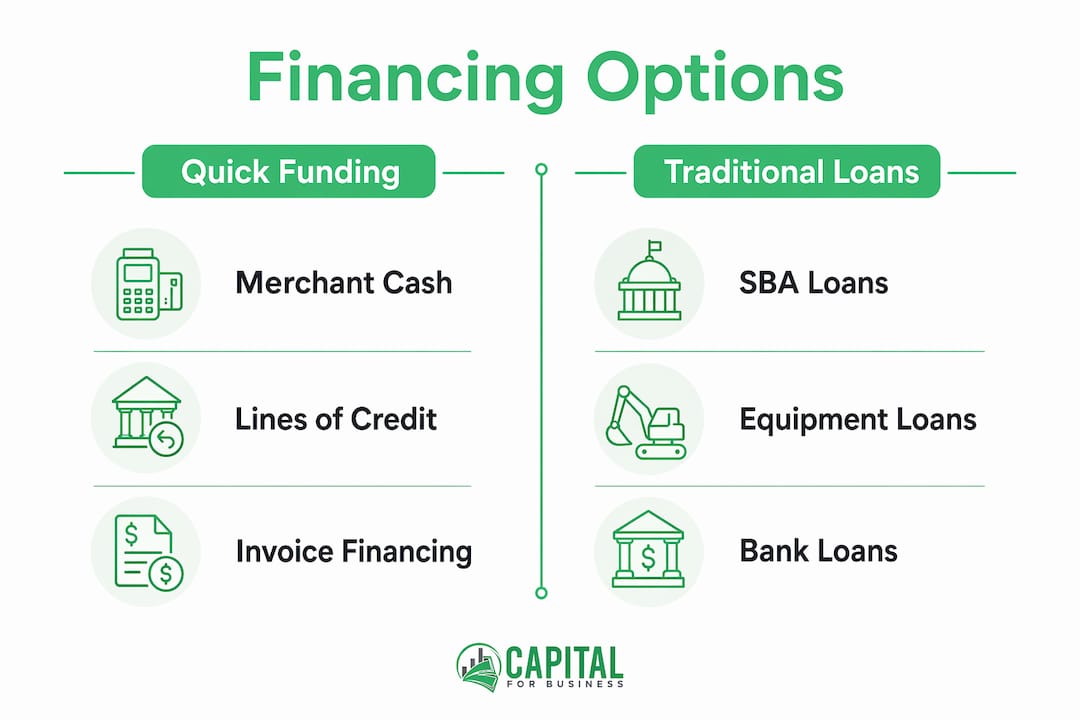
Factor rate vs. APR: A factor rate of 1.3 on a $50,000 advance means you repay $65,000 total. If you repay over six months, the annualized equivalent is roughly 60%+. Merchant cash advances can carry APR equivalents in the tens to low hundreds of percent, making cost comparison across product types critical before you sign.
Key strengths and traps by category:
- SBA loans: Lowest long-term cost, but documentation is heavy and timelines are longer. Businesses with stronger credit profiles should always check SBA options first.
- Invoice financing: Non-recourse models shift credit risk to the financier. Annualized costs can land in the single-digit to low-20% range depending on terms, far below MCA equivalents.
- MCAs: Fast and accessible at credit scores around 500, but daily ACH debits strain cash flow. Treat them as short-term bridges only.
- Capitalforbusiness: Covers the full product range so you can match the right product to your stage without switching lenders.
How to choose the right alternative for your business
Start with this rule: if you qualify for an SBA loan or a bank-backed line of credit, use it. The interest savings over 12–36 months are material. Move to faster, higher-cost products only when speed or credit constraints make bank options unavailable.
Evaluation checklist:
- What is your minimum monthly revenue, and does the lender's threshold match?
- What is the real annualized cost? Convert any factor rate to an APR equivalent using your expected repayment timeline.
- Are there prepayment penalties? Some short-term lenders charge the full factor-rate amount even if you pay early.
- For invoice financing: does the lender verify your customers' credit, and is the structure non-recourse?
- What is the ACH debit cadence? Daily debits can create overdraft risk if revenue is seasonal.
- Are there origination fees, renewal fees, or draw fees beyond the stated rate?
Red flags to watch:
- Factor-rate math presented without an APR equivalent
- Daily ACH debits with no option for weekly or monthly schedules
- Undisclosed renewal or maintenance fees
- Repayment windows shorter than your average sales cycle
Pro Tip: Take your expected repayment period in months, divide the total repayment amount by the advance amount, subtract 1, then divide by the number of months and multiply by 12. That rough calculation gives you an annualized cost to compare across any offer.
Understanding the importance of fast funding is useful, but speed should never be the only criterion. A lender who funds in 24 hours at a 90% annualized equivalent costs far more than one who funds in 72 hours at 25%.
What does each financing type look like in practice?
| Financing Type | Time to Fund | Typical Amount | Typical Cost | Key Trigger for Delays |
|---|---|---|---|---|
| Merchant cash advance | Same day–24 hours | $5K–$500K | Factor rate around 1.3 | Inconsistent bank deposits |
| Invoice financing | 24–72 hours | 80%–90% of invoice value | Single-digit to low-20% annualized | Disputed or overdue invoices |
| Business line of credit | 24–72 hours | up to $250,000 | Variable APR | Low credit score, thin history |
| Equipment financing | 24–72 hours | Up to $250K | single-digit to low-20% APR | Missing equipment invoice |
| Short-term term loan | 24–72 hours | $5K–$500K | Moderate-high APR | Bank statement anomalies |
| SBA 7(a) / CDC/504 | 2–6 weeks | Up to $5M | Prime + spread | Incomplete formation docs |
Merchant cash advance: The lender buys a portion of your future receivables at a discount. Repayment happens via a fixed percentage of daily card sales or daily ACH debits. Fast and accessible, but the operational impact of daily debits requires careful cash-flow planning.
Invoice financing: A B2B advance against outstanding invoices. In a non-recourse structure, the financier assumes the credit risk if your customer does not pay. Switching from MCAs to invoice financing can materially improve net profitability by removing daily ACH debits and aligning repayment with receivable timing.
Business line of credit: Revolving access up to a set limit. You draw what you need, repay, and draw again. Best for businesses with predictable but uneven revenue cycles.
Equipment financing: The purchased asset typically serves as collateral, which lowers lender risk and often produces better rates than unsecured products. Funding can reach $250,000 with same-day approval for straightforward applications.
SBA loans: The SBA 7(a) program offers the lowest cost of capital for qualifying businesses, with amounts up to $5 million. The CDC/504 program targets real estate and large equipment. Timelines run 2–6 weeks, and documentation requirements are heavier than alternative lenders.
Same-day funding is often conditional: lenders require stable revenue, clean bank statements, and submissions before a cut-off time, typically early afternoon.
Why Capitalforbusiness is a recommended alternative
Capitalforbusiness has been serving small-business financing since 2009, working with owners across hundreds of industries in the U.S. and Canada. The product range covers the full shortlist: working capital loans, merchant cash advances, equipment financing, business lines of credit, SBA loan access, and revenue-based financing.
What Capitalforbusiness offers:
- Working capital and merchant cash advances up to $500,000
- Equipment financing up to $250,000 with same-day funding available
- Business lines of credit up to $250,000
- SBA loan programs for qualified applicants
- Credit score eligibility starting around 500 for MCA products; higher thresholds for SBA and term loans
- Funding in as little as one day for qualifying applications
Three scenarios where Capitalforbusiness fits best:
- A retail business needs $80,000 for inventory before a peak season and cannot wait two weeks for a bank decision.
- A contractor needs $150,000 in equipment financing for a new project and wants the asset to serve as collateral.
- A service business with a 620 credit score wants a revolving line of credit to cover payroll gaps between client payments.
Pro Tip: If you are unsure which product fits your situation, describe your monthly revenue, average receivables cycle, and credit score when you contact Capitalforbusiness. That three-data-point summary lets a lending advisor match you to the right product in one conversation.
What documents and timelines should you expect?
Documents most lenders will request:
- Last three months of business bank statements (the single most critical document for fast underwriting)
- Most recent business tax return or year-to-date profit and loss statement
- Business formation documents (articles of incorporation, EIN confirmation)
- Government-issued ID for all owners with 20%+ ownership
- For invoice financing: copies of outstanding invoices and customer contact information
- For equipment financing: vendor invoice or equipment quote
Funding timelines by product type:
- Same day: MCA and PayPal Working Capital for pre-qualified applicants with clean bank statements and submission before the lender's cut-off time
- 24–72 hours: Business lines of credit, equipment financing, short-term term loans, and most alternative business funding products
- 2–6 weeks: SBA 7(a) and CDC/504 loans, LendingClub Business term loans for moderate to larger amounts
Common reasons for delays: inconsistent or unexplained large deposits in bank statements, missing formation documents, disputed invoices in invoice financing applications, and submissions after the lender's same-day cut-off.
Pro Tip: Before submitting, review your last three months of bank statements for one-off large deposits or payroll anomalies. Add a brief note to your application explaining any unusual entries. Underwriters flag unexplained spikes, and a one-line explanation can prevent a 24-hour hold.
Key Takeaways
For most U.S. small businesses evaluating sunwisecapital.com alternatives, Capitalforbusiness offers the broadest product match, while SBA loans deliver the lowest cost for those who qualify.
| Point | Details |
|---|---|
| SBA first if you qualify | Businesses with 680+ credit should compare SBA 7(a) or bank lines before high-cost alternatives. |
| Invoice financing for B2B | Non-recourse invoice financing can produce single-digit to low-20% annualized costs versus MCA equivalents. |
| MCAs as short-term bridges | Factor rates around 1.3 translate to high annualized costs; use MCAs only when speed is the priority. |
| Bank statements drive speed | The last three months of business bank statements determine approval speed more than FICO for fast lenders. |
| Capitalforbusiness | Covers working capital, MCAs, equipment financing, lines of credit, and SBA access from a single lender since 2009. |
A practical perspective on matching businesses to the right financing
At Capitalforbusiness, the most common question we hear is some version of: "What is the fastest option?" That is understandable, but it is rarely the right first question. When we review a business's situation, we look at three things first: monthly revenue consistency, the average time between a sale and cash in the account, and current credit standing. Those three data points usually tell us whether a business should be in an MCA, a line of credit, or working toward an SBA product. A restaurant with daily card sales and a 90-day equipment need is a different conversation than a B2B services firm waiting 60 days for client payments. We run a cost comparison across the realistic options, and when a short-term bridge is the only fit, we say so plainly and build a plan to transition to lower-cost capital once the business qualifies.
Capitalforbusiness funding options for your next step
Capitalforbusiness has matched small businesses to the right financing product since 2009, covering the full range from same-day merchant cash advances to SBA-backed term loans. If you have been comparing sunwisecapital.com alternatives and want a direct answer on what you qualify for, the process is straightforward.
Visit capitalforbusiness.net to start your application or request a funding consultation. You can also review the full range of small business loan types to identify the product that fits your revenue cycle before you apply.
- Response time: Most applicants receive an initial decision within 24 hours
- Documents to have ready: Three months of bank statements, basic formation docs, and a rough funding amount
- What happens next: A lending advisor reviews your profile and presents the options you qualify for, with real cost figures
If your credit score is below 620, the bad credit business loan options page outlines what is available and what to expect on pricing.
Useful sources and further reading
- SBA loan programs and eligibility: Explains the difference between SBA 7(a) and commercial loans and when each applies to your business structure.
- Same-day business loan criteria: Covers real-time underwriting requirements, revenue thresholds, and cut-off times for fast-funding products.
- Invoice financing for B2B businesses: Details non-recourse models and cost comparisons between invoice financing and MCA products.
- Sunwise Capital lender review: Independent analysis of Sunwise Capital's terms, useful for benchmarking what alternatives should offer.
- Capitalforbusiness funding solutions: Overview of the publisher's product range for readers comparing fit across lenders.
FAQ
What are the best alternatives to sunwisecapital.com for small businesses?
Capitalforbusiness, SBA 7(a) loans, business lines of credit, and invoice financing are the most practical alternatives, depending on your credit score, revenue, and funding timeline.
How fast can I get funded through a sunwisecapital.com alternative?
Merchant cash advances and some lines of credit fund same-day to 24 hours for qualified applicants; SBA loans typically take 2–6 weeks.
When does invoice financing make more sense than a merchant cash advance?
Invoice financing is the better fit for B2B businesses with outstanding receivables because non-recourse structures shift credit risk to the financier and annualized costs can be significantly lower than MCA factor-rate equivalents.
What credit score do I need to qualify for these alternatives?
MCA products at Capitalforbusiness are accessible starting around 500; lines of credit and term loans generally require 600+, and SBA loans typically require 680 or higher.
Are there hidden fees I should watch for with alternative lenders?
Yes. Watch for origination fees, renewal fees, prepayment penalties that charge the full factor-rate amount regardless of early payoff, and daily ACH debit structures that are not disclosed upfront.