
A sudden dip in cash flow or a new order from a major client can leave even the most prepared small business owner searching for rapid financial support. Fast access to capital is often the difference between capitalizing on new opportunities and falling behind. By clearing up common myths about fast funding and explaining how these quick solutions really work, this guide gives Canadian and American entrepreneurs a clear path to smarter, faster financial decisions.
Table of Contents
- Defining Fast Funding And Common Myths
- Types Of Fast Funding Solutions Available
- How Fast Funding Processes Operate
- Real-World Uses For Fast Funding
- Financial Implications And Risks To Consider
- Comparing Fast Funding With Traditional Lending
Key Takeaways
| Point | Details |
|---|---|
| Understanding Fast Funding | Fast funding provides quick capital solutions for small businesses, differing significantly from traditional lending methods in terms of speed and requirements. |
| Dispelling Myths | Entrepreneurs should recognize that not all funding sources have the same criteria, and faster options do not necessarily mean inferior quality or higher costs. |
| Types of Fast Funding Solutions | Various funding methods exist such as Merchant Cash Advances and Business Lines of Credit, each with unique characteristics tailored to specific business needs. |
| Evaluation and Risks | Careful evaluation of interest rates, repayment terms, and potential risks is crucial when selecting a fast funding option to ensure financial sustainability. |
Defining Fast Funding and Common Myths
For small business owners, fast funding represents more than just quick financial access — it's a critical lifeline for growth, opportunity, and survival. Unlike traditional lending models that can take weeks or months, fast funding provides entrepreneurs with rapid capital solutions tailored to their immediate business needs.
Understanding the nuanced landscape of business financing requires dispelling several persistent myths. Complex funding dimensions reveal that successful funding isn't simply about having a compelling business idea, but about strategically navigating multiple financial pathways.
Common misconceptions about fast funding include:
- Believing all funding sources have identical requirements
- Assuming speed compromises loan quality
- Thinking only businesses with perfect credit qualify
- Believing fast funding means higher interest rates
In reality, fast funding encompasses diverse financial instruments designed to meet varied business needs. These might include:
- Merchant cash advances
- Short-term business loans
- Invoice factoring
- Equipment financing
- Business lines of credit
Each funding method carries unique characteristics, application processes, and repayment structures. Entrepreneurs must understand these nuances to select the most appropriate financial solution for their specific business context.
Fast funding isn't about getting money quickly — it's about getting the right money at the right time for strategic business growth.
Pro tip: Research multiple funding sources and compare their terms, not just their speed of approval, to make the most informed financial decision for your business.
Types of Fast Funding Solutions Available
Small businesses today have access to multiple fast funding solutions designed to address diverse financial needs quickly and efficiently. Funding mechanisms vary widely across different sectors, offering entrepreneurs flexible options to support their growth strategies.
The most common fast funding solutions include:
- Merchant Cash Advances: Provides immediate capital based on future credit card sales
- Short-Term Business Loans: Quick lending with shorter repayment cycles
- Business Lines of Credit: Flexible funding allowing businesses to draw money as needed
- Equipment Financing: Specialized loans for purchasing business equipment
- Invoice Factoring: Converting unpaid invoices into immediate cash
Each funding type serves unique business requirements and comes with distinct advantages. Approval speed and accessibility are critical factors that differentiate these financial products from traditional bank loans.

Understanding the nuanced characteristics of each funding solution helps entrepreneurs make strategic financial decisions. Factors like interest rates, repayment terms, and qualification requirements vary significantly across different funding mechanisms.
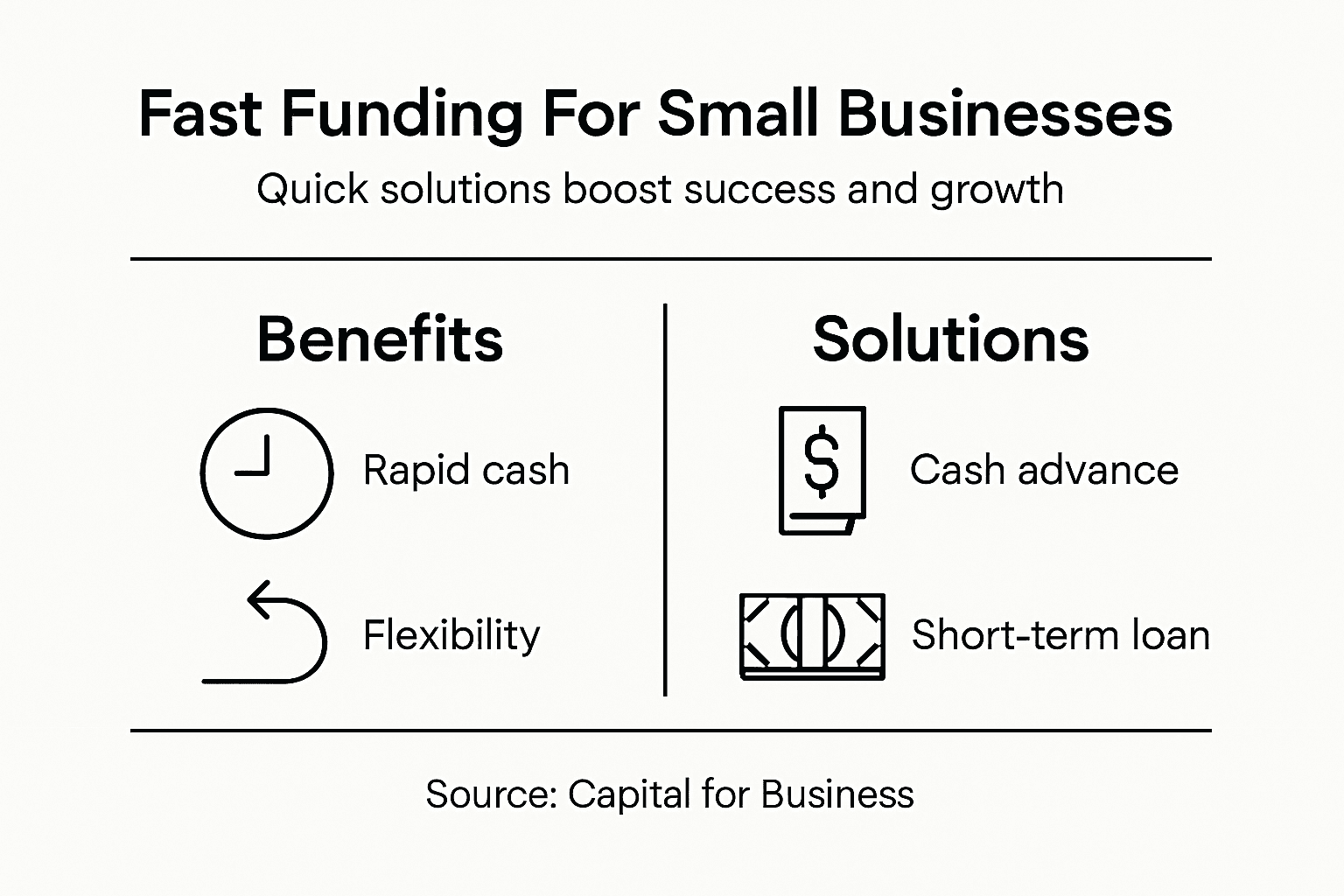
Here's a summary of key fast funding options, highlighting their primary use and typical business fit:
| Funding Option | Primary Business Use | Typical Suitable Business |
|---|---|---|
| Merchant Cash Advance | Quick cash for sales-driven needs | Retail, hospitality |
| Short-Term Business Loan | Emergency or project-based funding | Any small business |
| Equipment Financing | Purchase of machinery or tools | Construction, manufacturing |
| Invoice Factoring | Immediate cash from receivables | B2B service providers |
| Business Line of Credit | Ongoing flexibility for expenses | Growing businesses |
Fast funding solutions are not one-size-fits-all — they require careful evaluation of your specific business needs and financial circumstances.
Pro tip: Compare multiple funding sources, analyze their specific terms, and calculate the total cost of borrowing before making a final decision.
How Fast Funding Processes Operate
Fast funding processes represent a sophisticated financial mechanism designed to provide small businesses with rapid capital access. Research grant lifecycle insights reveal that these processes involve multiple strategic steps to ensure efficient and transparent funding delivery.
Typical fast funding processes generally include the following key stages:
- Initial Application Submission
- Digital Document Verification
- Automated Credit Assessment
- Funding Decision
- Capital Disbursement
Modern fast funding approaches leverage advanced technologies to streamline each step. Digital platforms enable businesses to submit applications quickly, with automated systems conducting rapid background checks and financial evaluations.
The primary components that accelerate funding processes include:
- Advanced algorithmic credit scoring
- Real-time financial document verification
- Instant risk assessment technologies
- Automated approval workflows
- Integrated banking system connections
Understanding these technological innovations helps entrepreneurs appreciate how fast funding differs from traditional lending models. The entire process can often be completed within 24-48 hours, compared to weeks or months with conventional bank loans.
Speed without compromising due diligence is the hallmark of effective fast funding solutions.
Pro tip: Prepare all financial documents electronically in advance to significantly reduce your funding application processing time.
Real-World Uses for Fast Funding
Small businesses encounter numerous scenarios where fast funding becomes a critical survival strategy. Small business finance insights demonstrate how rapid capital access can transform operational challenges into growth opportunities across multiple industries.
Real-world applications of fast funding include:
- Emergency Equipment Replacement: Quickly purchasing essential machinery when unexpected breakdowns occur
- Inventory Expansion: Seizing sudden wholesale purchasing opportunities
- Seasonal Cash Flow Management: Bridging financial gaps during revenue fluctuations
- Marketing Campaign Acceleration: Funding rapid marketing initiatives
- Talent Recruitment: Supporting immediate hiring needs for critical roles
The strategic deployment of fast funding can mean the difference between business stagnation and dynamic growth. Operational flexibility emerges as a key advantage, allowing entrepreneurs to respond swiftly to market changes and unexpected opportunities.
Different business sectors leverage fast funding uniquely. Retail businesses might use quick capital for inventory purchases, while service-based companies could invest in technology upgrades or marketing campaigns. Construction firms often require immediate equipment financing, and restaurants might need rapid funds for kitchen renovations.
Fast funding isn't just about money — it's about maintaining momentum and seizing time-sensitive business opportunities.
Pro tip: Develop a comprehensive financial strategy that anticipates potential funding needs before they become urgent business challenges.
Financial Implications and Risks to Consider
Fast funding provides significant opportunities for small businesses, but it simultaneously introduces complex financial considerations that entrepreneurs must carefully evaluate. Funding risk analysis reveals multiple strategic dimensions that extend beyond simple capital acquisition.
Key financial risks associated with fast funding include:
- Interest Rate Volatility: Potential for shifting loan costs
- Repayment Pressure: Strict timelines that might strain cash flow
- Collateral Requirements: Potential asset seizure risks
- Credit Score Impact: Long-term credit rating consequences
- Hidden Fee Structures: Unexpected additional costs
Small business owners must conduct thorough due diligence before accepting any fast funding option. Financial transparency becomes crucial in understanding the complete cost profile of potential funding sources, including all associated fees, penalties, and potential long-term financial implications.
Different funding mechanisms carry varying risk profiles. Short-term loans might offer quick capital but often come with higher interest rates, while merchant cash advances provide flexibility but potentially impact future revenue streams. Entrepreneurs must carefully weigh these trade-offs against their specific business needs and growth strategies.
Not all fast funding solutions are created equal — comprehensive risk assessment is the key to financial sustainability.
Pro tip: Always calculate the total cost of borrowing, including all fees and potential penalties, before committing to any fast funding solution.
Comparing Fast Funding With Traditional Lending
Small businesses face critical decisions when selecting financial resources, with fast funding and traditional lending representing two distinctly different approaches to capital acquisition. Digital lending practices demonstrate significant operational differences that entrepreneurs must carefully evaluate.
Key comparative characteristics include:
- Approval Speed:
- Fast Funding: 24-48 hours
- Traditional Lending: 2-8 weeks
- Documentation Requirements:
- Fast Funding: Minimal paperwork
- Traditional Lending: Extensive documentation
- Credit Score Impact:
- Fast Funding: Flexible credit criteria
- Traditional Lending: Strict credit requirements
- Interest Rates:
- Fast Funding: Generally higher
- Traditional Lending: Typically lower
- Funding Amounts:
- Fast Funding: Smaller, targeted amounts
- Traditional Lending: Larger, comprehensive financing
Traditional bank loans offer stability and potentially lower interest rates but require extensive documentation and lengthy approval processes. In contrast, fast funding solutions prioritize speed and accessibility, providing quick capital with more flexible qualification criteria.
Modern digital lending platforms have transformed the financial landscape, offering alternative credit assessment methods that consider broader business performance indicators beyond traditional credit scores. This approach enables more small businesses to access critical capital resources.
Compare the impacts of fast funding versus traditional lending on small business operations:
| Impact Area | Fast Funding | Traditional Lending |
|---|---|---|
| Decision Speed | 1-2 days | Several weeks |
| Access Criteria | Flexible eligibility | Stringent, credit-focused |
| Cash Flow Effect | Rapid boost, short repayment | Stable, long repayment |
| Documentation | Minimal, often digital | Extensive paperwork |
Speed and flexibility can be just as valuable as low interest rates in today's dynamic business environment.
Pro tip: Evaluate your specific business needs, comparing total borrowing costs and speed requirements before selecting between fast funding and traditional lending options.
Secure Fast Funding Solutions Tailored for Your Small Business Needs
The challenge of accessing the right funding quickly can feel overwhelming, especially when traditional lenders require lengthy processes and strict credit criteria. This article sheds light on the critical importance of fast funding for small businesses looking to seize opportunities, manage cash flow, and grow strategically. If you aim to avoid repayment stress while benefiting from rapid capital access, understanding your options is just the first step.
At Capital for Business, we specialize in delivering fast funding solutions that align with your unique business needs. Whether you require merchant cash advances, equipment financing, or a flexible business line of credit, our efficient approval processes and transparent terms help you stay ahead. Since 2009, we have empowered entrepreneurs across North America by providing quick and affordable capital when banks and credit unions hesitate to act.

Ready to transform urgent funding challenges into growth opportunities? Visit our Capital for Business homepage to explore how we can fast track your funding and give your business the financial momentum it deserves. Don't wait for weeks gain access to the resources you need now by partnering with a trusted lender that puts small business owners first.
Frequently Asked Questions
What is fast funding for small businesses?
Fast funding refers to quick financial solutions that provide small businesses with capital access in a short timeframe, typically within 24-48 hours. These funding options include merchant cash advances, short-term loans, and lines of credit, and are designed to meet urgent business needs.
How does fast funding differ from traditional bank loans?
Fast funding typically offers faster approval times, with applications processed in 1-2 days compared to several weeks for traditional loans. Additionally, fast funding often involves less documentation and more flexible credit requirements, but may have higher interest rates and smaller loan amounts.
What are the common types of fast funding available to small businesses?
Common types of fast funding solutions include merchant cash advances, short-term business loans, business lines of credit, equipment financing, and invoice factoring. Each option serves different business purposes and has unique repayment terms.
What should small business owners consider before applying for fast funding?
Business owners should evaluate the total cost of borrowing, including interest rates and potential fees, as well as the repayment terms and their ability to meet deadlines. Understanding the implications of fast funding on cash flow and long-term financial sustainability is crucial.