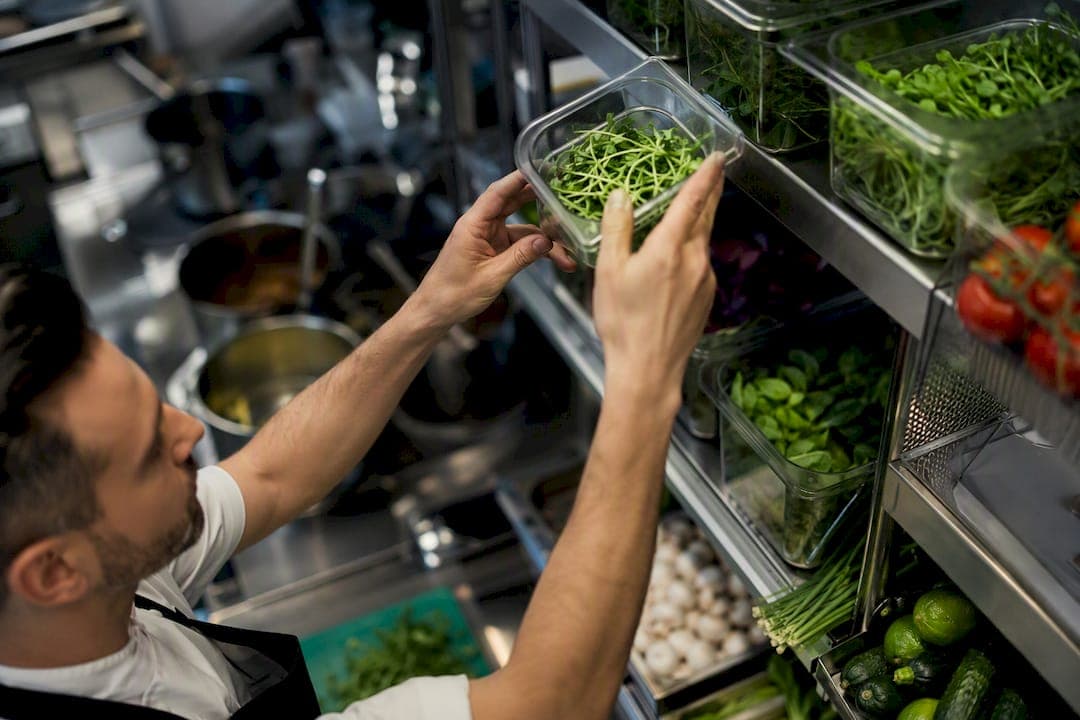
Restaurant working capital is your day to day cash cushion, calculated as current assets minus current liabilities. Aim for a floor of 4 to 6 weeks of operating expenses at minimum, and closer to 3 to 6 months if you run a full-service, seasonal, or growth-stage concept. Start by tallying your monthly operating costs, then run a 13-week cash forecast to see exactly where the gaps will hit.
TL;DR:
- Most restaurants operate on a narrow cash cushion, with labor and food costs consuming nearly 70% of sales, leaving little room for error or slow weeks.
- Seasonal fluctuations and growth ramps can tie up an additional $40,000 to $50,000 in cash, especially for multi-unit operators during opening or growth phases.
- Maintaining a 13-week cash forecast helps identify cash gaps early, with triggers like a three-day increase in cash conversion cycle prompting operational adjustments.
- Renegotiating vendor terms, tightening inventory, and accelerating receivables are effective operational strategies to free up cash before seeking external financing.
- The ideal funding tool depends on the timing of the cash gap; lines of credit are best for short-term needs, while SBA loans and equipment financing suit longer-term capital expenses.
Table of Contents
- What Restaurant Working Capital Covers and Why It's So Tight
- How Do You Calculate Restaurant Working Capital Needs?
- Building a 13-Week Cash Forecast That Catches Problems Early
- Operational Levers to Free Up Cash This Week
- Which Financing Option Fits Your Working Capital Gap?
- How Capital for Business Supports Restaurant Cash Flow
- A Sequencing Checklist Before You Choose Financing
- Get a Working Capital Facility Sized to Your Actual Cash Gap
- Sources
- FAQ
What Restaurant Working Capital Covers and Why It's So Tight
Working capital equals current assets (cash, food and beverage inventory, receivables from catering or corporate clients) minus current liabilities (payroll due, rent, and outstanding supplier invoices). That subtraction sounds simple. In a restaurant, it rarely leaves much room to breathe.
The reason is structural. Labor typically runs about 36.5% of sales and food cost another 32%, according to benchmark figures from Wall Street Prep. Occupancy adds another 6% to 10%. Add those together and you're covering roughly three-quarters of every sales dollar in recurring operating costs before you've paid for insurance, utilities, or a single repair.
| Cost category | Typical share of sales |
|---|---|
| Labor | ~36.5% |
| Food and beverage | ~32% |
| Occupancy (rent, utilities) | 6% to 10% |
Statistic callout: With labor and food alone consuming nearly 70 cents of every sales dollar, a restaurant's working capital cushion has almost no slack for a slow week, a broken walk-in cooler, or a late vendor payment.
That cost structure is also why separating capital expenditures from operating expenses matters. A new oven or a dining room remodel is CapEx. Payroll, food orders, and rent are OpEx and hit your checking account every week whether sales are strong or not. Keep a dedicated reserve account for OpEx cushioning separate from any fund earmarked for equipment or buildout, so a slow month doesn't force you to raid money set aside for growth.
How Do You Calculate Restaurant Working Capital Needs?
The most useful tool for sizing your cushion is the Cash Conversion Cycle, or CCC. It measures how many days pass between paying for inventory and collecting cash from the sale, and it has three moving parts: days inventory outstanding, days sales outstanding (DSO), and days payable outstanding (DPO).
CCC = Days Inventory + DSO − DPO
Each restaurant format lands in a different zone, and the differences are wide enough to change your entire cash strategy:
- Quick-service restaurants often run inventory of 3 to 5 days, near-instant card settlement, and payables stretched to 20+ days, producing a negative CCC (you collect cash before you pay vendors).
- Fast casual concepts sit close behind, benefiting from high turnover and simple menus.
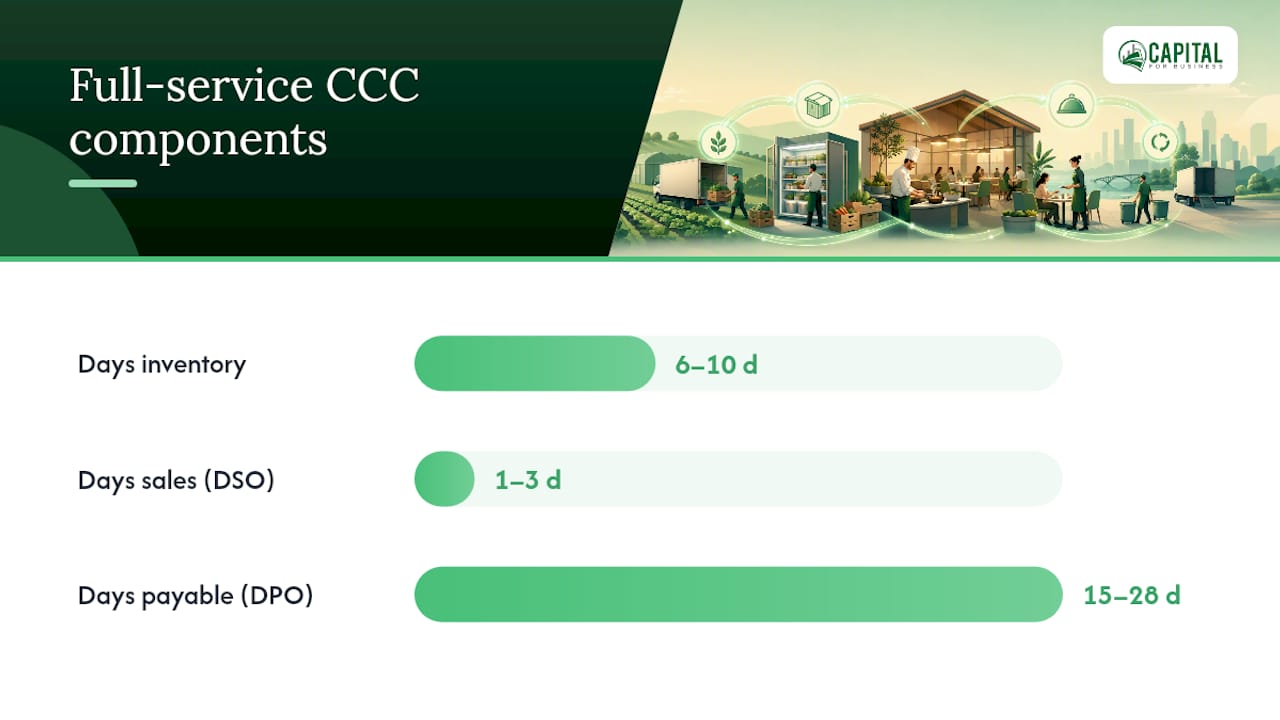
- Full-service restaurants typically carry inventory 6 to 10 days, card settlement lag of 1 to 3 days, and payables around 15 to 28 days, landing CCC near 0 to plus 5 days according to cash-cycle research from Restaurant Bottom Line.
- Fine dining often runs longer inventory days (up to 12) for specialty proteins and wine, pushing CCC higher still.
- Catering operations frequently see the widest gap, since corporate clients pay net 30 or later while ingredients and labor are paid up front.
Here's how that math plays out in dollars. Say your restaurant does $150,000 in monthly sales and grows 20% to $180,000. That growth doesn't arrive free. According to the same cash-cycle trap analysis, a ramp like that can tie up an additional $9,000 or more per month in working capital, driven by higher inventory purchases, more receivables in the pipeline, and the same card settlement lag applied to a bigger sales base.
Run that forward for four or five months of sustained growth and you're looking at $40,000 to $50,000 of cash quietly absorbed into the business, cash that never shows up as profit because it's sitting in walk-in coolers and unsettled batches. Multi-unit operators feel this even harder at the opening stage: total working capital for a new unit, including opening inventory, initial payroll, and a starting cushion, typically runs $110,000 to $305,000 depending on format and market.
Seasonality multiplies the same problem. Treat seasonal troughs and growth ramps as two separate sizing exercises, because the fix for one (a temporary line tied to a growth curve) is usually the wrong fix for the other (a reserve built during peak months to survive the trough).
Building a 13-Week Cash Forecast That Catches Problems Early
A 13-week rolling cash forecast is the single best early-warning tool available to a restaurant operator, and it takes less time to maintain than most managers assume once the template is built.
- List every cash inflow and outflow by week for the next 13 weeks: sales deposits, payroll runs, rent, vendor payments, loan payments, and tax remittances.
- Update it every week, replacing the oldest week's estimate with actuals and adding a new week 13 weeks out.
- Track four signals against your baseline: rising CCC, climbing inventory days, vendors quietly shortening your payment terms, and your card processor's settlement float stretching from one day to two or three.
- Set a trigger threshold, such as a CCC increase of 3 days or more, that automatically prompts a review of vendor terms, inventory levels, or financing options.
Pro Tip: Run the 13-week forecast every Monday morning before you open. Restaurants that catch a cash gap six weeks out have time to negotiate; restaurants that catch it two weeks out are stuck taking whatever financing they can get, fast.
The scenario worth modeling explicitly is the growth trap from the previous section. A unit ramping from $150,000 to $180,000 a month doesn't feel like a crisis in week one. It feels like success. By week eight, if nothing has been financed, the accumulated draw on cash can force a payroll-timing scramble even though the restaurant is more profitable on paper than it was three months earlier. Sizing a temporary line of credit equal to two to four weeks of the incremental operating cost, before the ramp begins, prevents that trap entirely.
Dashboard-wise, three numbers deserve a spot on your weekly review: CCC (trigger at +3 days), days inventory outstanding (trigger at +2 days over baseline), and cash runway in weeks (trigger below 4). Any one of those crossing its line means it's time to act, not wait.
Operational Levers to Free Up Cash This Week
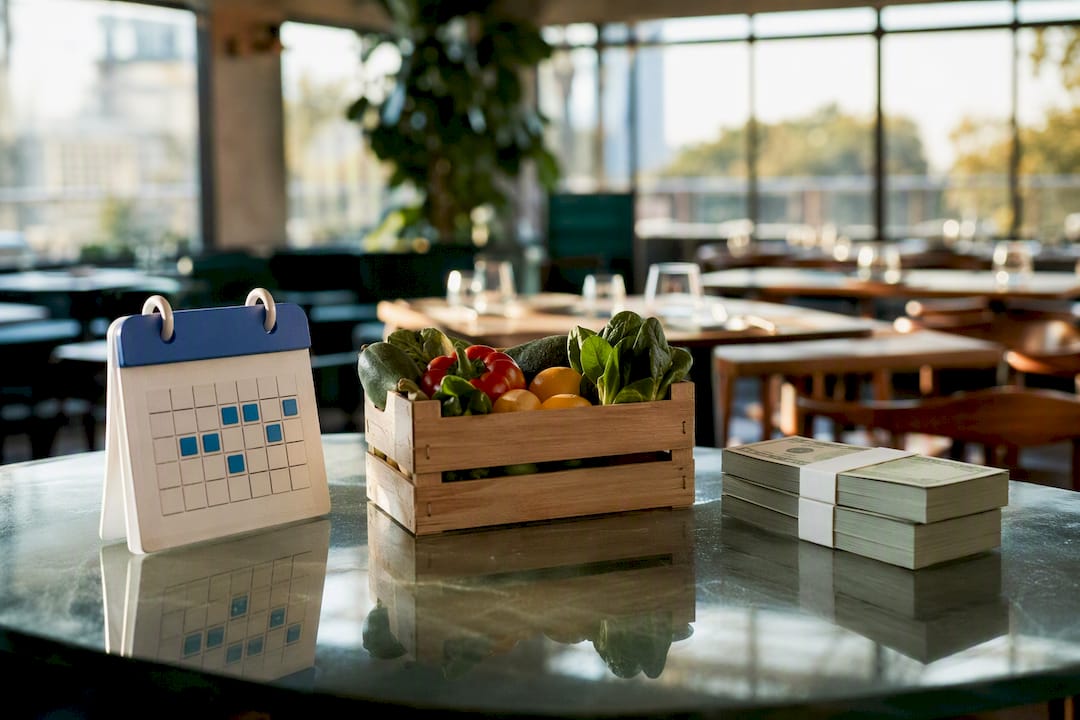
Financing should be the second move, not the first. Most restaurants have real cash trapped in their own operations, and releasing it costs nothing but attention.
- Renegotiate vendor terms. Moving a key produce or protein supplier from net 30 to net 45 effectively gives you two extra weeks of float on that spend, and staggering invoice due dates across the month smooths out payroll-week collisions.
- Cut SKU count and tighten delivery frequency. A 10% reduction in SKUs can shrink inventory carrying value by roughly 6% to 12%, and ordering high-value proteins closer to just-in-time cuts the dollars sitting in your walk-in on any given day.
- Accelerate receipts. Gift card sales bring cash in before the liability is redeemed, catering deposits move payment ahead of the event, and same-day invoicing for corporate accounts shortens DSO instead of letting it drift.
- Audit your payment processor's settlement speed. A one-day improvement in funding cadence on a high-volume unit can permanently free thousands of dollars that were previously sitting in transit.
- Rework labor scheduling around demand curves, not habit, to reduce the weekly payroll draw without cutting service quality during peak hours.
Pro Tip: Call your top three vendors this week and ask for five extra days on terms. Most will say yes to a paying customer with a track record, and it costs you nothing to ask. For a deeper breakdown of scheduling and receivables tactics, see this guide on improving restaurant cash flow, and for broader cash-management discipline, Finblog's guide to cash flow best practices is a useful outside perspective.
Which Financing Option Fits Your Working Capital Gap?
Not every cash gap needs the same fix, and matching the wrong instrument to the wrong problem is how operators end up paying for speed they didn't need or waiting for terms they couldn't afford to wait for.
- Business line of credit. Best suited to short, recurring timing gaps, like the week between a big payroll run and a slow sales stretch. A business line of credit can be drawn only when needed and paid down as cash comes back in, which makes it the natural tool for smoothing a CCC that runs near zero.
- SBA loans. The 7(a) and 504 programs offer structurally lower rates for expansion, buildout, or refinancing higher-cost debt, but they typically take 60 to 90 days to fund, so they're the wrong tool for an urgent gap.
- Equipment financing. Capitalizing a new range, walk-in, or POS system through equipment financing keeps that cost out of your operating account entirely, preserving working capital for the things that actually need daily cash.
- Alternative lenders and merchant cash advances. These fund fastest, often in one to three days, but they carry the highest cost of capital and belong at the bottom of the list, used only when the timing problem is truly urgent and other options aren't available in time.
Before approaching any lender, have your last three months of bank statements, a current P&L, your CCC calculation, and a specific dollar ask tied to a stated purpose ready to go. For a side-by-side look at how these instruments compare, this restaurant financing options guide walks through the tradeoffs in more depth.
How Capital for Business Supports Restaurant Cash Flow
Since 2009, Capital for Business has worked with small business owners, including hundreds of restaurant operators, to close exactly these gaps. Its lineup covers working-capital loans, lines of credit, merchant cash advances, and equipment financing, so the instrument can match the timing problem instead of forcing a one-size-fits-all fix. An advisory conversation typically starts with your CCC and monthly OpEx numbers, then sizes a facility around the actual gap rather than a generic loan amount.
A Sequencing Checklist Before You Choose Financing
Run the 13-week forecast and calculate your CCC before anything else. Fix what you can operationally first: vendor terms, SKU count, receipt timing. Open a line of credit while your numbers are healthy, since availability costs little and buys real insurance. Only then match financing to the specific gap, and document the ask with numbers, not adjectives.
— Capital
Get a Working Capital Facility Sized to Your Actual Cash Gap
Capital for Business is built for restaurant operators who need a financing decision measured in days, not the 60 to 90 days a bank or SBA process often requires. Whether the gap is a growth ramp, a seasonal trough, or a one-time equipment purchase eating into your OpEx cushion, the right fit might be a working capital loan, a revolving line, or equipment financing that keeps cash out of your CapEx column entirely.
Before you apply, pull together your last three months of bank statements, a current profit and loss statement, and your CCC calculation so the conversation starts with real numbers instead of guesswork. Get in touch with Capital for Business to size a working capital facility that matches your actual cash cycle, not a generic loan amount.
Sources
For deeper reading, the SBA's loan program overview covers 7(a) and 504 eligibility, and Wall Street Prep's working capital primer explains the underlying accounting in more detail than this guide covers.
- Working capital fundamentals — Wall Street Prep
- Restaurant working capital: the cash cycle trap that kills busy concepts — Restaurant Bottom Line
- Small Business Administration — Funding programs: loans
- Restaurant financing guide — DoorDash merchants blog
FAQ
What Is Working Capital in a Restaurant?
Working capital is current assets (cash, inventory, receivables) minus current liabilities (payroll, rent, supplier invoices), representing the cash available to cover day to day operating costs. Most operators should target a floor of 4 to 6 weeks of operating expenses, rising to 3 to 6 months for full-service or seasonal formats.
What Is the 30% Rule in Restaurants?
The 30% rule generally refers to keeping food cost near 30% to 32% of sales, one of the two biggest drivers, alongside labor near 36.5%, of the tight cash cushion restaurants operate on. It's a cost-control benchmark rather than a working capital formula, but the two are closely linked because high fixed costs leave little room for cash gaps.
How Hard Is It to Get a $1,000,000 Business Loan?
A loan at that size, whether through SBA 7(a) or a conventional bank term loan, generally requires strong financials, collateral, and a clear use of funds, and it typically takes several weeks to months to underwrite and fund. Smaller working capital facilities and lines of credit move considerably faster and fit most restaurants' actual cash gaps more precisely than a seven-figure loan would.
Are Restaurants Struggling With Cash Flow in 2026?
Operators who track their Cash Conversion Cycle and maintain a working capital reserve are better positioned to absorb those swings than those relying on sales growth alone to cover costs.
How Can I Improve My Restaurant's Working Capital Without a Loan?
Renegotiating vendor terms, cutting SKUs, accelerating receipts through gift cards and deposits, and reviewing your payment processor's settlement speed can free real cash without any financing at all. These operational levers work best as the first step, before turning to a line of credit or other financing to cover what remains.