
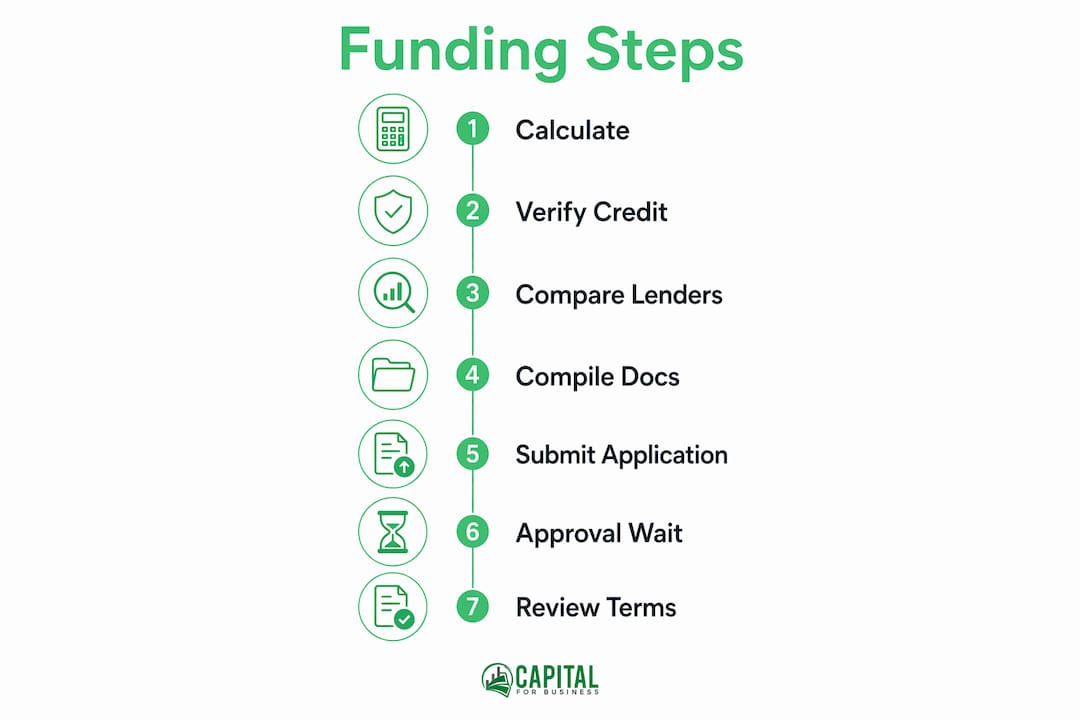
Securing restaurant funding is a deliberate, stepwise process. Most successful operators don't rely on a single source of capital. Instead, they stack three or four funding sources because no single product covers a full build-out. Here's the core sequence every restaurant owner should follow:
- Calculate your true funding need. Total build-out costs vary widely depending on the project scale and location. It is recommended to add a contingency buffer above your estimate to reduce risk.
- Assess your credit and financial standing. Pull your personal and business credit reports. Many qualification issues resolve within 30–90 days with targeted action.
- Research financing options. Compare SBA loans, equipment financing, merchant cash advances, business lines of credit, and alternative sources like crowdfunding.
- Prepare your documentation. Gather your business plan with financial projections, profit and loss statements, balance sheets, tax returns, and any required licenses.
- Approach lenders with a tailored application. Match each lender to the product that fits your timeline and capital need.
- Review and negotiate offers. Compare APR, fees, repayment terms, and total cost of capital before signing anything.
Table of Contents
- How to secure restaurant funding step by step
- What restaurant funding options are available to you?
- Tips to improve your financing approval odds
- Expert insights on timing and product selection in restaurant funding
- How to build a financing plan and realistic timeline
- Capitalforbusiness offers restaurant owners a faster path to funding
- Key Takeaways
- FAQ
How to secure restaurant funding step by step
The restaurant loan application process rewards preparation. Lenders want to see that you understand your numbers, your market, and your repayment capacity before they commit a dollar.
1. Calculate your true funding requirements
Start with a detailed cost breakdown: build-out, equipment, permits, initial inventory, working capital, and payroll for the first 90 days. Then add a 10–15% contingency buffer above your estimated build-out costs. Restaurant owners who skip this step often face emergency financing later, at far less favorable terms. Know the exact dollar amount you need before you talk to a single lender.
2. Verify and improve your credit profile
Pull your personal credit report from all three bureaus and your business credit report from Dun & Bradstreet or Experian Business. Lenders weigh credit scores, time in business, and revenue ratios heavily. The good news: most credit issues are fixable within 30–90 days by paying down balances, disputing errors, and clearing any delinquencies. A decline from one lender doesn't mean a universal denial. Specialized restaurant-vertical lenders often apply more flexible criteria than traditional banks.

3. Compare lender types before applying
Not all lenders are built for restaurants. Banks and credit unions offer the lowest rates but the strictest qualification standards. SBA-approved lenders provide government-backed loans with competitive terms and are worth pursuing if your timeline allows. Alternative lenders and online platforms fund faster but typically at higher cost. Map your timeline and credit profile against each lender type before submitting a single application.

4. Compile your documentation package
A complete package includes a business plan with three-year financial projections, profit and loss statements, balance sheets, two years of personal and business tax returns, a list of collateral, and copies of all required business licenses and permits. Missing even one document delays approval. Organize everything in a digital folder so you can send it to multiple lenders quickly.
5. Submit applications with a specific funding purpose
Lenders respond better to specific requests. Stating that you need $80,000 to purchase two combi ovens and cover payroll for the first 60 days signals planning and competence. Vague requests for "working capital" raise red flags. Tailor each application to the lender's product and your stated use of funds.
6. Understand approval timelines
SBA loans and traditional bank loans can take several weeks to months for approval. Online lenders may fund within 1–3 days after approval. Equipment financing often closes in 24–72 hours. Build your project timeline around these windows so you're not caught waiting on capital when contractors are ready to start.
7. Review offers and negotiate terms
Once offers arrive, compare them side by side on APR, origination fees, prepayment penalties, and total repayment cost. Shopping multiple lenders can reveal a 4–8% APR spread, which translates to thousands of dollars over the life of a loan. Negotiate where you can, especially on fees and repayment schedules.
What restaurant funding options are available to you?
Restaurant startup financing rarely comes from one place. Knowing each product's cost, speed, and ideal use case helps you build the right stack for your situation.
-
SBA 7(a) loans. The SBA 7(a) program provides government-backed funding up to $5 million with APRs typically between 8.5% and 11.5% and terms of 10–25 years. Approval takes 4–8 weeks, making this the right tool for large capital needs where you have time to wait.
-
Equipment financing. This product closes fast, often within 24–72 hours, with APRs between 5.99% and 24%. It's purpose-built for kitchen assets: ovens, refrigeration units, dishwashers, and ventilation systems. Use it alongside a slower SBA loan to keep your build-out on schedule. The equipment financing process is straightforward once you have your vendor quotes ready.
-
Merchant cash advances. An MCA provides a lump sum repaid through a percentage of daily card sales. Speed is the advantage: funding can arrive in days. The trade-off is cost. Fixed high-frequency repayments can strain cash flow during slow seasons, so understand the factor rate and total repayment amount before accepting.
-
Business lines of credit. A revolving line gives you flexible access to capital for operational needs: inventory, payroll gaps, or unexpected repairs. You draw what you need and pay interest only on the outstanding balance. This is one of the most practical tools for managing day-to-day cash flow once you're open.
-
Angel investors and friends and family. Equity or informal debt from investors can fill gaps that lenders won't touch, especially for pre-revenue startups. The SEC provides guidance for early-stage investors on structuring these arrangements properly. Document every agreement in writing, regardless of the relationship.
-
Crowdfunding. Platforms that allow restaurant owners to raise community capital work best when you have a compelling story and an existing audience. This approach takes time to execute well but can generate both capital and early customer loyalty.
-
Vendor financing and incubator programs. Some equipment vendors offer deferred payment or financing directly. Food business incubators occasionally provide grants or low-cost loans alongside mentorship. These sources rarely cover a full build-out but can reduce the amount you need from traditional lenders.
Pro Tip: Most restaurant startups need to stack three or four funding sources to cover a full build-out. Plan your stack before you apply anywhere, so each product fills a specific gap rather than overlapping with another.
Tips to improve your financing approval odds
Getting approved for restaurant financing is as much about preparation as it is about creditworthiness. These strategies give you a real edge.
-
Compare multiple loan quotes. A 4–8% APR difference between lenders can cost you thousands over a loan's life. Compare at least three loan quotes before committing to any offer.
-
Avoid maxing out loan terms unnecessarily. Longer terms lower monthly payments but increase total interest paid. Choose the shortest term your cash flow can comfortably support.
-
Use the Section 179 deduction. The IRS Section 179 deduction allows restaurant operators to deduct up to $1.16 million in equipment expenses in year one (2026). Many owners overlook this benefit entirely, leaving real savings unclaimed. Factor it into your financing cost calculations.
-
Build a thorough, realistic business plan. Lenders read projections critically. Overly optimistic revenue forecasts without supporting market data will undermine your credibility. Base your numbers on local comparable restaurants and realistic table-turn assumptions.
-
Ensure documentation is complete and accurate. Incomplete applications are the most common reason for delays. Double-check every figure, confirm all licenses are current, and verify that your tax returns match your financial statements.
-
Manage cash flow to handle repayment during slow seasons. Restaurants are seasonal businesses. Model your repayment obligations against your slowest projected months, not your busiest. If the numbers don't work in January, they won't work in January.
-
Understand collateral requirements. Many lenders require collateral for loans above a certain threshold. Know what assets you can pledge and what the lender's lien position will be before you apply.
A note on credit scores: Lenders consider credit scores, time in business, and revenue ratios together, not in isolation. A strong revenue history can sometimes offset a lower credit score with the right lender.
Expert insights on timing and product selection in restaurant funding
Experienced restaurant operators know that choosing the wrong financing product at the wrong time can be just as damaging as not having capital at all.
The clearest example involves merchant cash advances used during slow seasons. Industry experts caution against high-frequency fixed repayment products during low-sales periods because the daily deductions continue regardless of how much revenue comes through the door. A restaurant doing strong summer numbers may find those same fixed payments crushing in February.
Split-funding repayment structures solve this directly. With a split-funding arrangement, repayment adjusts based on daily card sales volume. When sales drop, so does the repayment amount. This keeps liquidity intact through seasonal slowdowns without requiring renegotiation or forbearance. Seasoned operators prioritize these variable repayment products specifically because they align with the restaurant's natural sales cycle.
Timing also matters for SBA loans. Applying for an SBA 7(a) loan while simultaneously pursuing equipment financing is a common and effective approach. The SBA loan covers the large capital need at a lower rate, while equipment financing closes quickly to keep the build-out on schedule. Trying to use a single slow-approval product for everything creates unnecessary delays.
Pro Tip: When evaluating any financing product, ask the lender specifically how repayment is calculated during your slowest projected month. If the answer is a fixed daily or weekly amount regardless of sales, factor that into your cash flow model before accepting.
Capitalforbusiness has worked with restaurant owners across hundreds of industry contexts since 2009. That depth of experience means the team recognizes which products create cash flow problems for operators and which ones support sustainable growth. Getting specialized advice from a lender who understands restaurant seasonality is worth more than chasing the lowest advertised rate.
How to build a financing plan and realistic timeline
A financing plan is not just a budget. It's a document that maps every projected expense, identifies funding gaps, and assigns a specific source of capital to each gap.
| Milestone | Estimated Timeline | Notes |
|---|---|---|
| Documentation gathering | Weeks 1–2 | Business plan, tax returns, licenses, financial statements |
| Lender research and outreach | Weeks 2–3 | Request quotes from at least three lenders |
| SBA 7(a) application submission | Week 3 | Allow 4–8 weeks for approval |
| Equipment financing application | Week 3–4 | Closes in 24–72 hours after approval |
| Offer review and negotiation | Weeks 6–10 | Compare APR, fees, and total repayment cost |
| Funding disbursement | Weeks 8–10 | Varies by lender and product type |
| Build-out and equipment installation | Months 3–6 | Coordinate with contractors and vendors |
| Soft open | Month 6–7 | Adjust based on permit timelines |
Start by outlining every projected expense in your build-out: construction, equipment, permits, furniture, technology systems, initial inventory, and working capital for the first 90 days of operation. Then identify which funding source covers each line item. Equipment financing covers the kitchen assets. An SBA loan or business line of credit covers the build-out and working capital. Personal investment or investor capital fills any remaining gap.
Use an equipment financing calculator to model monthly payments against your projected revenue before committing to a product. The Section 179 deduction of up to $1.16 million in year one can significantly reduce your effective equipment financing cost, so build that into your tax planning from the start.
Engage multiple lenders early, even before your documentation is complete. Early conversations reveal what each lender requires and how long their process takes. That information lets you sequence your applications so that fast-closing products (equipment financing) don't sit idle while you wait on slower approvals (SBA loans).
Pro Tip: Build your financing plan in a spreadsheet with three columns: expense item, estimated cost, and funding source. This format makes it easy to share with lenders and shows them exactly how their capital fits into your overall plan.
Capitalforbusiness offers restaurant owners a faster path to funding
Restaurant owners who have done the research, built the plan, and are ready to move need a lender who can keep pace. Capitalforbusiness provides small business funding up to $500,000 with a product line built specifically for the speed and flexibility that restaurant operators need.
Since 2009, Capitalforbusiness has served small business owners across hundreds of industries, including restaurants at every stage from first-time startups to multi-location expansions. The product line covers working capital loans, equipment financing, merchant cash advances with split-funding repayment options, and business lines of credit. When traditional banks say no or move too slowly, Capitalforbusiness steps in with fast approvals and terms that fit real restaurant cash flows.
The restaurant business loan options at Capitalforbusiness are designed for owners who need capital quickly and can't afford to wait months for a bank decision. Whether you need to close on kitchen equipment before a lease deadline or cover payroll through a slow season, the team at Capitalforbusiness has seen the situation before and knows how to structure the right product for it.
Ready to move forward? Visit capitalforbusiness.net to explore your options and get a funding decision without the wait.
Key Takeaways
Securing restaurant funding requires stacking multiple financing sources, preparing thorough documentation, and matching each product to the right stage of your build-out and cash flow cycle.
| Point | Details |
|---|---|
| Stack multiple sources | Most restaurant startups need three or four funding sources to cover a full build-out. |
| Add a contingency buffer | Budget a 10–15% buffer above your estimated build-out cost to avoid emergency financing later. |
| Compare lenders actively | A 4–8% APR spread between lenders can cost thousands over the life of a loan. |
| Match products to cash flow | Variable repayment products like split-funding MCAs protect liquidity during slow seasons. |
| Capitalforbusiness | Offers working capital, equipment financing, and MCAs up to $500,000 for restaurant owners who need fast, flexible funding. |
FAQ
How do restaurants typically get funding?
Most restaurants combine multiple sources: SBA loans, equipment financing, personal investment, and sometimes investor capital or crowdfunding. Most startups ultimately piece together three or four sources to cover the full build-out cost.
What are the stages of restaurant business funding?
The core stages are calculating your true capital need, assessing and improving your credit profile, researching and comparing lenders, preparing documentation, submitting applications, and reviewing and negotiating offers before accepting. SBA loan approvals can take 4–8 weeks, while equipment financing and online lenders may fund in as little as 24–72 hours.
What credit score do you need for a restaurant loan?
Lenders evaluate credit scores alongside time in business and revenue ratios, not in isolation. Many credit issues are fixable within 30–90 days, and specialized restaurant-vertical lenders often apply more flexible criteria than traditional banks.
Can you get restaurant funding with no revenue yet?
Pre-revenue startups face tighter options but are not without paths forward. SBA microloans, equipment financing, angel investors, and friends-and-family arrangements are all viable for operators who haven't opened yet. A detailed business plan with realistic financial projections becomes especially important when you have no revenue history to show.
What is the Section 179 deduction and how does it help restaurant financing?
The IRS Section 179 deduction allows restaurant operators to deduct up to $1.16 million in equipment expenses in the first year (2026), which directly reduces the effective cost of equipment financing. Many restaurant owners overlook this benefit, but factoring it into your financing plan can meaningfully lower your total cost of capital.