

Merchant account underwriting is the risk review a bank or processor completes before it lets your business accept card payments. The reviewer asks one question: if this business takes payments and something goes wrong, who pays? Owners who understand that question prepare better, get approved faster and are far less likely to be surprised by a reserve or a processing limit. We work with small business owners across construction, retail, restaurants, trades and manufacturing, and the same pattern holds in each: a clean, complete file moves quickly, and a thin or inconsistent one stalls.
This guide covers who is reviewing you and why, what happens between application and decision, the documents to have ready, the conditions an approval can carry, and what to do if the answer is no.
TL;DR
- Underwriting is a risk check on your business, your owners and your sales model. It is closer to a loan review than to a simple sign-up form.
- Reviewers look at credit, business activity, location, compliance and history, including past terminated accounts and chargebacks.
- A complete application with matching documents is the biggest factor in speed. Incomplete files get pended for manual review.
- Approval can be conditional: reserves, holds, activity limits or a personal guarantee are all standard tools.
- If you are declined, find out which factor drove it, fix it, and keep your cash flow covered in the meantime.
Table of Contents
- What merchant account underwriting actually is
- How the underwriting process works, step by step
- What underwriters assess
- Documents to have ready
- How long underwriting takes
- Conditions an approval can carry
- How to strengthen your application
- If you are declined or approved with conditions
- Covering the cash gap while underwriting runs
- Promo: funding that keeps your business moving
- Our perspective
- FAQ
- Sources
What merchant account underwriting actually is
A merchant account lets you accept card payments. The bank behind it, called the acquirer, takes on risk the moment you start processing. Customers can dispute charges, and if you cannot cover those disputes, the acquirer is left holding the loss. So before it opens your account, the acquirer evaluates you.
The FDIC's supervisory manual says acquiring banks should scrutinize prospective merchants with the same diligence used to evaluate prospective borrowers. It names three concerns: your ability to cover projected chargebacks, your potential for fraud, and the chance your business fails. A chargeback is when a cardholder disputes a charge and the money is pulled back from you.
That is why the process feels like applying for credit. In some payment models it is credit. Visa's risk guide for payment facilitators and marketplaces notes that when sellers receive settlement proceeds before delivering goods or services, the facilitator is effectively extending an unsecured line of credit to them. Think of a contractor who takes a deposit for a kitchen remodel that will not finish for three months. The processor has paid you for work it cannot yet see.
Merchant underwriting versus lending underwriting
The two reviews look at similar things but answer different questions.
| Merchant account underwriting | Business loan underwriting | |
|---|---|---|
| Who decides | Acquirer, processor or payment facilitator | Lender |
| Core question | Can this business process cards without creating losses from chargebacks or fraud? | Can this business repay the money it borrows? |
| What you receive | The ability to accept cards, sometimes with a reserve or limits | A lump sum, credit line or financed equipment |
| Typical conditions | Reserves, holds, processing caps, guarantees | Rate, term, collateral, repayment schedule |
Many owners go through both at once: a processing account to take payments and financing to buy equipment or cover payroll. Both reviews reward the same habits, which we cover below.
How the underwriting process works, step by step
Visa's onboarding guidance for acquirers lays out a sequence that most processors follow in some form. Here is how it looks from your side of the desk, based on that guidance.
- Application capture. You supply the critical fields: company name, tax ID, address, business type, expected sales and bank details. Errors here ripple through every later step. A name that does not match your tax records is the classic example.
- Validation. The processor checks what you submitted against online sources and, where needed, manually. The guidance describes automatic declines for matches such as bankruptcy or a low credit score.
- Full underwriting review. Trained staff confirm that you offer a valid product or service and that you comply with local and international laws. The account goes live only after this review is complete.
- Decision. Automated programs can approve, decline, or pend an application for manual review. Auto-approval is generally reserved for lower-risk segments and needs a completed, signed application, an agreement and a personal guarantee.
A personal guarantee means you, as an owner, agree to be personally responsible if the business cannot cover its obligations to the processor. Read that clause before you sign it, the same way you would on a loan.
The terminated merchant check
One step surprises owners who have closed a processing account before. Visa's acquirer standards require acquirers to consult their own declined or terminated lists and external resources such as the Terminated Merchant File before finalizing a contract. If your business or an owner appears there, the acquirer investigates the match using legal entity name, contacts, owner details, credit reports and business registries before deciding whether to accept you.
If a previous account was closed, be ready to explain why, in writing, with dates. A clear explanation of a past problem and what you changed reads very differently from silence.
What underwriters assess
Visa's standards direct underwriters to review creditworthiness, business activity, compliance, business location, service providers and business history, including prior terminations, excessive chargebacks, fraud or illegal activity. In practice that breaks down into a handful of questions.
Credit and financial strength
The reviewer pulls credit on the business principals and looks at whether the business can absorb a bad month. The FDIC manual notes that for a financially unstable merchant, a bank might require a holdback or security deposit. A newer business with thin history is judged on the owner's credit and on projections, so the quality of those projections matters.
What you sell and how you deliver it
The more time between payment and delivery, the more exposure the processor carries. Visa's guide gives travel, event ticketing and annual memberships as examples where reserves may be used for delayed delivery. The same logic applies to trades that collect large deposits: a roofing, HVAC or remodeling contractor with long lead times looks different from a restaurant that delivers the product within the hour.
Transaction size and sales channel matter too. FinCEN, the Treasury bureau that fights financial crime, has stated that a processor's risk profile can vary significantly with its customer base, and that telemarketing and Internet sales tend to see relatively higher incidences of consumer fraud. Card-not-present sales, where the card is not physically swiped or inserted, generally get more scrutiny than a counter sale.
Chargeback history
High chargeback rates are one of the most common reasons for a poor decision. FinCEN's advisory lists high numbers of consumer complaints and chargebacks among the red flags for third-party payment processors, and a processor that sees them in your history will treat you the same way. If you have a past processing record, the number reviewers care about is how many sales ended in disputes and how you handled them.
Compliance and location
The reviewer confirms you are a legitimate business at the address you gave. The FDIC's guidance for processor relationships calls for verifying that each merchant operates a legitimate business through public records, credit reports or references. Your business license, website and storefront should all tell the same story.
Risk is also sorted into tiers. Visa's standards require acquirers to segment merchants into low, medium and high risk categories, and the tier determines how deep the review goes and what conditions apply.
Documents to have ready
The FDIC manual lists what an acquiring bank may collect in a merchant file. You will not be asked for every item, but this is the full range, per the FDIC:
- Signed merchant application and processing agreement
- Signed corporate resolution, if applicable
- On-site inspection report
- Credit bureau reports on business principals
- Financial statements, tax returns and/or business credit reports
- Prior processor statements
- Projected sales activity
- Trade and bank references
- Evidence of MATCH status (the industry list of terminated merchants)
A practical packet for a small business looks like this:
- Business formation papers, tax ID confirmation and any required licenses. Trades such as plumbing, electrical and HVAC usually hold state licenses; have them on hand.
- Three to six months of business bank statements.
- Your most recent tax return and a year-to-date profit and loss statement.
- Statements from your previous processor, if you had one, showing volume, average ticket and chargebacks.
- A one-page sales projection: monthly volume, average ticket, and how quickly customers receive what they paid for.
- A short description of your refund and cancellation policy, as it appears on your website or invoices.
The most common cause of delay is mismatched details. The legal name, address and ownership percentages should read identically on the application, the tax documents and the bank statements. Fixing a mismatch before you submit takes minutes. Fixing it during review can add days.
How long underwriting takes
There is no single timeline. Visa's guidance says a full review requires trained staff and working days, and that acquirers should keep applicants updated. Lower-risk segments may be auto-approved, while applications that fall outside automated rules are pended for manual review.
What moves you toward the fast lane:
- A complete, signed application with every field filled in
- Documents that match each other
- An established business with clean processing history
- A business model with prompt delivery and low dispute exposure
What pushes you into manual review:
- Missing signatures or documents
- A new entity with no history and no processing statements
- A match on a terminated merchant list
- Large average tickets or delayed delivery
- Online or phone sales with limited verification
Answer follow-up requests the same day when you can. Underwriters work through queues, and an unanswered request usually means your file waits.
Conditions an approval can carry
Approval is not always yes or no. Visa's standards state that a decision can be approval, decline or conditional approval with exposure mitigation such as reserves, holds, limits on business activity or guarantees. Here is what each means for your cash flow.
| Condition | What it means | Where it hurts |
|---|---|---|
| Reserve | A portion of funds is set aside as collateral against future chargebacks | Less cash available after each sale |
| Account-level or transaction-level hold | Funds are delayed, either across the account or on specific payments | Slower access to deposits |
| Processing cap | A ceiling on monthly volume or ticket size | Limits seasonal peaks or large jobs |
| Personal guarantee | An owner agrees to cover obligations personally | Personal exposure |
Two points are worth knowing. First, Visa's exposure-mitigation standard requires acquirer contracts to state that reserves are collateral that remain the property of the merchant, held in a segregated deposit account in the merchant's name, with clarity on reconciliation and on the types of holds. Look for that language in your agreement. Second, Visa's facilitator guide says merchants must be underwritten on their merits, and that reserves are not a justification to onboard unreasonably high-risk merchants. A reserve is a risk tool, not a penalty.
The FDIC manual adds that approval authority within a bank is usually tied to the merchant's sales volume, so larger projected volume tends to be reviewed by more senior staff. Accurate projections matter for that reason: overstate them and you invite deeper scrutiny, understate them and you may hit a cap.
How to strengthen your application
Underwriters are not trying to find reasons to say no. They are trying to size a risk. The more clearly you size it for them, the better the terms.
- Check your own credit first. The reviewer will pull credit on the owners. Know what is on it, and be ready to explain any derogatory item in a sentence or two.
- Show delivery times honestly. If you collect deposits for work completed weeks later, say so and describe how you handle it. Staged deposits tied to milestones look safer than a single large prepayment.
- Publish clear policies. A visible refund, cancellation and contact policy reduces disputes and shows reviewers you run an orderly business.
- Keep chargebacks low and documented. Respond to disputes promptly with invoices, signed work orders and delivery proof. Our guides on chargeback prevention for small business merchants and fixing billing first walk through the routine, and our piece on chargeback alerts and management covers the faster response window.
- Run compliant hardware. If you take cards in person, your terminals should be set up correctly. See our terminal checks for EMV compliance.
- Submit everything at once. One complete packet beats three partial ones.
If you are declined or approved with conditions
A decline is information. Ask the processor which factor drove the decision: credit, history, business model, missing documents or a list match. Then work on that factor specifically.
- Document gaps: supply the missing items and reapply with a complete file.
- Credit or thin history: a few months of clean bank statements and steady deposits strengthen the next submission. Allow time between applications rather than sending several at once.
- Past terminations: prepare a dated written explanation of what happened and what you changed.
- High chargebacks: put prevention and response routines in place and show the trend improving.
- Conditions you can live with: a reserve or cap that is clearly defined and contractually protected can be a workable starting point. Many owners accept conditional terms, process cleanly for a period, and then discuss changing them.
While you work through it, protect your operations. A reserve or hold slows the cash that comes in from card sales, and a decline delays it entirely. Payroll, materials and rent do not wait. This is where financing comes in alongside the account rather than instead of it.
Covering the cash gap while underwriting runs
Processing terms and financing are separate decisions, and business owners often need both. A reserve held back from daily deposits, or a decline that postpones card acceptance, can leave a gap between what you have earned and what is available.
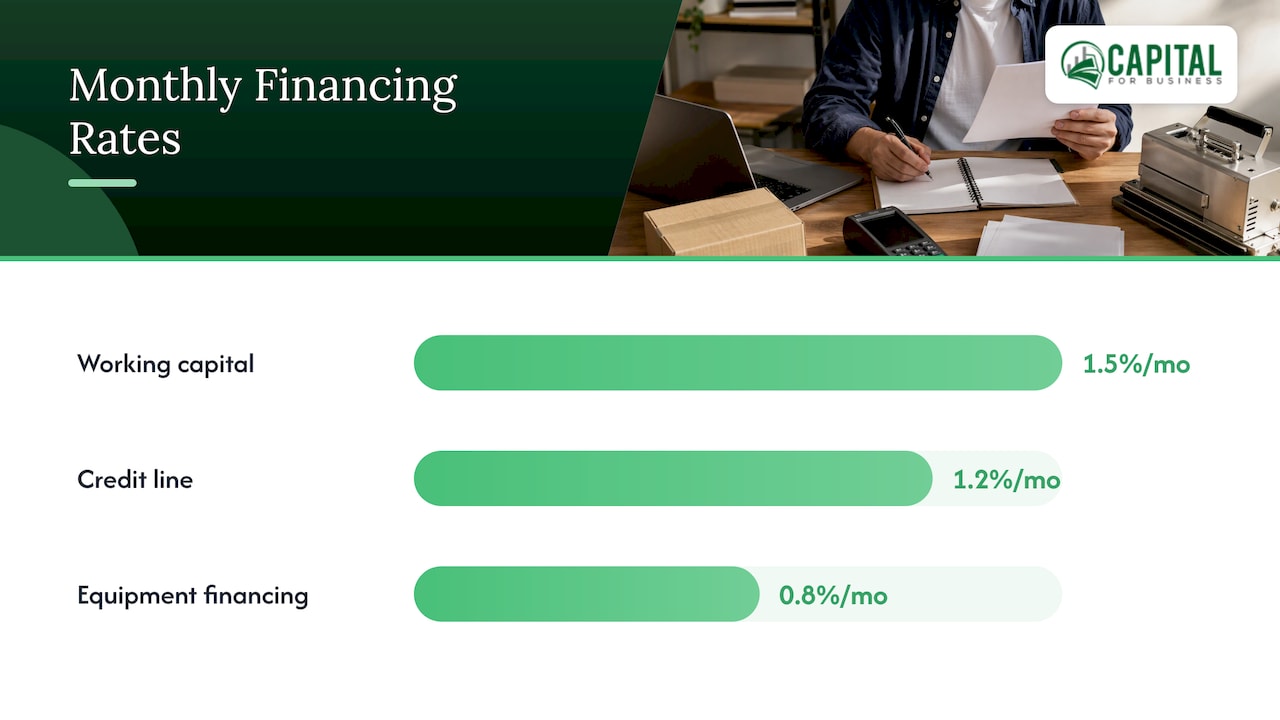
Capital for Business has worked with business owners since 2009, across hundreds of industries, and offers a range of products for exactly that gap. Our working capital loans start from 1.5% per month, and a business line of credit starts from 1.2% per month. For a purchase such as a new terminal setup, a truck or tools, equipment financing starts from 0.8% per month. If your card sales are strong and your processing is steady, a merchant cash advance starts from a 1.15 factor rate, one-off, and our guide to merchant cash advance underwriting explains why three to six months of statements are the core of that review. Our business loan application workflow shows what to expect at each stage.
The documents you gather for processing underwriting, bank statements, tax returns and processor statements, are largely the same ones a financing review uses, so one organized packet serves both.
Promo: funding that keeps your business moving
If a reserve, a hold or a delayed approval is squeezing your cash flow, we can help you look at funding built around how your business actually earns. We offer working capital, lines of credit, equipment financing, term loans, SBA loans, merchant cash advances and credit card processing solutions for small businesses in the US and Canada, and we aim to fund as soon as 24 hours for qualified applicants. We also work with a broad range of credit profiles, including bad credit business loans from 2.5% per month.

See every option on our funding solutions page and pick the product that fits your situation.
Our perspective
Underwriting is easiest when you treat it as a conversation about risk rather than a hurdle. Processors and lenders both want to see the same thing: a business with steady deposits, honest projections, clean paperwork and a plan for handling problems.
We built Capital for Business for owners who have been told no by a bank or credit union. Since 2009 we have worked with owners in hundreds of industries, from contractors and electricians to restaurants and flower shops, and our approach is to look at the whole business, not one number. That is why we offer a wide range of products, so the funding can match the need: working capital for daily operations, a line of credit for uneven months, equipment financing for tools and machinery.
Our advice is to prepare one complete, consistent packet of documents and use it everywhere. It speeds up a processing account review, and it speeds up ours.
Capital
FAQ
What is merchant account underwriting?
It is the risk review a processor or acquiring bank performs before approving your business to accept card payments. The reviewer evaluates your credit, business model, location, compliance and history to decide whether to approve, decline, or approve with conditions.
What do underwriters look at in a small business?
They look at creditworthiness, business activity, compliance, location, service providers and business history, including past terminations and chargebacks. For you, that means owner credit, bank statements, tax returns, prior processing statements and projected sales.
Why would a merchant account come with a reserve?
A reserve is collateral against future chargebacks, used when the reviewer sees added exposure, such as delayed delivery or a financially unstable business. Under Visa's standards, the reserve stays the merchant's property and must be held in a segregated account in the merchant's name.
What should I do if my application is declined?
Ask which factor drove the decision, then fix it: complete missing documents, improve chargeback handling, or document the history behind a past termination. Reapply with a full packet, and consider financing options so that your payroll and purchasing are covered in the meantime.
Sources
- FDIC, Merchant Card Banking (Introduction)
- Visa, Payment Facilitator and Marketplace Risk Guide
- Visa, Effective Merchant Onboarding to Drive Portfolio Growth
- Visa, Global Acquirer Risk Standards
- Visa, Acceptance Risk Standards
- FinCEN Advisory FIN-2012-A010
- FDIC, FIL-127-2008 Attachment