
TL;DR:
- First, florists should improve key metrics like AOV, repeat customer rate, and gross margin before seeking funding.
- Building predictable revenue streams such as subscriptions and corporate accounts reduces risks and eases loan approval.
The fastest, lowest-risk way to expand your flower shop is to stabilize cash flow first, then borrow with purpose. That means raising your average order value (AOV), building at least one recurring revenue stream, and matching your financing to a specific use-case: equipment financing for commercial refrigeration and leasehold improvements, or a working capital loan for inventory and payroll. Borrowing before fixing your margins is the most common and most expensive mistake florists make.
Your immediate three-step checklist:
- Run your core metrics: calculate AOV, 12-month repeat customer rate, and gross margin
- Pick one revenue lever to launch within 30 days (flower subscriptions or a corporate account program)
- Gather your lender documents and speak with Capitalforbusiness about the right funding vehicle
Table of Contents
- Are you ready to expand? Key metrics to check first
- High-ROI revenue strategies to pursue before expanding
- Which financing option fits your expansion goal?
- Step-by-step lender checklist: documents to get approved faster
- Where to spend borrowed money for the fastest measurable ROI
- How to reduce seasonality risk and protect your margins
- Operational and local-marketing moves that increase conversions today
- How Capitalforbusiness supports flower shop expansion
- Key Takeaways
- What actually matters when you decide to grow
- Ready to fund your next growth phase with Capitalforbusiness
- Useful sources and where to learn more
- FAQ
Are you ready to expand? Key metrics to check first
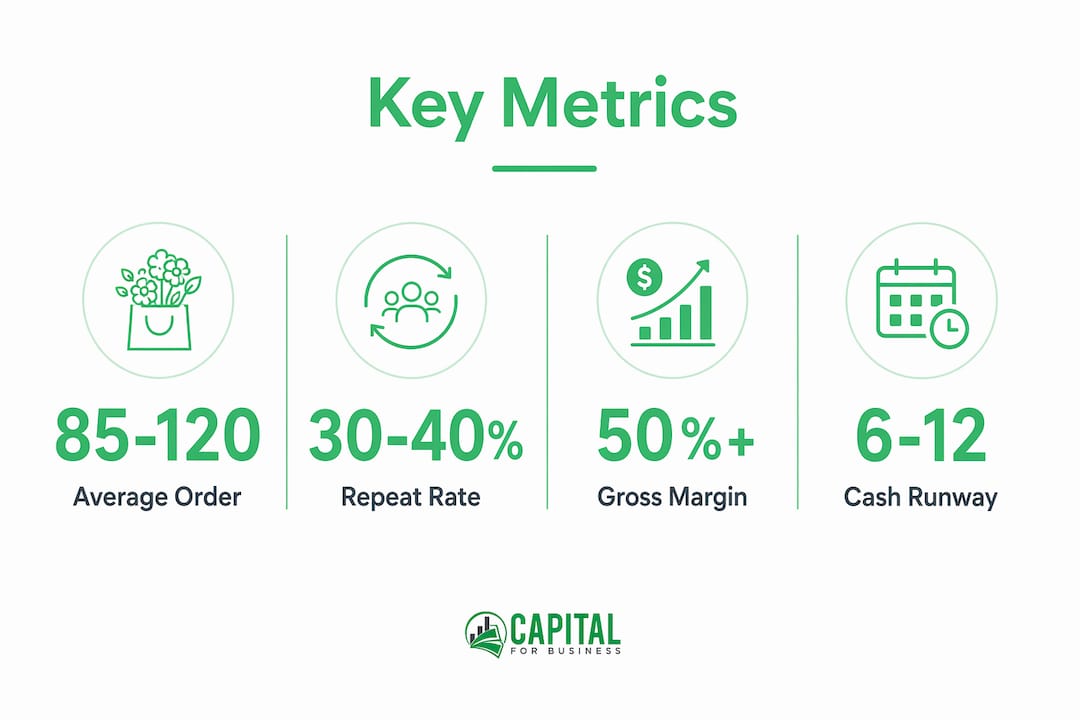
Before you apply for a single dollar, measure these four numbers. Lenders look at them, and they tell you whether borrowed money will accelerate growth or just cover a leaky bucket.
| Metric | How to calculate | Healthy target (US independent florist) |
|---|---|---|
| Average Order Value (AOV) | Total revenue ÷ number of orders | $85–$120 |
| Repeat customer rate (12-month) | Repeat buyers ÷ total customers | 30–40% |
| Gross margin | (Revenue – COGS) ÷ Revenue | 50–65% |
| Cash runway | Cash on hand ÷ monthly burn | 3+ months |
Hana Florist POS recommends prioritizing AOV, repeat rate, and gross margin for faster profit improvement before chasing more traffic. If your gross margin is below 50%, fix your pricing or supplier costs first. If your repeat rate is low, fix your follow-up and CRM before adding a second location.
Pro Tip: If only one metric is off, fix the operational one first. A low gross margin is a pricing or sourcing problem. A low repeat rate is a marketing problem. They need different solutions and different funding.
High-ROI revenue strategies to pursue before expanding
Conversion rate and AOV produce the fastest returns of the four florist revenue levers. Start there, not with paid traffic.
Highest-impact tactics, ranked by speed of return:
- Drop or reduce wire-service volume. Wire-service fees consume roughly 30% of each order, directly eroding margin. Shifting even 20% of that volume to direct bookings over 12–18 months materially changes your P&L.
- Launch a flower subscription program. Weekly or biweekly subscriptions create predictable volume and reduce waste. A shop with 40 active subscribers at $65/month generates $2,600 in recurring monthly revenue before a single walk-in.
- Land two or three corporate accounts. A single office account can generate 10–30 orders per month at above-average AOV. Pitch local restaurants, law firms, and real estate offices with a flat-rate weekly arrangement proposal.
- Add a premium signature tier. A curated "designer bouquet" at $120–$180 raises AOV without adding complexity. Pair it with one add-on prompt at checkout (a vase, a card, or chocolates).
- Host floral workshops. A two-hour workshop at $65–$85 per seat adds revenue, builds community loyalty, and costs little beyond your existing inventory and space.
Pro Tip: Fix AOV and repeat rate before you spend on ads. A shop converting at 3% with a $70 AOV gets far less from a $500 ad budget than one converting at 3% with a $110 AOV. The math compounds fast.
Which financing option fits your expansion goal?
Physical expansion is capital-intensive. Deposits, commercial refrigeration, and POS upgrades typically run $30,000–$80,000+. Choosing the wrong funding vehicle adds unnecessary cost or delays your timeline.
| Funding type | Best use-case | Typical timeline | Cost vs. speed |
|---|---|---|---|
| SBA term loan | Leasehold improvements, long-term equipment | 30 days | Lowest cost, slowest |
| Business term loan | Refrigeration, POS, build-out | 5 days | Moderate cost, moderate speed |
| Working capital loan / line of credit | Inventory, payroll, marketing | 1–5 days | Moderate cost, fast |
| Merchant cash advance (MCA) | Urgent inventory, seasonal bridge | 24–72 hours | Higher cost, fastest |
| Equipment financing | Commercial coolers, delivery vans, POS hardware | 2–7 days | Asset-secured, competitive rate |
When to prioritize speed over cost: If a holiday season is two weeks out and you need inventory now, an MCA or working capital draw makes sense even at a higher factor rate. When you have 60+ days of runway and a clear capital plan, an SBA or term loan saves meaningful money.
When to prioritize cost over speed: Any purchase that sits on your balance sheet for 3+ years (a commercial cooler, a walk-in refrigerator) deserves the lower rate of equipment financing or an SBA loan. Paying a premium rate on a five-year asset is an avoidable drag on margins.
Step-by-step lender checklist: documents to get approved faster
Lenders move faster when your file is complete on day one. Prepare these before you apply:
- Last 2 years of business tax returns
- Last 3–6 months of business bank statements
- Current profit and loss statement (within 60 days)
- Balance sheet
- Accounts receivable aging report
- Copy of your commercial lease
- Supplier references or contracts
- Equipment quotes (for equipment financing applications)
- A one-page use-of-funds summary
Sample use-of-funds split (entry-level expansion, ~$50,000):
| Category | Estimated amount | % of total |
|---|---|---|
| Commercial refrigeration | $15,000 | 30% |
| POS / e-commerce upgrade | $3,000 | 12% |
| Inventory build-up | $8,000 | 20% |
| Marketing (3-month campaign) | $3,000 | 12% |
| Hiring / training | $3,000 | 10% |
| Working capital reserve | $3,000 | 8% |
Pro Tip: Equipment financing is often easier to qualify for than an unsecured term loan because the asset itself secures the debt. If your credit profile is thin, start there. An MCA bridges the gap when you need speed and have strong card sales.
Where to spend borrowed money for the fastest measurable ROI
Not all capital allocations pay back at the same rate. Prioritize in this order:
- Commercial refrigeration and cold storage. Capacity constraints cap revenue directly. A second cooler can double your standing inventory and your ability to fulfill same-day orders.
- POS and e-commerce integration. A POS that handles subscriptions, occasion reminders, and online checkout removes friction from your highest-margin revenue streams. Shops reaching $300k+ in revenue typically automate routine tasks to maintain margins while scaling.
- Inventory smoothing for subscriptions. Pre-purchasing stems at volume locks in better wholesale pricing and reduces last-minute sourcing costs.
- Targeted marketing for weddings and corporate accounts. A focused 3-month campaign on two high-AOV segments outperforms broad brand awareness spend at this stage.
- Delivery staff and route optimization. Automation tools can save 8–12 hours per week and reduce waste by 30–50% through smarter routing and ordering.
Track these KPIs post-spend: AOV, repeat rate, gross margin, and delivery cost per stop. Only fund items that move at least one KPI within 3–6 months.
How to reduce seasonality risk and protect your margins
Wire-service fees consume roughly 30% of each order value, and holiday-driven revenue volatility can reach up to 40% of annual sales. Both are manageable with the right mix of recurring revenue and operational discipline.
Practical mitigation steps:
- Build subscriptions to 15–20% of monthly revenue before expanding fixed costs
- Lock at least two corporate accounts before signing a new lease
- Negotiate net-30 or net-45 terms with your primary wholesale supplier once monthly volume justifies it
- Implement inventory automation to reduce over-ordering around holidays
- Scenario-test your cash flow at 60% of peak-month revenue before committing to long-term debt
Shifting revenue away from wire services takes time. Expect 12–18 months to move a meaningful share to direct bookings if subscriptions, corporate outreach, and local SEO run in parallel.
Operational and local-marketing moves that increase conversions today
Google Business Profile is the highest-leverage free tool for any local florist. It appears before your website and before paid ads in local search results.
| Action | Frequency | Expected impact |
|---|---|---|
| Add 2–3 product photos | Weekly | Higher click-through from local search |
| Respond to every review | Within 24 hours | Improved trust and local ranking |
| Update holiday hours | 2 weeks before each holiday | Fewer lost orders from wrong-hours confusion |
| Publish a GBP post | Weekly | Signals active business to Google |
Beyond GBP, prioritize these operational fixes:
- Streamline your product menu to 12–20 featured items. Decision fatigue kills conversions.
- Add one add-on prompt at checkout (a vase, a card, or chocolates). This alone can lift AOV by $8–$15 per order.
- Use your POS CRM to send birthday and anniversary reminders automatically.
For shops ready to invest in local search and direct-to-consumer sales, working with a digital marketing agency that specializes in local SEO can accelerate GBP rankings and online order volume faster than DIY efforts alone.
Pro Tip: Independent florists typically spend 3–8% of annual revenue on marketing. Don't split that budget evenly across 12 months. Put 40–50% of it in the 4–6 weeks around your top four holidays.
How Capitalforbusiness supports flower shop expansion
Capitalforbusiness has worked with small business owners across hundreds of industries since 2009. For florists specifically, these products map directly to common expansion needs:
| Product | Best expansion use-case | Typical funding speed |
|---|---|---|
| Equipment financing | Commercial coolers, POS hardware, delivery vehicles | 2–7 days |
| Working capital loan | Inventory, payroll, marketing campaigns | 1–5 days |
| Merchant cash advance | Urgent seasonal inventory, cash flow bridge | 24–72 hours |
| Business line of credit | Flexible draw for ongoing operational needs | 1–5 days |
| SBA loan | Long-term leasehold improvements, major build-outs | 30 days |
Application tips that shorten review time:
- Submit a clear one-page use-of-funds summary
- Include equipment quotes for any asset purchase
- Provide a P&L updated within the last 60 days
- Show 3–6 months of bank statements with consistent deposit history
The flower shop expansion funding guide on the Capitalforbusiness blog walks through lender expectations and product selection in detail.
Key Takeaways
Expanding a flower shop sustainably requires fixing internal metrics first, then matching the right financing vehicle to a specific, measurable use-case.
| Point | Details |
|---|---|
| Fix metrics before borrowing | AOV ($85–$120), repeat rate (30–40%), and gross margin (50–65%) are the signals lenders and owners both need. |
| Recurring revenue reduces risk | Subscriptions and corporate accounts reduce holiday-driven volatility and make lenders more comfortable with term debt. |
| Match funding to use-case | Equipment financing suits coolers and POS; working capital or MCA suits inventory and payroll. |
| Wire-service leakage is real | Fees consume roughly 30% of order value; shifting to direct sales over 12–18 months materially improves margins. |
| Capitalforbusiness fits florists | Since 2009, Capitalforbusiness has offered working capital, equipment financing, MCAs, and lines of credit for shops at every growth stage. |
What actually matters when you decide to grow
Most florists who struggle after expansion borrowed too early or too broadly. The shops that scale well share one habit: they treat their P&L as a signal, not a formality. AOV and repeat rate are not vanity metrics. They tell you whether your operation is healthy enough to carry debt.
The other pattern worth noting is that recurring revenue changes the conversation with lenders entirely. A shop with 40 active subscribers and two corporate accounts looks fundamentally different on paper than a shop with the same total revenue driven entirely by holiday spikes. Stability is what lenders price. Build it before you apply.
Test small changes before committing to large debt positions. Launch a subscription program with 10 customers before building it into your loan projections. Land one corporate account before pitching a second location. The evidence you gather from small tests is the same evidence that makes a lender say yes faster.
Ready to fund your next growth phase with Capitalforbusiness
Florists who have done the work, fixed their AOV, built a recurring revenue base, and gathered their documents, deserve a lender who moves at the speed their business needs. Capitalforbusiness offers small business loans and funding solutions up to $500,000, with funding as fast as 24 hours for qualifying applicants. Whether you need equipment financing for a new commercial cooler or a working capital draw to cover a pre-holiday inventory build, the product line covers it.
Start your application at capitalforbusiness.net or review the full range of funding solutions to find the product that fits your expansion plan. Have your bank statements, P&L, and use-of-funds summary ready, and the process moves quickly.
This article is general business information, not financial or legal advice. Confirm current lending terms and eligibility requirements directly with Capitalforbusiness or a qualified financial professional for your specific situation.
Useful sources and where to learn more
- Flower Shop Growth Plan: A 12-Month Framework — Hana Florist POS: benchmarks for AOV, repeat rate, and quarterly growth sequencing
- 12 Ways to Increase Florist Sales — Hana Florist POS: revenue lever prioritization and conversion tactics
- Florist Marketing Strategies to Boost Sales — Hana Florist POS: Google Business Profile and local SEO guidance
- Marketing Ideas for Florists — Softscotch: wire-service fee data, subscription strategy, and direct-sales transition timelines
- AI and Automation for Florists — Axionis: automation ROI, waste reduction, and operational efficiency benchmarks
- Benefits of Working Capital for Flower Shops — Capitalforbusiness: how working capital smooths seasonality and supports inventory
FAQ
What metrics should a florist check before expanding?
Check AOV, 12-month repeat customer rate, gross margin, and cash runway. Lenders and your own P&L both depend on these four numbers being healthy before you take on debt.
How much does it cost to expand a physical flower shop?
Typical upfront costs for deposits, commercial refrigeration, and POS systems run $30,000–$80,000+, depending on the scope of the build-out and equipment needs.
What is the fastest funding option for a florist?
A merchant cash advance funds in 24–72 hours and suits urgent inventory or seasonal cash flow gaps. Equipment financing and working capital loans typically fund in 1–7 days.
How do subscriptions help a florist qualify for a loan?
Subscriptions create predictable weekly revenue, which reduces the holiday-spike volatility lenders view as risk. A shop with consistent recurring income looks more creditworthy than one with the same annual revenue concentrated in four holidays.
How does Capitalforbusiness help florists expand?
Capitalforbusiness offers working capital loans, equipment financing, merchant cash advances, and lines of credit, with funding timelines as fast as 24 hours. The team has worked with small business owners since 2009 across hundreds of industries, including floral retail.