TL;DR:
- Funding helps flower shops expand by financing infrastructure, inventory, and marketing during growth. Different costs require specific loans, such as equipment financing for refrigeration or working capital for seasonal inventory. Proper timing and disciplined spending ensure sustainable growth and prevent cash flow problems.
The role of funding in flower shop expansion is to provide the capital necessary for infrastructure upgrades, inventory management, and strategic growth that increases profitability and operational capacity. Floristry is a capital-intensive business with a unique challenge: your inventory is perishable, your demand is seasonal, and your equipment costs are significant. Refrigeration units, delivery vehicles, and expanded retail space all require upfront investment that daily sales revenue rarely covers fast enough. Structured financing tailored to floristry enables more sustainable growth compared to generic retail loans. Understanding which funding tools match each growth stage is the difference between a shop that scales and one that stalls.
What are the primary funding needs when expanding a flower shop?
Capital investment in floristry falls into four distinct categories, and each one demands a different funding approach. Treating them as a single budget line is the most common mistake flower shop owners make when planning growth.
Infrastructure and equipment
Refrigeration is the backbone of any flower shop. Commercial cooling units and refrigerated transport vehicles represent the largest single cost in most expansion plans. Infrastructure like refrigerated vans and cooling units consistently accounts for the largest share of expansion funding requirements. These are long-lived assets that justify long-term financing, such as equipment loans or leasing arrangements, rather than short-term working capital. Florists who fund refrigeration with revolving credit lines often find themselves paying high interest on assets that should carry fixed, predictable payments. The equipment financing workflow for florists outlines a step-by-step process for securing this type of funding correctly.

Seasonal inventory and working capital
Fresh flower procurement is a recurring, high-frequency cost that spikes sharply around Valentine's Day, Mother's Day, and wedding season. Working capital loans are the standard tool for covering these cycles. They give you access to cash before the revenue arrives, so you can place supplier orders on time without draining your operating account. Packaging, floral foam, and ancillary supplies also scale with order volume, adding to the working capital requirement during peak periods.
Marketing and staffing
Expanding a flower shop without investing in customer acquisition produces a larger operation with the same customer base. Digital advertising, local event sponsorships, and wedding industry partnerships all require budget. Staffing costs rise in parallel: additional designers, drivers, and counter staff are necessary before revenue from new customers fully materializes. These costs are best funded through a business line of credit, which lets you draw only what you need and repay as revenue comes in.
Typical expansion cost categories
| Cost Category | Typical Use | Recommended Funding Type |
|---|---|---|
| Refrigeration units | Cold storage for fresh inventory | Equipment loan or lease |
| Delivery vehicles | Transport for orders and events | Equipment loan |
| Retail space build-out | New or expanded storefront | Term business loan |
| Seasonal inventory | Peak-period flower procurement | Working capital loan |
| Marketing and advertising | Customer acquisition campaigns | Business line of credit |
| Staffing | Additional designers and drivers | Working capital loan |
Which financing options are available for flower shop expansion?
Financing flower shop growth requires matching the loan type to the specific cost it covers. Using the wrong product adds unnecessary cost and cash flow pressure.
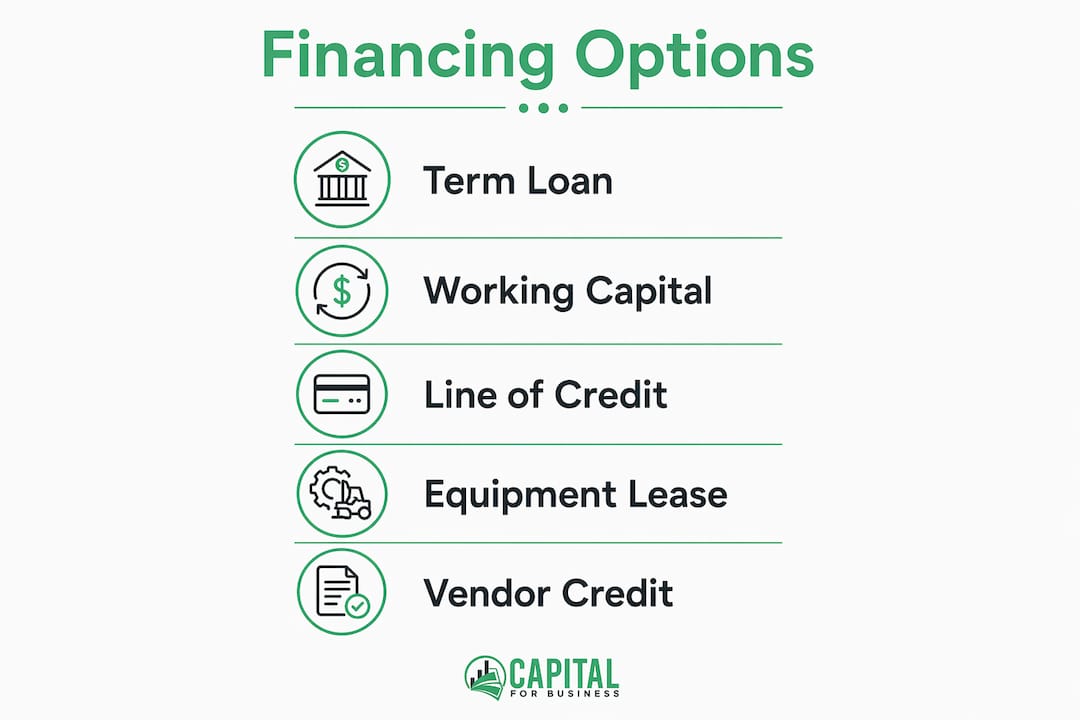
Business term loans are the right tool for long-term assets. A refrigeration unit that lasts ten years should be financed over a multi-year term, not paid off in 90 days. Term loans offer fixed repayment schedules, which makes budgeting predictable. They work best when you have a clear capital project with a defined cost and a reasonable timeline for the asset to generate returns.
Working capital loans address the gap between when you pay suppliers and when customers pay you. Working capital loans support recurring expenses like fresh flower procurement and packaging during peak seasons. The benefits of working capital for flower shops include maintaining consistent inventory without depleting your cash reserves between revenue cycles.
Business lines of credit function like a financial safety net you draw from as needed. They are ideal for variable costs such as marketing spend, part-time staffing, and opportunistic bulk purchases from suppliers. A revolving line of credit lets you borrow, repay, and borrow again within your approved limit, which suits the unpredictable cash flow patterns of a seasonal business.
Equipment leasing reduces upfront costs by spreading payments over the useful life of the asset. Leasing a refrigerated van rather than buying it outright preserves cash for inventory and staffing. The trade-off is that you build no equity in the asset, which matters if you plan to eventually sell the business.
Vendor credit and payment terms are an underused tool in floristry. Negotiating net-30 or net-60 payment terms with your wholesale flower supplier effectively gives you a short-term, interest-free loan on inventory. This works best once you have an established relationship and a track record of reliable payment.
Pro Tip: Before applying for any loan, calculate your average monthly revenue for the three months before and after your peak season. Lenders use this data to assess repayment capacity, and knowing your own numbers in advance puts you in a stronger negotiating position.
| Financing Type | Best Used For | Key Advantage |
|---|---|---|
| Business term loan | Refrigeration, vehicles, build-out | Fixed payments, long repayment term |
| Working capital loan | Inventory, packaging, labor | Fast access, short-term coverage |
| Business line of credit | Marketing, staffing, variable costs | Draw only what you need |
| Equipment lease | Vans, cooling units | Lower upfront cost |
| Vendor credit terms | Wholesale flower procurement | Interest-free short-term float |
How does seasonal demand affect funding strategies in floristry?
Seasonal demand is the defining financial challenge of the floral business. Revenue concentrates around a handful of dates each year, but operating costs run every week. That mismatch creates cash flow gaps that catch underprepared shop owners off guard.
Seasonal inventory financing aligns with major demand events like Valentine's Day and Mother's Day, which require accessible working capital for timely procurement. Missing a procurement window because funds are not available means lost sales that cannot be recovered. A florist who runs out of roses on February 13 does not get a second chance at that revenue.
The practical solution is to time your capital injections ahead of demand, not during it. Applying for a working capital loan in january for Valentine's Day inventory, or in march for Mother's Day, gives you enough lead time to receive funds, place supplier orders, and receive stock before the rush. Waiting until the week before a peak event to seek financing is a pattern that consistently results in either missed inventory or emergency borrowing at unfavorable terms.
Revolving credit lines are particularly well suited to floristry because they reset as you repay. After Valentine's Day revenue comes in, you repay the draw, and the full credit line is available again for the next peak. This cycle matches the natural rhythm of the business far better than a fixed-term loan that keeps accruing interest whether you need the funds or not. The seasonal business funding guide covers specific strategies for managing these cycles.
Key funding timing checkpoints for florists:
- January: Secure working capital for Valentine's Day inventory procurement
- March: Draw on credit line for Mother's Day stock and staffing
- April–May: Assess wedding season capacity and equipment needs
- October: Plan holiday season inventory financing before november demand builds
- Post-peak: Repay revolving balances to reset credit availability
Pro Tip: Track your gross margin by season, not just by month. Florists often discover that their highest-revenue months are not their most profitable ones, because procurement and waste costs spike in proportion. That data tells you exactly how much working capital you actually need versus how much you think you need.
What practical approaches can florists use to maximize funding effectiveness?
Securing funding is only half the equation. How you deploy capital determines whether expansion produces profit or just larger losses. These five approaches protect your return on investment during growth phases.
-
Prioritize functional infrastructure over aesthetics. Experts advise florists to prefer a "cleaner budget over a prettier budget," emphasizing consistent order flow before investing in storefront aesthetics. A well-refrigerated back room generates more revenue than a beautifully decorated front window. Spend on what keeps flowers alive and orders fulfilled before spending on what looks good to walk-in customers.
-
Start with a narrow product menu. Florists who limit initial refrigeration capacity and focus on a narrow product range reduce waste and preserve cash flow during early growth phases. Offering 40 SKUs when you have the order volume to support 15 ties up capital in slow-moving inventory that wilts before it sells. Expand the menu as demand proves it out.
-
Use preorder and event revenue to fund the next phase. Preorder and event revenues fund expansion phases by reducing upfront capital needs and aligning spending with actual sales. A confirmed wedding contract for june is collateral you can use to justify a working capital draw in may. Build your expansion calendar around confirmed revenue, not projected revenue.
-
Launch in phases to control risk. Opening a second location or adding a delivery fleet all at once multiplies your fixed costs before your revenue base has grown to support them. A phased launch, such as adding one delivery vehicle and testing a new service area for 90 days before committing to a second, keeps your risk contained and your cash flow manageable.
-
Avoid overspending on physical store upgrades before proving order flow. Overspending on store upgrades without proven order flow is a documented financial pitfall in floristry. The capital you spend on new shelving and decorative fixtures is capital you cannot spend on the inventory that actually generates revenue. Upgrade the customer experience after the customer base justifies it.
Small loan options can also support targeted growth without overextending your balance sheet. Ideas for using small loans in 2026 include funding specific equipment purchases or bridging a single seasonal gap rather than taking on more debt than the business currently needs.
Key Takeaways
Funding for flower shop expansion works best when each financing tool matches the specific cost it covers, from long-term equipment loans for refrigeration to revolving credit lines for seasonal inventory.
| Point | Details |
|---|---|
| Match funding to cost type | Use term loans for equipment and lines of credit for variable seasonal costs. |
| Time capital injections early | Secure working capital weeks before peak demand, not during it. |
| Prioritize functional spending | Fund refrigeration and inventory before storefront aesthetics. |
| Use phased expansion | Launch new capacity in stages to keep cash flow stable and risk low. |
| Leverage preorder revenue | Use confirmed event contracts to justify and time your next capital draw. |
What I've learned about funding and flower shop growth
Working with flower shop owners across hundreds of funding applications at Capitalforbusiness, I've noticed a consistent pattern. The florists who struggle most with repayment are not the ones who borrowed too much. They are the ones who borrowed for the wrong things at the wrong time.
The most common mistake I see is spending loan proceeds on a storefront renovation before the shop has a stable, repeatable order flow. A beautiful shop with inconsistent revenue is a cash flow problem waiting to happen. The florists who grow sustainably tend to be almost boring in their financial discipline. They fund refrigeration, they fund inventory, and they wait until the numbers justify everything else.
Seasonal timing also trips up more owners than I expect. Applying for working capital in the week before Valentine's Day is not a funding strategy. It is a crisis response. The florists who thrive plan their capital needs on a 12-month calendar and treat financing as a scheduled business activity, not an emergency measure.
My honest recommendation: before you apply for any expansion funding, write down exactly which cost the loan will cover, how that cost generates revenue, and when that revenue will arrive. If you cannot answer all three questions clearly, the timing is not right yet. When you can, the financing decision becomes straightforward.
— Capital
Capitalforbusiness funding options for flower shop owners
Flower shop owners looking to grow have access to a full range of financing products through Capitalforbusiness, including working capital loans up to $500,000, equipment financing for refrigeration and delivery vehicles, and flexible business lines of credit. Since 2009, Capitalforbusiness has helped small business owners in hundreds of industries expand when banks and credit unions said no.

The application process is fast, and approvals are designed to meet the timelines that seasonal businesses actually face. Whether you need to fund a single refrigeration unit or finance a full second-location build-out, Capitalforbusiness offers small business loan options structured to fit your revenue cycle and repayment capacity.
FAQ
What does funding cover in a flower shop expansion?
Expansion funding covers infrastructure such as refrigeration units and delivery vehicles, seasonal inventory procurement, marketing, and additional staffing. Business loans address long-term assets, while working capital loans and lines of credit cover short-term operational costs.
How much capital does a flower shop typically need to expand?
Capital requirements vary by market and scope, but a mid-sized flower boutique typically requires significant capital for startup or expansion, with inventory-specific funding needs during peak wedding and holiday seasons adding to that total. Infrastructure costs, particularly refrigeration and transport, represent the largest share.
What is the best loan type for managing seasonal inventory costs?
Working capital loans and revolving business lines of credit are the most effective tools for seasonal inventory financing. Revolving credit lines reset as you repay, which matches the cyclical cash flow pattern of floristry better than a fixed-term loan.
When should a flower shop owner apply for seasonal funding?
Apply for seasonal working capital at least four to six weeks before your peak demand period. Timing capital injections ahead of demand gives you time to receive funds, place supplier orders, and have stock ready before the revenue window opens.
How can florists avoid wasting expansion capital?
A disciplined approach to inventory and financial management is the most reliable way to protect profitability during growth. Prioritize spending on refrigeration and inventory over storefront aesthetics, and use phased launches to keep fixed costs aligned with actual revenue growth.