
TL;DR:
- Seasonal business owners need to plan cash flow gaps early to avoid crises during slow months. Choosing the right funding, such as lines of credit or invoice factoring, aligned with revenue cycles, is essential for maintaining control. Proper operational discipline combined with timely financing helps seasonal businesses grow sustainably and avoid costly financial pitfalls.
Running a seasonal business means you already know what the slow months feel like: payroll keeps coming, suppliers still need payment, and the revenue that covers it all is weeks or months away. Explaining seasonal business funding clearly matters because too many owners reach for the wrong solution at the wrong time, which turns a manageable gap into a real crisis. This guide breaks down what seasonal financing is, which funding options actually fit different cash flow patterns, and how to plan before the pressure hits so you stay in control year-round.
Table of Contents
- Key Takeaways
- What is seasonal business funding and why it matters
- Types of seasonal funding options and how they work
- Planning and timing your seasonal funding application
- Managing cash flow effectively during seasonal cycles
- Evaluating the costs and trade-offs of seasonal funding
- My perspective on seasonal funding after years in small business finance
- How Capitalforbusiness supports seasonal small businesses
- FAQ
Key Takeaways
| Point | Details |
|---|---|
| Seasonal funding fills predictable gaps | It covers payroll, inventory, and overhead during low-revenue periods before your busy season pays off. |
| Multiple funding types exist | Lines of credit, SBA CAPLines, short-term loans, and invoice factoring each serve different cash flow needs. |
| Timing your application matters | Apply 2 to 3 months before your busy season to secure better terms and avoid last-minute costs. |
| Fully burdened costs must be calculated | Include taxes, benefits, and overhead plus a buffer when estimating how much funding you actually need. |
| Matching funding to cash flow type is critical | Choosing the wrong product for your gap increases debt load and repayment pressure unnecessarily. |
What is seasonal business funding and why it matters
Seasonal business financing is a category of funding specifically designed for businesses whose revenue follows predictable cycles throughout the year. Rather than treating your cash flow gap as a sign of poor management, seasonal funding recognizes that the gap itself is structural. You spend money ahead of income, and the right financing product covers that interval without putting your operation at risk.
The role of seasonal financing goes beyond simply covering a shortfall. It supports working capital needs like payroll, inventory purchases, equipment rentals, and overhead costs during the months when revenue is either flat or nonexistent. A landscaping company in Minnesota, for example, may do 90% of its revenue between April and October. From November through March, the bills still arrive. Without deliberate funding in place, owners are forced to drain reserves, delay payments, or cut staff they will need again in spring.
Common seasonal businesses that benefit from this type of financing include:
- Landscaping and lawn care companies
- Hospitality businesses and resorts with peak travel seasons
- Retail shops with heavy holiday sales
- Construction contractors dependent on weather conditions
- Ski and recreational tourism operators
- Agricultural businesses tied to harvest cycles
The financial risk of unmanaged seasonal cash flow is not just a cash problem. It compounds. Missed payroll destroys employee trust. Late vendor payments raise costs or lose supplier relationships. And owners who repeatedly dip into personal savings to cover business expenses blur the line between business health and personal financial stability in ways that are difficult to untangle later.
What separates seasonal business financing from a general business loan is the structure. General-purpose loans are typically repaid in equal monthly installments regardless of your revenue cycle. Seasonal credit loans can provide term funding for up to nine months of seasonal need, with floating interest rates calibrated to the duration of the gap rather than a fixed multi-year schedule. That alignment between repayment and revenue timing is the defining feature of true seasonal financing.
Types of seasonal funding options and how they work
Understanding which product fits your situation is where most business owners get stuck. Each option carries a different cost structure, approval process, and best-use case. Here is a breakdown of the primary seasonal funding options available in 2026.
Business lines of credit
A business line of credit is flexible and only charges interest on the amount you draw, making it well-suited for managing seasonal cash flow fluctuations over multiple cycles. You access funds as needed, repay, and access again. This revolving structure is particularly useful when your cash needs vary week to week, such as during the buildup to a busy season when purchases and hiring happen on an irregular schedule.
SBA seasonal CAPLine loans
The SBA seasonal CAPLine is a government-backed credit line that finances seasonal accounts receivable, inventory, and labor costs, with loan amounts up to $5 million. It requires proof of a demonstrated seasonal need, at least one clean year of operations, and includes mandatory clean-up periods where the balance must be zeroed out for a set number of days each year. The clean-up requirement is a feature, not a flaw. It confirms you are using the credit line for its intended purpose and not becoming structurally dependent on it.
Short-term working capital loans
Short-term loans give you a lump sum upfront with repayment over a compressed schedule, often 3 to 18 months. They offer fast access to funds compared to traditional bank products, which matters when your window for pre-season preparation is tight. The trade-off is cost. Shorter repayment periods mean higher effective rates, so these work best when you have a clear revenue event coming that will cover repayment.

Invoice factoring
Invoice factoring converts unpaid invoices into immediate cash. Factoring companies typically advance 80% to 95% of invoice value within days of submission. This is especially useful for contractors and service businesses that complete work in spring and summer but collect payment 30 to 90 days later. You are not taking on new debt. You are simply accelerating cash that is already owed to you. For more detail on how this compares to invoice financing, Capitalforbusiness has a thorough breakdown of both invoice-based options.
Merchant cash advances
Merchant cash advances provide a lump sum repaid through a daily percentage of credit card sales. They work for businesses with high card transaction volumes but can become expensive during slow periods when daily repayments feel disproportionate to incoming revenue. They are best treated as a last resort rather than a primary seasonal tool.
Comparison table of seasonal funding options:
| Funding Type | Best Use Case | Typical Cost | Speed of Access | Key Requirement |
|---|---|---|---|---|
| Business line of credit | Ongoing operational gaps | Low to moderate | Moderate | Good credit, business history |
| SBA seasonal CAPLine | Inventory, payroll, receivables | Low (government-backed) | Slow | Proven seasonal need, clean year |
| Short-term loan | Defined pre-season expense | Moderate to high | Fast | Revenue history, basic documents |
| Invoice factoring | Delayed B2B payment collection | Moderate (factoring fee) | Very fast | Outstanding invoices |
| Merchant cash advance | High card-volume businesses | High | Very fast | Consistent card sales |
Pro Tip: Choose your funding product based on what type of gap you are filling, not just how fast you need money. A line of credit works for irregular, recurring expenses. A short-term loan works for a defined, one-time pre-season spend. Mixing these up leads to unnecessary costs.
Planning and timing your seasonal funding application
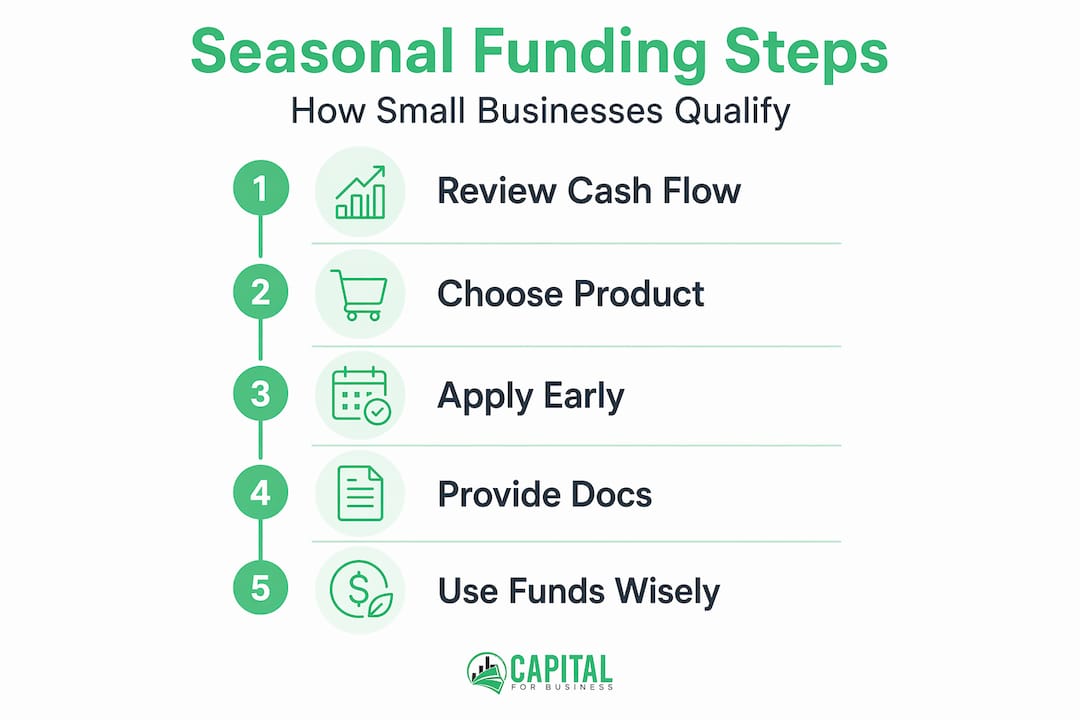
Getting the timing right is as important as choosing the right product. Most business owners wait too long, and what could have been a low-cost credit line becomes an expensive emergency loan. Planning funding applications 2 to 3 months ahead of your busy season gives you better terms, more options, and time to correct any problems in your application before they become deal-breakers.
Here is a practical timeline for seasonal funding preparation:
-
Four to five months out. Review last season's financials. Calculate your exact cash flow gap: how much did you spend before peak revenue arrived, and what was the timing difference? This number is your funding target.
-
Three months out. Gather your financial documents. Lenders typically want at least 12 months of bank statements, recent profit and loss statements, and tax returns from the prior two years. Have these ready before you start applications.
-
Two months out. Submit your applications. If you are pursuing an SBA CAPLine, build in extra lead time since government-backed loans move slower than direct lenders. If you are working with Capitalforbusiness or a similar direct lender, the process is faster, but earlier is always better.
-
One month out. Confirm your funding is in place. Align your draw schedule with your hiring timeline, inventory purchase schedule, and any equipment rental deposits. Do not draw funds before you need them if your product charges interest from the day of the draw.
-
Two weeks out. Review your repayment plan. Know when your first payment comes due and confirm your revenue projections support it. If there is any doubt, adjust the draw amount now rather than after the fact.
Pro Tip: If your lender requires a clean-up period, like many SBA CAPLines do, mark that date on your calendar at the moment you sign. Missing a clean-up requirement can disqualify you from the product in future years.
Understanding lender qualification criteria early also prevents surprises. Most seasonal lenders want to see a business that has operated for at least one full seasonal cycle, consistent revenue history during peak periods, and a credit profile that reflects responsible debt management. Startups or businesses in their first year face a narrower set of options, but short-term working capital loans and invoice factoring remain accessible even without a long track record.
Managing cash flow effectively during seasonal cycles
Securing funding is only half the solution. How you manage that funding once it is in place determines whether your seasonal cycle ends with profit or with stress. Operational discipline combined with sound financing is what separates businesses that grow year over year from those that simply survive each season.
Start with your payroll costs. Most business owners underestimate these significantly. Fully burdened payroll costs, including taxes, benefits, and overhead, plus an additional 10% to 20% buffer, are the accurate number to use for cash flow planning. Plugging in just the base wage leads to budget shortfalls every time.
Beyond accurate cost calculations, here are the operational tactics that make a measurable difference:
- Stagger your hiring. Bring on staff in phases as demand builds rather than all at once. This spreads payroll obligations and lets you adjust if the season ramps up slower than expected.
- Match pay periods to billing cycles. If your clients pay net 30, structure payroll bi-weekly rather than weekly where possible so your incoming cash and outgoing payroll align more closely.
- Use performance bonuses instead of base wage increases. This keeps fixed costs lower during slow starts to the season and rewards output once revenue is flowing.
- Monitor cash flow weekly during your peak season. Problems compound quickly in high-revenue periods because spending scales up alongside income. Weekly reviews catch imbalances before they become material.
- Build a demand buffer into your inventory budget. Order more than last year's peak demand by 10% to 15% to account for growth and unexpected surges. Running out of inventory or capacity during peak season costs more than over-ordering does.
Pro Tip: Track the ratio of your peak-season revenue to your off-season fixed costs. If your off-season costs are more than 40% of your peak-season monthly average, you either need to cut fixed expenses or build more reserve during peak months.
Combining these operational controls with a credit line or working capital loan gives you both a financial floor and behavioral discipline. One without the other leaves gaps. Cash flow disruption patterns are worth reviewing regularly. The factors that disrupt cash flow for seasonal businesses go beyond the obvious slow months and include late payers, unexpected expenses, and demand volatility.
Evaluating the costs and trade-offs of seasonal funding
Every funding product carries a cost, and understanding those costs clearly is how you make an informed choice rather than a reactive one. Choosing the right funding option based on your specific cash flow gap directly impacts repayment pressure and long-term financial health.
Here is how the main cost factors compare across seasonal funding products:
| Factor | Lines of Credit | Short-Term Loans | Invoice Factoring | Merchant Cash Advances |
|---|---|---|---|---|
| Interest/fee structure | Interest on drawn balance | Fixed rate on full amount | Factoring fee per invoice | Factor rate on advance |
| Impact on debt | Adds revolving debt | Adds term debt | Does not create new debt | Adds advance obligation |
| Collateral requirement | Often unsecured | Sometimes collateralized | Invoices serve as collateral | No collateral needed |
| Credit score impact | Moderate | Moderate | Low | Low |
| Risk of overborrowing | Low (draw as needed) | Moderate (lump sum) | Low | High if misused |
A few considerations worth understanding before you commit:
- Invoice factoring and merchant cash advances carry higher effective costs than lines of credit, but they serve situations where traditional credit is not accessible or where speed is genuinely critical.
- Short-term loans are not inherently bad, but they are best reserved for situations with a defined, near-term revenue event to repay them. Using a high-cost short-term loan to cover three months of slow season with no clear repayment catalyst creates a debt spiral.
- Matching your working capital funding choice to the specific nature of your gap, whether payroll, inventory, receivables, or overhead, keeps costs proportionate to the benefit received.
The clean-up period associated with SBA CAPLines also carries a real risk if ignored. It requires your outstanding balance to reach zero for a defined period each year, which forces you to confirm the line is being used for seasonal needs rather than ongoing operations.
My perspective on seasonal funding after years in small business finance
I've seen hundreds of seasonal businesses come through our doors at Capitalforbusiness, and the pattern is remarkably consistent. The ones who struggle most are not the ones with bad businesses. They are the ones who come to us in crisis mode, six weeks before peak season, having already depleted reserves, with no time to secure a well-structured product.
In my experience, the single biggest mistake seasonal business owners make is treating funding as something you figure out when you need it. The most financially stable seasonal operations I've worked with treat their funding strategy the same way they treat their hiring plan or their inventory order. It is scheduled, deliberate, and reviewed annually.
I've also noticed that many owners gravitate toward merchant cash advances or short-term loans because the application is simple and the approval is fast. Those are real advantages. But what I've found is that the ease of access often masks the cost, and businesses use high-rate products for situations where a credit line or invoice factoring would have cost them a fraction of the price.
What actually works is matching the funding type to the specific gap you are filling, applying early enough to qualify for better products, and combining that financing with tight operational controls on payroll and inventory. That combination is what keeps seasonal businesses growing instead of just recovering each year.
— Capital
How Capitalforbusiness supports seasonal small businesses

At Capitalforbusiness, we work directly with seasonal small business owners who need funding solutions built around how their revenue actually flows. Whether you need a working capital loan to cover pre-season inventory, a line of credit to manage payroll during slow months, or fast access to funds ahead of a busy period, we have options designed to fit your cycle, not a bank's calendar. Our application process is straightforward, decisions come quickly, and we serve businesses across hundreds of industries nationwide.
Explore easy small business loans tailored to seasonal cash flow needs, or review our business funding solutions to find the right product for your situation. If you are not sure where to start, our team is ready to help you identify the funding type that aligns with your specific cash flow gap and business goals.
FAQ
What is seasonal business financing?
Seasonal business financing is funding designed to cover operating costs during low-revenue periods for businesses with predictable annual revenue cycles. It typically includes lines of credit, short-term loans, SBA CAPLines, and invoice factoring products structured around seasonal cash flow timing.
Why choose seasonal funding over a regular business loan?
Seasonal funding aligns repayment schedules with your revenue cycle rather than a fixed monthly schedule, which reduces cash flow pressure during off-peak months. Standard loans repay at the same rate year-round regardless of when your income arrives.
How far in advance should I apply for seasonal funding?
Apply at least 2 to 3 months before your busy season starts to secure better terms and allow time for document review and approval. Last-minute applications often result in higher costs or limited product options.
What does the SBA seasonal CAPLine require?
The SBA seasonal CAPLine requires at least one full year of operations with a demonstrated seasonal pattern, proof of seasonal cash flow need, and compliance with periodic clean-up requirements where the loan balance must reach zero for a set number of days each year.
Is invoice factoring a good option for seasonal businesses?
Invoice factoring works well for seasonal businesses that complete work during peak periods but wait 30 to 90 days for client payment. It advances 80% to 95% of invoice value quickly without adding traditional debt, making it a practical option for cash-intensive seasonal service businesses.