
TL;DR:
- Many small business owners and freelancers mistake gross income for their actual available funds, leading to overspending and cash flow issues. Understanding the difference between gross and net income is essential for accurate budgeting, tax filing, and financial management. Budgeting from net income, not gross, ensures sustainable spending and better overall financial health.
Many small business owners and freelancers look at their gross income and assume that number represents what they actually have to spend. It does not. The difference between gross vs net is often the reason businesses overspend, underpay taxes, and run into cash flow problems they did not see coming. Understanding gross income vs net income is not just an accounting exercise. It directly affects how you budget, how you file taxes, and how much money you actually take home. This guide breaks it all down in plain terms with practical guidance you can apply right away.
Table of Contents
- Key Takeaways
- The core difference between gross and net income
- Gross revenue vs net profit for freelancers and businesses
- A closer look at deductions and how they affect your taxes
- Why you should budget from your net income, not your gross
- Tools and tracking methods to protect your net income
- My take on the gross vs net confusion
- Funding solutions that fit your actual financial picture
- FAQ
Key Takeaways
| Point | Details |
|---|---|
| Gross is not your real income | Gross pay is total earnings before deductions; your spendable income is always lower. |
| Net income drives budgeting | Budgeting on net income avoids overspending and keeps your cash flow healthy. |
| Deduction types change your tax bill | Pre-tax deductions like 401(k) contributions reduce your taxable income more than post-tax options. |
| Freelancers track expenses to protect profit | Every legitimate business expense lowers your taxable net profit and reduces self-employment tax. |
| Net income matters to lenders | Investors and lenders use net income to judge business sustainability, not gross revenue. |
The core difference between gross and net income
The simplest way to understand the difference between gross and net comes down to one word: deductions. Gross income is the total amount you earn before anything is taken out. Net income is what remains after all deductions have been applied.
For employees, gross income includes your base salary, hourly wages, overtime, bonuses, and commissions. Your paycheck stub shows this full amount at the top. What gets deposited into your bank account is your net pay. The gap between those two numbers can be significant. Net pay typically ranges from 60 to 75 percent of gross pay, depending on your deductions and withholding elections.
Types of deductions that reduce gross pay
Not all deductions work the same way, and knowing the difference matters when you are planning your finances. There are three main categories:
- Mandatory deductions: These are legally required and applied automatically. They include federal income tax, state and local income taxes, and FICA taxes covering Social Security and Medicare.
- Voluntary pre-tax deductions: These are amounts you choose to contribute before taxes are calculated. Common examples include 401(k) retirement contributions, health insurance premiums, and Health Savings Account deposits.
- Voluntary post-tax deductions: These come out after taxes have been calculated. Examples include Roth 401(k) contributions and wage garnishments.
The table below shows how deductions reduce a hypothetical gross salary to net pay:
| Deduction type | Example | Impact on taxable income |
|---|---|---|
| Federal income tax | 22% bracket withholding | Reduces take-home pay |
| Social Security (FICA) | 6.2% up to $168,600 cap | Mandatory, no opt-out |
| Medicare (FICA) | 1.45% on all wages | No earnings cap |
| 401(k) pre-tax contribution | $500/month | Lowers taxable income |
| Health insurance premium | $200/month | Lowers taxable income |
| Roth 401(k) post-tax | $200/month | No tax reduction now |
Understanding what appears on your tax forms, including your W-2 or 1099, starts with understanding this breakdown. Your gross salary is what gets reported to the IRS, but your taxable income is lower once pre-tax deductions are applied.
Gross revenue vs net profit for freelancers and businesses
For freelancers and small business owners, the gross vs net distinction works a little differently. You are not receiving a paycheck with deductions already applied. You receive the full payment from clients or customers, and it is your responsibility to account for taxes and expenses yourself.
Gross revenue is the total amount your business collects before any costs are subtracted. If you ran $120,000 in client billings last year, that is your gross revenue. But your net profit is what remains after you subtract all allowable business expenses. Rent for a workspace, software subscriptions, professional fees, equipment purchases, marketing costs, and contractor payments all reduce your gross revenue on the way to net profit.
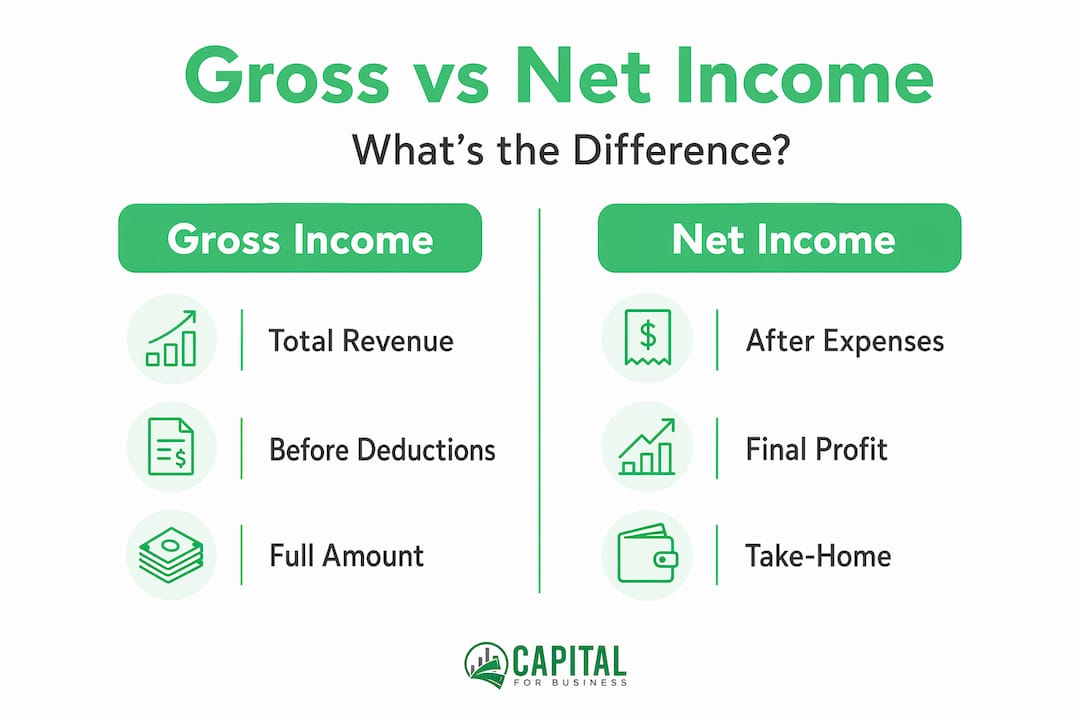
Net profit is the number that actually tells you whether your business is sustainable. Gross revenue can look impressive and still mask a business that is barely breaking even. Lenders and investors know this, which is why they focus on net income when evaluating loan applications or funding decisions.
For self-employed individuals, Schedule C net profit over $400 requires filing with the IRS, and that figure also determines your self-employment tax obligation. Missing deductible expenses does not just inflate your income on paper. It inflates your tax bill in real dollars.
- Track every business expense throughout the year, not just at tax time
- Separate your business and personal accounts to make expense tracking cleaner
- Categorize expenses as they occur to avoid reconstruction errors later
- Review deductible categories specific to your industry with a tax professional
Pro Tip: Failing to deduct legitimate expenses inflates your taxable income and causes you to overpay both income tax and the 15.3 percent self-employment tax. Accurate expense tracking is not optional for freelancers. It is how you keep more of what you earn. Capitalforbusiness recommends reviewing Capitalforbusiness resources on maximizing tax breaks as a starting point.
A closer look at deductions and how they affect your taxes
Understanding how deductions work in practice helps you make smarter decisions about where your money goes. The mechanics matter.

Federal income tax withholding for employees is calculated based on your Form W-4 elections, your filing status, and the IRS tax brackets, which range from 10 to 37 percent. The bracket that applies to each dollar of income is marginal, meaning you do not pay 22 percent on everything you earn if you fall in the 22 percent bracket. You pay lower rates on the first portions of income.
FICA taxes are straightforward but often misunderstood. Social Security is taxed at 6.2 percent, and your employer matches that amount. The Social Security wage cap sits at $168,600 for 2026, meaning earnings above that threshold are no longer subject to this tax. Medicare is taxed at 1.45 percent with no cap, and high earners face an additional 0.9 percent surcharge above certain thresholds. State and local taxes vary by location, with some states having no income tax at all and others applying rates well above 10 percent.
Pre-tax vs post-tax deductions: why timing matters
The order in which deductions are applied to your gross pay has real financial consequences. Pre-tax deductions reduce your taxable income before federal and state taxes are calculated. That means you save taxes on those contributions right now.
Here is how the numbers play out in practice:
- You earn $5,000 in gross pay this month.
- You contribute $500 to a traditional 401(k) pre-tax.
- Your taxable income drops to $4,500.
- Federal income tax, FICA, and state taxes are calculated on $4,500, not $5,000.
- Your take-home pay is higher than if you had contributed $500 after taxes.
A $100 pre-tax contribution might reduce your actual take-home pay by only $70 to $80 because of the tax savings built in. That is a meaningful difference over the course of a year.
Post-tax deductions like Roth 401(k) contributions do not reduce your current taxable income. The benefit comes later when qualified withdrawals in retirement are tax-free. Both options have legitimate uses depending on your current tax bracket and retirement strategy.
| Deduction category | Tax benefit now | Tax benefit at withdrawal |
|---|---|---|
| Traditional 401(k) pre-tax | Yes, reduces taxable income | Withdrawals taxed as ordinary income |
| Roth 401(k) post-tax | No current reduction | Withdrawals tax-free |
| HSA pre-tax | Yes, triple tax advantage | Tax-free for medical expenses |
| Health insurance premium pre-tax | Yes, reduces taxable income | Not applicable |
| Wage garnishment post-tax | No | Not applicable |
Pro Tip: If you are in a high tax bracket now and expect lower income in retirement, traditional pre-tax contributions typically save you more money. If you expect your tax rate to rise over time, Roth contributions make more sense. The choice between them is not just a preference. It is a financial calculation.
Why you should budget from your net income, not your gross
This is where most financial mistakes happen. Budgeting based on gross income overstates your real purchasing power and almost always leads to spending you cannot sustain. Using gross income to budget creates a mental picture of wealth that does not exist once taxes, benefits, and other obligations are subtracted.
Consider a freelancer earning $90,000 in gross revenue. After business expenses, that number might shrink to $65,000 in net profit. After self-employment tax of 15.3 percent on 92.35 percent of net profit, and federal income tax, the actual spendable amount could be closer to $45,000 to $50,000 annually. Planning a lifestyle or business budget around $90,000 when you are working with roughly half that creates serious problems fast.
- Build your monthly budget from your actual average net income, not your highest earning months
- Set aside 25 to 30 percent of every payment you receive for taxes if you are self-employed, before spending anything
- Create a separate savings account for tax reserves and treat it as non-negotiable
- Plan for variable income by calculating your lowest revenue months and budgeting from that floor
- Review your salary budget planning on a quarterly basis to account for income shifts
For freelancers with irregular income, the challenge is even greater. A strong quarter can create false confidence that leads to overspending, followed by a slower quarter that leaves you short on both operating costs and tax obligations. The fix is to calculate a conservative monthly average from the last 12 months of net income and budget from that number consistently.
Pro Tip: Many small business owners carry a mental number in their head that is actually their gross revenue figure. The moment you shift your baseline to net income, your financial stress level drops and your decision-making improves. It is a perspective shift with real financial consequences.
Tools and tracking methods to protect your net income
Accurate income and expense tracking is the foundation of understanding your real net income at any point in the year. Without it, you are guessing. And guessing with your finances tends to be expensive.
Digital tools have made this significantly more manageable for solo operators and small teams. Some of the most practical options include:
- Accounting software: Platforms designed for small businesses allow you to categorize income and expenses, generate profit and loss reports, and export data for tax preparation. These eliminate spreadsheet errors and save time at year-end.
- Expense tracking apps: Mobile apps that sync with your bank accounts or credit cards and automatically categorize spending are especially useful for freelancers who make frequent small purchases throughout the month.
- Payroll tools: If you have employees, payroll software calculates gross-to-net automatically, applies the correct withholdings, and generates pay stubs and year-end W-2 forms without manual calculation.
- Mileage and receipt trackers: Business-related mileage and receipts are deductible, but you need documentation. Apps that log mileage via GPS and let you photograph receipts on the spot make this painless.
The benefits of expense tracking apps extend beyond tax time. Regular tracking gives you a running view of your actual net income, so you always know where you stand financially rather than finding out after the fact.
Accurate tracking also directly reduces your tax bill. Every deductible expense dollar lowers your taxable net income and your self-employment tax. A freelancer who tracks diligently may save thousands more per year than one who reconstructs records at tax time from memory. Capitalforbusiness has put together detailed guidance on tracking business expenses to help you set up a system that works.
For filing purposes, know your thresholds. Self-employed individuals with over $400 in net profit file Schedule C. Business owners with employees manage quarterly payroll tax deposits and annual W-2 filings. Staying current on your tax obligations prevents penalties that eat into the net income you worked hard to protect.
My take on the gross vs net confusion
Working with small business owners and freelancers over many years, I have seen the same pattern repeat itself more often than any other financial mistake. Someone builds their business to a point where gross revenue looks solid, maybe $80,000 or $100,000 a year, and they operate as though that number is real. Then tax season arrives, and the bill is higher than expected. Or a slow month hits and there is nothing left because the budget was built on a gross number that never reflected actual cash availability.
I have found that most people know, on some level, that taxes will take a portion of what they earn. The problem is that this knowledge lives in the background while the gross number drives decisions in the foreground. It is one thing to understand the concept. It is another to actually change how you think and plan.
The uncomfortable truth I have seen play out repeatedly is this: budgeting from gross income is a form of optimism that the financial system does not reward. Budgeting from net income leads to healthier financial management and measurably less stress. The businesses that stay healthy through slow periods and tax seasons are the ones that treat net income as the only number that counts.
My recommendation is practical. Pull your last three months of bank statements. Calculate what actually landed in your account after all deductions and expenses. Build from that number. If the result feels uncomfortable compared to what you thought you were earning, that discomfort is useful information.
— Capital
Funding solutions that fit your actual financial picture
Understanding your true net income changes how you approach funding decisions. When cash flow gaps appear because revenue is seasonal or expenses spike unexpectedly, having the right financing in place matters.

Capitalforbusiness works with small business owners and freelancers every day who need capital that fits their real financial picture, not just their gross revenue. Whether the gap comes from a slow quarter, a growth opportunity, or a tax payment that is larger than expected, there are financing options designed for exactly these situations.
From easy small business loans to merchant cash advances and business lines of credit, Capitalforbusiness connects you with funding that aligns with your actual income structure. The application process is fast, and approvals do not require the same credit history or documentation that traditional banks demand. If you are ready to explore what your business qualifies for, Capitalforbusiness is built to help you take that step with confidence.
FAQ
What is the main difference between gross and net income?
Gross income is your total earnings before any deductions are applied. Net income is what remains after taxes, benefits, and other withholdings are subtracted. For most employees, net pay ranges from 60 to 75 percent of gross pay.
How do I calculate net income as a freelancer?
Start with your total gross revenue, then subtract all allowable business expenses to get net profit. From that figure, apply self-employment tax at 15.3 percent on 92.35 percent of net profit, along with federal and state income taxes, to estimate your actual take-home amount.
What are gross salary deductions I should know about?
The most common gross salary deductions include federal income tax withholding, Social Security tax at 6.2 percent up to the $168,600 cap, Medicare tax at 1.45 percent, state and local income taxes, health insurance premiums, and retirement contributions like 401(k) or HSA deposits.
Why does net profit matter more than gross revenue for my business?
Gross profit measures product performance, but net income shows whether your business is truly profitable after all costs and taxes. Lenders and investors evaluate net income when deciding whether to fund or partner with a business.
Should I budget based on gross or net income?
Always budget from your net income. Building a budget from gross income overstates what you can actually spend and regularly leads to cash shortfalls when tax obligations and expenses come due. Net income is the only figure that reflects your real financial capacity.