
TL;DR:
- Small business owners should compare total repayment amounts and various product options before choosing financing. Capitalforbusiness offers multiple loan types with transparent cost disclosures and flexible repayment terms across the U.S. and Canada. Considering factors like cost, speed, and documentation helps select the best solution for specific cash flow needs.
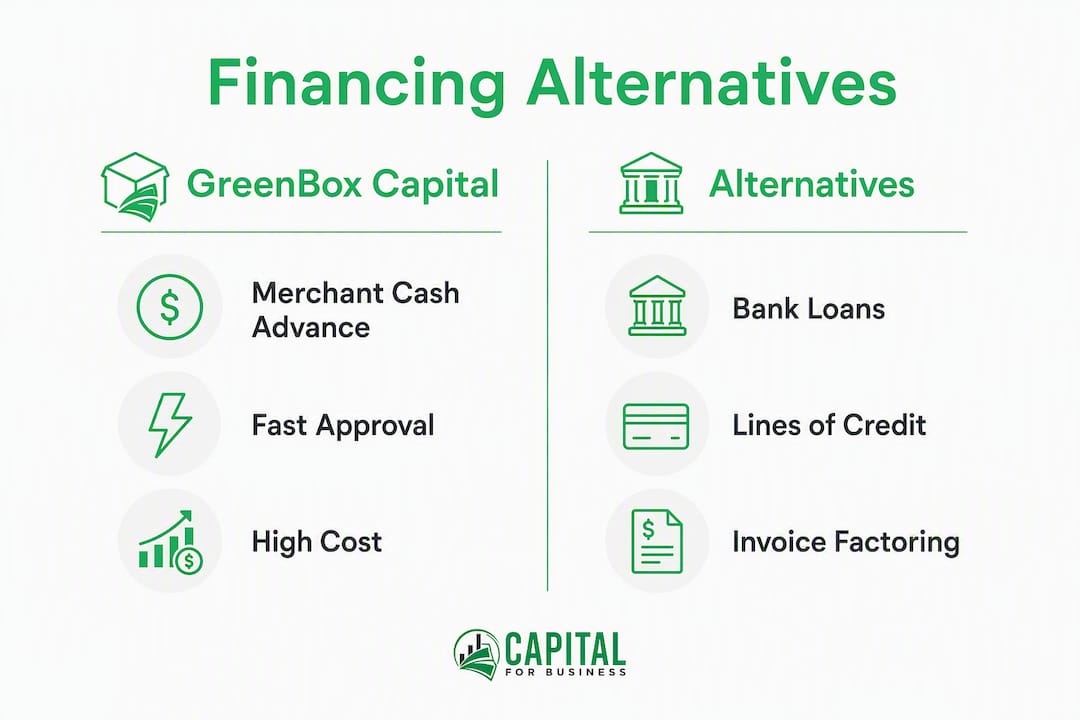
For most small business owners searching for greenboxcapital.com alternatives, the best starting point is a lender that offers multiple product types, transparent total-cost disclosures, and flexible repayment terms. Capitalforbusiness has served small businesses across the U.S. and Canada since 2009, covering working capital loans, lines of credit, merchant cash advances, equipment financing, and SBA loans. Before signing any offer, compare total dollars repaid, not just the weekly payment.
Quick shortlist of alternative financing categories to consider:
- Working capital loans — fixed repayment terms, predictable cost, good for planned expenses
- Merchant cash advances (MCAs) — fast funding (often same-day to 48 hours), repaid as a percentage of daily revenue
- Business lines of credit — draw what you need, pay interest only on what you use
- Invoice factoring / AR financing — converts unpaid B2B invoices into immediate cash without borrowing
- Equipment financing — asset-backed loans tied to the equipment itself, typically lower rates
Authoritative resources to consult throughout your search: the U.S. Small Business Administration (SBA), the Consumer Financial Protection Bureau (CFPB), and Capitalforbusiness.
Table of Contents
- How do GreenBox Capital alternatives compare across product types?
- How do you choose the right financing alternative for your business?
- How do you calculate the real dollar cost of a financing offer?
- Which financing product solves which business problem?
- Key Takeaways
- Why total cost beats speed as the deciding factor
- Capitalforbusiness: a direct alternative with transparent terms
- Useful sources and references
- FAQ
How do GreenBox Capital alternatives compare across product types?
The table below maps the named provider's general profile against common alternative product categories and where Capitalforbusiness fits.
| Category | Best for / use case | Product type | Typical funding speed | Loan amounts | Cost metric | Eligibility / credit | Recourse | Docs required |
|---|---|---|---|---|---|---|---|---|
| GreenBox Capital (general profile) | Quick working capital, thin credit file | MCA / short-term advance | Same-day to 48 hrs | — | Factor rate (typical range) | Low-to-mid credit scores | Recourse (personal guarantee common) | Bank statements, ID |
| Short-term MCA lender | Immediate cash gap, high card volume | Merchant cash advance | 24–48 hours | — | Factor rate; APR can reach 40%–350% | 500+ FICO, 6+ months in business | Recourse | 3–6 months bank/card statements |
| Business line of credit | Recurring working capital needs | Revolving credit | 1–3 business days | $10,000–$500,000 | APR (variable) | FICO score varies | Recourse | Tax returns, financials |
| Invoice factoring | B2B firms with unpaid invoices | AR-based advance | 24–48 hours | Up to invoice value | Factoring fee (1%–5%) | Based on customer credit | Non-recourse options available | Invoices, AR aging report |
| Equipment financing | Buying machinery, vehicles, tech | Secured term loan | 1–5 business days | — | Fixed APR | FICO score varies | Secured by equipment | Invoice, equipment details |
| Capitalforbusiness | Broad needs: cash flow, equipment, growth | Multiple products | Same-day to 5 days | Up to $500,000 | Transparent total-cost modeling | Flexible across credit profiles | Varies by product | Bank statements, basic business docs |
Key takeaways from the table:
- Cost is the most critical row. A low weekly payment on a short-term MCA can still mean a very high total repayment.
- Speed matters most for emergency cash gaps; for planned purchases, a term loan or equipment loan almost always costs less.
- Invoice factoring is non-recourse in many structures, which protects your personal assets.
State-level disclosure laws are raising the bar for transparency. Florida's HB 1353, for example, requires MCA providers to disclose standardized cost fields, making it easier to compare offers side by side. Check whether your state has similar requirements before you sign.
How do you choose the right financing alternative for your business?
Match the product to the job it needs to do. Bridging a payroll gap is a different problem than financing a $90,000 piece of equipment or converting 60-day invoices into cash today.
Decision criteria to weigh:
- Total dollar cost — what you repay in full, not the daily or weekly installment
- Repayment cadence — daily ACH debits hit cash flow harder than monthly payments
- Recourse vs. non-recourse — does a default put your personal assets at risk?
- Effect on cash flow — a holdback percentage on card sales can squeeze operations during slow weeks
- Speed — genuine emergencies justify higher cost; planned needs rarely do
- Accounting integration — does the product sync with QuickBooks or your existing platform?
Understanding how alternative lending works before you apply saves you from comparing products that were never designed for your situation.
Questions to ask every lender before signing:
- What is the total dollar amount I will repay?
- What is the estimated APR or APR-equivalent?
- Is there a prepayment discount, and how is it calculated?
- What is the holdback percentage, and how does it adjust if revenue drops?
- Are there origination fees, processing fees, or renewal fees?
- What documentation do you need, and how long does underwriting take?
- Is the agreement recourse or non-recourse?
Red flags to watch for:
- No clear disclosure of total repayment amount
- Vague or missing prepayment terms
- Pressure to sign within hours
- Factor rate presented without an APR equivalent
Industry guidance consistently recommends exhausting bank and credit union options first, since they typically carry the lowest APRs. When those channels are closed, prepare three to six months of bank statements, your most recent tax return, and a basic business profile before approaching any alternative lender. Most alternative lenders can reach a decision within one to three business days once documents are submitted.
Pro Tip: Before you apply anywhere, check whether your state mandates standardized MCA disclosures. States with disclosure laws give you a ready-made comparison template.

How do you calculate the real dollar cost of a financing offer?
The weekly payment number tells you almost nothing about what a deal actually costs. Total dollars repaid, and the APR equivalent, are the only figures that let you compare offers objectively.
How to convert a factor rate to total repayment and APR:
- Multiply the advance amount by the factor rate to get total repayment. ($10,000 × 1.35 = $13,500)
- Subtract the advance amount to find the total cost. ($13,500 − $10,000 = $3,500)
- Divide total cost by advance amount to get the cost rate. ($3,500 ÷ $10,000 = 35%)
- Divide the cost rate by the repayment term in days, then multiply by 365 to annualize. (35% ÷ 120 days × 365 = ~106% APR)
Worked Example 1: $10,000 advance
- Factor rate: 1.35
- Repayment term: 120 days (daily ACH)
- Total repaid: a calculated amount based on advance and factor rate
- Estimated APR: a high annual percentage rate typical for short-term merchant cash advances
Worked Example 2: $75,000 advance
- Factor rate: 1.28
- Repayment term: 180 days (weekly ACH)
- Total repaid: a calculated amount based on advance and factor rate
- Estimated APR: an estimated annual percentage rate typical for mid-term merchant cash advances
| Example | Advance | Factor rate | Term | Total repaid | Est. APR |
|---|---|---|---|---|---|
| Small deal | $10,000 | 1.35 | 120 days | $13,500 | ~106% |
| Mid-size deal | $75,000 | 1.28 | 180 days | $96,000 | high annual percentage rate |
These are illustrative calculations using the published methodology. MCA factor rates can translate to effective APRs ranging from roughly 40% to 350% depending on structure and term length, which is why the annualized figure matters far more than the factor rate alone.
Pro Tip: A fast approval and a low weekly payment can still mean a very expensive loan. Always run the total repayment math before you compare two offers.
Which financing product solves which business problem?
Match the product to the problem, not the marketing label. A merchant cash advance and an equipment loan are both "business financing," but they solve completely different problems.
- Merchant cash advance — best for businesses with strong card sales that need cash within 48 hours. Avoid it for planned, non-urgent purchases where a term loan would cost far less.
- Invoice factoring / AR financing — the right tool for B2B companies sitting on unpaid invoices. Firms with receivables are often better candidates for invoice-linked products than for short-term advances. Review the mechanics of invoice factoring before deciding.
- Equipment financing — secured by the asset itself, so rates are typically lower than unsecured advances. Use it whenever the purchase is the equipment, not general cash flow.
For operational fit, consider how each product interacts with your accounting software. Invoice factoring requires AR reconciliation; MCAs require daily or weekly ACH tracking. Working capital management becomes significantly easier when your financing product matches your cash-flow cycle.
Key Takeaways
The single most important step when comparing financing options like GreenBox Capital is calculating total dollars repaid, not just the weekly payment, before signing any agreement.
| Point | Details |
|---|---|
| Calculate total cost first | Multiply advance amount by factor rate; annualize to get APR before comparing any two offers. |
| Match product to job | MCAs fit emergency cash gaps; invoice factoring fits B2B receivables; equipment loans fit asset purchases. |
| Get at least two quotes | Market guidance recommends multiple offers and modeling total repayment before committing. |
| Ask for APR disclosure | Always request total $ repaid and estimated APR, not just the daily or weekly payment figure. |
| Capitalforbusiness | Has offered transparent, multi-product financing to U.S. and Canadian small businesses since 2009, up to $500,000. |
Why total cost beats speed as the deciding factor
The financing market rewards lenders who lead with speed. Approvals in hours, funding by tomorrow — these are real advantages when a business genuinely faces an emergency. But the speed pitch has a cost that most business owners only discover after they sign.
What the conventional wisdom misses is that most small business financing decisions are not true emergencies. A restaurant owner who needs a new walk-in cooler, a contractor who wants to bridge a 45-day payment gap, a retailer stocking up for a seasonal push — none of these are situations where paying a 106% APR equivalent is justified. They feel urgent, but they are plannable.
Capitalforbusiness has worked with business owners across hundreds of industries since 2009, and the pattern is consistent: the owners who compare total repayment across two or three offers before signing almost always find a materially better deal. The owners who sign the first fast approval often spend the next six months managing a cash-flow squeeze caused by daily ACH debits they underestimated. Speed is a feature. Total cost is the product.
Capitalforbusiness: a direct alternative with transparent terms
Capitalforbusiness offers small business owners a practical path to funding without forcing you into a single product type. Since 2009, the team has matched businesses across the U.S. and Canada to the right product for their situation, whether that is a working capital loan, a merchant cash advance, a line of credit, or equipment financing up to $500,000.
What Capitalforbusiness brings to the comparison:
- Transparent total-cost modeling so you see total $ repaid before you commit
- Multiple product types matched to your specific cash-flow need
- Flexible repayment structures, including options that adjust with revenue
- Industry-specific experience across hundreds of business categories
- U.S. and Canada coverage, with typical funding in one to five business days
To apply, prepare three to six months of bank statements, your most recent business tax return, and basic business identification. Decisions typically come within one to three business days. Explore the full range of small business loan types Capitalforbusiness offers, then apply directly at capitalforbusiness.net to get a concrete quote you can compare against any other offer on the table.
Still compare at least two offers and run the total repayment math on each before you sign.
Useful sources and references
- U.S. Small Business Administration (SBA) — loan programs, lender directory, and eligibility guidance
- Consumer Financial Protection Bureau (CFPB) — small business lending rights and complaint resources
- Federal Trade Commission (FTC) — guidance on deceptive financing practices
- CB Insights: GreenBox Capital alternatives — competitive landscape overview
- MCA Guide: GreenBox Capital profile — state disclosure law context, including Florida HB 1353
- Platinum Capital Advisors: commercial loan qualification — external checklist for lender qualification criteria
State disclosure requirements vary. Check your state's Department of Financial Institutions or equivalent agency to confirm whether standardized MCA disclosure fields are mandated in your market.
FAQ
What are the best alternatives to GreenBox Capital for small businesses?
The strongest alternatives depend on your specific need. Capitalforbusiness offers working capital loans, lines of credit, MCAs, and equipment financing up to $500,000 across the U.S. and Canada, with transparent total-cost disclosures.
How do I convert a factor rate to an APR?
Multiply the advance by the factor rate to get total repayment, subtract the principal to find the cost, divide by principal, then divide by term days and multiply by 365. A $10,000 advance at a 1.35 factor rate over 120 days equals roughly 106% APR.
What documents do I need to apply for alternative financing?
Most alternative lenders require three to six months of bank statements, a recent business tax return, and basic business identification. Some products, like invoice factoring, also require an AR aging report.
When is invoice factoring better than a merchant cash advance?
Invoice factoring fits B2B businesses with unpaid invoices; it converts receivables into cash without adding debt. An MCA fits businesses with high card-sales volume that need cash within 24–48 hours.
What red flags should I watch for with any alternative lender?
No disclosure of total repayment amount, missing prepayment terms, and pressure to sign within hours are the three most common warning signs. Always ask for total $ repaid and an estimated APR before committing.