
TL;DR:
- A funding pipeline is a structured process that small businesses use to secure financing from research to closing deals. Businesses that treat funding as an ongoing system maintain relationships and diversify sources, enabling consistent capital access. Managing pipeline stages, diversifying funders, and balancing prospects help small businesses avoid cash gaps and grow steadily.
A funding pipeline is a structured process that moves a small business from identifying financing opportunities to closing deals and receiving capital. Most business owners treat funding as a one-time event. The ones who grow consistently treat it as an ongoing system. Understanding funding sources, managing outreach, and tracking deals at every stage separates businesses that scale from those that stall.
What is explaining funding pipelines and why does it matter?
A funding pipeline is the industry term for the full sequence of steps a business takes to secure financing, from the first research phase through signed agreements and funded accounts. The concept borrows from sales pipeline thinking. Just as a sales team tracks leads, proposals, and closed deals, a funding pipeline tracks prospects, active applications, pending decisions, and awarded capital.
For small business owners, explaining funding pipelines means understanding that capital does not arrive in a single conversation. It arrives at the end of a process that requires preparation, consistent outreach, and active follow-up. Businesses that skip pipeline thinking often face cash gaps because they only start looking for money when they need it urgently.
The funding sources that feed a pipeline vary widely. Venture capital, Small Business Administration loans, bank credit lines, equipment financing, merchant cash advances, and federal or foundation grants all represent distinct pipeline tracks. Each has different timelines, requirements, and conversion rates. A well-managed pipeline includes multiple tracks running at the same time.
What stages make up a typical funding pipeline?
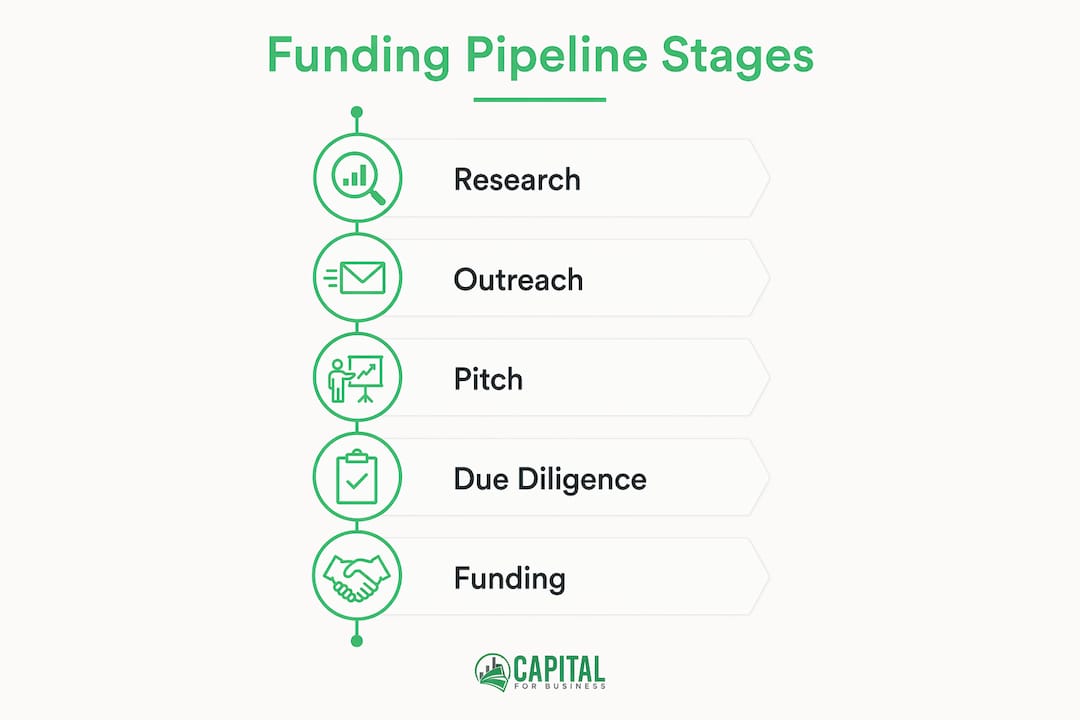
The funding process explained in practical terms follows five clear stages. Each stage has a defined purpose, and skipping one creates problems downstream.
-
Research and targeting. Identify which funding sources match your business stage, industry, and capital need. For equity investors, this means building a list of venture capital firms or angel investors whose portfolio focus aligns with your sector. For debt financing, this means comparing lenders by loan size, rate, and speed. For grants, it means matching your mission and geography to funder priorities.
-
Outreach and introduction. Contact funders through the most effective channel available. Warm introductions convert 3–5 times better than cold outreach. That gap matters enormously when you are trying to get meetings. Tap your network, advisors, and existing investors to make introductions before sending cold emails.
-
Pitch and application. Present your business through a pitch deck, loan application, or grant proposal. The format depends on the funding type, but the goal is the same: demonstrate that your business is creditworthy, your plan is sound, and the funder's capital will be put to productive use.
-
Due diligence and review. Funders verify your financials, legal structure, and business history. For equity deals, this stage can take 2–4 weeks. For SBA loans, it can take longer. For grants, review committees meet on fixed schedules. Delays here are normal. Stalling here without follow-up is a mistake.
-
Closing and funding. Agreements are signed, and capital is transferred. For equity deals, a term sheet signals progress but is non-binding. Legal review and final closing take an additional 2–4 weeks. Many deals stall between term sheet and closing due to legal complications, so experienced legal counsel is worth the cost.
The full fundraising timeline from first outreach to funded account typically spans 3–6 months. The active raise phase, meaning pitches and meetings, takes 6–12 weeks. Preparation takes 2–4 weeks before that. Business owners who underestimate this timeline often run out of runway before closing.
Pro Tip: Stagger your outreach over several weeks rather than contacting every prospect at once. This keeps your pipeline active across multiple stages simultaneously and prevents the momentum drop that happens when all your conversations hit the same wall at the same time.
How to choose and diversify funding sources
Choosing the right mix of funding sources is as important as the outreach itself. Relying on a single funder or a single funding type creates fragility. If that source falls through, your entire pipeline collapses.

The debt versus equity trade-off is the first decision most business owners face. Debt financing, such as term loans or lines of credit, preserves ownership but requires steady cash flow to service. Equity financing brings in capital without monthly payments but dilutes your ownership stake. Neither is universally better. The right choice depends on your cash flow, growth stage, and how much control you want to retain. For a deeper look at this decision, Capitalforbusiness covers the debt vs. equity trade-offs in detail.
For businesses that pursue grants, a proven diversification guideline recommends allocating roughly 30% to federal sources, 30% to foundation grants, 30% to individual donors or earned revenue, and 10% to reserves. No single funder should represent more than 25% of your total budget. That ceiling protects you if one source reduces or eliminates its funding.
Here is a practical comparison of common funding types for small businesses:
| Funding type | Speed | Ownership impact | Cash flow requirement | Best for |
|---|---|---|---|---|
| Bank term loan | Moderate | None | High | Established businesses |
| SBA loan | Slow | None | Moderate | Growth and expansion |
| Merchant cash advance | Fast | None | Revenue-based | Short-term working capital |
| Equipment financing | Fast | None | Low to moderate | Asset purchases |
| Venture capital | Slow | High dilution | Low | High-growth startups |
| Grants | Slow | None | None | Nonprofits and qualifying businesses |
A healthy pipeline tracks three categories at once: prospects you are researching, active deals in progress, and awards or loans already closed. Pipeline health depends on balance across all three. Too many prospects with no active deals means you are doing research without execution. An empty prospect stage means future funding gaps are already forming.
- Keep 5–10 prospects in active research at any given time.
- Maintain 8–15 active applications or conversations in progress.
- Track closed awards separately to monitor your funding mix over time.
Pro Tip: Treat your funding sources the way you treat your customer base. Diversify across types and funders so that losing one does not threaten your operations. A diversified funding approach is the single most effective way to protect your business from cash flow disruptions.
What common challenges impact funding pipelines?
The most common pipeline problem is not rejection. It is imbalance. Business owners either flood the top of the pipeline with prospects they never follow up on, or they focus so hard on one active deal that they neglect building new prospects. Both patterns create gaps.
- Low meeting conversion. Founders typically need to target 100–150 investors to produce 1–3 term sheets. That ratio surprises most first-time fundraisers. Expecting a high conversion rate from a short list leads to early discouragement and pipeline abandonment.
- Stalled deals after term sheets. A signed term sheet feels like a finish line. It is not. Legal review, due diligence, and final documentation can take weeks. Deals stall most often in this phase, and business owners who stop outreach after receiving a term sheet are left with nothing if the deal falls apart.
- Timing mismatches. Less than half of venture capital firms are actively writing new checks at any given time. Fund deployment pace, LP mandates, and portfolio concentration all affect whether a firm can invest, regardless of how strong your business is. Rejection often reflects timing, not quality.
- Neglecting pipeline velocity. Deal velocity is the speed at which prospects move through your pipeline. Slow velocity signals that deals are stalling. Tracking it helps you identify which funders are genuinely interested and which are stringing you along.
Pro Tip: Treat fundraising exactly like a sales process. Set weekly outreach targets, schedule follow-up calls, and move deals through stages on a defined timeline. Passive waiting is the fastest way to lose a deal that was already in progress.
What practical steps build and manage a funding pipeline?
Building a funding pipeline from scratch follows a clear sequence. Each step builds on the one before it.
-
Define your funding need. Determine how much capital you need, what you will use it for, and how long it needs to last. Funding rounds that provide 18–24 months of runway give your business enough time to hit meaningful milestones without forcing premature follow-on raises. Less than 18 months creates pressure that leads to poor decisions.
-
Build a tiered target list. Organize your prospects into three tiers. Tier 1 includes your strongest matches, funders whose focus, size, and stage align closely with your business. Tier 2 includes good fits with some misalignment. Tier 3 includes long shots worth tracking but not prioritizing. Start outreach with Tier 1 and work down as you gather feedback.
-
Warm up introductions before outreach. Ask advisors, existing investors, or professional contacts to introduce you to Tier 1 prospects. Startups using warm introductions close funding rounds approximately 40% faster than those relying on cold outreach alone. That speed advantage compounds when you are managing a timeline.
-
Prepare your pitch materials. Your pitch deck, financial model, and executive summary should be ready before you contact anyone. Funders move quickly when they are interested. Being unprepared when a funder asks for materials is a credibility problem that is hard to recover from. For practical guidance on pitching, Capitalforbusiness offers tips for pitching investors that apply across funding types.
-
Manage inbound interest carefully. When funders reach out to you, respond promptly and qualify their interest early. Ask about their current deployment pace, check size, and portfolio focus. Not every interested funder is the right fit, and spending weeks in conversations with a misaligned investor costs you time you could spend on better prospects.
-
Track every deal in a simple system. A spreadsheet with columns for funder name, contact, stage, last contact date, and next action is enough. The goal is visibility. You need to know at a glance where every deal stands so you can prioritize follow-ups and identify stalled conversations before they go cold.
Most venture capital funds invest in 20–35 companies over a 3–4 year deployment period. That pace means any given fund has limited capacity at any given time. Understanding how funders operate helps you time your outreach and set realistic expectations for conversion.
Key takeaways
A well-managed funding pipeline is the most reliable way for small business owners to secure capital consistently, combining diversified sources, disciplined outreach, and active deal tracking.
| Point | Details |
|---|---|
| Pipeline stages matter | Move deals through research, outreach, pitch, due diligence, and closing in sequence. |
| Diversify funding sources | No single funder should exceed 25% of your total budget to reduce risk. |
| Volume drives term sheets | Targeting 100–150 prospects typically produces only 1–3 term sheets. |
| Warm introductions accelerate deals | Warm intros close rounds roughly 40% faster than cold outreach alone. |
| Runway targets protect execution | Aim for 18–24 months of runway per funding round to hit milestones without pressure. |
What I have learned from watching small business owners build funding pipelines
Working with business owners across hundreds of industries since 2009, Capitalforbusiness has seen the same mistake repeated more than any other: treating funding as a reaction instead of a system. A business hits a slow quarter, cash gets tight, and suddenly the owner is scrambling to find capital under pressure. That is the worst possible time to start building a pipeline.
The business owners who grow steadily are the ones who start building their pipeline before they need the money. They maintain relationships with lenders, keep their financials current, and stay aware of grant cycles and loan programs relevant to their industry. When an opportunity appears, they are ready to move.
The second pattern worth noting is overconfidence after a term sheet. Experienced founders know that a term sheet is a signal, not a guarantee. The period between signing and closing is where deals die. Keeping your pipeline active during that window is not pessimism. It is discipline.
The third observation is about runway. A funded runway of 18–24 months does not just keep the lights on. It creates the conditions where good decisions get made. Businesses operating on 60 days of cash make desperate choices. Businesses with 18 months of runway make strategic ones.
Build the pipeline before you need it. Keep it balanced. Never stop adding prospects to the top, even when deals are closing at the bottom.
— Capital
How Capitalforbusiness supports your funding pipeline
Capitalforbusiness has worked with small business owners across the country since 2009, providing financing when traditional banks say no. Whether you need working capital to cover a slow season, equipment financing to take on a larger contract, or a merchant cash advance to move quickly on an opportunity, the funding options are built around your timeline, not a bank's.

Capitalforbusiness offers business funding up to $500,000 with a fast application process and decisions that do not take weeks. For business owners who want to see the full range of options available, the small business loan types page covers everything from term loans to lines of credit. If your credit is not perfect, funding options for lower credit scores are also available. The right funding source for your pipeline is closer than you think.
FAQ
What is a funding pipeline in simple terms?
A funding pipeline is the structured process a business uses to identify, pursue, and close financing opportunities. It organizes funding sources into stages from initial research through signed agreements and received capital.
How long does the funding process take for small businesses?
The full fundraising process typically spans 3–6 months from first outreach to funded account, with the active pitch phase taking 6–12 weeks. Loan-based funding through lenders like Capitalforbusiness can move significantly faster.
How many funding prospects should a small business target?
Founders typically need to contact 100–150 prospects to generate 1–3 term sheets when pursuing equity funding. For loan-based pipelines, the volume is lower, but comparing multiple lenders still produces better terms.
What is the biggest risk in a funding pipeline?
The biggest risk is pipeline imbalance, specifically having too many prospects with no active deals, or focusing entirely on one deal while neglecting new prospects. Both patterns create funding gaps that are hard to recover from quickly.
Should a small business use debt or equity financing?
Debt financing preserves ownership but requires consistent cash flow for repayment. Equity financing eliminates monthly payments but dilutes ownership. Most small businesses benefit from debt-based options like term loans or lines of credit unless they are pursuing high-growth venture-backed models.