
The most reliable examples of expansion strategies for florists are subscriptions (working capital), weddings and events (revenue-based financing or short-term loan), corporate accounts (business line of credit), e-commerce (working capital), delivery expansion (equipment financing), workshops (low-capital, working capital), wholesale partnerships (line of credit), pop-ups and kiosks (merchant cash advance), and giftware add-ons (working capital). Capitalforbusiness has funded florist growth across all of these channels since 2009, and the SBA recognizes floral retail as a qualifying small business category for term loans and microloans.
Quick capital match by strategy:
- Subscriptions: Low capital. Working capital loan. Timeline to revenue: 1–3 months.
- Weddings and events: Medium–high. Revenue-based financing or short-term loan. 3–9 months.
- Corporate accounts: Low–medium. Business line of credit. 1–3 months.
- E-commerce: Low–medium. Working capital. 1–2 months.
- Delivery expansion: Medium. Equipment financing (van, cooler). 1–3 months.
- Workshops and classes: Low. Working capital. 1–2 months.
- Wholesale partnerships: Low–medium. Line of credit. 1–3 months.
- Pop-ups and kiosks: Low–medium. Merchant cash advance. 1–2 months.
- Giftware and merch add-ons: Low. Working capital. 1–2 months.
Table of Contents
- What are the best expansion strategies for florists?
- How do you pick the right financing for your expansion?
- Are your operations ready to scale?
- When should you use financing: proactive vs. reactive?
- What do expansion moves actually cost in the U.S. market?
- Real-world florist expansion scenarios
- Key Takeaways
- What Capitalforbusiness has seen work for florists
- Capitalforbusiness funds florist growth at every stage
- Useful sources
- FAQ
What are the best expansion strategies for florists?
More than half of U.S. floral sales now originate online, which makes e-commerce not just a growth channel but a financial stabilizer. That single fact shapes how you should prioritize the list below.
Subscriptions and recurring boxes
Weekly or monthly curated deliveries create predictable income and better inventory forecasting. The downside is subscriber churn if variety fades. Working capital covers the upfront stem inventory before subscription fees clear.
Weddings and events
High average order value, but extreme upfront COGS and labor. A single wedding can require several thousand dollars in flowers before the client pays. Revenue-based financing or a short-term loan can help cover that gap. Client deposits help, but rarely cover full material costs.
Corporate accounts and B2B contracts
Weekly lobby arrangements and office deliveries generate reliable recurring revenue with low marketing cost per order. A business line of credit handles the timing gap between delivery and net-30 invoice payment.
E-commerce and website optimization
Pre-orders and online subscriptions provide ZIP-code-level demand data that sharpens your buying decisions. A working capital loan funds the initial inventory build and paid search campaigns to drive traffic.
Delivery expansion
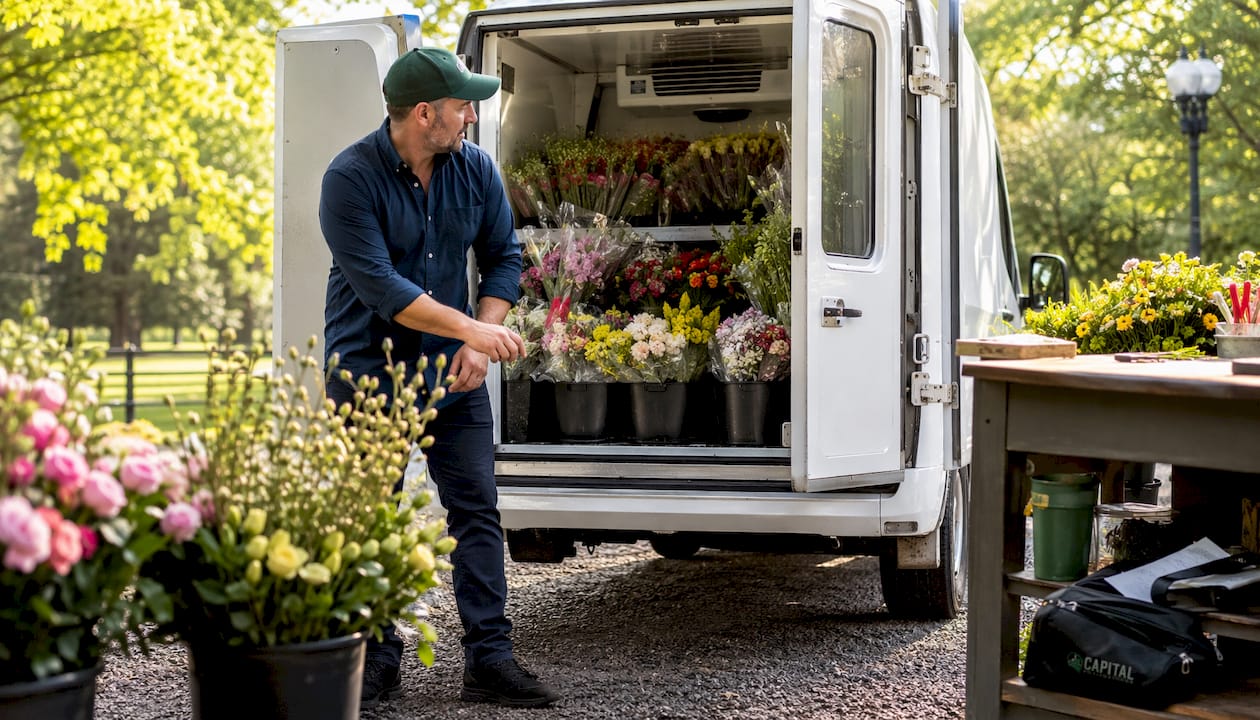
Adding a second delivery zone or same-day service requires a reliable vehicle and possibly a second cooler. Equipment financing covers both, with the asset itself serving as collateral.
Workshops and classes
Low overhead, high margin. A single evening class with 10 participants at $75 each generates $750 with minimal material cost. Working capital covers supplies and marketing.
Wholesale and retail partnerships
Supplying grocery stores, hotels, or event venues at volume requires consistent inventory and reliable delivery. A line of credit smooths the gap between purchase and payment.
Pop-ups and kiosks
Farmers markets, holiday pop-ups, and airport kiosks test new markets with low lease commitment. A merchant cash advance funds the setup and initial inventory, with repayment tied to card sales.
Giftware and merch add-ons
Candles, vases, and gift bundles increase average order value without adding design labor. Working capital covers the initial product buy.
| Strategy | Capital Required | Time to Revenue | Upfront vs. Ongoing | Risk / Cash Flow | Best Financing |
|---|---|---|---|---|---|
| Subscriptions | Low–Medium | 1–3 months | Upfront inventory; ongoing fulfillment | Low–Medium | Working capital |
| Weddings/Events | Medium–High | 3–9 months | High upfront COGS | High | Revenue-based financing |
| Corporate accounts | Low–Medium | 1–3 months | Low upfront; ongoing delivery | Low | Line of credit |
| E-commerce | Low–Medium | 1–2 months | Upfront site/ads | Medium | Working capital |
| Delivery expansion | Medium | 1–3 months | High upfront (vehicle/cooler) | Medium | Equipment financing |
| Workshops | Low | 1–2 months | Low upfront | Low | Working capital |
| Wholesale partnerships | Low–Medium | 1–3 months | Moderate upfront inventory | Medium | Line of credit |
| Pop-ups/Kiosks | Low–Medium | 1–2 months | Low upfront | Low–Medium | Merchant cash advance |
| Giftware/Merch | Low | 1–2 months | Upfront product buy | Low | Working capital |
Stat to know: High-growth florists use short-term financing and integrated POS systems to align inventory purchases with confirmed demand and reduce perishable waste.
How do you pick the right financing for your expansion?
The core decision comes down to two variables: how long until you see revenue, and how predictable that revenue is. Match those to the right product.
Decision matrix:
- Predictable, recurring revenue (subscriptions, corporate accounts): line of credit or working capital. Draw when needed, repay as invoices clear.
- Seasonal spikes (Valentine's Day, Mother's Day, holidays): merchant cash advance or revenue-based financing. Repayment scales with sales volume.
- Large asset purchases (cooler, van): equipment financing. Fixed payments, asset as collateral.
- Multi-year buildouts or real estate: SBA loan or business term loan. Longer amortization, lower monthly pressure.
Questions to ask any lender before signing:
- How fast does funding arrive after approval?
- Is repayment fixed or tied to daily/weekly revenue?
- Are there prepayment penalties?
- Are there restrictions on how proceeds can be used?
- What is the total cost of capital (factor rate or APR)?
Lender selection checklist:
- Gather 3–6 months of bank statements and your most recent tax return before you apply.
- Run a simple cashflow test: can your projected weekly revenue cover the repayment amount with at least 20% left over?
- Compare total cost of capital across at least two products, not just the monthly payment.
- Confirm the lender funds your specific use case (inventory, equipment, or buildout).
- Have a contingency plan: if revenue comes in 20% below forecast, can you still service the debt?
Capitalforbusiness walks owners through this process and can match you to the right product quickly. The benefits of working capital guide covers the seasonal inventory use case in detail.
Are your operations ready to scale?
Successful expansion works best when focused on 2–3 operational priorities rather than trying to fix everything at once. Before deploying capital, confirm these controls are in place:
- Pricing and stem counts: Set fixed stem counts per menu price point and hold designers accountable. Overstuffing arrangements is one of the most common profitability drains in growing shops.
- COGS benchmarking: Track cost per arrangement bi-weekly. Margins erode quietly without this discipline.
- Cold chain: Maintain cooler temperature at 34–38°F. Every degree of variance shortens vase life and increases waste.
- POS and inventory integration: A modern POS that syncs with your e-commerce site eliminates double-entry and gives you real demand data.
- Staffing and training: Event work requires trained staff weeks before the event, not the day before.
- Delivery routing: Optimize routes before adding zones. Inefficient routing erodes delivery margin fast.
- Supplier contracts: Direct farm sourcing can extend vase life by 3–4 days and reduce acquisition costs by roughly 40–50% versus traditional wholesalers.
Pro Tip: Automate order confirmations, subscription billing, and inventory reorder triggers first. These three tasks consume disproportionate staff time and are the lowest-risk automation wins. A POS with integrated e-commerce (Square or Shopify) handles all three without custom development.
Before scaling, also confirm your business license covers your new delivery zones, your vehicle is properly insured for commercial use, and any contracted events carry event liability coverage.
When should you use financing: proactive vs. reactive?
The most successful florist operators treat financing as a strategic tool, not a last resort. Waiting until you are in a cash crunch means paying higher rates and accepting worse terms.
The practical timing rule: secure a line of credit in Q4 so it is available when Valentine's Day inventory opens in January. Draw on it to pre-buy stems at better prices, then repay it from February sales. The same logic applies to Mother's Day (secure in March, draw in April) and holiday season (secure in September).
When each product fits best:
- Equipment financing: When you need a cooler or delivery van and want fixed monthly payments.
- SBA or term loan: When you are building out a second location or signing a multi-year lease.
- Merchant cash advance or revenue-based financing: When you need fast capital for a holiday inventory spike and can repay from card sales over 3–6 months.
- Line of credit: When your cash flow is seasonal and you need flexible draw-and-repay access year-round.
Key insight: Florists who use financing proactively sign up for credit access before peak season so they can deploy funds exactly when inventory opens and marketing investment yields the highest return.
For practical guidance on getting the most from short-term capital, the short-term financing goals resource covers draw timing and repayment planning.
What do expansion moves actually cost in the U.S. market?
| Expansion Move | Typical Capital Range | Implementation Timeline | Notes |
|---|---|---|---|
| Subscription pilot (10–30 subscribers) | $6,000 | 1–3 months | Inventory + billing setup |
| Local delivery expansion | $18,000 | 1–2 months | Vehicle, routing software |
| Events/weddings scaling | $10,000–$40,000 | 3–9 months | Inventory, labor, deposits |
| Walk-in shop build-out | — | 3–6 months | Cooler, plumbing, signage |
| Equipment (cooler or van) | — | 1–3 months | Equipment financing available |
| Wholesale or pop-up launch | — | 1–3 months | Inventory + display setup |
Budget a 6–8 week working capital cushion for payroll and inventory during any seasonal peak. These ranges reflect U.S.-based suppliers and typical small business scale; costs vary by market and build-out scope.
Absentee ownership of a second location generally requires at least $600,000 in annual revenue to support a local manager and preserve owner profit. Below that threshold, the economics rarely justify the model.
Real-world florist expansion scenarios
Scenario 1: Subscription pilot
A florist with steady walk-in traffic decides to launch a weekly subscription for 20 local households. She uses a $6,000 working capital draw to pre-buy two weeks of stem inventory and set up automated billing through her POS. Within 60 days, recurring subscription revenue covers the repayment. The key operational change: fixed weekly stem counts per subscription tier, enforced before any arrangement is built.
Scenario 2: Scaling weddings and events
A mid-size shop books three weddings in one month, each requiring $4,000–$6,000 in upfront flowers. The owner uses a revenue-based advance of $18,000, repaid as a percentage of daily card sales over four months. Client deposits reduce the net draw needed. The funding workflow: advance approved in 48 hours, stems ordered within the week, events fulfilled, repayment completes before the next peak.
Scenario 3: Multi-location growth
Danny Sanchez grew one of South Florida's largest floral operations through strategic acquisitions, using SBA loans to fund purchases and equipment financing to upgrade each acquired location. The French Florist franchise model offers a parallel path: staged expansion through corporate test stores, then acquisitions and conversions, supported by predictive analytics and direct farm sourcing. Both approaches require long-term term loan financing and a clear revenue threshold before adding management overhead.
Key Takeaways
The most effective florist growth strategy pairs a specific revenue channel with the financing product that matches its cash flow timing and capital requirement.
| Point | Details |
|---|---|
| Match financing to cash flow | Subscriptions and corporate accounts suit lines of credit; holiday spikes suit merchant cash advances. |
| Fix operations before scaling | Enforce stem counts, benchmark COGS bi-weekly, and automate billing before deploying growth capital. |
| Use financing proactively | Secure a line of credit in Q4 before Valentine's Day inventory opens, not after the crunch hits. |
| Know your scale threshold | Absentee multi-location ownership typically requires $600,000+ in annual revenue to remain profitable. |
| Capitalforbusiness as funding partner | Capitalforbusiness has matched florists to working capital, equipment financing, and merchant cash advances since 2009. |
Next steps for the next 30 days:
- Run a bi-weekly COGS check on your three highest-volume arrangements.
- Identify one expansion channel from the table above that fits your current revenue base.
- Contact Capitalforbusiness to check eligibility and review product options before your next peak season.
What Capitalforbusiness has seen work for florists
Since 2009, Capitalforbusiness has worked with florists across the U.S. and Canada to fund subscriptions, event scaling, equipment purchases, and multi-location growth. The typical workflow: a short application, bank statement review, and funding in as little as 24–48 hours for working capital or merchant cash advance products. For equipment financing, the asset itself serves as collateral, which makes approval more accessible than a general loan. The flower shop expansion guide and the equipment financing workflow walk through each step in detail. Check your eligibility at Capitalforbusiness to start the conversation before your next peak season.
Capitalforbusiness funds florist growth at every stage
Florists who plan their expansion carefully still need capital that moves as fast as their busiest week. Capitalforbusiness offers the full product range florists actually need: working capital loans for inventory and subscriptions, a business line of credit for corporate account timing gaps, merchant cash advances for holiday spikes, equipment financing for coolers and delivery vans, and SBA-style term loans for buildouts and acquisitions.
Every product is available without the delays that come with traditional bank applications. Capitalforbusiness has funded small businesses in hundreds of industries since 2009, and the process is built for owners who need answers quickly. Check your funding options today and have capital in place before your next peak season opens.
Useful sources
- How To Manage Costs, Cash Flow And Growth In A Challenging Market — Florists' Review: financing timing, POS integration, and proactive credit use for florists.
- Plan to Grow Florist Retail Business — Hana Florist POS: operational focus areas and the case for limiting priorities during growth phases.
- 7 Smart Ways Florists Can Thrive in 2026 — Rio Roses: workflow automation and protecting creative capacity while scaling.
- Building a Flower Shop Empire with Kyle Brown — SMB15 Substack: direct farm sourcing economics, COGS benchmarking, stem-count discipline, and absentee ownership thresholds.
- French Florist Franchise Model — Franchise Brief: staged expansion, predictive analytics, and direct sourcing as an illustrative multi-location model.
- EP35: Danny Sanchez on Acquisition-Led Growth — Invest & Scale: SBA loan use and acquisition strategy for scaling a floral operation.
- Funding for Flower Shop Expansion: A 2026 Guide — Capitalforbusiness: product-matched funding workflows for florists.
- Marketing Automation Checklist for SMBs — Babylove Growth: step-by-step automation checklist for marketing workflows that support subscription and event growth.
FAQ
What financing works best for a florist starting a subscription service?
Working capital is the most practical fit. It covers the upfront stem inventory before subscriber payments clear, and repayment aligns with the recurring revenue the subscriptions generate within 1–3 months.
How much capital does a florist need to scale weddings and events?
A single wedding typically requires $3,000–$8,000 in upfront flowers and labor. Florists scaling to multiple events per month often need $10,000–$40,000 in short-term financing, funded through revenue-based advances or short-term loans.
When should a florist apply for a line of credit?
Apply in Q4, before Valentine's Day inventory opens. Securing access before the peak means you draw at better terms and can pre-buy stems at favorable prices rather than paying spot rates under pressure.
Can a florist qualify for an SBA loan to open a second location?
Yes. SBA loans are available to qualifying floral retail businesses and suit multi-year buildouts or acquisitions. Absentee ownership of a second location generally requires at least $600,000 in annual revenue to support the added management cost.
How does Capitalforbusiness help florists access funding?
Capitalforbusiness matches florists to working capital, merchant cash advances, equipment financing, lines of credit, and SBA-style term loans, with funding available in as little as 24–48 hours for qualifying applicants.
This article is general information for educational purposes and does not constitute financial or legal advice. Confirm current rates, eligibility requirements, and regulatory obligations with a qualified professional or the relevant primary source for your situation.