
TL;DR:
- Securing trade business financing requires comprehensive credit evaluation beyond just a credit score, including cash flow, payment history, and business stability. Building a strong business credit profile involves obtaining a D-U-N-S number, reporting trade accounts, and maintaining timely, early payments, which can improve approval chances and loan terms. The 2026 SBA policy shift mandates manual credit reviews and narrative explanations, emphasizing the importance of proactive credit management and ongoing risk monitoring.
Securing financing as a trade business owner means more than showing up with a credit score and hoping for the best. Credit evaluation for trade businesses has grown considerably more detailed, and lenders are now looking at a broader picture of financial health, payment behavior, and business stability. The 5 Cs of credit have always mattered, but the standards for how they are measured shifted again in 2026 with major SBA policy updates. Understanding what lenders examine before they approve or deny your application puts you in a far stronger position to act on that knowledge.
Table of Contents
- Key takeaways
- Core components of credit evaluation for trade businesses
- Building a strong business credit profile
- Monitoring ongoing trade credit risk
- How 2026 SBA changes affect your loan applications
- My perspective on what trade businesses get wrong
- How Capitalforbusiness supports your financing goals
- FAQ
Key takeaways
| Point | Details |
|---|---|
| Credit score alone is not enough | Lenders assess cash flow, payment history, liens, and business stability alongside your score. |
| D-U-N-S number is your starting point | Without a Dun & Bradstreet profile, your business has no commercial credit file regardless of how long you've operated. |
| SBA now requires manual review | As of March 2026, all 7(a) small loan applicants must pass a manual credit analysis with a minimum 1.1x DSCR. |
| Monitor risk continuously | A trade credit assessment older than 18 months reflects history, not your current risk profile. |
| Early payments build credit faster | Paying before the due date actively raises your Paydex score above 80, signaling low risk to lenders and suppliers. |
Core components of credit evaluation for trade businesses
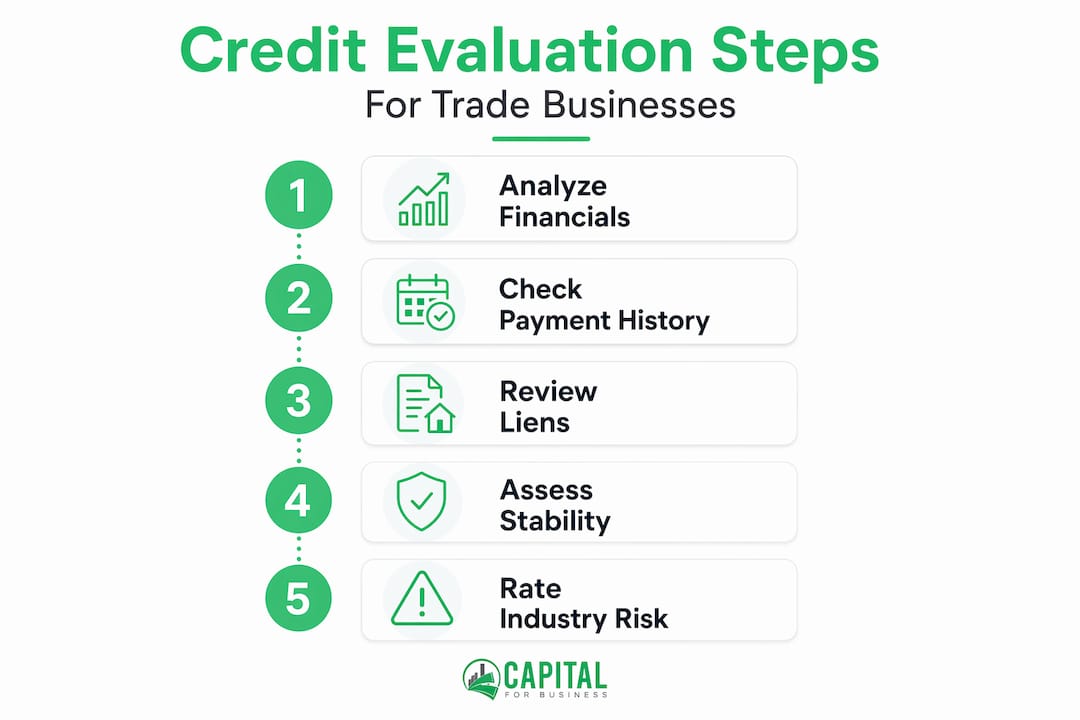
When a lender or supplier evaluates your trade business for credit, they are not running a single check and calling it done. Credit evaluation for trade businesses involves layering several data sources together to form a full picture. Here is what each of those layers looks at.
Financial statement analysis
Your financial statements tell a lender whether your business generates enough cash to service debt. The focus is on cash flow first, then debt load, and finally liquidity. A business that shows strong revenue but weak operating cash flow raises immediate concerns. Lenders want to see that your business produces cash consistently, not just on paper during good months.
Debt load matters because it tells the lender how much of your income is already committed to existing obligations. Liquidity measures whether you could cover short-term payments without selling assets. All three factors are reviewed together, and a weakness in any one of them demands explanation.
Payment history and trade references
Your history of paying suppliers and vendors is one of the most direct signals of how you will handle new credit. Lenders pull data from commercial bureaus and request trade references to verify payment patterns. Consistent on-time or early payments signal reliability. Late payments, even occasional ones, raise questions about cash management.
Pro Tip: Contact your top vendors and ask them to report your payment history to commercial bureaus if they do not already. Many small suppliers do not report automatically, and unreported good payment history is wasted credit-building opportunity.
Business stability factors
Lenders look beyond financials to assess how stable your business structure is. Ownership changes, outstanding liens, and UCC (Uniform Commercial Code) filings all factor into this assessment. A recent ownership transfer, for example, can reset trust with lenders because the risk profile of the business may have changed entirely.

UCC liens in particular carry real weight. Tax liens rank as the highest-risk signal. Multiple UCC liens can indicate a business is already heavily collateralized, which limits what future lenders can secure against. Even if payments are current, these filings change the risk calculus.
Industry risk and concentration exposure
Not all trade industries carry the same credit risk. A roofing contractor operating in a storm-prone region faces different revenue volatility than a commercial HVAC service business with long-term maintenance contracts. Lenders factor in the cyclical or seasonal nature of your industry when evaluating credit risk.
Concentration risk is also reviewed carefully. If a large percentage of your revenue comes from one or two clients, a lender sees that as a vulnerability. Losing one major client could collapse your cash flow almost overnight. Credit professionals assess how diversified your customer base is and whether any single customer exposure exceeds what most lenders consider a safe threshold.
Building a strong business credit profile
Your personal credit history and your business credit profile are two separate things. Most trade business owners focus too much on the first and not enough on the second. Building a credible commercial credit profile takes specific steps, and skipping any of them delays the entire process.
-
Obtain a D-U-N-S number. The D-U-N-S number is required to create a Dun & Bradstreet credit profile. Without it, your business has no file at D&B regardless of its age or revenue history. You can request a D-U-N-S number for free directly from Dun & Bradstreet, and the process typically takes a few business days.
-
Open trade accounts that report. Not every vendor or supplier reports payment activity to commercial bureaus. Prioritize accounts with vendors who actively report to D&B, Experian Business, or Equifax Business. Net-30 accounts from office supply companies, fuel vendors, or building material distributors are common starting points for trade businesses.
-
Build to at least three to five trade references. Generating a Paydex score requires a minimum of three trade experiences reported to D&B. Below that threshold, no score is calculated. The more active trade lines you have reporting, the more accurate and representative your score becomes.
-
Pay early, not just on time. A Paydex score of 80 represents on-time payment. Anything above 80 reflects early payments, and lenders and suppliers use that distinction to price credit and set terms. Paying invoices a few days before their due date is a low-effort, high-impact strategy to push your score above the baseline.
-
Allow time for the profile to mature. Credit profiles update slowly. New trade lines take 30 to 90 days to appear in a D&B file after being reported. There is no shortcut here. Businesses that promise rapid credit building often mislead owners about how long a meaningful profile actually takes to develop.
Pro Tip: Check your D&B, Experian Business, and Equifax Business files at least twice per year. Errors in commercial bureau files are more common than most owners realize, and a disputed or incorrect entry can suppress your score for months.
A strong business credit profile does more than improve your approval odds. It directly affects loan pricing and can reduce or eliminate the need for a personal guarantee. Lenders who see a well-established business credit file with years of clean payment history treat the business as the primary borrower. Owners with thin or absent commercial credit files often find that lenders require them to personally guarantee every loan, which exposes personal assets unnecessarily.
For practical steps on raising your score across all bureaus, the guide on improving your business credit score walks through the process in detail.
Monitoring ongoing trade credit risk
A credit evaluation is not a one-time event. A trade credit assessment older than 18 months is essentially a historical document. Conditions change. Customers change. Industries shift. What was low risk last year may be moderate or high risk today.
The four types of trade credit risk
Understanding the types of risk you are actually monitoring helps sharpen your response to early warning signs.
| Risk Type | Definition | Early Warning Signs |
|---|---|---|
| Capacity risk | Customer cannot pay due to financial deterioration | Revenue drops, missed payments, overdrafts |
| Willingness risk | Customer can pay but delays intentionally | Slow payment trend, excuses, partial payments |
| Concentration risk | Too much exposure to a single buyer | One customer represents more than 25% of receivables |
| Information risk | Incomplete or unreliable data on the customer | No bureau file, refused financials, vague references |
Willingness risk deserves particular attention because it is often misread. When a customer starts paying 15 days late instead of their usual 5 days late, many business owners chalk it up to a busy period. Consistently slow payments are a behavioral signal, not a scheduling issue. Addressing it early through a direct conversation or credit limit adjustment prevents a small problem from becoming a write-off.
UCC filings and liens as risk signals
Monitoring UCC filings regularly uncovers lienholder priorities that credit scores do not capture. Multiple new UCC filings against a customer can indicate financial stress that precedes payment problems by weeks or months. State databases track UCC filings and are publicly accessible, though automated monitoring tools make the process faster and more consistent.
Blanket UCC liens filed by non-bank lenders are a particularly specific warning sign. These filings typically indicate a business has taken on merchant cash advances or similar high-cost debt, which often signals severe cash constraints. By the time such a filing appears, the financial stress may already be well advanced.
Setting a monitoring cadence
Treating all customers with the same review frequency wastes time and misses the customers who actually need attention. A practical framework is to divide customers into risk tiers and set review schedules accordingly.
- High-balance or high-risk customers: Quarterly review
- Mid-tier customers: Semi-annual review
- Low-balance or established customers: Annual review or triggered by a specific event (new lien, missed payment, ownership change)
Customized review frequencies improve early detection of credit deterioration significantly compared to reviewing everyone on an annual cycle.
How 2026 SBA changes affect your loan applications
The lending environment shifted meaningfully in March 2026. The SBA discontinued its automated Small Business Scoring Service (SBSS) for 7(a) small loans, ending the era of a single score determining preliminary loan eligibility. The removal of automated SBSS scoring means every lender must now manually review the three commercial credit bureaus for every applicant.
Here is what that means in practical terms for trade businesses applying for SBA-backed loans:
- Minimum DSCR threshold: Lenders must confirm a debt service coverage ratio of at least 1.1x. This means your business must generate at least 10% more cash than needed to cover all debt payments. Thin margins or seasonal cash flow gaps can make this difficult without proactive documentation.
- All three commercial bureaus are reviewed: D&B, Experian Business, and Equifax Business all get pulled. A strong profile on one bureau and a thin or error-filled profile on another creates an inconsistent picture that lenders must reconcile manually.
- Detailed credit memos are now required: Lenders must produce narrative credit memos with clear repayment analysis per SBA SOP. This documentation raises the bar for both lenders and borrowers. Applicants who provide organized financials, clean bureau profiles, and a clear business story move through the process faster.
- Manual analysis means more human judgment: Without an automated score to screen applications, individual loan officers exercise more discretion. A business with a slightly below-average bureau profile but strong financials and a well-prepared application has a legitimate path to approval that the old automated system might have blocked.
For trade businesses, this shift rewards preparation. Owners who have invested in building their commercial credit profiles and maintaining clean financials are positioned well under the new standards. Those who relied on a decent personal credit score to carry their applications will find the process more demanding. Understanding why banks decline small business loans in 2026 helps you anticipate and address the gaps before submitting an application.
The manual credit analysis requirement also means your credit narrative matters. Be ready to explain any blemishes, late payments, or bureau inconsistencies in writing. A clear, factual explanation included with your application file demonstrates financial maturity and often satisfies the lender's due diligence requirement without additional back-and-forth.
My perspective on what trade businesses get wrong
I've spent years working with trade business owners across dozens of industries, and the pattern I see most often is the same one. Owners check their credit once when they need a loan, find a problem, and then feel blindsided. They treat credit evaluation like a toll booth you only encounter when you need to pass through, not like an ongoing part of running the business.
What I've found actually works is treating your credit profile like you treat your equipment: you maintain it regularly so it does not fail you when you need it most. The businesses that get the best loan terms are not always the most profitable ones. They are the ones that have been paying trade lines consistently for two or three years, maintaining clean bureau profiles, and monitoring their own files for errors.
The 2026 SBA changes have exposed how many trade business owners have never looked at their commercial bureau files. Most have never heard of the SBSS score, and many have no D&B file at all. That lack of awareness is a real liability now that lenders are manually reviewing all three bureaus for every application.
The other gap I see repeatedly involves customer credit risk. Trade businesses extend credit to their customers all the time through net-30 or net-60 payment terms, yet very few have a formal process for evaluating that risk. High-risk SMEs sought credit 2.9 times more often than low-risk ones in Q1 2026, and 86% reported invoice delays. That is your customer base. Knowing who you are extending credit to, and reviewing that exposure regularly, protects your own cash flow and creditworthiness.
My advice: start with a full audit of your commercial bureau profiles today. Fix the errors. Add trade lines that report. And set a calendar reminder to review your high-exposure customers every quarter.
— Capital
How Capitalforbusiness supports your financing goals
If you have been working to understand your credit profile and want to put that knowledge to work, Capitalforbusiness has the products and experience to help you move forward. Since 2009, Capitalforbusiness has worked with trade business owners across the country to secure funding when banks and credit unions say no.

Whether you are looking for working capital to cover payroll between project payments, equipment financing for a new truck or tool fleet, or a business line of credit to manage seasonal cash flow, Capitalforbusiness matches trade businesses with the right product at a price that works. Explore the full range of small business loan options available to trade businesses, or visit Capitalforbusiness directly to start the application process. The goal is to get you funded quickly, with terms that reflect your actual creditworthiness.
FAQ
What does credit evaluation for trade businesses involve?
Credit evaluation for trade businesses covers financial statement analysis, payment history, UCC filings, liens, business stability, and industry risk factors. Lenders assess all of these together, not just a single credit score.
How many trade references do I need to build a business credit score?
You need at least three to five reporting trade references to generate a Paydex score through Dun & Bradstreet. Fewer than three reported trade experiences means no score is calculated.
What is the minimum DSCR required for an SBA loan in 2026?
As of March 2026, SBA 7(a) small loan applicants must demonstrate a minimum debt service coverage ratio of 1.1x during the manual credit review process.
How often should I review my customers' trade credit?
High-balance or high-risk customers should be reviewed quarterly. Mid-tier customers warrant a semi-annual review, and low-balance customers can be reviewed annually or when a specific event triggers concern, such as a new lien or a missed payment.
What does a UCC blanket lien signal to a lender?
A blanket UCC lien filed by a non-bank lender typically signals that a business has taken on high-cost debt like a merchant cash advance, which often indicates significant cash flow pressure and raises the risk level in any credit evaluation.