
TL;DR:
- Most small businesses rely on external working capital solutions for growth and stability.
- Effective management of receivables, payables, and inventory improves profitability and cash flow.
- Proactive cash forecasting and technological tools are key to building financial resilience.
Most small business owners focus on revenue and assume that strong sales solve every financial problem. That assumption is expensive. 85% of growth companies in North America now use external working capital solutions, a number that challenges the belief that self-funding is the norm. Working capital is what keeps your business running between the money coming in and the money going out. Without enough of it, even profitable businesses stall, miss payroll, or turn down new orders. This guide breaks down what working capital is, why it matters more than most owners realize, and how smart management can give your business the stability and room to grow it deserves.
Table of Contents
- Understanding working capital: The lifeblood of business
- How managing working capital impacts profitability
- Accessing and using external working capital solutions
- Forecasting, tech, and strategies: Setting up for resilient growth
- Why working capital is often overlooked—and what small businesses get wrong
- How Capital for Business can support your working capital needs
- Frequently asked questions
Key Takeaways
| Point | Details |
|---|---|
| Central to daily operations | Working capital keeps your small business running smoothly every day. |
| Directly boosts profit | Good management of working capital significantly improves your bottom line. |
| Most use external funding | Today, most small businesses rely on external working capital solutions. |
| Forecasting prevents surprises | Using cash flow forecasts and tech tools shields your business from financial shocks. |
| Neglect is costly | Overlooking working capital can lead to missed opportunities and avoidable crises. |
Understanding working capital: The lifeblood of business
Before you can manage working capital well, you need to know exactly what it is. Understanding what working capital is starts with a simple formula: current assets minus current liabilities. If your business holds $150,000 in current assets and carries $90,000 in current liabilities, your working capital is $60,000. That number tells you how much financial cushion you have to operate day to day.
Current assets include everything your business can convert to cash within a year. Current liabilities are all the obligations your business must pay within that same period. Here is a quick breakdown of what falls into each category for most small and medium businesses:
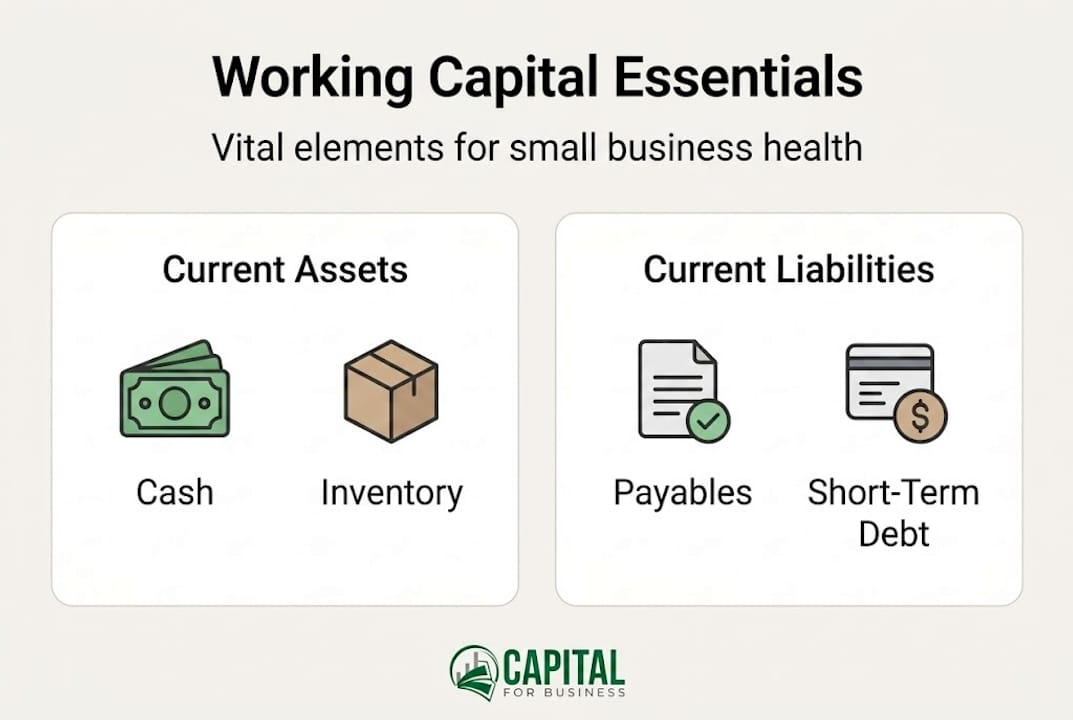
| Current Assets | Current Liabilities |
|---|---|
| Cash and cash equivalents | Accounts payable |
| Accounts receivable | Short-term loans |
| Inventory | Accrued payroll |
| Prepaid expenses | Taxes payable |
| Short-term investments | Credit card balances |
When that gap between assets and liabilities shrinks, your options shrink with it. The impact shows up fast and in several critical areas:
- Payroll gaps: If receivables are slow and liabilities are due, staff wages are often the first casualty.
- Inventory shortfalls: Without enough cash, you cannot restock, which means missed sales and unhappy customers.
- Missed growth opportunities: A new contract or bulk order discount requires available cash. Low working capital means you pass.
- Damaged supplier relationships: Late payments to vendors put your trade credit and future supply at risk.
- Increased borrowing costs: Scrambling for emergency cash usually means higher-rate options and rushed decisions.
Research confirms that the way businesses manage their working capital has measurable financial consequences. Efficient inventory turnover specifically has been shown to positively impact return on assets, with studies reporting an adjusted R-squared of 0.93, meaning working capital efficiency explains nearly all of the variation in profitability. That is not a minor detail. That is a direct link between how you handle day-to-day cash and how much your business earns.
Good working capital management is not just an accounting exercise. It is an operational strategy that protects your business when customers pay late, demand slows, or unexpected costs arrive. Every business faces those moments. What separates the ones that survive and grow from those that don't is usually the cushion they have when things go sideways.
How managing working capital impacts profitability
Having established the basics, it is time to examine how managing your working capital can make or break profitability. The connection is more direct than most owners expect. A business with strong working capital management collects faster, pays smarter, and keeps inventory lean. One with poor management bleeds cash quietly until the damage becomes undeniable.

The contrast between the two paths is stark:
| Metric | Good WCM | Poor WCM |
|---|---|---|
| Cash flow | Predictable and stable | Irregular, often negative |
| Supplier relationships | Strong, favorable terms | Strained, late fees common |
| Growth readiness | Can act on opportunities | Reactive, always catching up |
| Borrowing needs | Strategic and planned | Emergency-driven, costly |
| Profitability (ROA) | Higher, consistent | Lower, volatile |
Improving your working capital management does not require a financial overhaul. It requires focused attention on three specific areas. Here is a practical sequence:
- Accelerate receivables. Invoice immediately after delivery. Offer small early payment discounts (1 to 2 percent) to motivate faster payment. Follow up on overdue accounts within 48 hours, not 30 days.
- Extend payables strategically. Negotiate payment terms with suppliers. If your vendor offers net-30, use it. Holding cash longer improves your liquidity without costing more.
- Tighten inventory control. Audit your inventory monthly. Identify slow-moving items and liquidate or discount them. Overstocking locks up cash that could be working elsewhere in your business.
These three levers, receivables, payables, and inventory, are the core of working capital optimization. They are also where working capital management tips tend to make the biggest measurable difference in financial outcomes.
Pro Tip: Track your inventory turnover ratio (cost of goods sold divided by average inventory) and your receivables turnover ratio (net credit sales divided by average accounts receivable) every month. If either number is declining, investigate immediately. These two metrics are your early warning system for cash flow trouble.
The evidence backing this approach is strong. Studies on the importance of working capital and its link to profitability consistently show that small businesses with disciplined cash management outperform peers over time. The research showing an adjusted R-squared of 0.93 for inventory management impact on return on assets is particularly striking. It means that businesses that manage inventory well are not just slightly more profitable. They are dramatically more profitable, in a way that is statistically reliable and repeatable.
The businesses that treat working capital management as a core discipline, not an afterthought, are the ones that build real financial resilience over time.
Accessing and using external working capital solutions
While management is vital, sometimes external support is the game-changer. The financing landscape shaping today's business decisions has expanded significantly, and the data reflects it. The fact that 85% of growth businesses in North America use external working capital solutions tells you something important: relying entirely on internal resources is not the norm for growing companies. It is the exception.
External working capital comes in several forms. Each has specific strengths depending on your business model, cash cycle, and credit profile:
- Small business loans: Lump-sum funding with fixed repayment schedules. Best for planned expenses, equipment, or expansion costs. Predictable and structured.
- Pro: Fixed terms make budgeting straightforward.
- Con: Qualification may require strong credit history and financials.
- Business lines of credit: Revolving access to a set credit limit. You draw what you need and only pay interest on what you use. Ideal for seasonal businesses or variable cash needs.
- Pro: Flexible and reusable.
- Con: Rates can be variable and limits may be lower than term loans.
- Merchant cash advances: A lump sum repaid through a percentage of daily card sales. Good for businesses with high card volume.
- Pro: Fast access, minimal paperwork.
- Con: Effective cost of capital can be higher than traditional loans.
You can explore working capital loan options to find the right fit based on your specific situation. The key is matching the financing type to your actual cash cycle. A restaurant with daily card sales has different needs than a contractor waiting 60 days for invoice payment.
Technology is also reshaping how quickly and accurately businesses access external capital. The same data showing high adoption of external solutions also reports that AI adoption at 42% is improving operational efficiency for businesses managing working capital. Lenders are now using AI-powered underwriting to make faster decisions, and businesses are using automation tools to track cash positions in real time.
Pro Tip: Before applying for any external capital, calculate your cash conversion cycle (days inventory outstanding plus days sales outstanding minus days payable outstanding). This single number tells you exactly how long your cash is tied up in operations, and it helps you choose the right product from the right business funding options.
Forecasting, tech, and strategies: Setting up for resilient growth
After covering how to access capital, the next step is learning how to forecast, plan, and use technology to keep your business strong. Reactive cash management is always more expensive than proactive planning. Most cash crises are not surprises. They are predictable events that were never mapped out in advance.
Cash flow forecasting changes that. A structured forecast, especially a 13-week rolling cash flow model, gives you a clear view of what is coming and enough lead time to act before a shortfall becomes a crisis. Research on cash flow forecasting and business resilience consistently shows it is one of the most valuable tools available to small businesses navigating economic volatility.
Here is how to build a basic 13-week cash flow forecast:
- List all expected cash inflows. Include customer payments, loan disbursements, and any other income sources. Use historical data to estimate timing accurately.
- List all expected cash outflows. Cover payroll, rent, supplier payments, loan repayments, taxes, and any planned purchases. Be conservative. Costs often run higher than expected.
- Calculate the weekly net cash position. Subtract outflows from inflows each week. Identify any weeks where the balance turns negative.
- Plan your response ahead of time. For negative weeks, decide in advance whether you will draw on a line of credit, delay a non-critical payment, or accelerate a collection effort.
- Update the forecast every week. A static forecast becomes useless quickly. Rolling it forward weekly keeps it accurate and actionable.
Beyond the manual forecast, modern tools can make this process faster and more reliable. The business cash flow guide for 2026 highlights that AI-driven forecasting tools and automated alerts are becoming standard for SMBs that want to compete effectively in volatile markets. Here are the technology tools worth adopting:
- AI-powered cash flow dashboards: Platforms that connect to your bank accounts and accounting software to generate real-time cash position updates.
- Automated payment reminders: Tools that send overdue invoice alerts to customers without requiring manual follow-up from your team.
- Inventory management software: Systems that flag reorder points and track turnover rates automatically, reducing the risk of overstock or stockouts.
- Accounting platform integrations: Connecting tools like QuickBooks or Xero to your forecasting model eliminates manual data entry and reduces errors.
Building forecasting habits and adopting the right technology is not about complexity. It is about removing the guesswork from cash management so that your decisions are grounded in real data instead of intuition.
Why working capital is often overlooked—and what small businesses get wrong
We have looked at strategies and data. Now it is worth stepping back and considering working capital from a real-world, experience-based perspective.
Here is what we see consistently: most small business owners know they need cash, but they treat working capital as a buffer rather than a strategic tool. They check the bank balance. If there is money there, they feel fine. If there is not, they scramble. That reactive pattern is where businesses get hurt.
The conventional wisdom in business circles is that profit is the ultimate goal. And profit matters. But cash flow is what actually keeps the doors open. A business can be profitable on paper and still fail because the timing of inflows and outflows is misaligned. That is not a rare scenario. It is one of the leading reasons small businesses close.
What very few businesses actually do is treat working capital planning the way they treat sales planning. They set revenue goals every quarter. They track new customer acquisition. But they rarely set a working capital target, model out their cash cycle, or review their turnover ratios monthly. Those are the habits that build long-term resilience.
The businesses that have figured this out tend to access working capital insights early, build relationships with lenders before they need them, and use forecasting tools before a shortfall forces their hand. Proactive planning is not cautious or overly conservative. It is the most practical and effective approach to keeping a business healthy through every phase of growth.
If there is one shift we encourage every small business owner to make, it is this: stop thinking about working capital only when there is a problem. Start managing it like the strategic asset it is.
How Capital for Business can support your working capital needs
Understanding working capital is the first step. Having access to the right solutions is what turns that knowledge into results.

At Capital for Business, we have spent over 15 years helping small business owners across North America get the working capital they need to stay stable, grow confidently, and move quickly when opportunity arrives. Whether you need a short-term bridge, a flexible line of credit, or a structured business loan, we have options built for real businesses, not just the ones with perfect credit and years of bank history. You can compare loan options to find what fits your situation, or go ahead and apply for working capital directly. Our process is fast, straightforward, and designed to get you funded without unnecessary delays.
Frequently asked questions
What is working capital in simple terms?
Working capital is the money your business uses to cover day-to-day operations like paying bills, inventory, and staff. You can find a detailed breakdown of the concept explained for small business owners specifically.
How does working capital affect business growth?
Adequate working capital lets your business act on growth opportunities, while a shortage leads to missed sales and operational disruptions. Research confirms that efficient working capital management, especially inventory turnover, directly and significantly improves return on assets.
What are the best ways to improve working capital?
Focus on collecting customer payments faster, managing inventory tightly, and using external solutions when internal cash falls short. Studies show that disciplined cash management produces measurable and consistent improvements in financial performance for small and medium businesses.
How common is it to use external working capital financing?
Very common. Recent data shows that 85% of North American growth businesses now use external working capital solutions, making it a standard practice rather than a last resort.