
Working capital is the cash available to cover your HVAC company's day-to-day operations and short-term financial obligations. For HVAC businesses specifically, accessing it consistently is not optional — it is the difference between keeping your crew paid through a slow February and watching your best technicians walk out the door. The core reason to access working capital in HVAC comes down to a structural mismatch: you pay suppliers and employees now, but customers often pay 30–60 days later. That gap has to be funded by something.
Here is what reliable working capital access makes possible for HVAC operators:
- Payroll continuity through seasonal revenue dips, when monthly revenue can drop from $250,000 in peak months to $85,000 in slow months — a $165,000 gap that roughly equals three months' payroll
- Vendor payment reliability, which protects supply chain relationships and priority access to parts during high-demand periods
- Emergency response capacity, so your team can take urgent calls without waiting for a receivable to clear
- Growth readiness, covering marketing, training, and equipment upgrades when opportunities arise
- Tax and compliance obligations, which do not pause because your busy season ended early
Table of Contents
- How HVAC businesses put working capital to work
- What are the real benefits of working capital for HVAC companies?
- Working capital vs. other HVAC financing options
- How to manage cash flow and choose the right funding partner
- What happens when working capital runs short?
- How to calculate the ideal amount of working capital you need
- How seasonality shapes your working capital needs throughout the year
- Capitalforbusiness gives HVAC operators fast, flexible working capital
- Key Takeaways
- FAQ
How HVAC businesses put working capital to work
Working capital covers the full range of operational expenses that keep an HVAC company running between revenue cycles. The practical applications are specific and worth naming clearly.
- Payroll funding during off-peak months, when revenue drops but your fixed labor costs do not
- Pre-season inventory purchases, buying refrigerant, filters, and replacement parts before demand spikes and prices rise
- Vendor bill management, paying suppliers on time to maintain favorable terms and avoid supply disruptions
- Marketing and lead generation, running campaigns before peak season to fill the schedule ahead of time
- Training and certifications, investing in technician skills during slow periods when scheduling is easier
- Emergency equipment replacement, covering the cost of a failed service van or a broken diagnostic tool without derailing cash flow
- Bridging receivables gaps, covering operating costs while waiting on commercial or residential customers to pay outstanding invoices
Each of these uses reflects the same underlying reality: HVAC work is capital-intensive and time-sensitive, and the cash to support it needs to be available before the job is done, not after the invoice clears.
What are the real benefits of working capital for HVAC companies?
The benefits of working capital in HVAC go beyond simply keeping the lights on. Structured access to operating funds changes how you run the business day to day.
- Seasonal stability: Working capital smooths the revenue swings that define the HVAC calendar. Maintenance agreements account for roughly 55% of HVAC service revenue and generate predictable recurring income, but even with them, most operators still face significant slow-season gaps that working capital must fill. Increasing maintenance agreements from 200 to 600 can add around $80,000 in annual recurring revenue and reduce slow-season revenue gaps by 40%.
- Faster emergency response: When a customer calls at 10 PM in July with a failed compressor, having cash available means you can dispatch immediately, order parts, and close the job — rather than stalling because your account is thin.
- Vendor relationship protection: Paying suppliers on time keeps you in good standing for priority parts access and favorable credit terms, which matters most during peak season when everyone is competing for the same inventory.
- Growth capacity: Equipment upgrades, fleet expansion, and new service offerings all require upfront capital. Working capital funding covers those investments without forcing you to drain your operating reserves.
Industry data point: 58% of small business owners rely on personal funds or credit cards to cover cash flow shortfalls — a pattern that puts personal credit at risk and signals a structural gap in how many HVAC operators manage their finances.
The businesses that access working capital through structured financing rather than personal credit tend to operate with more predictability and less financial stress across the full year.
Working capital vs. other HVAC financing options

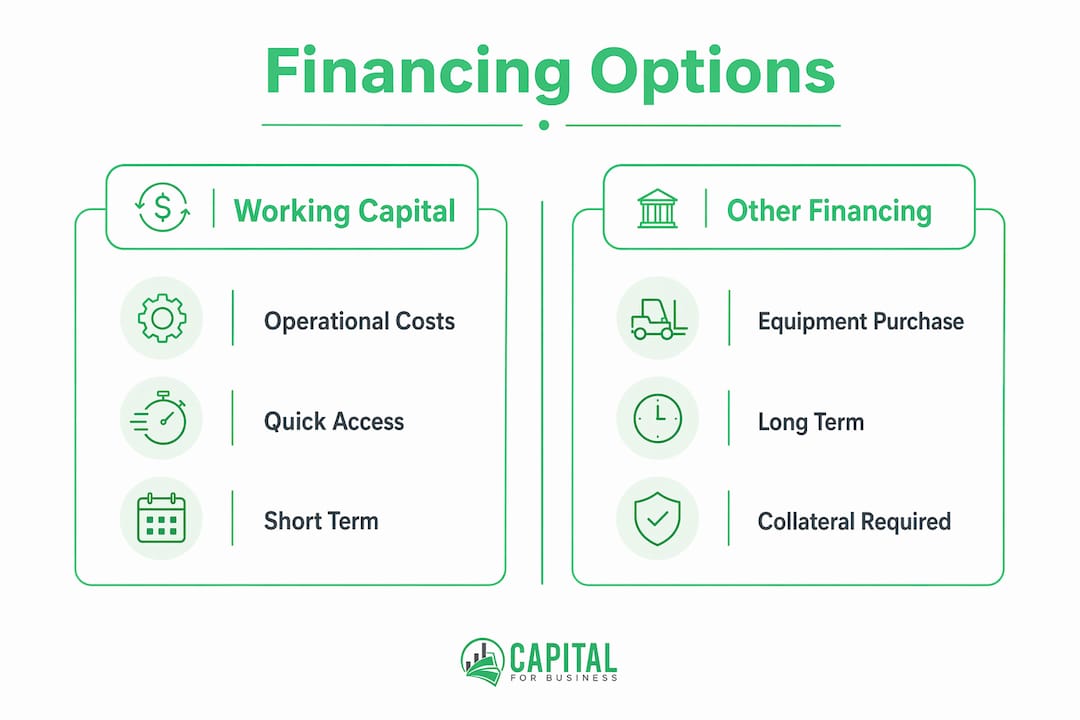
Working capital funding serves a different purpose than most other HVAC financing options. Understanding where each product fits helps you avoid using the wrong tool for the job.

Working capital loans are designed for transient, operational cash flow needs — payroll, vendor bills, short-term inventory — not for long-term asset purchases. Equipment loans and lines of credit serve different functions and carry different structures.
| Funding Type | Best Use | Speed | Collateral | Repayment |
|---|---|---|---|---|
| Working capital loan | Payroll, vendor bills, operating gaps | Fast (often 24–72 hrs) | Often unsecured | Short-term, fixed |
| Business line of credit | Recurring, flexible cash needs | Moderate | May require assets | Revolving, draw-based |
| Equipment financing | Trucks, HVAC units, diagnostic tools | Moderate | Equipment itself | Medium-term, fixed |
| Merchant cash advance | Rapid cash against future revenue | Very fast | None | Revenue-based repayment |
| — | Larger growth investments | Slow (weeks to months) | Often required | Long-term, lower rate |
The key distinction is purpose. Working capital covers what you owe today. Equipment financing covers what you are buying for tomorrow. Using a long-term equipment loan to cover payroll, or draining a working capital draw to buy a new van, creates mismatches that compound over time. Match the funding type to the expense category, and your cash position stays cleaner.
How to manage cash flow and choose the right funding partner
Cash flow management in HVAC starts with visibility. Most operators look at their profit and loss statement and assume they understand their financial position — but a P&L shows revenue when it is earned, not when cash actually arrives. The gap between those two dates is where cash flow problems live.
Steps to manage cash flow effectively:
- Build a 13-week rolling cash flow forecast. A 90-day forward view of weekly cash in and out reveals pinch points before they become crises, giving you time to draw on working capital proactively rather than reactively.
- Set seasonal cash reserves. Identify your fixed monthly costs (payroll, insurance, lease payments) and maintain enough reserve to cover at least 60–90 days of those obligations heading into your slow season.
- Accelerate receivables collection. Reducing Days Sales Outstanding from 45 to 28 days can free $140,000 in cash without changing a single dollar of revenue or expenses.
- Evaluate funding partners carefully. Look for speed of approval, flexibility in draw amounts, transparent fee structures, and demonstrated experience with HVAC or trades businesses specifically.
- Understand the full funding process. Expect to provide bank statements, tax returns, and basic business documentation. Reputable lenders move quickly — often within 24–72 hours — and do not require collateral for working capital draws.
Pro Tip: Negotiate extended payment terms with your suppliers (net 30 to net 45) while tightening your customer payment terms (net 15 to net 30). That single adjustment can shrink your cash conversion cycle by two to three weeks without borrowing a dollar.
When evaluating a funding partner, prioritize transparency above all else. A lender who cannot clearly explain the total cost of capital, repayment structure, and any fees upfront is not the right partner for your business.
What happens when working capital runs short?
The cost of a working capital gap in HVAC is not just the missed job. It compounds. When your team cannot respond to an emergency call because cash is thin, that customer calls a competitor. If the competitor does the job well, they earn the maintenance contract. That single missed call can translate into years of lost recurring revenue.
Industry experts note that HVAC companies operating in the $3M–$8M revenue range are particularly vulnerable to this pattern. They are large enough to carry significant fixed costs but not always capitalized well enough to absorb a two-week slow stretch without feeling it. The businesses that lose market share fastest are often the ones that look profitable on paper but are quietly running out of cash.
Cash flow blind spots make this worse. Delayed receivables, unbilled work sitting in a technician's truck, and seasonal revenue gaps that were not forecasted — these are the specific failure points that working capital access is designed to address. Structured access to operating funds is not a sign of financial weakness. It is how well-run HVAC businesses stay competitive when conditions tighten.
How to calculate the ideal amount of working capital you need
The standard formula for working capital is straightforward: current assets minus current liabilities. But for HVAC businesses, the more useful calculation is forward-looking rather than backward-looking.
Start with your fixed monthly operating costs: payroll, insurance, vehicle payments, software subscriptions, and lease obligations. Add your average variable costs for a typical month (parts, fuel, subcontractors). That total is your baseline monthly cash requirement.
From there, apply a seasonal multiplier. If your slowest month generates 35% of your peak-month revenue, you need enough working capital to cover the difference between what you earn and what you owe during that period. For a company with $200,000 in monthly fixed and variable costs and a slow-season revenue of $85,000, the working capital requirement for that month alone is $115,000.
A practical target for most HVAC operators is two to three months of operating expenses held in accessible working capital or available through a credit facility. That buffer covers the typical slow season without forcing you to cut staff, delay vendor payments, or use personal funds. Revisit the calculation quarterly, because your cost base changes as you add trucks, hire technicians, or expand your service area.
How seasonality shapes your working capital needs throughout the year
HVAC demand follows a predictable pattern: peak in summer (cooling) and winter (heating), slow in spring and fall. That rhythm creates two distinct working capital challenges each year, and they require different responses.
Pre-peak season (March–April and October–November): This is when you need the most working capital. You are hiring seasonal staff, pre-purchasing inventory, and running marketing campaigns — all before the revenue surge arrives. Drawing on working capital during this window funds the preparation that makes peak season profitable.
Post-peak season (September and February): Revenue drops sharply, but fixed costs do not. Payroll, insurance, and vehicle payments continue regardless of call volume. Working capital drawn during this period covers the gap while you rebuild your maintenance agreement base and prepare for the next cycle.
Seasonal revenue swings in HVAC can reach as high as 66% over a single quarter. Planning your working capital draws around those swings — rather than reacting to them after the fact — is what separates operators who grow steadily from those who scramble every spring and fall. Flexible financing options that allow you to draw and repay as needed, rather than taking a fixed lump sum, fit the HVAC seasonal model particularly well, as explained in this concepto de pago diferido guide. You can learn more about managing these cycles in Capitalforbusiness's HVAC working capital guide.
Capitalforbusiness gives HVAC operators fast, flexible working capital
HVAC operators who have read this far know the problem clearly: the cash timing gap is real, the seasonal pressure is predictable, and personal credit is not a sustainable solution. Capitalforbusiness offers a direct path to structured working capital that fits how HVAC businesses actually operate.

Since 2009, Capitalforbusiness has worked with small business owners across hundreds of industries, including HVAC contractors who need fast, flexible access to operating funds without the delays of traditional bank lending. Working capital loans up to $500,000 are available with approvals often completed within 24–72 hours, no collateral required for most draws, and repayment structures designed around your cash flow rather than a bank's calendar. The application process is straightforward: basic business documentation, recent bank statements, and tax returns are typically all that is needed.
If your HVAC business needs reliable access to operating funds this season, explore your working capital options at Capitalforbusiness and see what you qualify for today.
Key Takeaways
Accessing working capital is the most direct way HVAC businesses can close the gap between when expenses are due and when customer payments arrive.
| Point | Details |
|---|---|
| Seasonal cash gaps are significant | Monthly HVAC revenue can drop from $250,000 in peak months to $85,000 in slow months, creating a $165,000 shortfall that roughly equals three months' payroll. |
| Personal credit is a risky substitute | 58% of small business owners use personal funds or credit cards to cover shortfalls, putting personal finances at risk. |
| Receivables acceleration frees cash | Cutting Days Sales Outstanding from 45 to 28 days can release $140,000 in cash without changing revenue or expenses. |
| Match funding type to expense type | Working capital covers operational gaps; equipment loans and lines of credit serve different, longer-term purposes. |
| Capitalforbusiness fits HVAC operators | Working capital loans up to $500,000 with fast approvals and flexible repayment are available through Capitalforbusiness. |
FAQ
What does accessing working capital mean for an HVAC business?
Accessing working capital means securing cash to cover day-to-day operating expenses — payroll, vendor bills, inventory, and taxes — between the time you pay for a job and the time your customer pays you. For HVAC businesses, that gap typically runs 30–60 days.
Why is working capital so important in HVAC?
HVAC businesses carry high fixed costs year-round but earn revenue unevenly across seasons. Working capital fills the gap during slow months and funds the preparation needed before peak season, keeping operations stable and competitive.
What happens if an HVAC business runs low on working capital?
Low working capital forces operators to decline emergency calls, delay vendor payments, and cut staff — each of which erodes market share as competitors absorb the unmet demand. Missed emergency calls often become lost maintenance contracts, compounding the revenue loss over time.
Why do private equity firms and investors value HVAC businesses?
HVAC businesses generate recurring revenue through maintenance agreements, operate in a non-discretionary service category, and have predictable seasonal demand cycles. Those characteristics make cash flow relatively forecastable, which is attractive to investors seeking stable returns.
How do I get working capital for my HVAC business?
Apply through a lender like Capitalforbusiness with basic business documentation, recent bank statements, and tax returns. Approvals for HVAC working capital typically take 24–72 hours, and funds can be available the same week.