
Refinancing an equipment loan makes sense when the new terms save more than they cost. That usually means a lower interest rate, a lower monthly payment, or a cash-out option if your equipment is worth more than you owe on it. Banks, SBA-backed lenders, and online lenders are the three practical starting points, but a prepayment penalty on your current loan can erase those savings fast.
TL;DR:
- Refinancing makes sense only if the savings from lower rates or payments outweigh the total costs, including fees and prepayment penalties.
- Lenders vary: banks require strong credit and documentation, while online lenders accept shorter business histories but charge higher rates.
- Funds, fees, and timing are crucial; calculating your break-even point by including all costs determines if refinancing is worthwhile within your remaining loan term.
- Proper preparation, such as obtaining current loan details and equipment appraisals, speeds up the process and avoids delays during approval.
- Refinancing may impact warranties and requires updated insurance, with lender-specific coverage requirements that must be addressed beforehand.
Table of Contents
- Refinancing Options and How They Differ
- When Should You Refinance an Equipment Loan?
- Costs, Fees, and How to Calculate Break-Even Savings
- Steps to Refinance Equipment Loan Successfully
- Alternatives to Refinancing and When to Consider Them
- Practical Checklist From Capital for Business
- Impact of Refinancing on Equipment Warranties and Insurance Requirements
- What the Data Actually Suggests About Refinancing
- Get Started With Capital for Business
- Sources
- FAQ
Refinancing Options and How They Differ
Not every lender solves the same problem. Some are built for speed, others for price, and a few solve a cash-flow problem you didn't know you had.
- Bank equipment loans work best for borrowers with strong credit, at least two years in business, and clean financials. Banks tend to offer the lowest rates but move slowly and want extensive documentation.
- SBA equipment programs suit businesses that don't quite qualify for conventional bank terms but have solid fundamentals. The SBA's own guidance on cash-flow management is worth reading before you apply, since eligibility often hinges on how your cash flow looks on paper, not just your credit score.
- Captive or manufacturer financing offers some of the tightest pricing available, but it's typically restricted to that manufacturer's own equipment, which limits its use for a straight refinance unless you're rolling in a new purchase.
- Online and alternative lenders fund quickly and accept shorter time-in-business records, a real advantage when timing matters more than shaving a point off your rate.
- Sale-leaseback arrangements let you sell owned equipment to a lender and lease it back, generating immediate liquidity without adding new unsecured debt to your balance sheet.
Each path trades something for something else. Speed costs you price. Price costs you time. Knowing which one you need first narrows the search considerably.
When Should You Refinance an Equipment Loan?
Timing matters as much as the rate itself. Lenders typically expect at least two years in business and a credit score in the high 600s or better for bank and SBA products, though online lenders will work with thinner files at a higher cost. Equipment age matters too. Machinery older than its useful life estimate may need a formal appraisal before a lender will refinance it, and that appraisal cost should factor into your decision.
Before you get too far into the process, walk through this checklist:
- Pull your current loan agreement and confirm whether a prepayment penalty applies.
- Check your business credit score and personal credit if you're a sole proprietor or guarantor.
- Gather two to three years of tax returns and recent bank statements.
- Prepare a current profit and loss statement and balance sheet.
- Get a market valuation or appraisal on the equipment if it's more than a few years old.
Lenders universally ask for bank statements, tax returns, and the existing loan agreement as baseline underwriting documents, so having them ready before you shop saves weeks.
Pro Tip: Call your current lender first and ask directly whether a prepayment penalty applies and how it's calculated. Some calculate it as a flat fee, others as a percentage of remaining interest, and that difference changes your entire break-even math.
Costs, Fees, and How to Calculate Break-Even Savings
The advertised rate rarely tells the whole story. Origination fees, appraisal costs, and prepayment penalties on the old loan all stack onto the true cost of refinancing. That's why APR, not the headline rate, is the number that actually determines whether you save money.
Common fees to budget for:
- Origination fee, often 1% to 3% of the new loan amount
- Appraisal or valuation fee if the equipment needs formal assessment
- Prepayment penalty on your existing loan, if one applies
- Documentation or processing fees charged by some online lenders
Here's the simple math: add up every fee tied to the new loan, then divide that total by your monthly payment savings. If refinancing costs $2,400 in combined fees and saves you $200 a month, you break even in 12 months. Anything faster than your remaining loan term is worth pursuing; anything slower needs a harder look at whether cash-flow relief today outweighs paying more interest over time.
Rate ranges vary meaningfully by lender type, and program-level snapshots can help you set realistic expectations before you request quotes. Checking broader bond market movement also helps you judge whether now is a favorable window or whether rates are trending in a direction that makes waiting smarter.
Steps to Refinance Equipment Loan Successfully
The process itself is straightforward once your documents are in order. Most businesses move through it in five stages.
- Gather your paperwork and confirm current loan terms. Know your exact payoff amount, remaining term, and any prepayment penalty before you request a single quote.
- Get your equipment valued. A quick market check works for standard machinery; specialized or heavy equipment often needs a formal appraisal.
- Request term sheets from at least three lender types. Compare APR, fees, and term length side by side, not just the monthly payment.
- Submit your application. Expect a hard credit pull and, depending on the lender, a valuation step before final approval.
- Close and verify the payoff. Confirm your old lender received full payoff and that the account shows a zero balance. Errors here can hurt your credit even after refinancing successfully.
Pro Tip: Request term sheets from all lenders within the same 14-day window. Multiple credit inquiries for the same purpose within a short period typically count as one inquiry on most credit scoring models, protecting your score while you shop.
Alternatives to Refinancing and When to Consider Them
Refinancing isn't always the right move. If your equipment still has years of useful life ahead and you want to preserve cash for other priorities, leasing can sometimes make more sense than restructuring an owned asset.
- Sale-leaseback generates immediate liquidity but comes with lease costs that can exceed what you'd pay on a straight refinance over time.
- A business line of credit fits short-term cash needs better than restructuring long-term equipment debt.
- A merchant cash advance covers urgent gaps quickly, though at a higher cost than most equipment refinance options.
- A hybrid approach, refinancing the equipment loan while opening a line of credit for working capital, often solves both the rate problem and the cash-flow problem at once.
Practical Checklist From Capital for Business
Capital for Business has worked with small business owners across dozens of industries since 2009, matching them with financing when banks and credit unions say no. That experience shapes a simple checklist for anyone considering a refinance:
- Confirm your current payoff amount and any penalty clause in writing.
- Pull two years of tax returns and your most recent three months of bank statements.
- Get an equipment valuation if the machinery is more than three years old.
- Call a lender or broker once your documents are assembled, not before. You'll get faster, more accurate quotes.
- Ask what happens to your insurance and warranty coverage before you sign anything new.
Reach out once you're within 30 days of wanting new terms in place. That window gives underwriting enough time without leaving you exposed to rate movement.
Impact of Refinancing on Equipment Warranties and Insurance Requirements
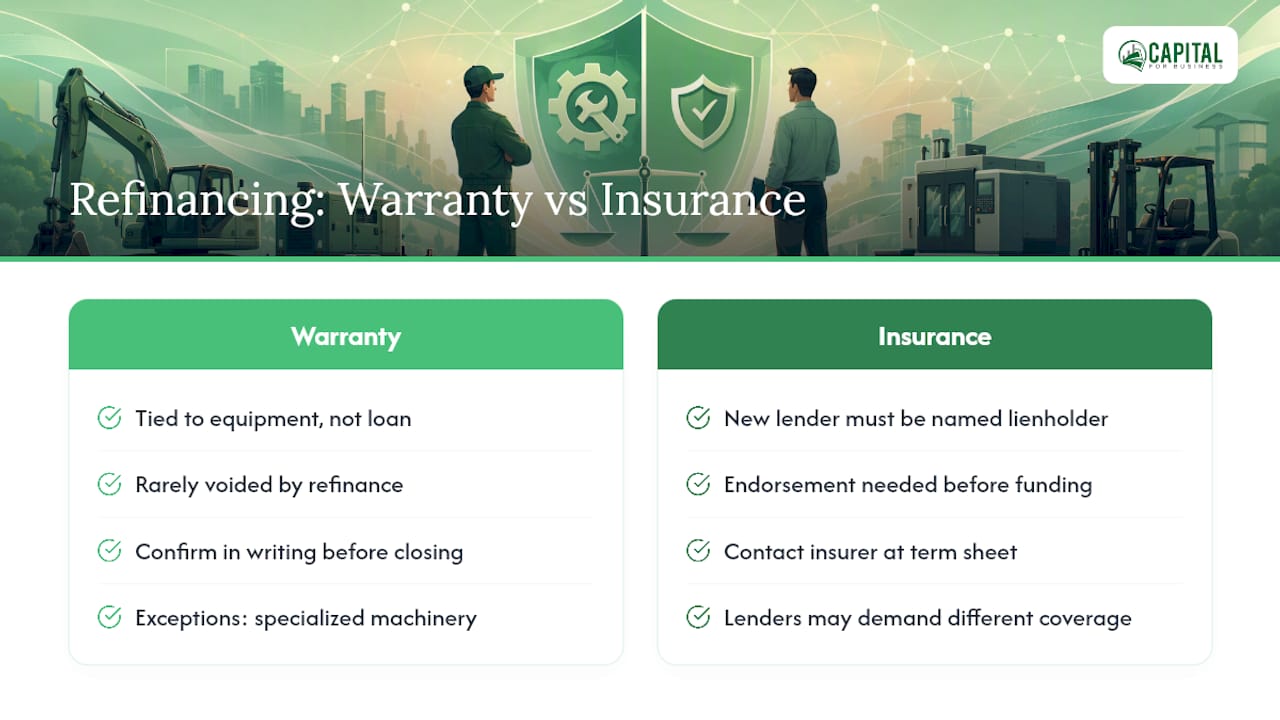
Refinancing changes who holds the lien on your equipment, and that shift can ripple into both your warranty and your insurance policy. Most manufacturer warranties stay attached to the equipment itself rather than the loan, so refinancing rarely voids coverage. Still, confirm this in writing with the manufacturer before closing, especially on specialized machinery where warranty terms are tied to specific ownership records.
Insurance is where refinancing creates more immediate work. Your new lender will almost certainly require proof of commercial property or equipment insurance naming them as the lienholder, replacing your previous lender on the policy. Skipping this step is a common closing delay. Contact your insurance provider as soon as you have a term sheet, not after closing, so the endorsement change is ready when the new loan funds.
Some lenders also set minimum coverage requirements that differ from your original loan, particularly around replacement-cost coverage versus actual cash value. Read the new loan agreement's insurance clause closely. A gap between what your policy covers and what the new lender requires can delay funding by days or trigger a forced-placed insurance charge, which costs considerably more than a standard policy.
What the Data Actually Suggests About Refinancing
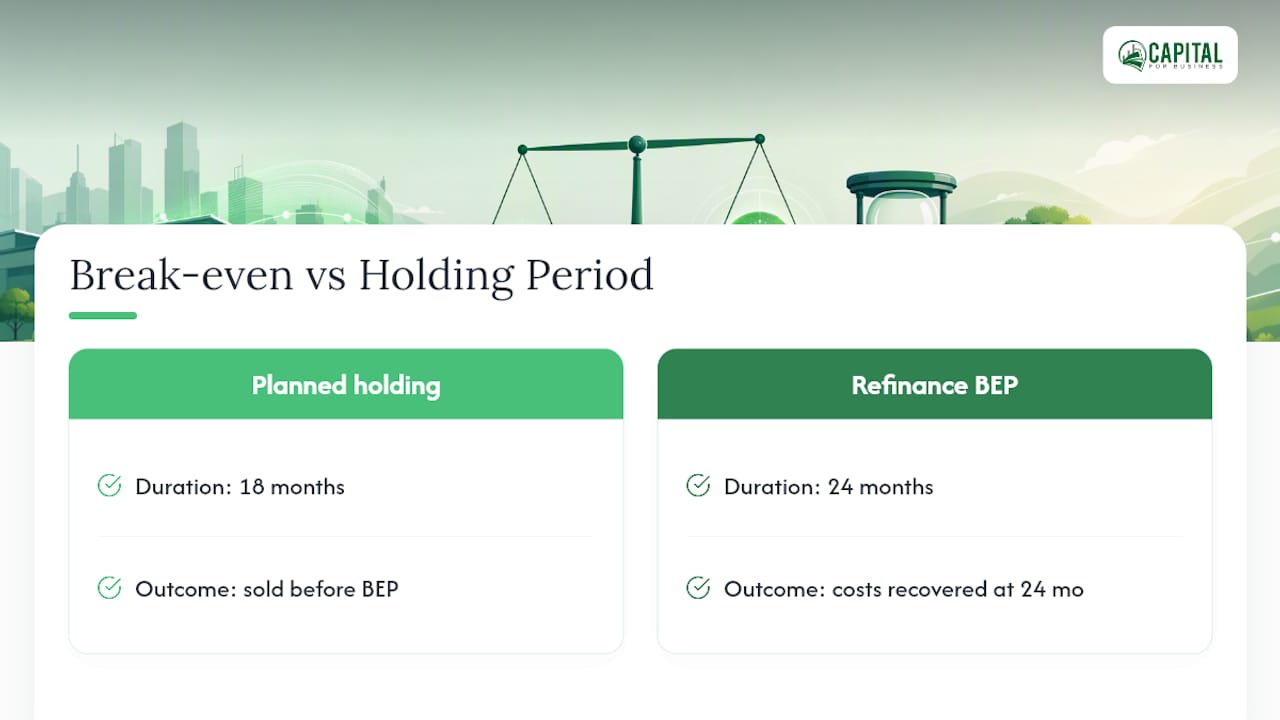
The conventional advice treats refinancing like a rate-shopping exercise: find the lowest APR, sign, move on. That misses the bigger picture. The real decision hinges on your break-even timeline versus how long you'll actually keep the equipment or the loan. A business planning to sell or upgrade machinery in 18 months has no business chasing a refinance with a 24-month break-even point, no matter how attractive the new rate looks on paper.
The other overlooked factor is timing relative to your existing penalty structure. Many owners assume refinancing is purely a rate decision and skip checking their prepayment terms until after they've already fallen in love with a new offer. That backward sequence costs real money. Check the penalty first, calculate break-even second, and shop rates last.
What should come first, always, is the document checklist. Lenders move faster and quote more accurately when your financials are organized before you ask for a number. That's not a formality. It's the difference between a two-week close and a six-week one.
— Capital
Get Started With Capital for Business
Capital for Business offers equipment financing up to $250,000 with same-day funding, giving small business owners a direct alternative when a bank or credit union says the timeline doesn't work or the file doesn't fit their box. Experience helping business owners across hundreds of industries since 2009 has informed many equipment refinancing requests.

Getting started is simple: reach out with your current loan payoff amount, a recent equipment valuation if you have one, and your last three months of bank statements. A representative will walk through your numbers and tell you honestly whether refinancing clears your break-even point before you commit to anything. Run that break-even math first, every time, then decide. If the numbers work, start your equipment financing request today and get a same-day answer instead of a weeks-long wait.
Sources
- Can you refinance an equipment loan? | CreditDoc
- Today's Equipment Financing Rates | July 2026 | PeerSense
- SBA: Cash flow management
- Bloomberg: Markets — Rates & Bonds
FAQ
What Is the 2% Rule for Refinancing?
The 2% rule is a rough guideline suggesting refinancing only makes sense if the new rate is at least two percentage points lower than your current one. It's a starting filter, not a final answer. Always run the actual break-even math using your specific fees and remaining term instead of relying on the rule alone.
How Much Does It Cost to Refinance a Loan Around That Size?
Costs vary by lender and loan size, driven mainly by origination fees (typically 1% to 3%), appraisal costs if required, and any prepayment penalty on the existing loan. Add these together and compare against your monthly savings to find your true break-even timeline.
What Disqualifies You From Refinancing?
Common disqualifiers include a low credit score, insufficient time in business, missing financial documentation, and equipment that's aged beyond a lender's acceptable valuation range. A pre-check of your existing loan agreement and current financials before applying helps you spot these issues early.
What Is the Current Interest Rate on Equipment Loans?
Rates vary significantly by lender type and borrower profile, with banks and SBA programs typically offering the lowest pricing and online lenders charging more for speed and flexibility. Check current program-level rate ranges before assuming any single number applies to your situation.
Can I Get Cash Out When I Refinance Equipment?
Yes, if your equipment's fair market value exceeds what you currently owe, many lenders allow a cash-out refinance up to a capped percentage of that value. The exact cap depends on the lender and equipment type, so confirm it during your initial quote request.