
Refinancing a business loan makes sense when your current rate sits well above market benchmarks, when a balloon payment is approaching, or when juggling several loans is straining your cash flow. Most businesses that refinance successfully land a lower rate, a smaller monthly payment, or a single consolidated loan instead of several. Before signing anything, run the numbers on origination fees and prepayment penalties. They can quietly erase the savings you're chasing.
TL;DR:
- Refinancing makes sense if your current interest rate exceeds market offers by several points or if your loan has a balloon payment upcoming.
- Calculate your break-even period by adding upfront costs and dividing by monthly savings; if you plan to keep the loan longer than this, refinancing is likely beneficial.
- Be aware that origination fees, prepayment penalties, and closing costs can offset potential savings, making comprehensive APR comparisons essential.
- Refinancing typically takes weeks with banks and credit unions, but online lenders can fund loans within days, depending on the lender type.
- Qualifying criteria include strong credit scores, a debt service coverage ratio of at least 1.25, and sufficient business revenue; consider how the loan type aligns with your priorities.
Table of Contents
- Signs It's Time to Refinance Your Business Loan
- Costs vs. Benefits: Calculating Break-Even and Total Savings
- Step-by-Step Refinancing Process and Timeline
- What Lenders Look For: Eligibility Benchmarks
- Types of Refinance Options and When to Use Each
- How to Compare Refinance Offers: A Practical Checklist
- Documents and Checklist to Speed Approval
- SBA-Specific Considerations for Refinancing Debt
- When Not to Refinance: Common Pitfalls to Avoid
- Impact of Refinancing on Business Credit Score
- How to Negotiate Refinancing Terms With Lenders
- Publisher Perspective: How Capital for Business Evaluates Refinance Requests
- How Capitalforbusiness Can Help You Refinance
- Sources
- FAQ
Signs It's Time to Refinance Your Business Loan
Rates move, businesses grow, and the loan that made sense two years ago might be costing you more than it should today. A handful of signals tend to show up together when refinancing is worth exploring.
Start with a rate comparison. If your existing loan carries an interest rate that's a few points above current market offers for businesses with your credit profile, that gap alone can justify the switch. Next, look at your monthly obligations as a whole. Businesses juggling three or four separate loans, each with its own due date and payment amount, often find that consolidating into one loan simplifies bookkeeping and frees up mental bandwidth for actually running the business.
Watch your calendar, too. A balloon payment or an approaching maturity date is one of the clearest triggers for refinancing, since waiting until the last minute leaves you with fewer options and less negotiating leverage.
Finally, consider what's changed on your end. If your personal credit score has climbed, your revenue has grown, or your debt service coverage ratio (DSCR) has improved since you first borrowed, you may now qualify for terms that weren't available to you back then.
Common signs it's time to look at refinancing:
- Your current rate is noticeably above what similar businesses are getting today
- You're managing multiple loans with different rates, terms, and due dates
- A balloon payment or loan maturity is approaching soon
- Your credit score, revenue, or DSCR has improved meaningfully since you took out the original loan
Pro Tip: Pull your current loan's payoff statement before you shop anywhere. Lenders need that exact figure to build an accurate offer, and knowing it upfront keeps you from wasting time on quotes that don't reflect your real payoff cost.
Costs vs. Benefits: Calculating Break-Even and Total Savings
A lower advertised rate doesn't automatically mean you'll save money. Refinancing can lower your interest rate or monthly payment, but origination fees, closing costs, and prepayment penalties on your old loan can offset a meaningful chunk of that gain. The math that actually matters compares APR, not the nominal rate, since APR bakes in fees and gives you the true cost of borrowing.
Here's the basic process for figuring out if a refinance pencils out:
- Add up all upfront costs: origination fee, closing costs, and any prepayment penalty on the loan you're replacing.
- Calculate your monthly savings by subtracting the new payment from your current payment.
- Divide total upfront costs by monthly savings to get your break-even period in months.
- Compare that break-even period to how long you plan to keep the business or the loan.
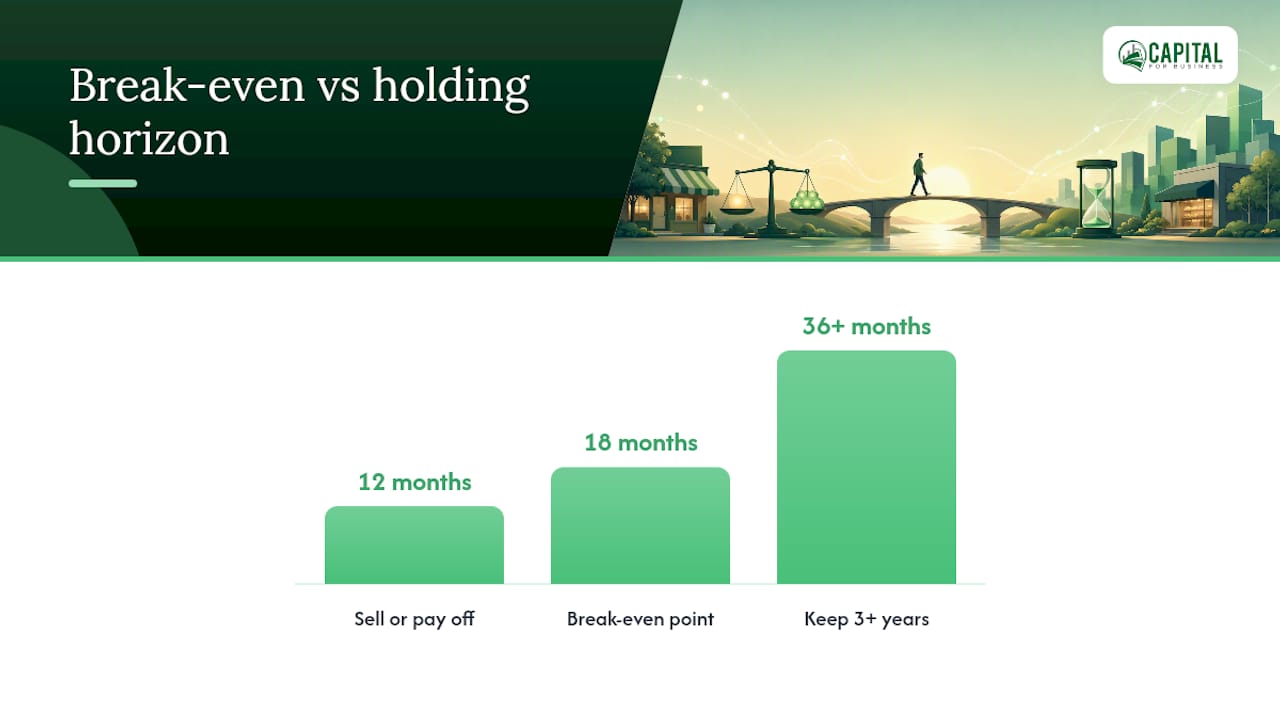
Quick example: Say you owe $150,000 with a $4,200 prepayment penalty and $3,000 in new closing costs, for $7,200 in total costs. If refinancing drops your monthly payment by $400, your break-even point is 18 months. If you plan to hold that loan for three or more years, refinancing wins. If you're likely to sell the business or pay it off within a year, it probably doesn't.
You'll sometimes hear lenders reference a "2% rule," the idea that refinancing only makes sense if the new rate is at least 2 percentage points lower than your current one. It's a decent gut check, but it ignores your loan balance, remaining term, and fee structure, so treat it as a starting point rather than a decision. A worksheet that lines up APR, fees, and break-even period side by side for each offer will tell you more than any flat percentage rule.
If your business needs breathing room now, prioritize monthly payment relief even if total interest paid rises slightly. If cash flow is stable and you're focused on long-term cost, prioritize total interest savings instead. Reducing what you pay in interest overall is also one of several ways to cut borrowing costs beyond refinancing alone.
Step-by-Step Refinancing Process and Timeline
Refinancing follows a predictable sequence, and knowing what's coming next keeps you from getting blind sided by a lender's request for one more document.
- Set your goal. Decide upfront whether you want a lower monthly payment, a lower total cost, or fewer loans to track. That goal shapes which offers you should even consider.
- Request your payoff amount. Contact your current lender for an exact payoff figure, including any prepayment penalty, and build a debt schedule if you're consolidating more than one loan.
- Check your financial standing. Pull your personal and business credit reports and calculate your current DSCR. Fix anything fixable, like paying down a credit card balance, before you apply.
- Shop multiple lenders. Setting a goal, confirming payoff amounts, reviewing your qualifications, and comparing lenders before applying is the standard sequence that keeps the process from turning into guesswork.
- Gather documents and apply. Submit applications to your shortlist of lenders once you've built a comparison worksheet.
- Move through underwriting and closing. Once approved, the new lender pays off your old loan directly, and your new terms take effect.
Timelines vary sharply by lender type. Online lenders can move from application to funding in a matter of days, since much of their underwriting is automated. Banks and credit unions typically take several weeks, since they lean more heavily on manual review and in-person documentation. SBA-backed refinancing tends to run the longest, often several weeks to a few months, because of the additional paperwork and government review layered on top of standard underwriting.
What Lenders Look For: Eligibility Benchmarks
Refinancing applications go through nearly the same scrutiny as a brand-new loan. Lenders evaluate personal and business credit, time in business, revenue, collateral, and DSCR when deciding whether to approve you, and not every applicant will qualify for the lowest advertised rate.
- Personal and business credit scores: Both matter. Your personal score signals how you've managed debt historically, and your business score reflects how the company itself has performed on obligations like vendor accounts and existing loans.
- DSCR (debt service coverage ratio): This measures whether your business cash flow can comfortably cover loan payments. Many lenders look for a DSCR around 1.25 or higher, meaning your income needs to exceed your debt obligations by a healthy margin, not just barely cover them.
- Time in business and annual revenue: Lenders want to see at least a year or two of operating history and revenue that supports the new loan amount.
- Collateral: Equipment, real estate, or receivables can strengthen an application and sometimes unlock better pricing.
- Personal guarantees: Borrowing against an LLC doesn't shield you from exposure. Owners commonly still sign a personal guarantee, which means your personal assets remain on the line even though the loan sits under the business entity.
Pro Tip: Calculate your own DSCR before a lender does. Divide your net operating income by your total debt payments. If the result lands below 1.25, spend a few months improving cash flow before applying rather than getting rejected and having that inquiry sit on your credit file.
Types of Refinance Options and When to Use Each
Not every refinancing path fits every business, and the loan type you choose should match your priorities on speed, cost, and qualification difficulty.
- Bank term loans offer the lowest rates and longest terms, but they favor businesses with strong credit, several years of operating history, and clean financials.
- SBA 7(a) and 504 loans bring competitive rates and long repayment terms, often the best value on the market, in exchange for stricter documentation and a longer approval timeline.
- Online lenders move fast and accept looser credit profiles, but that convenience comes at a meaningfully higher rate than a bank or SBA loan.
- Merchant cash advances should generally be treated as a last resort or a short bridge, since their factor-rate pricing structure makes them one of the most expensive ways to access capital.
- Consolidation loans simplify operations when you're managing several separate debts with different due dates, but consolidating isn't always the right move if one of your existing loans already carries a better rate than anything you'd qualify for today.
Matching the loan type to your actual situation, rather than chasing the fastest approval, is what separates a refinance that saves money from one that just moves the debt around. If you're still building out your understanding of the loan products available to growing businesses, it helps to review the full range of business loan types before you commit to a lender.
How to Compare Refinance Offers: A Practical Checklist
Comparing offers side by side, using the same criteria for each one, keeps you from getting swayed by whichever lender pitches the most convincingly.
- Line up APR, not just the interest rate. APR includes origination fees and other costs, giving you an apples-to-apples number across lenders.
- Total the cash required at closing. Add origination fees, appraisal costs, and any other upfront charges to see what you'll actually need in hand.
- Check both loans for prepayment penalties. Confirm what it costs to exit your current loan and whether the new loan carries its own penalty if you want to pay it off early.
- Weigh term length against total interest. A longer term lowers your monthly payment but usually raises the total interest you'll pay over the life of the loan.
- Run break-even math for every offer. Divide total upfront costs by monthly savings for each lender so you can rank offers by how fast they pay for themselves.
A simple worksheet that tracks APR, fees, monthly payment, and break-even period for each offer turns a confusing pile of term sheets into a straightforward comparison.
Documents and Checklist to Speed Approval
Having your paperwork ready before you apply shaves days, sometimes weeks, off the process.
- Two to three years of business tax returns and profit-and-loss statements
- Recent business bank statements, usually the last three to six months
- A payoff statement from your current lender
- Personal identification and credit documentation for anyone signing a personal guarantee
- Business formation documents, such as your articles of organization or incorporation
- Collateral paperwork if you're pledging equipment, real estate, or receivables
- A debt schedule listing every existing loan, balance, and monthly payment
SBA-Specific Considerations for Refinancing Debt
The SBA allows refinancing of existing business debt under specific circumstances, and its 7(a) and 504 programs are commonly used to replace higher-cost debt or consolidate multiple loans into one manageable payment. The catch is that proceeds and eligible uses are restricted, so not every existing loan qualifies for SBA refinancing, and lenders will check that the original debt was used for eligible business purposes.
- Benefits: Competitive rates and repayment terms that stretch longer than most bank or online options, which lowers monthly payments meaningfully.
- Drawbacks: Heavier documentation requirements and a longer approval timeline than online or even most bank refinancing.
- Eligibility signals: Approved SBA lenders typically want to see solid time in business, a reasonable DSCR, and credit that supports the loan amount requested.
- 7(a) vs. 504: The 7(a) program is more flexible and commonly used for working capital and general debt refinancing, while 504 loans are geared toward major fixed assets like real estate or heavy equipment.
SBA refinancing can be especially valuable for consolidating high-interest debt into a longer-term, lower-cost loan, but the extra paperwork is a real trade-off if you need funding fast. For current requirements on rates and terms, it's worth reviewing recent SBA and bank term loan updates before you apply.
When Not to Refinance: Common Pitfalls to Avoid
Refinancing isn't automatically the right move. Stretching your term to lower the monthly payment can raise your total interest paid over the life of the loan, even though it feels like relief today. Fees and prepayment penalties sometimes cancel out projected savings entirely once you run the real math. Refinancing also can't fix a business with chronic cash flow problems; it just delays the reckoning. And trading a reasonable loan for a faster, higher-cost product just to speed up funding rarely pays off once you account for how repayment timing actually works.
Impact of Refinancing on Business Credit Score
Applying for a new loan typically triggers a hard inquiry on your business credit file, which can cause a small, temporary dip in your score. That's normal and usually recovers within a few months as long as you keep making payments on time.
The bigger, longer-term factor is what happens to your credit mix and your utilization. Paying off multiple smaller loans and replacing them with one new loan can actually help your profile, since it reduces the number of open accounts lenders see and can lower your overall credit utilization if the new loan carries a higher limit relative to what you're using. On the other hand, closing several accounts at once can shorten your average account age, which some scoring models weigh negatively.
Payment history remains the single biggest factor either way. A refinanced loan paid on time every month will rebuild or strengthen your business credit faster than almost any other action you can take. The inquiry ding is temporary; a track record of consistent payments is what actually moves your score upward over the following year.
How to Negotiate Refinancing Terms With Lenders
Lenders expect some back-and-forth on a refinance, especially if you're bringing solid credit and revenue numbers to the table. Getting competing term sheets from two or three lenders is your strongest leverage, since a written offer from one lender gives you something concrete to ask another to beat.
Focus your negotiation on the levers that actually move the needle: the origination fee, the interest rate, and any prepayment penalty on the new loan itself. Lenders have more flexibility on fees than they typically advertise, particularly for borrowers with strong DSCR and a clean payment history on the loan being refinanced. If your revenue or credit has improved since your original loan, say so directly and back it up with recent bank statements or tax returns, since that improvement is exactly what justifies better pricing.
Don't negotiate on rate alone. A slightly higher rate with no prepayment penalty can beat a lower rate that locks you in, especially if there's a real chance you'll pay off the loan early or refinance again down the road. Ask each lender directly whether their quoted rate is negotiable and what specifically would move it, whether that's a larger down payment, additional collateral, or a shorter term.
Publisher Perspective: How Capital for Business Evaluates Refinance Requests
Since 2009, Capitalforbusiness has worked with small business owners across dozens of industries on working capital, SBA loans, term loans, equipment financing, and merchant cash advances. The refinance requests that come across our desk most often involve businesses juggling two or three high-cost loans, or ones facing a balloon payment they didn't plan around early enough.
Our approach starts with the same goal-first question we'd ask any borrower: are you optimizing for a lower payment, a lower total cost, or fewer moving pieces? From there, we weigh fees and prepayment penalties against projected savings before ever recommending a switch, and we're upfront about realistic timelines rather than promising same-day miracles a lender type can't actually deliver. If the math doesn't work in your favor, we'll tell you that too.
— Capital
How Capitalforbusiness Can Help You Refinance
If you've run the break-even math and decided refinancing makes sense, Capitalforbusiness gets you there without the weeks of paperwork a traditional bank often demands.

We work directly with small business owners across the US and Canada to match refinancing needs with the right product, whether that's a working capital loan to smooth out monthly cash flow, a business term loan to consolidate multiple debts into one payment, or a merchant cash advance when speed matters more than the lowest possible rate. Because we work with borrowers banks and credit unions often turn down, approval decisions typically move faster than what you'd wait on with a traditional lender, without sacrificing a fair rate.
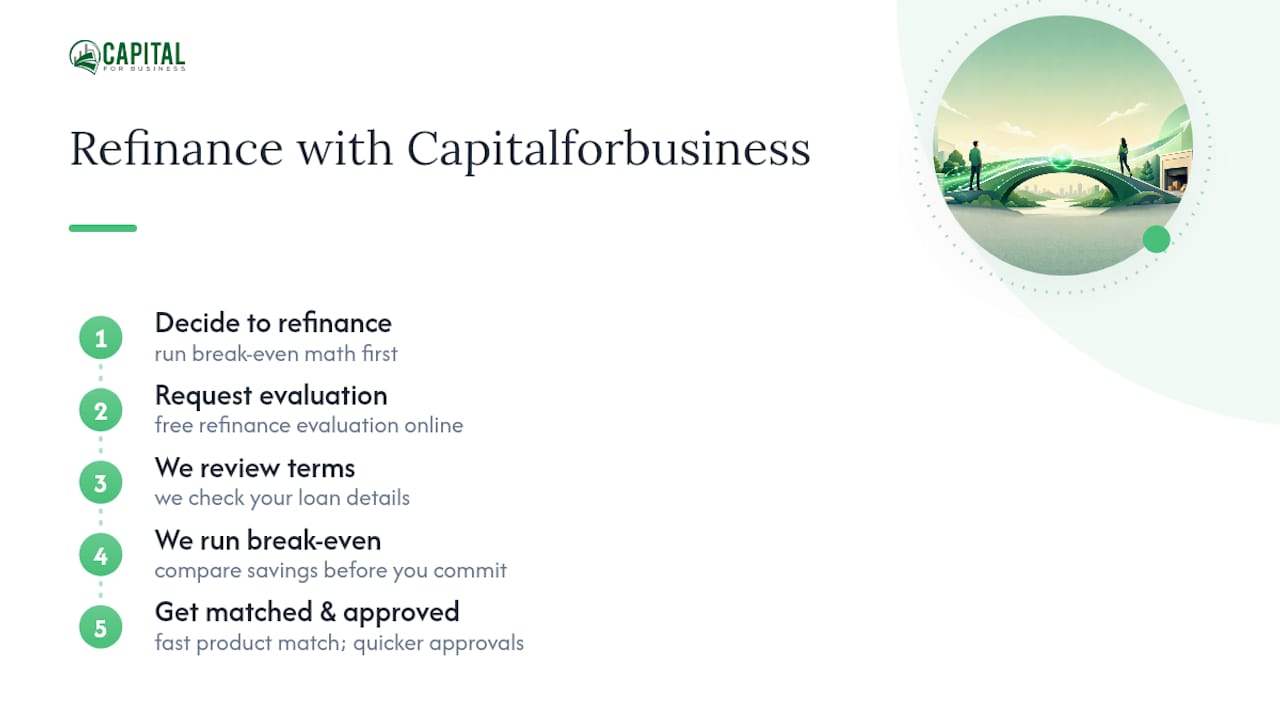
The next step is simple: request a free refinance evaluation. We'll look at your current loan terms, run the same break-even math covered above, and tell you honestly whether refinancing saves you money before you commit to anything. Start by reviewing the types of small business loans available and get in touch to see what you qualify for today.
This article is general information, not a substitute for advice from a qualified financial advisor. Consult a qualified financial professional about your own circumstances before acting on anything here.
Sources
- U.S. Small Business Administration — Funding programs: loans
- NerdWallet — How to refinance a business loan
- Lendio — When to refinance a business loan
FAQ
How much is the monthly payment for a $100,000 business loan?
It depends heavily on your rate and term, but monthly payments vary widely depending on those factors; running your exact rate and term through a loan calculator gives you the precise figure.
How much does it cost to refinance a $300,000 loan?
Costs vary by lender, but expect origination fees, closing costs, and any prepayment penalty on your existing loan to add up to a few thousand dollars, which is why calculating your break-even period before refinancing matters so much.
What is the 2% rule for refinancing?
The 2% rule is an informal guideline suggesting refinancing only makes sense if your new rate is at least 2 percentage points lower than your current one, but it ignores fees, loan balance, and term, so a full break-even calculation is more reliable.
How do I borrow money against my LLC?
You can borrow against your LLC's assets or revenue through products like a business term loan or working capital loan, but most lenders will still require a personal guarantee, meaning you remain personally exposed even though the LLC is the borrower.