
TL;DR:
- Understanding real estate loan terminology helps borrowers compare offers and avoid costly surprises at closing. It also enables smarter borrowing decisions by clarifying concepts like amortization, DTI, LTV, and loan product types. Knowing these terms improves negotiation and increases confidence throughout the financing process.
Real estate loan terminology refers to the specific words and phrases that describe the features, conditions, and components of loans secured by property. Knowing these terms before you apply gives you a real advantage. You can compare offers accurately, ask better questions, and avoid costly surprises at closing. This guide covers real estate loan terminology explained from the ground up, including core concepts like amortization and APR, underwriting metrics like DTI and LTV, loan product types, closing costs, and the qualification process. Whether you are buying a home, financing an investment property, or exploring commercial real estate, understanding this vocabulary is the foundation of every smart borrowing decision.
What are the essential real estate loan terms every borrower should know?
Real estate loans, also called mortgage loans, share a common vocabulary that applies across most loan products. Learning these terms first makes every other part of the process easier to follow.

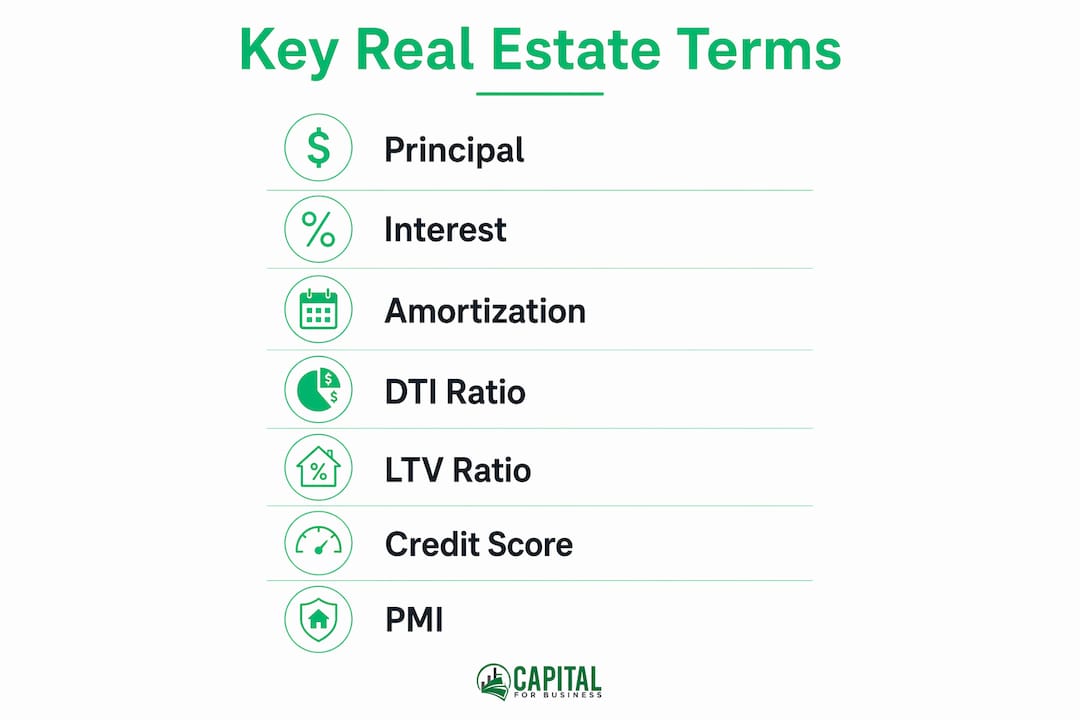
Principal is the original amount you borrow. If you take out a $300,000 loan, $300,000 is your principal. Every payment you make reduces that balance over time.
Interest is the cost the lender charges for lending you money. It is expressed as a percentage of the outstanding principal. Your interest rate and your Annual Percentage Rate (APR) are not the same thing. The interest rate reflects only the cost of borrowing the principal, while the APR includes the interest rate plus lender fees, making it the more accurate number for comparing loan offers.
Amortization describes how your loan is paid off through scheduled payments over time. Amortization schedules show exactly how much of each payment goes toward principal versus interest. Early in a loan, most of your payment covers interest. As the balance falls, more goes toward principal. A longer loan term lowers your monthly payment but increases the total interest you pay over the life of the loan. That trade-off is worth calculating before you commit.
Loan term is the length of time you have to repay the loan. The most common residential terms are 15 years and 30 years. A 15-year term costs more per month but saves significantly on total interest.
PITI stands for Principal, Interest, Taxes, and Insurance. Lenders use PITI to calculate your total monthly housing payment because property taxes and homeowner's insurance are real costs that affect your ability to repay. Many lenders collect taxes and insurance through an escrow account, which is covered in a later section.
- Principal: The original loan balance you owe.
- Interest: The lender's fee for the loan, expressed as a percentage.
- APR: The true annual cost of the loan, including fees.
- Amortization: The schedule of payments that gradually pays off the loan.
- Loan term: The repayment period, typically 15 or 30 years for residential loans.
- PITI: The full monthly payment including principal, interest, taxes, and insurance.
Pro Tip: Ask your lender for a full amortization schedule before signing. Seeing the total interest paid over 30 years often motivates borrowers to make extra principal payments early, which can save tens of thousands of dollars.
How do underwriting metrics like DTI, LTV, and credit score affect real estate loans?
Lenders use specific metrics to decide whether to approve your loan and at what rate. These numbers are not arbitrary. They reflect the statistical risk that a borrower will default.
Debt-to-income ratio (DTI)
DTI compares your total monthly debt payments to your gross monthly income. Many lenders prefer a DTI of no higher than 43% for loan approval. That means if you earn $6,000 per month before taxes, your total debt payments including the new mortgage should not exceed $2,580. A lower DTI signals to lenders that you have enough income to manage the loan comfortably.
Loan-to-value ratio (LTV)
LTV measures how much you are borrowing relative to the property's appraised value. A $240,000 loan on a $300,000 property gives you an LTV of 80%. When LTV exceeds 80%, lenders typically require private mortgage insurance (PMI), which protects the lender if you default. PMI adds to your monthly cost until you build enough equity to cancel it.
Credit score
Your credit score is a three-digit number that summarizes your borrowing history. Higher scores unlock lower interest rates. Most conventional loans require a minimum score of 620, while FHA loans allow scores as low as 580 with a 3.5% down payment. A difference of 40 points in your credit score can change your interest rate by a quarter of a percent or more, which adds up to thousands of dollars over a 30-year term.
DSCR for investment loans
For investment and commercial properties, lenders use the Debt Service Coverage Ratio (DSCR) instead of personal income. DSCR compares rental income to debt payments. A DSCR above 1.0 means the property generates enough rent to cover its debt obligations. Most lenders require a DSCR of 1.2 or higher to provide a safety margin.
- Calculate your DTI before applying. Add all monthly debt payments and divide by gross monthly income.
- Check your LTV. If it exceeds 80%, budget for PMI or plan a larger down payment.
- Pull your credit report at least 90 days before applying. Dispute errors and pay down revolving balances.
- For investment properties, calculate DSCR using projected rental income from comparable properties in the area.
What are the different types of real estate loan products?
Real estate financing covers a wide range of loan products. Each carries its own terminology, qualification standards, and use cases.
Conventional loans are not backed by a government agency. They follow guidelines set by Fannie Mae and Freddie Mac, including conforming loan limits that change annually. Conventional loans typically require a 620 credit score and a down payment of at least 3% to 20%.
FHA loans are insured by the Federal Housing Administration. They allow lower credit scores and smaller down payments, making them popular with first-time buyers. FHA loans require both an upfront mortgage insurance premium (MIP) and an annual MIP, which differs from the PMI structure on conventional loans.
VA loans are guaranteed by the Department of Veterans Affairs and are available to eligible veterans, active-duty service members, and surviving spouses. VA loans require no down payment and no private mortgage insurance, making them one of the most cost-effective loan products available.
Jumbo loans are non-conforming loans that exceed the conforming loan limits set by the Federal Housing Finance Agency (FHFA). Because they cannot be sold to Fannie Mae or Freddie Mac, lenders hold them on their own books and apply stricter underwriting standards, including higher credit score requirements and larger reserves.
DSCR loans are designed for real estate investors. Qualification is based on the property's rental income rather than the borrower's personal income. This makes them accessible to self-employed investors and those with complex tax returns. You can learn more about how commercial real estate financing works in a dedicated guide from Capitalforbusiness.
| Loan type | Key qualification factor | Government backed | Best for |
|---|---|---|---|
| Conventional | Credit score, DTI, LTV | No | Primary homes, investment |
| FHA | Lower credit score, MIP | Yes (FHA) | First-time buyers |
| VA | Military eligibility | Yes (VA) | Veterans and service members |
| Jumbo | High credit score, reserves | No | High-value properties |
| DSCR | Rental income coverage | No | Real estate investors |
| Bridge | Short-term collateral | No | Transitional purchases |
Bridge loans are short-term loans used to finance a property purchase before a borrower's existing property sells or longer-term financing is arranged. They typically carry higher interest rates and fees because of their short duration and higher risk. Capitalforbusiness offers real estate bridge loans for borrowers who need flexible, short-term property financing.
Hard money loans come from private lenders rather than banks. They are secured by the property itself and are based primarily on asset value rather than borrower creditworthiness. Hard money loans close fast but carry high rates, making them suited for fix-and-flip investors with short holding periods.
How do closing costs and loan servicing terms affect your loan?
Closing costs are the fees and expenses paid at the end of the loan transaction, when ownership of the property officially transfers. They typically range from 2% to 5% of the loan amount and include several distinct charges.
- Origination fee: A fee charged by the lender for processing the loan, usually expressed as a percentage of the loan amount.
- Discount points: Prepaid interest that lowers your interest rate. One point equals 1% of the loan amount. Paying points makes sense if you plan to stay in the property long enough to recoup the upfront cost.
- Escrow account: A third-party account that holds funds for property taxes and homeowner's insurance. Your lender collects a portion of these costs with each monthly payment and pays the bills on your behalf.
- Title insurance: A policy that protects the lender (and optionally the buyer) against claims on the property's ownership history. Lender's title insurance is almost always required. Owner's title insurance is optional but strongly recommended.
- Lien: A legal claim against a property used as security for a debt. A mortgage is itself a lien. Before closing, a title search confirms no other liens exist on the property.
- PMI vs. MIP: Private mortgage insurance (PMI) applies to conventional loans with LTV above 80%. PMI is typically canceled once LTV falls below 80%. Mortgage insurance premium (MIP) applies to FHA loans and in many cases lasts for the life of the loan.
Loan servicing refers to the ongoing administration of your loan after closing. Your servicer collects payments, manages your escrow account, and handles any modifications or payoff requests. The company that originates your loan may not be the company that services it. Lenders frequently sell servicing rights to other institutions, which is legal and common.
Pro Tip: Request a Loan Estimate from every lender you consider. The Loan Estimate form is a standardized three-page document provided within three business days of your application. It lets you compare fees and rates across lenders on an apples-to-apples basis.
What are the key loan qualification and pre-approval terms borrowers encounter?
The path from application to closing involves several formal steps, each with its own terminology. Knowing what each step means prevents confusion and keeps your timeline on track.
-
Prequalification is an initial estimate of how much you may be able to borrow. It is based on self-reported information about your income, assets, and debts. Prequalification does not involve a hard credit pull and carries no guarantee of approval.
-
Pre-approval is a formal review by a lender that includes verification of your income, assets, employment, and credit history. Pre-approval signals to sellers that you are a serious buyer with verified financing capacity. In competitive markets, sellers often reject offers that are not backed by a pre-approval letter.
-
Underwriting is the process by which a lender's underwriter evaluates your full loan file to confirm you meet all qualification standards. The underwriter reviews your credit report, tax returns, bank statements, appraisal, and title report. Underwriting can result in approval, conditional approval, or denial. Conditional approval means you must provide additional documentation before the loan can close.
-
Loan Estimate (LE) is a standardized document provided within three business days of your application. It outlines the loan amount, interest rate, projected monthly payment, and estimated closing costs. The LE is not a commitment to lend, but it is a binding estimate of costs.
-
Closing Disclosure (CD) is provided at least three business days before closing. It mirrors the Loan Estimate format but reflects the final, confirmed numbers. Compare the CD to your LE carefully. Any significant changes require explanation from your lender.
A financing contingency is a clause in a purchase contract that makes the sale conditional on the buyer securing a loan. If financing falls through, the contingency allows the buyer to exit the contract without losing their earnest money deposit. Waiving a financing contingency is risky and should only be considered by buyers with extremely strong financial positions.
Key Takeaways
Understanding real estate loan terminology is the single most effective way to protect yourself from costly mistakes and negotiate better loan terms.
| Point | Details |
|---|---|
| APR beats interest rate for comparisons | APR includes fees, making it the accurate number for comparing loan offers across lenders. |
| DTI and LTV drive approval decisions | Keep DTI below 43% and LTV at or below 80% to qualify for the best loan terms without PMI. |
| Pre-approval outweighs prequalification | Pre-approval involves verified income and credit review, giving sellers confidence in your offer. |
| Loan Estimate enables cost comparison | Request a Loan Estimate from every lender within three days of application to compare fees directly. |
| DSCR matters for investment properties | A DSCR above 1.0 confirms rental income covers debt payments, which is the core metric for investor loans. |
What I have learned from years of watching borrowers navigate real estate financing
The terminology gap is real, and it costs people money. At Capitalforbusiness, we have worked with borrowers across hundreds of industries since 2009, and the pattern is consistent. Borrowers who understand the vocabulary close faster, negotiate better, and avoid the fees that catch unprepared buyers off guard.
The term I see overlooked most often is the prepayment penalty. Prepayment penalties in commercial and non-conforming loans can be structured as "yield maintenance" or "defeasance," both of which can cost tens of thousands of dollars if you refinance or sell before the penalty period expires. Most borrowers never ask about this until it is too late.
My practical advice is this: treat your lender like a vendor, not an authority. Ask them to define every term in writing. Request the amortization schedule on day one. Compare the Loan Estimate across at least three lenders before choosing. A well-understood amortization schedule gives you the power to choose a loan term that balances monthly affordability against total interest cost. That is not a small decision. On a $400,000 loan, the difference between a 15-year and 30-year term can exceed $150,000 in total interest paid.
The borrowers who do best are the ones who treat terminology as a tool, not a barrier. Every term in this guide represents a lever you can pull. Understanding it means you control the outcome.
— Capital
Real estate financing options from Capitalforbusiness
Capitalforbusiness has helped small business owners and real estate investors access financing since 2009, and the product line reflects what borrowers actually need.

For real estate investors and business owners who need capital quickly, Capitalforbusiness offers business funding up to $500K with a straightforward application process. Whether you need working capital to cover operating costs between property closings or a bridge loan to move on a time-sensitive deal, the team at Capitalforbusiness works with borrowers when traditional banks fall short. Explore the full range of small business loan options to find the product that fits your financing goals.
FAQ
What is the difference between interest rate and APR?
The interest rate is the cost of borrowing the principal only. The APR includes the interest rate plus lender fees, making it the more accurate figure for comparing loan offers.
What DTI ratio do most lenders require for real estate loan approval?
Most lenders prefer a total DTI ratio of no higher than 43%, meaning total monthly debt payments should not exceed 43% of gross monthly income.
What is the difference between prequalification and pre-approval?
Prequalification is an estimate based on self-reported data. Pre-approval involves verified review of income, assets, and credit, and carries significantly more weight with sellers in a competitive market.
When is PMI required on a real estate loan?
PMI is required on conventional loans when the LTV ratio exceeds 80%, meaning the borrower puts down less than 20%. PMI is typically canceled once the LTV falls below 80% through payments or appreciation.
What is a DSCR loan and who uses it?
A DSCR loan qualifies borrowers based on a property's rental income rather than personal income. Real estate investors use DSCR loans when their tax returns do not reflect their true cash flow.