
Prequalification is a fast, soft-check estimate of what you might qualify for; preapproval is a document-backed, conditional commitment that typically involves a hard credit pull and verified underwriting. For most small business owners, the right move is to run soft prequalifications across two to four lenders first, then pursue preapproval only with the one or two you intend to work with.
Here is your immediate action plan:
- Run prequalifications now to compare estimated rates, amounts, and terms without touching your credit score.
- Gather your documents (tax returns, bank statements, P&L) before requesting preapproval.
- Contact an SBDC advisor to review your packet before any hard-pull application.
- Consider Capitalforbusiness for a single-application match across working capital, equipment financing, merchant cash advances, and lines of credit, with lending experience dating to 2009.
- Check the U.S. Small Business Administration (SBA) website for program-specific requirements before applying for SBA-backed loans.
Key Takeaways
Prequalification uses a soft credit check and self-reported data to produce an estimate; preapproval uses verified documents and often a hard pull to produce a near-final, conditional commitment.
| Point | Details |
|---|---|
| Prequalification vs preapproval | Prequalification is a soft-check estimate; preapproval is a verified, conditional commitment with underwriting behind it. |
| Credit score thresholds | A score of 670 or above opens the most competitive options; — gives fair access; below 580 limits choices to alternative lenders. |
| Preapproval expiration | Preapproval letters commonly expire in 60–90 days, so time procurement to close well within that window. |
| SBDC review step | Have an SBDC advisor or accountant review your document packet before any hard-pull preapproval submission. |
| Capitalforbusiness | Offers soft prequalification across multiple products nationwide, with lending experience since 2009 and a single-application process. |
Table of Contents
- What prequalification vs preapproval actually means for business lending
- What lenders actually check at each stage
- How the difference plays out by loan type
- Documents to prepare before you apply
- Credit inquiries, score impact, and realistic timelines
- When to use prequalification, when to pursue preapproval, and what to do next
- How Capitalforbusiness supports both steps
- What most borrowers get wrong — and how to avoid it
- Getting started with Capitalforbusiness
- Sources
- FAQ
What prequalification vs preapproval actually means for business lending
Prequalification is a low-risk initial assessment. Lenders use self-reported revenue, a bank balance snapshot, and a soft credit inquiry to generate an estimated offer range. No documents are verified. The result is an estimate, not a promise.
Preapproval goes further. Lenders verify tax returns, bank statements, and business financials, often running a hard credit pull. The result is a near-final, conditional offer that reflects real underwriting.
| Factor | Prequalification | Preapproval |
|---|---|---|
| Documentation required | Self-reported revenue, basic business info | Tax returns, bank statements, P&L, balance sheet |
| Credit inquiry type | Soft pull (no score impact) | Hard pull (temporary score impact) |
| Underwriting depth | Minimal, estimate only | Verified, near-final terms |
| Reliability of terms | Indicative, subject to change | Conditional but close to final |
| Common use case | Rate shopping, early exploration | Vendor negotiations, committed procurement |
When prequalification fits: You are exploring options, comparing lenders, or not yet ready to commit to a specific product or timeline.
When preapproval fits: You have a specific need, a vendor quote in hand, or a timeline that requires committed funds within weeks.
What lenders actually check at each stage
During prequalification, lenders look at self-reported monthly or annual revenue, approximate bank balances, time in business, and a soft credit tier. No documents change hands. The process often takes minutes.
Preapproval is a different exercise. Underwriters verify two years of business tax returns, three to six months of bank statements, a current profit and loss statement, a balance sheet, collateral details, and both business and personal credit reports. The depth varies by lender type.
- Banks and SBA lenders tend to run full underwriting even at the preapproval stage, requiring the most documentation.
- Fintech lenders often automate much of the verification using bank-data connections, which speeds the process considerably.
- Merchant cash advance providers focus primarily on daily bank deposits and point-of-sale volume rather than tax returns.
Pro Tip: Before clicking "see my offer" on any platform, check whether the lender uses a soft or hard pull. Some platforms trigger a hard inquiry at that moment without a clear warning. Ask directly: "Will viewing this offer affect my credit score?"
How the difference plays out by loan type
The prequalification-to-preapproval gap looks different depending on which product you are pursuing.
- SBA loans: Prequalification is often a preliminary screen. Preapproval requires SBA-specific forms, lender underwriting, and then SBA sign-off. Treat SBA conditional commitments as preapprovals that still need additional verification. Budget weeks to months for final approval.
- Equipment financing: Prequals are fast, sometimes same-day. A preapproval letter can speed vendor procurement because it shows the seller you have verified funding capacity. Capitalforbusiness offers equipment financing up to $250,000 with same-day funding options.
- Lines of credit: Preapproval preserves your borrowing capacity on paper, which is useful when negotiating vendor payment terms or lease agreements. Lenders want to see consistent revenue and a clean deposit history.
- Merchant cash advances and revenue-based financing: The prequalification is largely driven by average daily bank deposits and card processing volume. A preapproval can cut funding time significantly because the core data is already verified. See the full MCA workflow for timing expectations.
- Working capital loans: Prequalification gives a quick range; preapproval locks in terms so you can plan cash flow with confidence. Working capital funding up to $500,000 is available through Capitalforbusiness.
Documents to prepare before you apply
Having your documents ready before requesting preapproval cuts re-verification rounds and speeds underwriting. Use this checklist:
- Two years of business federal tax returns
- Three to six months of business bank statements
- Current profit and loss statement (year-to-date)
- Current balance sheet
- Articles of organization or incorporation plus your EIN confirmation letter
- Government-issued ID for all owners with 20%+ ownership
- Equipment invoice or vendor quote (for equipment financing only)
- Business and personal credit reports (pull your own first to check for errors)
Save everything as clearly named PDFs. If your lender offers bank-data connection (account linking), use it — it replaces manual statement uploads and reduces errors. Watch for two red flags: inconsistent monthly deposits that do not match your stated revenue, and missing owner SSNs on the application.
Legitimate prequalification does not require your full Social Security number or an upfront fee before showing you estimated terms. If a platform demands either before displaying an offer, treat it as a warning sign and move on.
Pro Tip: Have a Small Business Development Center (SBDC) advisor or your accountant review your full document packet before submitting a preapproval application. A complete, correctly formatted packet reduces back-and-forth with underwriters and can shorten approval timelines by days.
Credit inquiries, score impact, and realistic timelines
A soft inquiry does not affect your credit score and is not visible to other lenders. A hard inquiry typically causes a short-term dip and remains on your report for two years, though its scoring impact fades after about 12 months.
Multiple hard pulls within a short window may be treated as rate-shopping by some scoring models, which can limit the damage. Still, the safest approach is to complete all your soft prequalifications before triggering any hard pulls.
Credit score guidance for business lending:
| Credit score range | Typical lender access |
|---|---|
| — | Best access to competitive rates and terms |
| — | Fair access; more lenders, higher rates |
| — | Limited options; alternative lenders only |
Source: NerdWallet business loan guidance
Typical timelines:
- Prequalification: instant to 24 hours for most online lenders
- Preapproval: 1–14 business days depending on lender type and document completeness
- SBA final approval: several weeks to a few months
- Fintech or MCA funding after preapproval: often 24–72 hours
When to use prequalification, when to pursue preapproval, and what to do next
Use this decision framework before you apply for anything.
Choose prequalification when:
- You are comparing lenders and want rate estimates without credit impact.
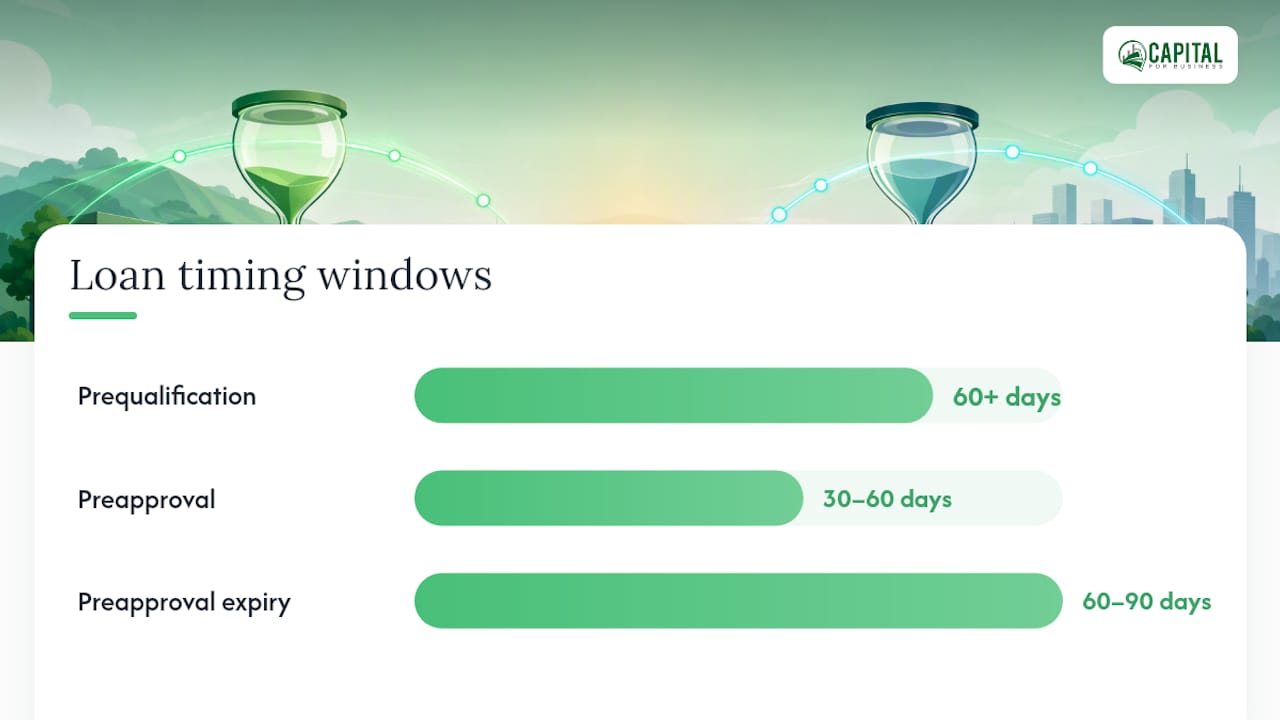
- Your procurement timeline is more than 60 days out.
- You are not yet certain which product fits your need.
Choose preapproval when:
- You have a vendor quote, lease, or equipment purchase ready to move on.
- You need a commitment letter for negotiations.
- You are within 30–60 days of needing funds.
Step-by-step next actions:
- Run two to four soft prequalifications across lenders to establish your market range.
- Narrow to one or two lenders based on rate, terms, and product fit.
- Gather your full document checklist (see above) before requesting preapproval.
- Have an SBDC advisor or accountant review the packet.
- Submit preapproval applications to your chosen lenders.
- Plan procurement to close before the preapproval expires.
Pro Tip: Preapproval letters commonly expire in 60–90 days. Time your vendor negotiations and equipment orders to close well within that window. If your timeline slips, ask the lender whether a renewal requires a new hard pull.
Review common financing mistakes before submitting any application to avoid the errors that most often delay funding.
How Capitalforbusiness supports both steps
Capitalforbusiness matches small business owners to the right product through a single application, covering working capital, equipment financing, merchant cash advances, lines of credit, and SBA guidance. The process starts with a soft prequalification so you can see estimated terms without credit impact, then moves to preapproval only when you are ready to commit.
Since 2009, Capitalforbusiness has worked with owners across hundreds of industries nationwide. The team reviews documents before submission and recommends an SBDC advisor check for complex applications. Explore the full range of small business loan options to find the product that fits your situation, then start your application at Capitalforbusiness.
What most borrowers get wrong — and how to avoid it
The most common mistake is skipping the SBDC review step. Owners assume their documents are complete, submit a preapproval application, and then spend days responding to underwriter requests for missing pages or corrected figures. A 30-minute review with an SBDC advisor catches most of those gaps before they cost time.

The second mistake is triggering hard pulls too early. Owners click "see my offer" on three or four platforms in the same week, not realizing each one ran a hard inquiry. Running soft prequalifications first, then limiting hard pulls to one or two lenders you have already chosen, protects your score and keeps your options open.
A practical habit worth building: run a soft prequalification check annually, even when you do not need capital immediately. It gives you a current read on your borrowing capacity and flags any credit issues before they become urgent.
Getting started with Capitalforbusiness
Capitalforbusiness gives small business owners a faster path from estimate to funded, without the back-and-forth that slows down bank applications.

Here is what the process looks like:
- Estimate your need — decide on loan amount, product type, and timeline.
- Prequalify online (soft pull) — get estimated terms in minutes with no credit impact.
- Select your product — choose from working capital, equipment financing, merchant cash advance, or line of credit.
- Submit documents for preapproval — the team guides you through exactly what is needed.
- Close and receive funds — many products fund within 24–72 hours of final approval.
Capitalforbusiness has served small business owners since 2009 and works with borrowers across hundreds of industries nationwide. Start your application today and see what you qualify for without affecting your credit score.
Sources
The following resources support the guidance in this article and are worth bookmarking for your own research:
- How to Get a Business Loan Successfully - NerdWallet
- Pre-Approved vs. Pre-Qualified: What’s the difference and which is best for your embedded finance product?
- Prequalify for a Business Loan: What to Prepare | Axiant
- Business Loan Prequalification: What it is and How it Helps You Prepare | Lendio
- Prequalification vs Preapproval — Business Loans
This article is general information, not a substitute for advice from a qualified financial advisor. Consult a qualified financial professional about your own circumstances before acting on anything here.
FAQ
What is the main difference between prequalified and preapproved for a business loan?
Prequalification uses self-reported data and a soft credit check to produce an estimate; preapproval uses verified documents and often a hard pull to produce a near-final, conditional offer with real underwriting behind it.
Does prequalification hurt my credit score?
No. Prequalification typically uses a soft inquiry, which does not affect your credit score and is not visible to other lenders. Only preapproval, which usually involves a hard pull, can cause a temporary score dip.
How long does a business loan preapproval last?
Preapproval letters commonly expire within 60–90 days. Plan your vendor negotiations and procurement to close well before that deadline, and ask your lender whether a renewal requires a new hard pull.
When should a small business owner pursue preapproval instead of prequalification?
Pursue preapproval when you have a specific vendor quote, lease, or equipment purchase ready to move on, or when you need a commitment letter to use in negotiations. If you are still exploring options, stick to soft prequalifications.
Can Capitalforbusiness help with both prequalification and preapproval?
Yes. Capitalforbusiness starts with a soft prequalification so you can see estimated terms without credit impact, then guides you through the preapproval and document submission process for working capital, equipment financing, merchant cash advances, and lines of credit.