
A personal guarantee is a signed promise to repay a business loan out of your own pocket if the company can't. Sign one, and your house, savings, and personal credit score become collateral for a debt that belongs to your business, not you. Guarantees range from limited (capped exposure) to unlimited, and SBA-backed loans carry their own fixed rules that leave little room to negotiate.
TL;DR:
- Most small business owners signing personal guarantees are unaware that guarantees often have no caps, meaning your personal assets could be fully liable.
- SBA 7(a) loans automatically require owners with 20% or more ownership to sign an unconditional guarantee, with little room for negotiation or removal.
- Negotiating guarantee terms is feasible with private lenders, including requesting caps, time limits, or collateral swaps to reduce personal exposure.
- Building business credit or offering collateral can help minimize or eliminate personal guarantees before applying for loans.
- Guarantee clauses often include vague language and contingency provisions that can dramatically expand your liability if not carefully reviewed with legal counsel.
Table of Contents
- Personal Guarantee Business Loan Basics: Types You'll Encounter
- What Happens When a Guarantor Gets Sued Over a Business Default
- The SBA 20% Ownership Rule Every Borrower Should Know
- How to Negotiate a Personal Guarantee Before You Sign
- Ways to Reduce or Avoid a Personal Guarantee
- How Capital For Business Structures Financing Around Guarantee Risk
- The Real Problem With How Guarantees Get Explained
- Talk to Us Before You Sign Anything
- Sources
- FAQ
Personal Guarantee Business Loan Basics: Types You'll Encounter
A personal guarantee is a legally binding contract attached to the loan agreement, usually as a signature page near the back that borrowers skim past. Lenders ask for it specifically because the business itself lacks the credit history to justify the risk alone, which is common for startups and businesses under three years old.
The guarantee language you sign determines how bad a default can get for you personally. Here's how the major types break down:
- Limited guarantee: Caps your liability at a set dollar amount or percentage of the loan, sometimes tied to your ownership stake.
- Unlimited guarantee: Makes you liable for the entire outstanding balance, plus interest, collection fees, and legal costs if the lender has to sue.
- Joint and several guarantee: When multiple owners sign, the lender can pursue any one guarantor for the full amount, not just their proportional share.
- Continuing guarantee: Stays active across future advances, renewals, or additional credit lines with the same lender, so it can outlive the original loan by years.
Read every guarantee clause as if it were the main contract, because functionally, it is.
What Happens When a Guarantor Gets Sued Over a Business Default
Lenders don't move straight to seizing assets the day a payment is missed. There's a sequence, and understanding it buys you time to react.
- Default notice and demand letter. The lender formally demands payment, usually citing the specific guarantee clause you signed.
- Collection or negotiation attempt. Some lenders offer a workout plan before litigation, especially if the business shows partial revenue.
- Lawsuit and judgment. If no resolution happens, the lender sues the guarantor directly. Once a court enters judgment, the corporate veil is irrelevant. The loan was never the corporation's problem alone once you signed.
- Asset levy or wage garnishment. With a judgment in hand, lenders can pursue bank accounts, real estate liens, and in many states, garnish wages.
Personal guarantees show up far more often than most borrowers assume going in. The Federal Reserve's Small Business Credit Survey has found that a majority of small business owners who took on debt signed a personal guarantee to get it, which means this isn't a rare fine-print trap. It's standard practice across most lender types.
Once a default judgment lands, expect it on your personal credit report within one to two reporting cycles, and it can sit there for up to seven years, dragging down your score long after the business itself has closed or restructured.
The SBA 20% Ownership Rule Every Borrower Should Know
SBA 7(a) loans operate under a federal rule that isn't up for discussion. Any individual owning 20% or more of the borrowing entity must sign an unconditional personal guarantee, full stop.
- The requirement applies per owner, so a business with four equal partners at 25% each means all four sign.
- "Unconditional" means there's no negotiating the guarantee away, even if your credit and collateral are strong.
- SBA guarantee scope tends to run unlimited rather than capped, unlike some private lender agreements.
- The 7(a) program covers loans up to $5 million, and larger loan amounts often mean more owners cross the 20% threshold and get pulled into the guarantee requirement.
Private lenders sometimes offer flexibility, SBA loans simply don't. That distinction shapes which loan type makes sense for your ownership structure.
How to Negotiate a Personal Guarantee Before You Sign
Guarantee terms are far more negotiable with private and alternative lenders than most borrowers realize. Lenders that ask for guarantees are largely reading them as a signal of character and commitment, one piece of the Five Cs of credit rather than a substitute for real underwriting on capacity and collateral. That gives you room to push back.
Levers worth raising with your lender:
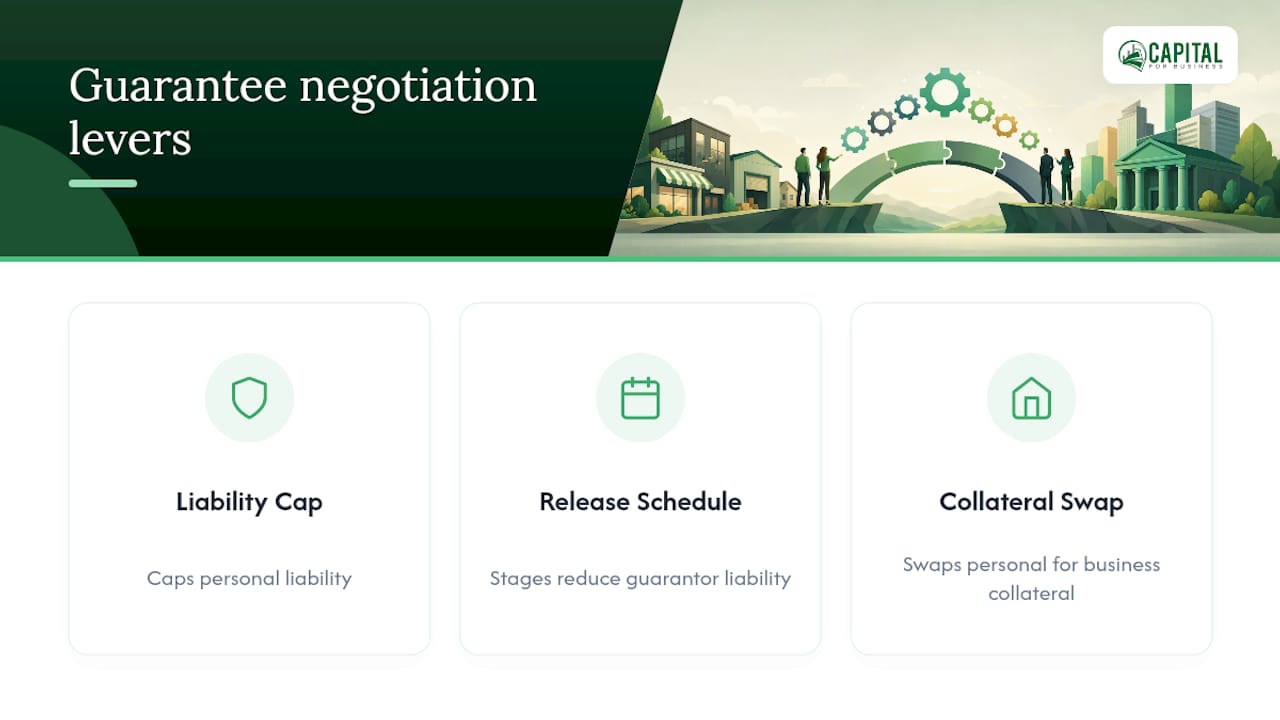
- Cap the amount. Ask for a percentage cap instead of full exposure, especially if you have co-owners.
- Time-limit the guarantee. Some lenders will agree to release the guarantee after 12 to 24 consecutive on-time payments.
- Offer collateral instead. Business equipment or receivables can sometimes swap in for personal liability.
- Request a release schedule tied to the loan balance declining below a set threshold.
Watch for red flags buried in guarantee language: continuing guarantees that quietly cover future credit, vague conversion clauses that let a limited guarantee balloon into an unlimited one, and "bad boy" carve-outs that void your cap entirely if the lender alleges fraud or misused collateral. Review every consideration before signing a small business loan line by line.
Pro Tip: Bring an attorney into the room before you sign, not after. A one-hour contract review typically costs far less than the legal fees you'd face fighting an unlimited guarantee later.
Ways to Reduce or Avoid a Personal Guarantee
You have more leverage than most borrowers assume, particularly once your business has a track record. A few paths worth exploring before you accept a guarantee at face value:
- Build business credit first. A business with two or more years of clean payment history and its own credit profile can qualify for financing with lighter guarantee terms.
- Offer business collateral. Equipment, inventory, or receivables pledged against the loan can reduce or eliminate the need for personal exposure, which is part of why equipment financing often carries lighter guarantee requirements than a general term loan.
- Consider a secured line of credit instead of a lump-sum loan, since ongoing collateral coverage can shrink personal liability over time.
- Share the guarantee across co-owners if you have partners, splitting exposure rather than carrying it alone, though joint-and-several language can undercut that protection if you're not careful.
- Look at unsecured options for smaller amounts, where lenders sometimes weigh cash flow more heavily than personal assets. Learn more about how an unsecured business loan is structured before assuming it's guarantee-free.
None of these routes eliminate risk entirely, but each one shifts some of the weight off your personal balance sheet.
How Capital For Business Structures Financing Around Guarantee Risk
Not every financing product carries the same guarantee weight. Capitalforbusiness works across several product types where underwriting and collateral structure can change what's actually required of you as an owner:
- Equipment financing, where the equipment itself often secures the loan, reducing reliance on a personal pledge.
- Merchant cash advances, underwritten primarily against revenue rather than personal assets.
- Working capital loans and business lines of credit, where terms can flex based on time in business and cash flow strength.
Because Capitalforbusiness underwrites across multiple product types instead of a single loan format, there's more room to match the right structure to your risk tolerance, sometimes with limited guarantees or release terms built in. That said, guarantee language still deserves a legal review before you sign anything.
The Real Problem With How Guarantees Get Explained
Most guidance on personal guarantees treats them as a binary: sign or don't. That framing misses the point. The real work happens in the specific clauses, not the yes-or-no decision, and too many owners sign without ever asking whether a cap, a release schedule, or a collateral swap was on the table.
The conventional advice to "just negotiate" also undersells how differently that plays out by lender type. SBA 7(a) borrowers over the 20% ownership threshold have zero room to remove the guarantee. Private and alternative lenders often have plenty of room, but only if you ask before signing, not after.
If there's one priority worth putting ahead of everything else, it's this: read the guarantee section as closely as the interest rate. Owners obsess over APR and fees, then sign a continuing, unlimited guarantee without blinking. The interest rate affects your monthly payment. The guarantee affects whether you keep your house.
Talk to Us Before You Sign Anything
Capitalforbusiness works across equipment financing, merchant cash advances, working capital loans, and business lines of credit, which means the guarantee terms you're offered depend on the product, not a one-size-fits-all rulebook. That's the real advantage over walking into a single bank product blind: you get options structured around your revenue and collateral, not just your signature.

Before you reach out, gather a few basics: your last three to six months of revenue, time in business, and any equipment or receivables you could offer as collateral. Those three details shape what kind of guarantee, if any, gets attached to your offer. Compare that against what a bank or SBA lender would require, then request a free consultation or pre-qualification through our business funding options to see where you actually stand.
This article is general information, not a substitute for advice from a qualified financial advisor. Consult a qualified financial professional about your own circumstances before acting on anything here.
Sources
- Personal guarantee definition — Investopedia
- 13 CFR § 120.160 — Personal or corporate guarantees (Cornell LII)
- SBA 7(a) loans — U.S. Small Business Administration
- Business loan personal guarantee — Bankrate
FAQ
Is a personal guarantee legally enforceable on a business loan?
Yes. A signed personal guarantee is a binding contract, and courts routinely enforce them once a lender proves default and produces the signed agreement.
What does it mean to be a personal guarantor on a business loan?
It means you agree to repay the loan personally if the business can't, using your own assets, savings, or credit if the lender pursues collection or a lawsuit.
What's the typical monthly payment on a $50,000 business loan?
Monthly payments vary widely by rate, term, and lender type, generally landing somewhere in the low thousands over a multi-year term, but the exact figure depends on your specific offer.
How does a personal guarantee change on a $1,000,000 business loan?
At that loan size, especially through the SBA 7(a) program, every owner with 20% or more equity must sign an unconditional guarantee, and the guarantee typically covers the full balance rather than a capped amount.
Can I get a business loan without a personal guarantee?
Some equipment financing, merchant cash advances, and revenue-based products reduce or waive personal guarantee requirements by leaning on collateral or cash flow instead, though most traditional term loans still expect one.