
No-doc business loans skip the tax returns and financial statements traditional lenders demand, but "no documents" is a stretch. Lenders still pull bank statements, payment processor data, and your EIN to underwrite the loan through software instead of a loan officer. That trade means approval in hours instead of weeks, at a materially higher cost. Use this route for short-term cash gaps, not long-term financing.
TL;DR:
- No-doc loans still verify bank statements, payment processor data, and business ID, but avoid requiring tax returns or detailed financial statements.
- Most no-doc financing options have short repayment periods of three to eighteen months and often require daily or weekly withdrawals that can strain cash flow.
- Qualification mainly depends on consistent cash flow shown through bank deposits and processor data, not on business credit scores or traditional financial documentation.
- They tend to carry higher costs, with factor rates often translating to APRs above 60%, especially when factoring in repayment frequency.
- Use no-doc financing for short-term needs only, and prioritize matching repayment schedules with cash flow to avoid damaging your business finances.
Table of Contents
- What "No-Doc" Actually Means in Practice
- Types of No-Doc and Low-Doc Financing
- Pros and Cons: Speed, Eligibility, and Repayment Trade-Offs
- How Lenders Assess Eligibility and What You'll Need to Apply
- Costs, Repayment Patterns, and How to Compare Total Cost
- Who Offers No-Doc Financing and How to Vet Them Safely
- Step-by-Step: From Application to Funding
- Why Trust This Guide, and How Capital for Business Fits In
- The Real Trade-Off Nobody States Plainly Enough
- Get Funded Fast Without the Bank Runaround
- Sources
- FAQ
What "No-Doc" Actually Means in Practice
Marketing calls it "no documentation," but every legitimate lender still verifies something. The phrase really means "no tax returns, no financial statements, no business plan." What replaces those documents is a direct look at your business's cash movement.
Lenders in this space commonly ask for:
- Three to six months of business bank statements
- Your EIN and business formation documents
- Payment processor or point-of-sale data (Square, Stripe, Shopify)
- A voided check or bank account for the deposit
That data feeds an automated underwriting engine that scans deposit frequency, average daily balance, and revenue trends within minutes rather than the weeks a bank underwriter needs to review tax returns and financial statements, using SME business automation tools to evaluate cash-flow data efficiently. Automated analysis of bank transaction and sales data is what makes same-day decisions possible, but it also means the lender is pricing risk on thinner information, which shows up later in your rate.
Be skeptical of any offer claiming approval on your EIN alone with zero bank access requested. In practice, lenders still typically require bank statements, business identification, and often a personal guarantee even when they market the product as document-free. A lender asking for literally nothing is rarely a lender you want funding you.
Types of No-Doc and Low-Doc Financing
"No-doc" isn't one product. It's a category that spans several structures, each with different repayment mechanics and best-fit use cases.
- Merchant cash advances. You get a lump sum in exchange for a percentage of future card sales or a fixed daily/weekly withdrawal from your bank account. Approval leans heavily on processor and deposit history rather than credit history.
- Invoice factoring. You sell unpaid B2B invoices to a factor at a discount and get most of the cash upfront. This works well for businesses with slow-paying commercial clients and steady receivables, since the factor is really underwriting your customers, not just you.
- Revenue-based short-term loans and lines. These use bank statement data to size a loan or credit line against your monthly revenue, then collect fixed daily or weekly payments until it's repaid.
- Platform and processor loans. Amazon Lending, PayPal Working Capital, and Square Loans size offers directly from sales data already sitting in your seller account, often with no separate application at all.
- Equipment financing with reduced paperwork. Because the equipment itself secures the loan, some lenders will fund based on an invoice and a few months of bank statements instead of full financial packages.
Each product includes merchant cash advances, invoice financing, revenue-based financing, and bank-statement-based lines as the core categories underwriters lean on when tax returns aren't part of the file. Which one fits depends on whether your problem is a cash flow gap, a slow-paying client, or a piece of equipment you need running by next week.
Pros and Cons: Speed, Eligibility, and Repayment Trade-Offs
Speed is the entire appeal. Industry analysts point to automated processing replacing manual document review as the main reason borrowers choose this route over a bank. But that speed comes at a price, literally.
What works in your favor:
- Funding in as little as one to three business days, sometimes same-day
- Approval is realistic for newer businesses or owners with credit dings, since underwriting weighs cash flow over credit score
- Far less paperwork than an SBA or bank application
What works against you:
- Effective borrowing costs run well above traditional bank term loans
- Repayment windows are short, often three to eighteen months
- Daily or weekly withdrawals strain cash flow more than a single monthly payment
- Most products require a personal guarantee, putting your personal assets on the line if the business defaults
Prefer no-doc financing when you have a defined short-term need and can absorb frequent withdrawals. Avoid it for anything you'd normally finance over multiple years, like a build-out or a major equipment purchase with a long payback horizon.
Pro Tip: Before signing, ask the lender to show you the total dollar amount you'll repay, not just the daily withdrawal figure. A small daily number can still add up to a rate that would shock you on paper.
How Lenders Assess Eligibility and What You'll Need to Apply
Qualification for no-doc financing hinges on cash flow evidence, not a credit file review. Here's what most applications actually require:
- Three to six months of business bank statements. Lenders want to see consistent deposits, not just a healthy end balance.
- Your EIN and proof of business formation. An LLC or corporation registered with your state, even a young one, satisfies this.
- A dedicated business checking account. Mixing personal and business deposits muddies the underwriting picture and can slow or sink approval.
- Processor or POS data, if applicable. Retailers and e-commerce sellers benefit from linking Square, Stripe, or Shopify accounts directly.
- A personal guarantee. Most no-doc products require this regardless of your business's credit standing, since the lender has no collateral beyond your receivables.
Personal credit still plays a role even when it isn't the headline factor. A very low score can still trigger a decline or a steeper rate, even with strong bank deposits. To improve your odds, keep your average daily balance positive, avoid excessive overdrafts in the months before applying, and consolidate deposits into one primary business account rather than scattering revenue across several.
Costs, Repayment Patterns, and How to Compare Total Cost
This is where no-doc financing gets confusing on purpose. Many products quote a factor rate instead of an APR. A factor rate of 1.3 means you repay $1.30 for every dollar borrowed, expressed as a flat multiplier rather than an annualized percentage.
The gap that matters: A 1.3 factor rate on a six-month repayment term can translate to an APR well above 60%, even though "1.3" sounds modest on its own. No-doc loans typically carry higher interest rates and shorter repayment terms compared with SBA or bank term loans, which is exactly why the factor-rate format tends to understate the real cost to a borrower doing quick mental math.
To compare offers fairly, convert the factor rate into an equivalent APR using the loan term, then check repayment frequency separately. A $50,000 advance at a 1.3 factor rate repaid daily over six months means roughly $500 leaving your account every business day, a very different cash flow reality than one monthly payment of the same total. Repayment frequency materially affects cash flow, and daily or weekly withdrawals are the detail that catches borrowers off guard more than the headline rate does. Read more on how daily repayment structures affect short-term loans before signing anything with a factor rate attached.
Who Offers No-Doc Financing and How to Vet Them Safely
Legitimate no-doc financing comes from a specific set of channels: online fintech lenders, direct merchant cash advance companies, invoice factoring firms, and platform lenders tied to e-commerce or payment processors. None of these are banks, and that's the point. Their entire business model is built around underwriting speed that traditional institutions can't match.
Before signing with any of them, run a few checks:
- Search the lender on NMLS to confirm state licensing where required
- Check the Better Business Bureau for complaint patterns, not just a star rating
- Read the contract for confessions of judgment, automatic daily debit authorizations, and prepayment penalty language
- Walk away from any lender that pressures you to sign same-day without letting you review terms overnight
If your business has two or more years of tax returns, solid financials, and can wait two to eight weeks for funding, a bank or SBA-backed loan will almost always cost less. No-doc financing exists for the gap SBA and bank underwriting can't fill fast enough.
Step-by-Step: From Application to Funding
- Gather your bank access and separate your accounts. If personal and business deposits are still mixed, open a dedicated business checking account first.
- Match the product to your timing need. A short cash gap points toward a line of credit or short-term loan; a slow-paying client points toward invoice factoring.
- Apply online and connect your accounts. Most platforms link directly to your bank or processor for instant data pulls instead of manual uploads.
- Review the offer before signing. Confirm the factor rate, total payback amount, and withdrawal frequency in writing.
- Plan your cash flow around the new repayment schedule. Build the daily or weekly debit into your budget immediately, not after the first missed cushion.
Pro Tip: Apply early in the day. Some lenders can fund the same business day if your application and account connection go through before their internal cutoff, often late morning.
Why Trust This Guide, and How Capital for Business Fits In
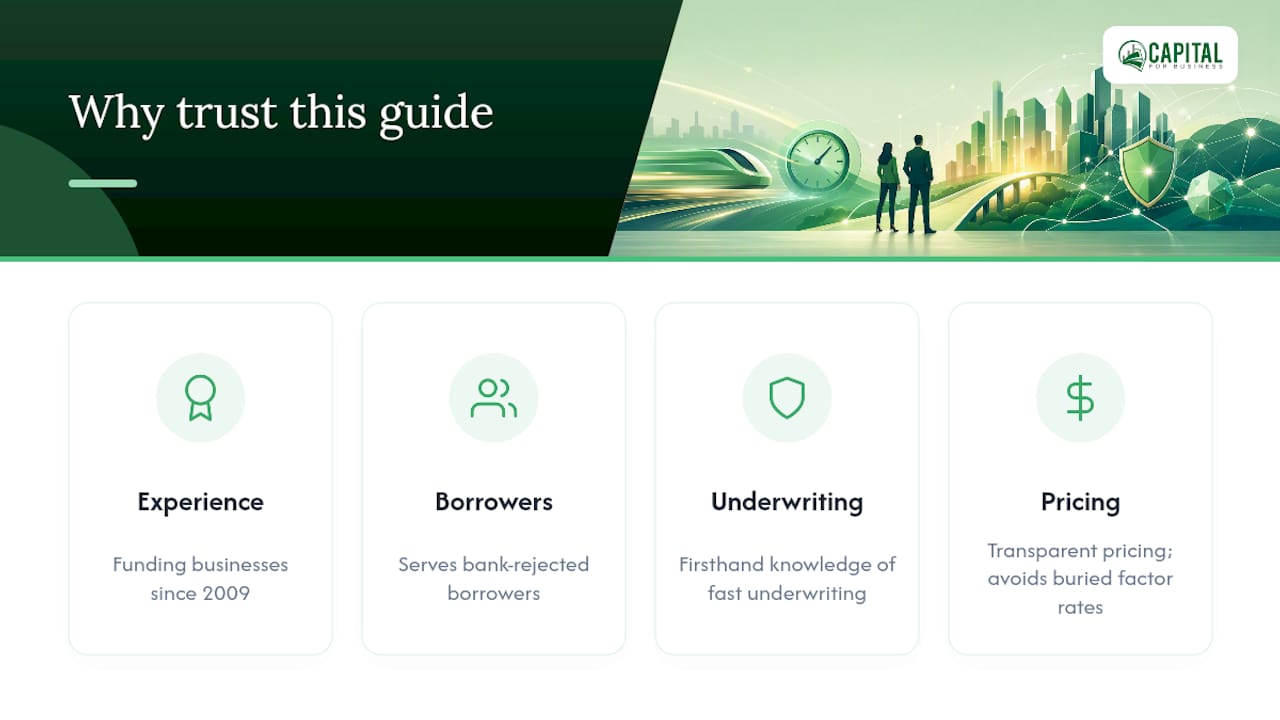
Capitalforbusiness has funded small business owners across dozens of industries since 2009, working specifically with the borrowers banks and credit unions turn down. That history means firsthand familiarity with how fast underwriting actually functions and where the fine print tends to hide in this category.
If your business runs consistent revenue but lacks the multi-year financials a bank wants, a bank-statement-based product from a direct lender is often the realistic path forward, not a workaround. Capitalforbusiness structures offers around what your deposits and processor data actually show, and prices them plainly rather than burying the total cost in a factor rate quoted without context.
The Real Trade-Off Nobody States Plainly Enough
Most coverage of no-doc financing treats speed as the selling point and cost as an afterthought buried in a disclosure paragraph. That framing gets the priority backward. The real question isn't "can I get funded fast?" It's "can my cash flow absorb what fast funding actually costs once the daily withdrawals start?"
The conventional advice tells borrowers to shop rates. Better advice: shop repayment frequency first, because a daily debit on a tight-margin business can do more damage than a slightly higher factor rate on a monthly schedule. Businesses with irregular revenue face worse volatility under daily-withdrawal products specifically, which means the product structure matters more than the label "no-doc" ever will.
Prioritize matching the repayment cadence to your actual cash rhythm before you compare a single rate. Everything else in this decision is secondary to that one fit.
— Capital
Get Funded Fast Without the Bank Runaround
Capitalforbusiness works directly with business owners who need capital now, not in six weeks. Where a merchant cash advance, a working capital loan, or an equipment financing package fits your bank statements and processor history better than a full loan package, that's the product Capitalforbusiness structures for you, priced clearly with no hidden factor-rate math to decode.
Most applicants who connect their bank account get a decision within hours, and funding often follows within one to two business days once terms are accepted. Whether you need a short-term bridge, a working capital loan up to $500,000, or equipment financing tied to a specific purchase, the process starts with a single application. Check your eligibility and see actual offer terms at Capitalforbusiness before committing to any lender quoting you a factor rate without an APR equivalent.
Sources
- Everything You Need To Know About No-Doc Business Loans | Forbes Advisor
- No-Doc business loan explanation | Investopedia
- U.S. Small Business Administration (SBA)
FAQ
How Do You Qualify for a No-Doc Business Loan?
You typically need three to six months of business bank statements, an EIN, a dedicated business checking account, and sometimes payment processor data. Most lenders also require a personal guarantee regardless of credit score.
What Is the Monthly Payment on a $50,000 Business Loan?
It depends entirely on the factor rate and term length rather than a fixed formula. A $50,000 advance at a 1.3 factor rate repaid over six months results in a higher total repayment, split into daily or weekly withdrawals rather than one monthly payment.
Is It Hard for a New LLC to Get a Business Loan?
A brand-new LLC can struggle with traditional bank loans that require two or more years of tax returns, but no-doc products underwritten on bank deposits and revenue trends are far more accessible for newer businesses.
Can You Get a Business Loan Without Collateral?
Yes. Many no-doc products, including merchant cash advances and revenue-based loans, don't require physical collateral, though they almost always require a personal guarantee instead.
Does a No-Doc Loan Affect My Business Credit Score?
Repayment history on most no-doc products, particularly merchant cash advances, doesn't always report to major business credit bureaus, but missed payments or defaults can still trigger collections that damage your credit standing and limit future financing options.