

Choose a loan when you need a one-time lump sum with predictable, fixed payments. Choose a line of credit when you need flexible, reusable access to cash you can draw on as needs arise. The structural difference drives everything else: a loan is installment debt disbursed all at once, while a line of credit is revolving credit you tap and repay repeatedly against a set limit.
TL;DR:
- Lines of credit typically carry variable interest rates, and fees such as draw, maintenance, and inactivity fees can raise overall costs unexpectedly.
- A fixed-rate loan disburses all funds at once with interest accruing on the full amount from day one, best for predictable, large expenses.
- Loans usually require collateral or guarantees for larger amounts, while smaller lines of credit may be unsecured but have lower limits.
- Understanding the impact of draw frequency and fees is essential, as the actual cost depends on your borrowing pattern rather than the advertised APR.
- Combining a term loan with a revolving line of credit is common for businesses with recurring or unpredictable cash needs, optimizing funding efficiency.
Table of Contents
- Line of Credit vs. Loan: How the Structures Compare
- Pros and Cons of Each Borrowing Option
- What Will This Actually Cost You?
- When Should You Use a Loan vs. a Line of Credit?
- What Lenders Look for When You Apply
- How Capitalforbusiness Helps Clients Choose Between the Two
- A Lender's Take on Pairing Both Products
- Get Funding That Matches How You'll Actually Use It
- Where to Read More
- Sources
- FAQ
Line of Credit vs. Loan: How the Structures Compare
A term loan gives you a fixed amount of money upfront, and you repay it in scheduled installments over a set period, usually with a fixed interest rate. A line of credit works more like a reusable pool of funds: you draw what you need, repay it, and draw again, paying interest only on the amount you've actually borrowed.
The mechanics matter more than most borrowers realize:
- Access to funds: Loans disburse in full at closing; lines of credit sit available until you draw against them.
- Interest accrual: Loans accrue interest on the full balance from day one; lines of credit accrue interest only on outstanding draws.
- Rate type: Fixed rates are standard on loans, while lines of credit commonly carry variable rates.
- Collateral: Larger loans often require collateral or a personal guarantee; smaller lines may be unsecured but capped lower.
One contract feature catches borrowers off guard: some lenders attach a cleanup clause requiring the balance to hit zero for a stretch each year. That single requirement can turn a line of credit you assumed was always available into something you have to actively manage. Understanding how a draw period actually works before you sign helps you avoid a surprise cash crunch later.
Pros and Cons of Each Borrowing Option
Every borrowing decision comes down to what you're willing to trade. A loan trades flexibility for certainty. A line of credit trades certainty for flexibility.
Loan advantages:
- Predictable monthly payments make budgeting straightforward.
- Fixed rates are often lower than variable line-of-credit rates.
- Full funding upfront suits large, defined purchases.
Loan drawbacks:
- You pay interest on the entire amount, even if you don't need all of it immediately.
- Once funded, there's no reusing the credit without applying again.
Line-of-credit advantages:
- You pay interest only on what you draw.
- Funds are reusable as you repay, ideal for recurring or uncertain needs.
Line-of-credit drawbacks:
- Variable rates mean your payment can rise without warning.
- Draw fees, maintenance fees, and inactivity fees can quietly add up.
Pro Tip: Before you sign anything, ask the lender for the worst-case scenario: what happens to your payment if the variable rate climbs two points, and what fees apply if you draw the full limit at once? That answer tells you more than the advertised rate ever will.
What Will This Actually Cost You?
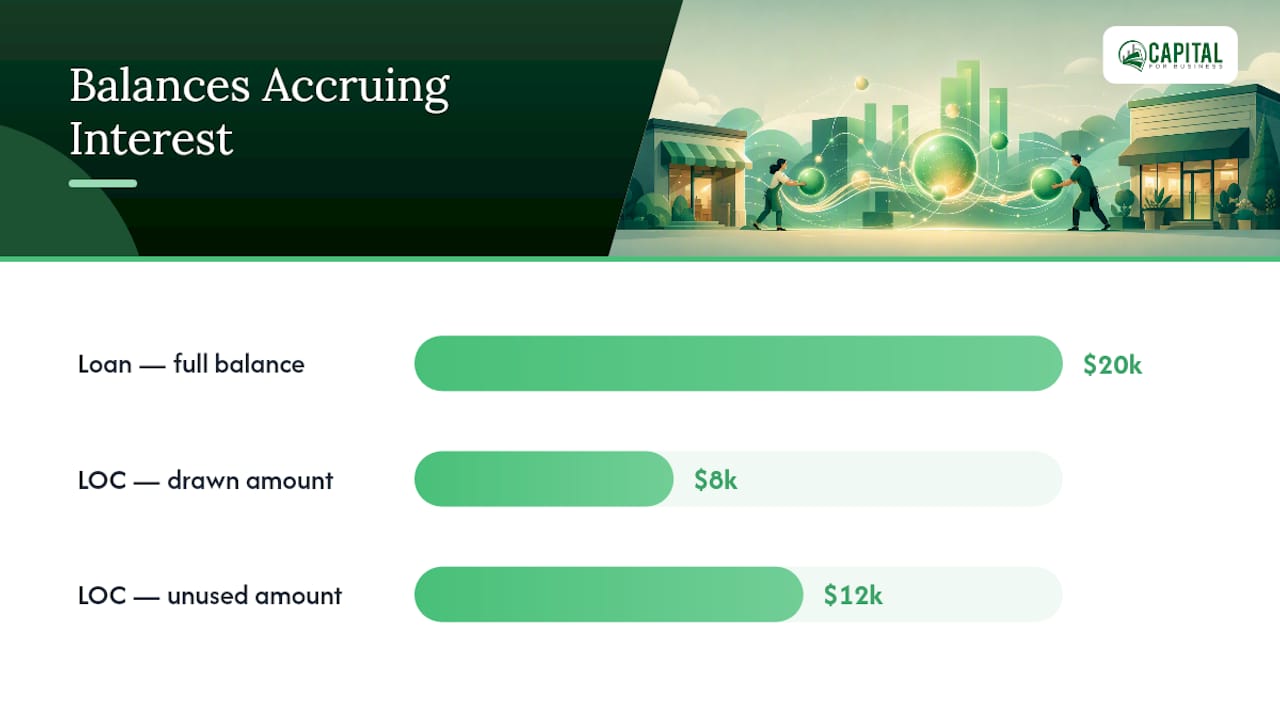
APR bundles the interest rate with fees into one comparable figure, and it's the number to compare, not the headline rate a lender quotes you. Loans accrue interest on the full balance starting the day funds land in your account. Lines of credit accrue interest only on the portion you've drawn, which is why two products with identical APRs can produce very different bills depending on how you actually use them.
Fees to check on any disclosure:
- Origination fee (charged upfront on loans, sometimes on lines too)
- Draw fee (charged each time you access funds on a line of credit)
- Annual or maintenance fee (common on lines of credit)
- Prepayment penalty (more common on loans)
- Inactivity fee (charged if you don't use an open line of credit)
Here's a simple illustration. A $20,000 loan at a fixed rate accrues interest on the full $20,000 from day one, regardless of whether you spend it all immediately. A $20,000 line of credit where you draw $8,000 for three months and repay it accrues interest on that $8,000 alone, not the unused $12,000. Modeling your realistic draw pattern against a full-amortization loan is the only reliable way to know which product actually costs less for your situation. Sources at Nav note that draw fees and renewal charges are what surprise borrowers most, not the headline rate.
When Should You Use a Loan vs. a Line of Credit?
Match the product to the shape of your expense, not just its size.
- Equipment purchase. A defined cost with a known payoff date favors a loan. You know the amount, so a fixed installment schedule keeps budgeting simple.
- Seasonal inventory buildup. A retailer stocking up before a busy quarter benefits from drawing only what's needed and repaying it once sales come in, which is exactly what a business line of credit is designed for.
- Payroll gaps or emergency repairs. Unpredictable timing and uncertain amounts favor revolving access over a fixed lump sum you might not fully need.
Individuals face the same logic on a smaller scale: a fixed home renovation budget points toward a loan, while covering irregular freelance income gaps points toward a line of credit.
What Lenders Look for When You Apply
Loan underwriting centers on your ability to repay fixed installments. Lenders lean on your credit history, debt-to-income ratio, and, for larger amounts, collateral or a personal guarantee. Line-of-credit underwriting leans more heavily on cash flow and repayment consistency, since the lender is extending ongoing access rather than a single payout.
Expect to provide tax returns, bank statements, and, for business applicants, a UCC filing may accompany secured lines. To improve your odds before applying:
- Pull your credit report and fix errors months in advance.
- Organize cash flow records that show consistent revenue, not just profit.
- Have two years of tax returns ready for either product.
- Ask every lender for a sample all-in monthly cost, not just the advertised rate.
Reviewing how business loans differ from personal loans before applying helps you know which documents to prepare.
How Capitalforbusiness Helps Clients Choose Between the Two
Capitalforbusiness has worked with small business owners across dozens of industries since 2009, and one pattern shows up constantly: the owners who plan best rarely pick one product exclusively. They pair a term loan for a defined purchase with a standing line of credit for the unpredictable weeks. The most common mistake is borrowing a lump sum for a need that was actually recurring, then paying interest on money that sat idle for months.
A short checklist worth running before you apply:
- What's the purpose: a one-time cost or a recurring gap?
- How soon do you need funds, and for how long?
- How predictable is your monthly cash flow?
- How much rate variability can your budget absorb?
A Lender's Take on Pairing Both Products
Speed matters, but fit matters more. In practice, the fastest approval isn't worth much if the product doesn't match how you'll actually use the money. Borrowers who ask the right questions upfront rarely regret the product they chose.
— Capital
Get Funding That Matches How You'll Actually Use It
Some lenders offer alternatives to slow bank underwriting for owners who already know whether they need a lump sum or ongoing access and can move quickly on both term loans and flexible lines of credit.

Before you apply, have your last two years of tax returns, recent bank statements, and a clear number in mind, whether that's a $20,000 equipment purchase or a revolving limit to smooth out payroll. If your need is ongoing rather than one-time, our working capital funding page walks through how the application works and what to expect. Start there, gather your documents, and request a quote to see real numbers instead of guesswork.
Where to Read More
- Investopedia: core structural differences.
- NCUA: regulatory definitions and protections.
This article is general information, not a substitute for advice from a qualified financial advisor. Consult a qualified financial professional about your own circumstances before acting on anything here.
Sources
FAQ
Which Is Better, a Line of Credit or a Loan?
Neither is universally better. A loan suits one-time, predictable expenses, while a line of credit suits recurring or uncertain cash needs where you only want to pay interest on funds you actually use.
What Are the Disadvantages of a Line of Credit?
Variable rates can raise your payment unexpectedly, and fees like draw charges, annual fees, or cleanup clause requirements can add cost and complexity you won't find on most fixed-rate loans.
How Does a $10,000 Line of Credit Work?
You only pay interest on what you draw. If you draw a portion and repay it, that amount becomes available again without reapplying.
Which Is Better, a Line of Credit or a Mortgage?
A mortgage is a secured installment loan built for one large, long-term purchase, a home, and isn't a practical substitute for a line of credit's revolving, short-term flexibility; they serve entirely different purposes.