
A line of credit draw period is the borrowing window on a business revolving credit line during which you can draw funds, repay them, and draw again up to your approved limit. According to Lendio, payments during this window are often interest-only, and the repayment period that follows requires full principal-plus-interest amortization. Before you sign anything, check three things immediately:
- Draw period length: Business LOCs typically run several months to multiple years depending on the lender and product type.
- Payment type during draw: Confirm whether you owe interest-only or principal-and-interest (P&I) each month while drawing.
- Conversion risk: The biggest financial shock comes when the draw period ends and payments jump to full amortization. Plan for it early.
This article covers business lines of credit only, not HELOCs. All examples reference U.S. lenders, including Capitalforbusiness products.
Key Takeaways
The draw period on a business line of credit determines how long you can borrow, what you pay monthly, and what financial obligation you face when that window closes.
| Point | Details |
|---|---|
| Confirm draw period length | Match the draw window to your business cycle; a period shorter than your repayment cycle creates conversion risk. |
| Know your payment type | Interest-only payments lower monthly costs during draw but increase total interest and payment shock at conversion. |
| Understand renewal triggers | Get renewal or conversion terms in writing; "we usually renew" is not a contractual commitment. |
| Negotiate fee caps | Request performance-based fee waivers tied to payment history before signing, not after. |
| Capitalforbusiness lines | Offers revolving lines up to $250,000 with flexible underwriting for businesses since 2009. |
Table of Contents
- What happens when your draw period ends?
- How payments and interest work during the draw period
- How long do draw periods typically run?
- Fees tied to draw periods and renewals
- Red flags in draw-period contract language
- How to choose and negotiate draw-period terms
- How Capitalforbusiness structures draw periods: two examples
- When does a draw-period LOC make more sense than alternatives?
- What Capitalforbusiness has learned about draw periods
- Capitalforbusiness lines of credit: flexible funding when banks say no
- Sources
- FAQ
What happens when your draw period ends?
Stripe's business LOC guide identifies four common outcomes lenders use at draw-period maturity:
- Convert to a term loan: The outstanding balance becomes a fixed amortizing loan with set monthly payments.
- Renew the line: The lender resets the draw period, often after a brief review of your financials.
- Require full payoff: Less common, but some lenders demand the balance paid in full before issuing a new line.
- Close to new draws: The line stays open for repayment only; no new borrowing is permitted.
Most lenders notify borrowers 30–90 days before maturity. That window is your planning runway. Use it to model cash flow under each scenario, gather updated financials, and open renewal conversations early. A simple timeline: draw period ends → lender sends maturity notice → you choose to renew, convert, or pay off → new terms take effect.
Confirm the post-draw process in writing before you draw heavily. A lender who says "we usually renew" but whose contract says "full payoff at maturity" leaves you exposed. Get the renewal or conversion path documented in the agreement itself.
How payments and interest work during the draw period
Most business LOC draw periods require interest-only payments on the drawn balance. Some lenders allow or require small principal payments alongside interest, which reduces total interest cost but increases monthly cash outflow during the draw window.
| Payment Type | Monthly Cash Impact | Total Interest Cost | Refinancing Risk |
|---|---|---|---|
| Interest-only | Lower during draw | Higher overall | Higher at conversion |
| Principal + interest (P&I) | Higher during draw | Lower overall | Lower at conversion |
Variable-rate LOCs add another layer. When the prime rate moves, your monthly interest payment moves with it. Budgeting for a 1–2 percentage point rate increase on your average drawn balance is a practical cushion, especially for lines you plan to carry for 12 months or more. For broader context on rate trends affecting revolving credit, this credit interest forecast outlines what borrowers should watch.
Pro Tip: If your lender offers a P&I option during the draw period, run the numbers both ways. The higher monthly payment often saves more in total interest than the difference looks like on paper, and it reduces the payment shock when the line converts.
How long do draw periods typically run?
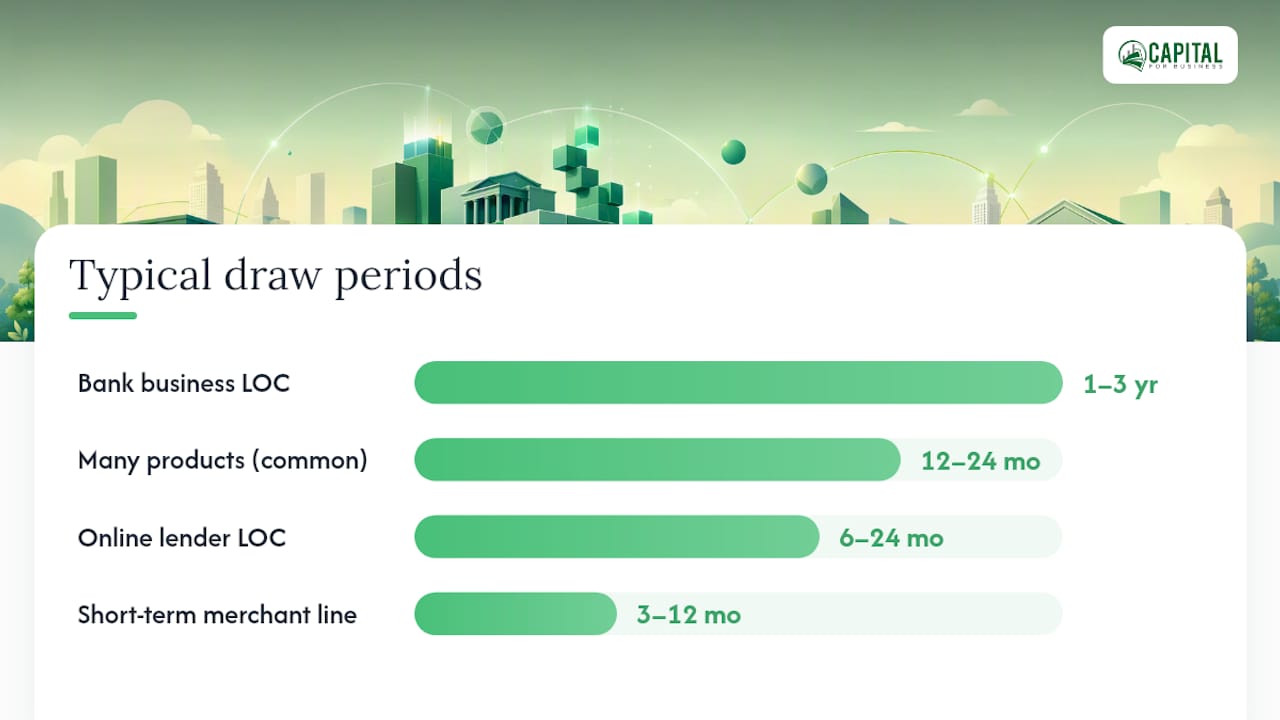
Liminal Lending's LOC guide notes that draw periods commonly run 12–24 months for many products, though some lines are evergreen and renew indefinitely when the account stays in good standing.
| Product Type | Typical Draw Period | Notes |
|---|---|---|
| Bank business LOC | 1–3 years | Annual review common; renewal not guaranteed |
| Online lender LOC | 6–24 months | Faster approval; shorter draw windows |
| Short-term merchant line | 3–12 months | Higher cost; tied to revenue volume |
| Evergreen business LOC | Ongoing | Renews automatically if covenants are met |
Two quick examples:
- You draw $50,000 on a $100,000 line at 9% annual interest. Interest-only payment: $375/month. After a 24-month draw period, the balance converts to a 36-month term loan at the same rate. Amortized payment: roughly $1,590/month. That jump is the payment shock to plan for.
- You draw $20,000 on a $75,000 line at 10%. Interest-only: $167/month. If the lender renews the draw period rather than converting, your payment stays at $167 as long as you carry that balance.
Fees tied to draw periods and renewals
The fees below appear most often in business LOC agreements:
- Origination/administration fee: Charged at closing, typically 1–3% of the credit limit.
- Commitment or availability fee: An annual or quarterly charge on the total approved limit, regardless of how much you draw.
- Unused-line fee: Charged on the undrawn portion of the limit, usually 0.25–0.5% annually.
- Renewal fee: Assessed when the lender resets the draw period, often $150–$500 or a percentage of the limit.
- Conversion fee: Some lenders charge to convert the balance to a term loan at draw-period end.
When negotiating, ask for a fee cap on renewals and a waiver trigger tied to payment history. A clean 12-month payment record is a reasonable basis to request a renewal-fee waiver.
Red flags in draw-period contract language
Watch for these clauses before you sign:
- No renewal language: If the contract is silent on renewal, assume full payoff is required at maturity.
- Steep conversion amortization: A 12-month repayment schedule on a large balance creates severe cash-flow pressure.
- Broad material adverse change (MAC) clauses: These let the lender freeze or cancel the line if your financials "materially change," a term that can be defined very broadly.
- Immediate paydown triggers: Some contracts require full repayment on any default event, including a missed payment on a separate obligation.
- Rising margin tied to covenants: If your debt-service coverage ratio drops, your interest rate can step up automatically.
Ask every lender these three questions before signing: "What specific events trigger a MAC clause in this agreement?" "What is the amortization schedule if my balance converts at maturity?" "Can the line be frozen or reduced during the draw period, and under what conditions?"
Getting clear answers in writing protects you from surprises that are entirely avoidable. Understanding the science behind business line of credit underwriting helps you anticipate what lenders are watching.
How to choose and negotiate draw-period terms
Start with this prioritized checklist before comparing lenders:
- Credit limit fit: Does the approved limit cover your peak working capital need with room to spare?
- Draw period length: Is it long enough to match your business cycle (seasonal, project-based, or ongoing)?
- Payment type during draw: Interest-only or P&I? Which fits your cash flow?
- Renewal terms: Is renewal automatic, discretionary, or requires reapplication?
- Fees: What is the total annual cost including commitment, unused-line, and renewal fees?
- Conversion amortization: If the line converts, how many months do you have to repay?
Sample language to request:
- Renewal clause: "The draw period shall automatically renew for successive 12-month terms provided no event of default has occurred and borrower's financial statements meet the original underwriting criteria."
- Conversion schedule: "In the event of conversion to a term loan, the repayment period shall be no less than 36 months."
- Fee cap: "Annual renewal fees shall not exceed $250 and shall be waived if borrower maintains a payment history free of 30-day delinquencies."
Trust signals to verify before committing:
- Years in operation and track record with small businesses
- Published credit limits and product caps (not just "up to" language with no floor)
- Clear underwriting criteria stated upfront
- Average time from application to funding
How Capitalforbusiness structures draw periods: two examples
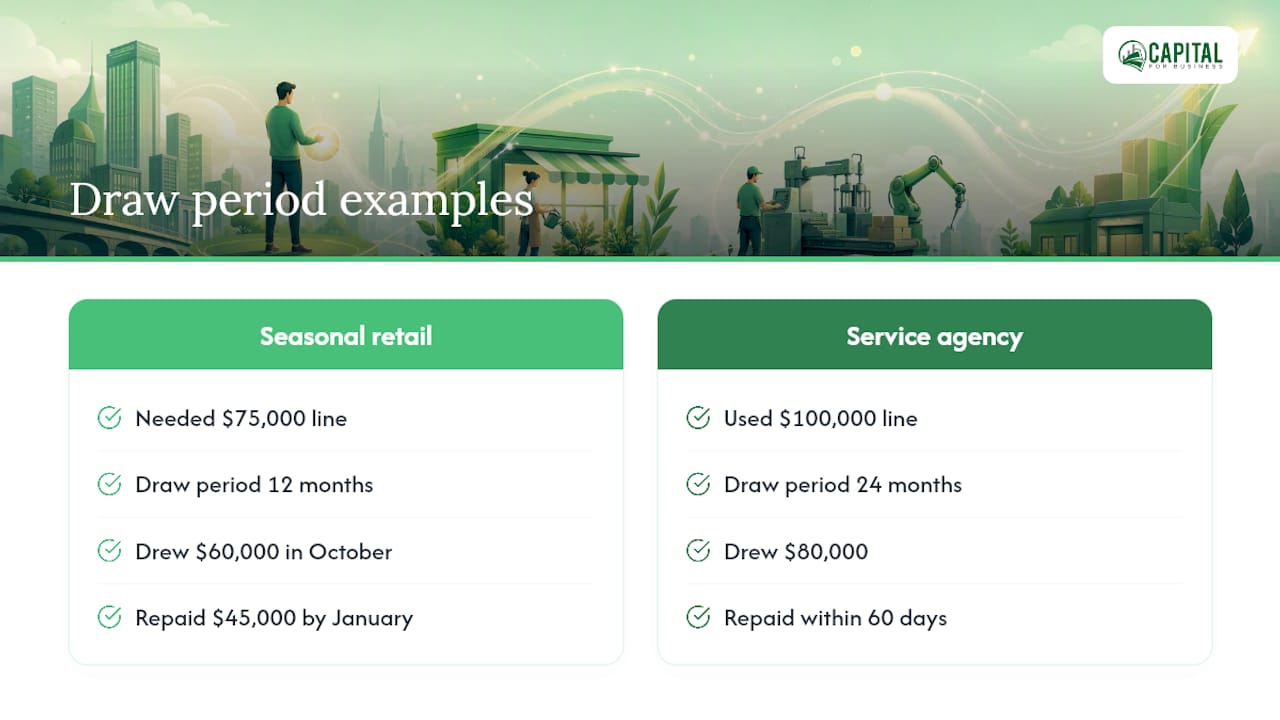
Case A — Seasonal retail business: A gift shop owner needed a $75,000 line to stock inventory before the holiday season. Capitalforbusiness structured a 12-month draw period with interest-only payments. The owner drew $60,000 in October, repaid $45,000 by January from holiday revenue, and drew again in March for spring inventory. At the 12-month mark, the line renewed after a brief financial review. The operational lesson: drawing and repaying within the same season kept utilization low and made renewal straightforward.
Case B — Service business with payroll gaps: A staffing agency carrying $180,000 in outstanding receivables used a $100,000 line to cover payroll during a 45-day client payment delay. The draw period was 24 months. The agency drew $80,000, repaid it within 60 days when receivables cleared, and maintained the line as a standing reserve. The lesson: treating the line as a short-term bridge rather than permanent capital kept interest costs minimal and preserved the full limit for the next gap.
Capitalforbusiness has structured flexible revolving credit for small businesses across hundreds of industries since 2009, with lines up to $250,000.
Pro Tip: Before your draw period ends, set aside a cash reserve equal to at least one full amortized repayment-period payment. That buffer gives you 30 days of breathing room if the conversion timeline shifts or renewal is delayed.
When does a draw-period LOC make more sense than alternatives?
Choosing the right product depends on what the capital is actually for. Here is a quick guide:
- Working capital and cash-flow gaps: A revolving LOC with a draw period is the right fit. You borrow only what you need and repay as revenue comes in.
- Seasonal inventory buildup: An LOC lets you draw before peak season and repay after, without carrying a fixed loan balance year-round.
- One-time equipment purchase: A term loan or equipment financing is usually better. Fixed payments match the asset's useful life, and rates are often lower.
- Payroll smoothing during receivables delays: An LOC draw period handles this well, provided the draw period is long enough to cover your typical collection cycle.
- Large, one-time capital projects: A term loan wins here. Predictable amortization is easier to budget than a revolving balance with a variable rate.
For a direct comparison of LOCs against merchant cash advances, this MCA vs. business loan breakdown covers the trade-offs clearly.
What Capitalforbusiness has learned about draw periods
Most small business owners focus on the credit limit and the rate. The draw period length and the post-draw terms are what actually determine whether the line helps or hurts. At Capitalforbusiness, the first question in underwriting is not "how much does this borrower need?" It is "how long does this borrower need access to capital, and what does their repayment cycle look like?" Those two answers shape the draw period structure more than any other variable.
One practical action you can take right now: before you apply anywhere, write down your peak borrowing month, your typical repayment month, and the gap between them. That number is your minimum draw period requirement. Any line shorter than that gap puts you at risk of conversion before you have repaid.
Capitalforbusiness lines of credit: flexible funding when banks say no
Small businesses that have been turned down by traditional banks often qualify through Capitalforbusiness. Lines go up to $250,000, with flexible underwriting that looks at real business performance rather than just credit scores. The application process is straightforward, and funding can move quickly for qualified borrowers.

Since 2009, Capitalforbusiness has worked with owners across hundreds of industries who needed revolving credit that fits how their business actually operates, not how a bank spreadsheet models it. Whether you need a 6-month draw period for a seasonal push or a 24-month window for ongoing working capital, the structure can be matched to your cycle. Apply for a business line of credit or explore all small business funding options to find the product that fits your situation.
Sources
- Draw Period vs. Repayment Period, Explained | Lendio
FAQ
What is a draw period on a business line of credit?
The draw period is the window during which you can borrow, repay, and re-borrow up to your approved credit limit.
How long does a typical business LOC draw period last?
Draw periods commonly run 12–24 months for many products, though bank lines can extend to 3 years and some evergreen lines renew indefinitely when the account stays in good standing.
What happens after the draw period ends?
Lenders typically renew the line, convert the outstanding balance to a term loan, or require full repayment, as Stripe's LOC guide outlines. The specific outcome depends on your contract language.
How can I avoid payment shock when my draw period converts?
Build a cash reserve equal to at least one full amortized payment before conversion, and negotiate a repayment schedule of at least 36 months in your original agreement to keep monthly payments manageable.
Does Capitalforbusiness offer business lines of credit with draw periods?
Yes. Capitalforbusiness offers revolving business lines of credit up to $250,000 with flexible underwriting for small businesses across the U.S., including owners who do not qualify through traditional banks.