
TL;DR:
- HVAC contractors can access specialized financing options for equipment, working capital, and seasonal needs.
- Choosing the right financing type depends on business purpose, cash flow cycle, and credit profile.
- Strategic, industry-aware funding approaches help maintain business stability and growth.
Running an HVAC business means managing equipment costs, seasonal cash flow swings, and unexpected repairs all at once. Many contractors assume that business financing is limited to a standard bank loan, but the reality is far more flexible. Specialized funding options exist specifically for HVAC contractors, covering everything from purchasing service vans to bridging the slow winter months. This guide breaks down the main financing types available to you, explains what lenders actually look for, and helps you match the right funding product to your specific business goals. Whether you are just starting out or ready to expand your fleet, understanding your options puts you in control.
Table of Contents
- What is HVAC business financing?
- Types of financing: Which works for HVAC businesses?
- Getting approved: Requirements, hurdles, and tips
- Matching financing to HVAC business goals
- Avoiding mistakes: Pitfalls and best practices
- Why smart HVAC financing is more than loan approval
- How to get trusted HVAC financing now
- Frequently asked questions
Key Takeaways
| Point | Details |
|---|---|
| Specialized funding options | HVAC financing offers industry-specific solutions beyond generic business loans. |
| Product fit matters | Choosing the right financing type can lower costs and boost approval odds. |
| Approval requires preparation | Strong documentation and aligning with lender requirements are key steps. |
| Strategic use drives growth | Smart HVAC owners match financing to goals for long-term stability and profits. |
What is HVAC business financing?
HVAC business financing refers to funding products tailored specifically for HVAC contractors and small business owners who need capital to grow, stabilize, or operate. Unlike a personal loan or general small business credit, HVAC-specific financing accounts for the unique cost structure and cash flow patterns that come with this trade.
In plain terms, it means getting access to money that helps you do your job without draining your operating budget. That could mean buying a new service van, restocking refrigerant, replacing diagnostic equipment, or simply covering payroll during a slow February.
According to HVAC Business Financing Blog, "HVAC business financing refers to specialized funding options tailored for small HVAC contractors to purchase equipment, manage seasonal cash flow, expand operations, or cover working capital needs." That definition matters because it frames financing not as a last resort, but as an operational tool.
Here are the most common working capital needs HVAC businesses face:
- Purchasing or leasing service vans and trucks
- Buying HVAC units, tools, and diagnostic equipment
- Covering payroll and labor costs during offseason months
- Managing accounts receivable gaps when invoices are delayed
- Funding marketing campaigns ahead of peak season
- Paying for licensing, insurance renewals, and compliance costs
- Bridging cash flow when a large commercial job ties up resources
Startup costs for an HVAC business can range from $2,000 to over $100,000 depending on scale, with a basic service van and core equipment alone running $55,000 to $95,000. These numbers underscore why financing is not optional for most operators, it is foundational.
The ServiceTitan HVAC financing guide provides a solid look at how HVAC contractors typically structure their initial capital needs. Understanding the full scope of those costs is the first step toward choosing funding that actually fits your situation.
Types of financing: Which works for HVAC businesses?
Once you understand what HVAC financing covers, the next step is knowing which product fits your goals. Not every funding type suits every situation, and choosing the wrong one can cost you more than you saved.
Here are the main financing types available to HVAC contractors:
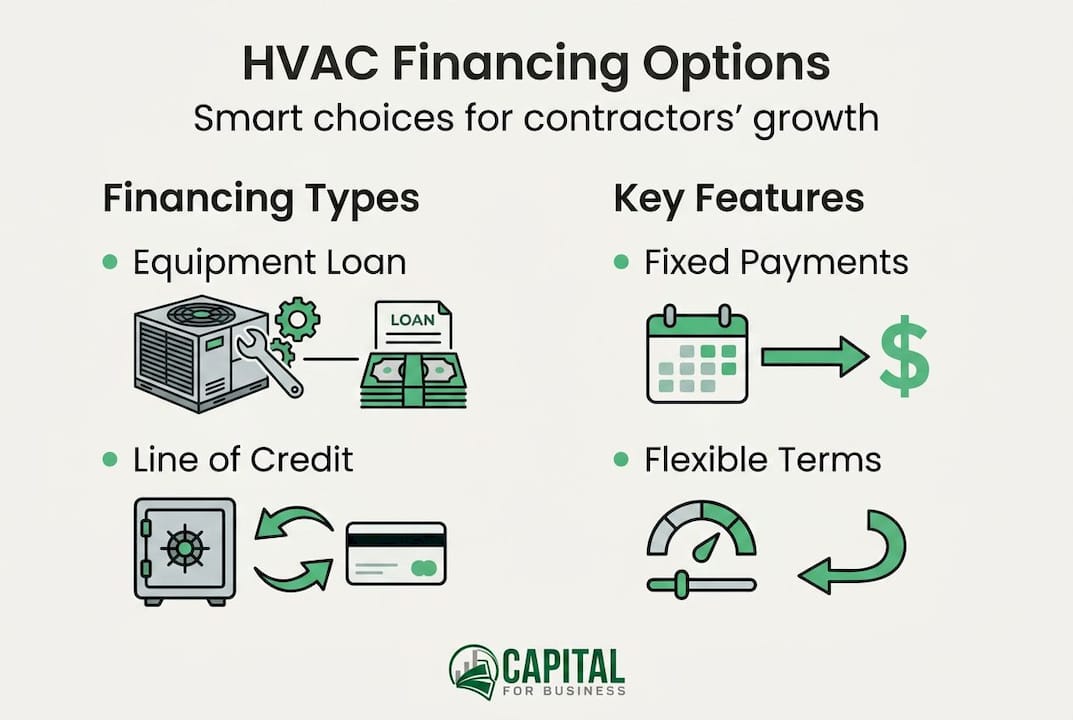
- Equipment financing: Designed specifically for asset purchases. The equipment itself serves as collateral, which means approval is more accessible even with a lower credit score. Equipment financing typically covers 80 to 100 percent of the asset cost. Common HVAC assets financed this way include service vans ($35,000 to $65,000), refrigerant recovery machines, and diagnostic tools.
- SBA loans: Backed by the Small Business Administration, these offer competitive rates and longer repayment terms. They require more documentation and take longer to process, but they suit stable, established businesses planning significant expansion.
- Business line of credit: A revolving credit facility that lets you draw funds as needed and repay on a flexible schedule. This is ideal for working capital solutions during seasonal dips or to cover unexpected costs without taking on a fixed lump-sum loan.
- Merchant cash advance (MCA): An advance against future receivables, repaid through a percentage of daily or weekly revenue. Approval can happen in 24 hours, which makes it valuable for urgent needs.
- Traditional bank loans: Offer the lowest rates but demand strong credit, solid revenue history, and longer approval timelines.
| Financing type | Typical APR | Approval speed | Best use case | Credit requirement |
|---|---|---|---|---|
| Equipment financing | 5.5% to 18% | 1 to 3 days | Asset purchases | Moderate |
| SBA loan | 6% to 13% | 2 to 3 months | Long-term expansion | Good to excellent |
| Business line of credit | 8% to 24% | 1 to 7 days | Seasonal cash flow | Moderate |
| Merchant cash advance | Factor rate varies | 24 hours | Emergencies, peaks | Low to moderate |
| Bank loan | 5% to 15% | Weeks to months | Large projects | Good to excellent |
To decide which option is right for you, work through these steps:
- Identify the specific purpose: equipment, cash flow, or expansion
- Assess how quickly you need the funds
- Review your current credit score and monthly revenue
- Calculate what monthly repayment you can realistically absorb
- Compare total cost of capital, not just the interest rate
As noted in the ServiceTitan HVAC Business Loans breakdown, equipment financing allows lenders to finance specific HVAC assets and use the asset as collateral, which significantly eases approval even for owners with lower credit scores.
Pro Tip: If you are buying equipment that holds strong resale value, prioritize equipment financing over an MCA. You will pay less over time and the approval process is often just as fast.
For flexible day-to-day needs, a business line of credit gives you revolving access to capital without committing to a fixed repayment schedule.
Getting approved: Requirements, hurdles, and tips
Knowing which loan type to pursue is only half the work. Getting approved requires preparation and an honest look at where your business stands financially.
Most lenders evaluate HVAC applicants using a combination of the following criteria:
| Requirement | Typical threshold | Notes |
|---|---|---|
| Monthly revenue | $10,000 to $20,000 | Some lenders require this minimum |
| Time in business | 6+ months | Startups may qualify through alternative lenders |
| Credit score | 550 to 680+ | Varies significantly by product |
| Annual revenue | $120,000+ | For SBA and bank loans |
| Documentation | Tax returns, bank statements, P&L | Needed for most traditional lenders |
Startups face a tougher path. With limited revenue history and no business credit profile, traditional lenders often decline them. However, equipment financing and alternative lenders remain accessible because they rely more on asset value and revenue potential than on credit history alone.
Common reasons HVAC applications get denied include:
- Credit score below lender minimums
- Insufficient monthly or annual revenue
- Missing or incomplete financial documentation
- Too little time in business
- High existing debt load relative to revenue
- No clear plan for using the funds
Each of these hurdles has a solution. Building business credit early, even through a small credit card or vendor account, establishes a track record. Keeping clean, organized financial records reduces delays and builds lender confidence. If your personal credit is the issue, explore HVAC loan options with poor credit that rely on revenue performance instead.
For HVAC owners who move fast and need funding without a long paper trail, the MCA process for HVAC offers a streamlined path with minimal documentation requirements.
Pro Tip: Before you apply, gather three to six months of bank statements, your most recent tax return, and a brief written summary of how you plan to use the funds. Lenders move faster when the package is complete, and a clear use-of-funds statement signals that you are a low-risk borrower.
Matching financing to HVAC business goals
Different goals require different tools. A financing product that works perfectly for buying a new service van may be entirely wrong for bridging a seasonal cash flow gap. Matching the right product to the right situation saves money and protects your business health.
Here is a practical breakdown of common HVAC financing needs and the products that fit best:
- Buying a new service van or HVAC unit: Equipment financing is the clearest fit. The asset secures the loan, rates are competitive, and you preserve cash for operations.
- Bridging the winter slowdown: A business line of credit gives you flexible, revolving access to funds without a fixed monthly obligation tied to your slowest revenue period.
- Emergency equipment failure mid-season: An MCA can fund your account within 24 hours, keeping you on the job when a critical tool breaks down unexpectedly.
- Hiring technicians ahead of summer peak: Working capital loans or lines of credit cover payroll while your receivables catch up to your labor costs.
- Opening a second location or buying a competitor: SBA loans or traditional bank loans offer the scale and term length needed for major strategic moves.
- Covering materials on a large commercial job: Invoice financing or a short-term business loan bridges the gap between project start and payment receipt.
When speed is the priority, MCAs and fast-approval lenders can prevent you from losing jobs to slower competitors. However, fast funders like MCAs carry higher effective rates and should be reserved for short-term needs, not ongoing operational costs.
Seasonality is one of the most underappreciated financial pressures in the HVAC industry. Summer and winter peak seasons generate strong revenue, but the spring and fall shoulder seasons can create real cash crunches. Using MCAs for seasonal cash needs during peaks makes sense if repayment aligns with high-revenue months. For the slow months, a line of credit is often a better structural fit.

For contractors navigating the cold months specifically, strategies for managing winter slowdowns can help you plan financing around your actual revenue cycle rather than reacting to shortfalls after they hit.
Avoiding mistakes: Pitfalls and best practices
Even with the right information, HVAC business owners make costly financing mistakes. Most of them are avoidable with a bit of planning and a realistic view of total loan cost.
One of the most common traps is focusing only on the approved amount, not the cost of borrowing. MCAs, in particular, use factor rates rather than traditional interest rates, and the effective annual percentage rate can reach well above 50 percent in some cases. That is not necessarily a reason to avoid them, but it is a reason to use them surgically, not habitually.
Newly established businesses and startups are especially vulnerable. As noted by HVAC Business Financing Blog, startups with limited history can access equipment financing or alternative lenders, and revenue-based products like MCAs process in as little as 24 hours, but the high factor rates mean these should be short-term solutions only.
Here are five best practices every HVAC owner should follow:
- Calculate total repayment cost, not just the rate. A low interest rate on a long-term loan can still cost more than a higher-rate short-term product depending on the term length.
- Align repayment terms with your revenue cycle. If you generate most revenue in summer, avoid products with fixed daily payments that drain you through winter.
- Separate business and personal finances. Mixing them complicates your application and weakens your financial profile with lenders.
- Borrow with a purpose. Vague use-of-funds reasoning leads to poor decisions and overspending. Know exactly what the capital will produce.
- Compare at least two to three lenders before committing. Rates and terms vary more than most owners realize, and a single comparison can save thousands.
When deciding between ownership and monthly payments, weighing your options in an equipment leasing vs loan analysis helps you see the true long-term cost of each path. The HVAC financing mistakes outlined by industry experts confirm that skipping this comparison is one of the most common and expensive errors HVAC operators make.
Pro Tip: Build your repayment calendar around your actual revenue peaks. If you know July through September are your strongest months, structure repayment to fall heavier in that window and lighter in slow periods when possible.
Why smart HVAC financing is more than loan approval
Here is something most guides will not tell you: getting approved is the easy part. The harder, more important question is whether the financing you chose actually serves your business a year from now.
At Capital for Business, we have worked with HVAC contractors since 2009, and the ones who build durable businesses treat financing as an ongoing strategy, not a one-time event. They do not grab the first approval they receive. They ask whether the product fits their current growth phase, their cash flow rhythm, and their three-year plan.
The contractors who struggle are usually the ones who took a fast MCA out of urgency and then rolled it over repeatedly, slowly eroding their margins. A quick approval feels like a win until the daily repayment starts pulling from your operating account every morning, including the slow weeks in November.
Smart financing often means layering products: using equipment financing for assets, a line of credit for seasonal gaps, and reserving MCA access strictly for genuine emergencies. This structure keeps your cost of capital low while maintaining flexibility.
We also believe strongly in working with lenders who understand HVAC cycles specifically. A lender unfamiliar with seasonal revenue patterns may flag a slow March as a red flag rather than a normal part of your business year. Finding a partner who knows the industry changes the entire relationship.
The real HVAC financing experiences shared by contractors in our network confirm this consistently: strategy beats speed, and the right lender matters as much as the right loan product.
How to get trusted HVAC financing now
You now have a clear picture of how HVAC business financing works, which options fit which goals, and how to avoid the mistakes that cost contractors real money. The next step is finding a lender who understands your business and can move as fast as your needs require.

Capital for Business has helped HVAC contractors access equipment financing, working capital, and merchant cash advances since 2009. Our application process is straightforward, our team understands seasonal cash flow challenges, and we offer same-day funding on select products. Whether you are looking to explore easy small business loan types, need HVAC equipment financing for a new van or system upgrade, or want to understand the HVAC merchant cash advance process before you apply, we are ready to walk you through it. Start your application today and get funding that actually fits your business.
Frequently asked questions
What types of financing are available for HVAC businesses?
HVAC businesses can access equipment financing, lines of credit, SBA loans, merchant cash advances, and traditional bank loans. Each product serves a different need, from asset purchases to seasonal cash flow gaps, as outlined by the HVAC Business Financing Blog.
Can new HVAC businesses get financing with little credit history?
Yes, equipment financing and alternative lenders work with startups using asset value rather than credit history as the primary qualifier. Revenue-based products like MCAs also approve quickly, sometimes within 24 hours, even with limited business credit.
What are the common requirements to qualify for HVAC business funding?
Most lenders require monthly revenue of $10,000+ and at least six months in business, along with basic financial documents like bank statements and tax returns.
When should an HVAC owner use a merchant cash advance?
MCAs are best for urgent, short-term needs like emergency equipment replacement or covering a seasonal peak. As noted in reporting on same-day HVAC funding, their high effective rates make them a poor choice for ongoing or long-term financing.
How much does it cost to start an HVAC business?
Startup costs range from $2,000 to over $100,000 depending on scale, with a service van and core equipment typically running between $55,000 and $95,000 on their own.
Recommended
- HVAC Business Loans - Up to $500K | Capital for Business | Capital for Business
- Consumer Financing | Capital for Business
- MCA Workflow for HVAC Companies: Step-by-Step Guide
- Plumbing Business Loans - Up to $500K | Capital for Business | Capital for Business
- Business Banking - Prominence Bank
- Merchant Solutions Corp | Payment Processing & POS Systems