TL;DR:
- Starting a food truck requires careful planning, permits, and sufficient startup capital.
- Focus on a focused menu, strategic location, and efficient daily operations for profitability.
- Proper permits, financing, and operational systems are crucial for long-term success and compliance.
Starting a food truck sounds straightforward until you realize how many moving parts are involved. You need a concept, a truck, permits, a location strategy, and enough cash to survive the first few months before revenue stabilizes. The U.S. food truck industry hit $1.09 billion in 2025, and that number is climbing. This guide gives you a practical, step-by-step roadmap with real numbers, honest tradeoffs, and clear actions. Whether you're still sketching ideas on a napkin or already scouting trucks, by the end you'll know exactly what to do next and what mistakes to avoid.
Table of Contents
- Understanding the food truck landscape and requirements
- Planning your concept and business plan
- Understanding costs, financing, and essential purchases
- Navigating permits, licenses, and compliance
- Executing daily operations and marketing for success
- What most new food truck owners get wrong (and how to avoid it)
- Next steps: Secure your funding and launch with confidence
- Frequently asked questions
Key Takeaways
| Point | Details |
|---|---|
| Startup costs vary widely | Expect to invest $50,000 to $250,000 depending on your market and concept. |
| Permits are complex | Navigating permits and licenses is essential and differs by city and state. |
| Business planning matters most | Success hinges on a focused concept, clear menu, and accurate financial forecasting. |
| Operational discipline pays | Use checklists, track profits per event, and stay adaptable for profitability. |
| Funding unlocks launch | Smart financing options like SBA loans or equipment leasing can get your truck on the road. |
Understanding the food truck landscape and requirements
Before you commit your savings and energy to a food truck, it helps to understand the business model clearly. Food trucks sit between a catering operation and a restaurant, offering mobility and lower overhead, but also unique operational demands that brick-and-mortar owners never face.
Market size and growth
The numbers are encouraging. The food truck industry statistics show roughly 36,000 trucks operating across the U.S. in 2025, with annual growth projected at 5 to 8% through 2030. That's a market expanding steadily, not saturating. Owners who position themselves well in their local market have real room to grow.
Revenue potential is solid too. Average annual revenue runs between $250,000 and $346,000, translating to $1,000 to $3,000 per day in active service. Net profit margins land between 6% and 15%, meaning a well-run truck can net $20,000 to $70,000 per year for an owner-operator. About 60% of food trucks survive past the three-year mark, which is actually competitive with traditional restaurants.
Benefits vs. challenges
Benefits of a food truck:
- Lower startup costs than a full restaurant (no lease, no buildout)
- Flexibility to move to high-traffic events and locations
- Faster launch timeline, often 2 to 6 months
- Ability to test a concept before committing to a permanent location
- Lower staffing requirements, especially in the early stages
Key challenges to prepare for:
- Regulatory complexity varies dramatically by city and state
- Equipment breakdowns can shut you down without warning
- Weather and seasonality affect revenue significantly
- Limited kitchen space requires tight menu discipline
- Parking and vending restrictions can limit your best locations
Is this business right for you?
| Factor | Food truck | Brick-and-mortar restaurant |
|---|---|---|
| Startup cost | $50k to $250k | $175k to $750k+ |
| Flexibility | High | Low |
| Regulatory complexity | Moderate to high | High |
| Revenue ceiling | Moderate | Higher |
| Risk level | Moderate | High |
If you value flexibility, want to test a concept with lower capital, and can handle the physical demands of mobile operations, a food truck is a strong fit. Exploring your food truck funding options early will also help you understand what's realistic given your financial position.
Planning your concept and business plan
With a clear landscape in mind, now turn your ideas into a focused plan. This is where most aspiring owners either build a strong foundation or set themselves up for costly mistakes.

Choosing a profitable concept
Your menu is your product. Keep it tight. SCORE recommends limiting your menu to 5 to 8 items, with food costs kept below 30 to 35% of your selling price. A focused menu speeds up service, reduces waste, and makes training easier. Tacos, gourmet burgers, bowls, and specialty sandwiches consistently perform well because they're fast to prepare and easy to customize.
Choose a niche that matches local demand. Research nearby food trucks, check what's missing at local events and business parks, and look at what cuisines are trending in your city. A concept that fills a gap beats a concept that competes head-on with five established trucks.
Writing your business plan
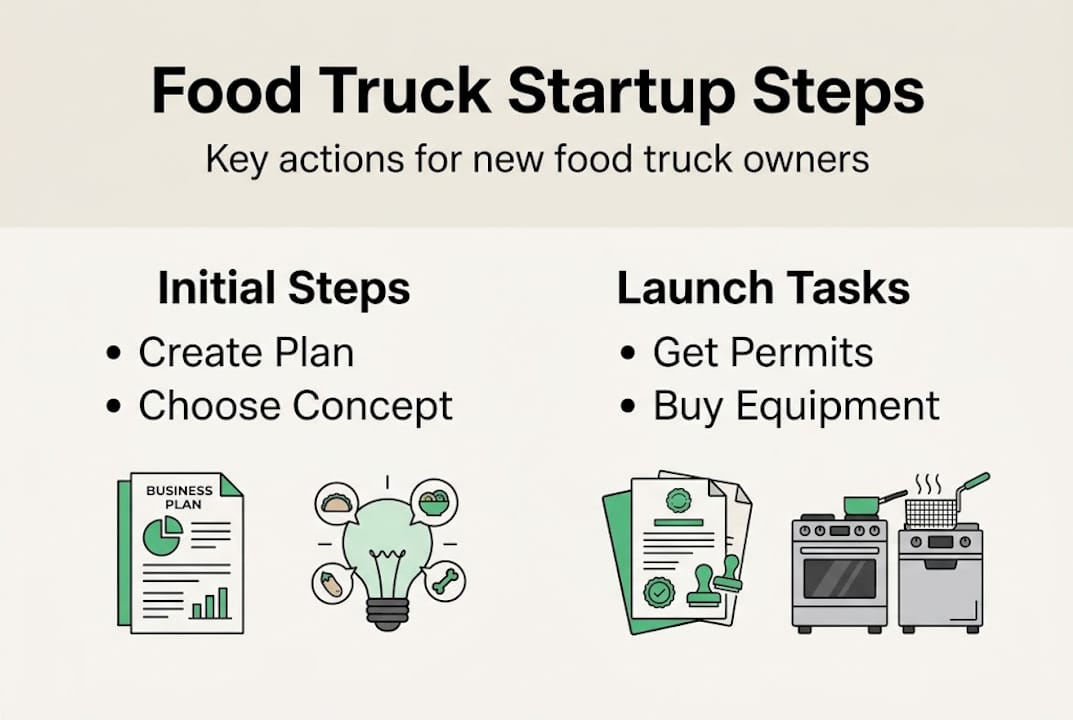
A food truck business plan doesn't need to be 40 pages. It needs to be accurate and actionable. Here are the core sections to include:
- Executive summary: Your concept, target market, and financial goals in one page
- Market analysis: Local competition, target customer profile, and demand validation
- Menu and pricing: Your 5 to 8 items with cost breakdowns and target margins
- Operations plan: Commissary use, daily schedule, staffing, and event strategy
- Financial projections: Startup costs, monthly expenses, revenue forecast, and break-even timeline
- Funding strategy: How much you need, where it's coming from, and repayment plan
"A business plan is not just for investors. It's a decision-making tool that forces you to stress-test your numbers before you spend a dollar."
Pro Tip: Write out your full menu before you finalize your business plan. Price each item, calculate the food cost, and project how many you'd need to sell daily to cover expenses. This one exercise reveals whether your concept is financially viable before you commit.
For more guidance on structuring your finances, review these business plan funding tips to align your plan with lender expectations.
Understanding costs, financing, and essential purchases
A great plan needs clear financials, and here's how to get yours right. Many new food truck owners underestimate total startup costs, and that gap between expectation and reality is where businesses fail early.
Startup cost breakdown
Startup costs range from $50,000 to $250,000, with most owners spending between $100,000 and $200,000. Here's where that money goes:
| Expense category | Estimated cost range |
|---|---|
| Food truck (new or used) | $28,000 to $175,000 |
| Kitchen equipment | $8,000 to $45,000 |
| Permits and licenses | $1,500 to $12,000 |
| Initial inventory | $1,000 to $3,000 |
| Branding and signage | $1,000 to $5,000 |
| POS system | $500 to $2,000 |
| Working capital (3 months) | $15,000 to $30,000 |
Funding sources compared
- SBA loans: Low interest rates, longer terms, but slower approval (30 to 90 days)
- Equipment financing: Tied to the truck or equipment itself, faster approval, good for asset-heavy purchases
- Personal savings: No debt, but depletes your safety net
- Merchant cash advances: Fast access, but higher cost, best for short-term needs
- Business lines of credit: Flexible draw-down, useful for managing cash flow gaps
For a deeper look at your options, the food truck financing overview covers how each funding type works in practice. You can also explore reducing startup costs with strategies that apply directly to new food truck owners.
Pro Tip: Build a repair buffer of at least $3,000 to $5,000 into your working capital. Equipment failures are not a question of if, but when. A broken generator or refrigeration unit on a busy Friday can cost you an entire weekend of revenue.
If you're weighing whether to buy or lease your equipment, reviewing the differences between comparing equipment leasing vs loans can help you decide which approach fits your cash flow best.
Navigating permits, licenses, and compliance
Financing in place, next up is the paperwork you can't afford to miss. Permit requirements are one of the most underestimated parts of launching a food truck, and skipping steps here can delay your opening by weeks or even months.
Core permits and licenses you'll need
Most food truck operators need the following, though exact requirements vary by location:
- Business license: Required in virtually every city and state
- Health department permit: Covers food safety inspections of your truck
- Fire safety certificate: Confirms your cooking equipment meets fire codes
- Food handler certifications: Required for you and any staff handling food
- Parking and vending permit: Authorizes where you can legally operate
- Sales tax permit: Required to collect and remit sales tax
- Commissary agreement: Many cities require you to prep and clean at a licensed commissary kitchen
State and city differences
Permit requirements vary widely by location. California is among the strictest, with health permits costing $600 to $1,000 and approval taking 6 to 12 weeks. Texas is more operator-friendly, with health permits running $250 to $450 and approvals often completed in 2 to 4 weeks. Cities like New York have permit caps that create secondary markets where operators buy or lease existing permits.
"In some cities, the permit process is the longest part of your launch timeline. Start it before you buy your truck, not after."
How to organize your paperwork for fast approval
- Contact your city's health department and business licensing office first to get the complete list
- Gather all required documents before submitting any application
- Schedule your health inspection as soon as your truck buildout is complete
- Secure your commissary agreement early since many inspectors require proof before approval
- Keep copies of every permit in a binder on the truck at all times
If permit costs are straining your budget, a small business loan can help you cover permit costs alongside other launch expenses. For a full breakdown of what's required in your area, review the permits and licensing details guide.
Executing daily operations and marketing for success
Once you clear compliance, you're ready for the realities of daily business. A great concept and solid permits only take you so far. Execution is what separates profitable trucks from struggling ones.
Daily operations checklist
Consistent operations reduce errors and speed up service. Pre-service preparation should begin 90 minutes before opening and include equipment checks, temperature verification, inventory count, and staff briefing. During service, aim to keep ticket times under 5 minutes. After service, complete cleaning, restock inventory, and return to your commissary if required.
Key operational priorities:
- Inventory turnover: Aim for a 3 to 5 day turnover cycle to minimize waste
- Ticket speed: Track average ticket time daily and identify bottlenecks
- POS system: Use it to track sales by item, location, and time of day
- P&L per event: Monitor profit and loss per location and target a margin above 30%
- Closing duties: Clean all surfaces, secure equipment, and log daily sales
Staffing and event selection
Most food trucks start with one to two people. Hire for reliability and speed, not just cooking skill. For events, prioritize high-foot-traffic locations: farmers markets, corporate parks, festivals, and food truck rallies. These venues often bring built-in audiences and reduce your marketing burden.
Marketing your food truck
Social media is your lowest-cost, highest-return marketing channel. Post your location daily on Instagram and Facebook. Use short videos of food prep to build an audience. Respond to every review, positive or negative. Build a simple email list for catering inquiries.
Pro Tip: Track your profit per event for the first 90 days. You'll quickly identify which locations and days deliver the best return. Shift your schedule toward those spots and cut the underperformers. This single habit can improve your monthly net by 15 to 20%.
For slow periods, pivot to catering. Corporate lunches, private events, and weddings can fill revenue gaps during off-peak weeks. Review daily food truck operations for a deeper breakdown of how to structure your service workflow.
What most new food truck owners get wrong (and how to avoid it)
Most articles tell you to focus on your food. That's obvious. What they don't tell you is that the operators who survive long-term are the ones who treat their truck like a data-driven business from day one.
The biggest mistake new owners make is underestimating regulatory complexity. They buy the truck, build out the kitchen, and then discover their city requires a commissary agreement, a separate fire inspection, and a vending permit with a six-week wait. That delay costs real money in loan payments and lost revenue.
The second mistake is treating working capital as optional. Your first three months will be unpredictable. Some days you'll do $2,500. Others you'll do $400. Without a cash buffer, one slow week can put you behind on expenses. Strategies for startup cost tips can help you stretch your initial capital further.
The third mistake is ignoring operational systems. Checklists feel bureaucratic until the day they prevent a health code violation or a forgotten propane refill that shuts you down mid-service. POS technology is not a luxury. It tells you exactly which items drive profit and which ones are dragging down your margins.
Long-term success in this business comes from resilience and adaptation. The food has to be good, but the operators who are still running five years in are the ones who track their numbers, adjust their locations, and build financial buffers before they need them.
Next steps: Secure your funding and launch with confidence
You now have a clear picture of what it takes to launch a food truck, from concept and permits to daily operations and marketing. The next step is making sure your funding is in place before you need it.
Capital for Business has worked with food truck owners and small business operators since 2009, providing fast and flexible financing when traditional banks fall short. Whether you need easy small business loan types to cover your startup costs, or an equipment financing guide to help you purchase your truck and kitchen setup, we have options built for businesses at exactly your stage. Our team moves quickly, works transparently, and structures loans around your actual cash flow. Visit Capital for Business today to explore your options and get your launch moving.
Frequently asked questions
What permits and licenses do I need for a food truck?
You'll need a business license, health and fire permits, food handler certifications, parking and vending permits, a sales tax ID, and usually a commissary agreement. Exact requirements depend on your city and state, so contact your local health department first.
How much does it cost to start a food truck?
Startup costs range from $50,000 to $250,000, with most owners spending $100,000 to $200,000 when you factor in the truck, equipment, permits, and working capital.
How profitable are food trucks?
Average annual revenue runs $250,000 to $346,000, with net profit margins of 6% to 15%. Most well-managed trucks reach break-even within 6 to 18 months of opening.
How long does it take to launch a food truck?
Most owners launch within 2 to 6 months. The timeline depends heavily on your local permit approval process, truck buildout, and how quickly you secure financing.
Can I finance the purchase of a food truck?
Yes. SBA loans, equipment loans, and working capital loans are all common options for food truck startups, and approval timelines vary from a few days to several weeks depending on the lender.