
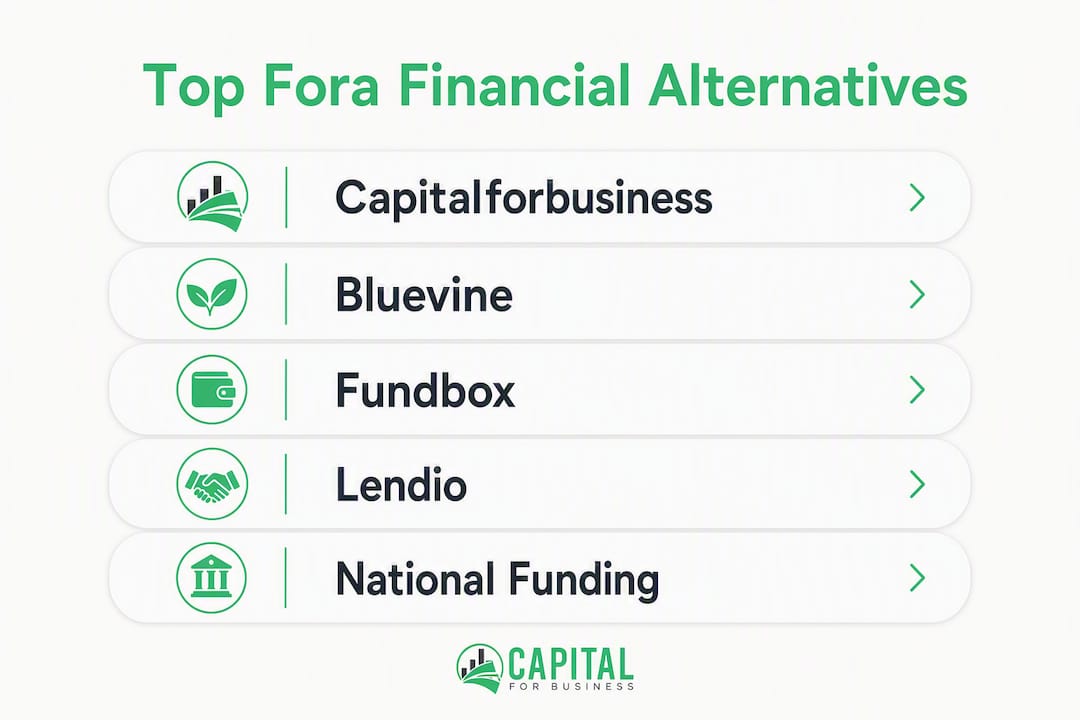
Capitalforbusiness is the strongest all-around alternative to Fora Financial for most small business owners, offering merchant cash advances, working capital loans, equipment financing, and SBA assistance under one roof with fast approvals and accessible eligibility. If you need a shortlist right now, here it is:
- Capitalforbusiness — broadest product mix, fast funding, works with lower credit profiles
- Bluevine — best for lines of credit and invoice factoring
- Fundbox — revolving credit lines with same-day draws
- Lendio — marketplace model that shops multiple lenders at once
- SBA loans — lowest cost available, but plan for weeks, not days
One important caveat: if your credit score is strong (680+), your business has been operating for two or more years, and you can wait several weeks, an SBA loan will almost always cost you less than any MCA or short-term product on this list.
Pro Tip: Before contacting any lender, calculate the total repayment amount, not just the monthly payment. A lower daily payment can hide a much higher total cost.

Table of Contents
- How do Fora Financial alternatives compare side by side?
- Which Fora Financial alternative fits your business best?
- How does Fora Financial compare to these alternatives?
- How do you choose the right lender for your business?
- How we evaluated these lenders
- Key Takeaways
- What most lender comparisons get wrong
- Capitalforbusiness covers the full range of small business financing needs
- Useful sources
- FAQ
How do Fora Financial alternatives compare side by side?
The table below covers the key dimensions that actually matter when you are choosing between forafinancial.com alternatives: product type, funding size, speed, credit requirements, cost range, and how you pay it back.

| Lender | Best for | Products | Typical funding range | Funding speed | Min. credit score | Est. cost range | Repayment structure |
|---|---|---|---|---|---|---|---|
| Capitalforbusiness | Broad product access, lower credit | MCA, term loan, LOC, equipment, SBA | $5K–$500K | 24–72 hours | ~550+ | Varies by product | Fixed-term, revenue-based, factor |
| Fora Financial | Fast MCA, accessible eligibility | MCA, term loan | Up to $1.5M | ~72 hours | ~500 | Factor rate 1.15–1.40+ | Factor / fixed-term |
| Bluevine | Revolving credit, invoice factoring | LOC, invoice factoring | $6K–$250K | 24 hours | ~625 | Starting ~6.2% APR | Revolving / weekly |
| Fundbox | Fast revolving draws | LOC | Up to $150K | Same day | ~600 | Starting ~4.66% draw fee | Revolving / weekly |
| Lendio | Shopping multiple offers | Marketplace (20+ lender types) | $1K–$5M | 24 hours–weeks | Varies | Varies by matched lender | Varies |
| National Funding | Equipment and working capital | Term loan, equipment finance | $10K–$500K | 24 hours | ~600 | Factor rate / fixed | Fixed-term |
| Credibly | Revenue-based repayment | MCA, working capital, SBA | $5K–$600K | 48 hours | ~500 | Factor rate / APR | Revenue-based, fixed |
| Kapitus | Established businesses, multiple products | Term loan, LOC, equipment, revenue-based | $10K–$5M | 2–5 days | ~625 | APR varies | Fixed-term, revenue-based |
| FundKite | Fast MCA, low documentation | MCA | $5K–$2M | 24 hours | ~500 | Factor rate | Factor |
| SBA loans | Lowest cost, long terms | 7(a), 504, microloan | $500–$5.5M | Weeks–months | ~640+ | Prime + 2.25–4.75% | Fixed-term, long amortization |
A note on factor rates vs. APR: A factor rate of 1.30 means you repay $1.30 for every $1.00 borrowed, regardless of how fast you pay it back. APR, by contrast, accounts for time. A 1.30 factor rate on a 6-month advance can translate to an APR well above 60%. When comparing an MCA with a term loan or line of credit, always convert to total repayment cost so you are comparing the same thing. The MCA mechanics guide at Capitalforbusiness walks through this conversion step by step.
Pro Tip: Ask every lender for the total repayment amount in dollars, not just the factor rate or APR. That single number makes cost comparisons straightforward.
Which Fora Financial alternative fits your business best?
Capitalforbusiness
Best for: Small businesses that need one lender for multiple product types, including owners with credit scores below 620.
Capitalforbusiness has been serving small businesses since 2009 across hundreds of industries, offering merchant cash advances, working capital loans, business lines of credit, equipment financing, and SBA loan assistance. The breadth matters: you can start with an MCA when your credit is thin, then graduate to a term loan or equipment financing as your profile strengthens, without switching lenders. Funding typically moves in 24–72 hours for MCA and working capital products. Businesses with at least three months of revenue history and $10,000 or more in monthly deposits are generally in range.
- Retail, restaurants, contractors, healthcare practices, and service businesses
- Owners rebuilding credit or operating with seasonal revenue swings
- Businesses that want to use an MCA for growth and then refinance into a lower-cost product
Fora Financial
Best for: Businesses that need fast capital and have limited credit history or a prior default.
Fora Financial is a direct funder offering MCAs and short-term term loans, known for accessible eligibility and quick decisions. Funding typically arrives in about 72 hours for standard files, and the minimum credit score sits around 500. One genuine differentiator: Fora Financial offers an early payoff discount when negotiated upfront, which can reduce your total repayment cost meaningfully if your cash flow improves faster than expected. The trade-off is cost. Factor rates in the 1.15–1.40+ range place Fora in the mid-to-high cost tier compared with A-paper lenders.
- Businesses with sub-600 credit scores
- Seasonal operators needing a bridge advance
- Owners who want to negotiate an early-payoff clause before signing
Bluevine
Best for: Established businesses that need a revolving credit line or invoice factoring.
Bluevine's line of credit product starts at roughly 6.2% APR and allows draws up to $250,000 with repayment over 6 or 12 months. The invoice factoring product advances up to 90% of outstanding invoices, which makes it particularly useful for B2B businesses waiting on slow-paying clients. Minimum credit score is around 625, and the business needs at least 24 months of operating history for the best terms.
- B2B service companies with outstanding invoices
- Businesses that need flexible, recurring access to capital
- Owners with solid credit who want bank-adjacent pricing
Fundbox
Best for: Businesses that need same-day access to a revolving credit line with minimal paperwork.
Fundbox connects directly to your accounting software (QuickBooks, FreshBooks, Wave) and makes credit decisions based on cash flow data rather than credit score alone. Draw fees start around 4.66% per draw on a 12-week repayment schedule. The maximum line is $150,000, which limits its usefulness for larger capital needs, but for working capital gaps it is one of the fastest options available.
- Freelancers, consultants, and small service businesses
- Owners with thin credit files but strong bank transaction history
- Businesses that need capital in hours, not days
Lendio
Best for: Business owners who want to compare multiple offers without filling out multiple applications.
Lendio is a marketplace, not a direct lender. One application routes to more than 75 lender partners covering term loans, SBA loans, lines of credit, equipment financing, and MCAs. The range of matched funding runs from $1,000 to $5 million. The practical benefit is time: instead of applying to six lenders separately, you get competing offers in one place. The trade-off is that Lendio earns a referral fee from the matched lender, which can affect which offers surface first.
- First-time borrowers who want to see the market
- Businesses with strong profiles that can attract multiple competing offers
- Owners comparing SBA and conventional products simultaneously
National Funding
Best for: Equipment-heavy businesses and working capital needs up to $500,000.
National Funding focuses on small business term loans and equipment financing, with funding amounts from $10,000 to $500,000. Decisions typically come within 24 hours. The equipment financing product covers new and used equipment and can include a same-day funding option for qualifying files. Minimum credit score is around 600.
- Construction, trucking, manufacturing, and medical practices
- Businesses replacing or adding revenue-generating equipment
- Owners who want a single lender for both working capital and asset financing
Credibly
Best for: Businesses with variable revenue that prefer revenue-based repayment.
Credibly's working capital advance adjusts daily repayment to a percentage of your daily revenue, which means slower days cost you less. That structure suits seasonal businesses and restaurants better than a fixed daily debit. Credibly also offers SBA loan assistance and conventional working capital products. Minimum credit score is around 500, and funding typically arrives within 48 hours.
- Restaurants, retail, and seasonal businesses
- Owners who want repayment tied to actual revenue performance
- Businesses exploring SBA options alongside faster alternatives
Kapitus
Best for: Established businesses with 2+ years of history seeking larger amounts or multiple product types.
Kapitus offers term loans, lines of credit, equipment financing, and revenue-based financing, with funding amounts reaching $5 million for qualified borrowers. The minimum credit score is around 625, and the business typically needs at least two years of operating history. Funding speed runs 2–5 days, slower than pure MCA providers but competitive for the loan sizes involved.
- Businesses with strong revenue and credit profiles
- Owners who want a longer repayment term to reduce cash flow pressure
- Companies that need equipment financing alongside working capital
FundKite
Best for: Businesses that need a large MCA quickly with minimal documentation.
FundKite is a direct MCA funder with a stated funding range up to $2 million and a 24-hour turnaround for qualifying files. The minimum credit score sits around 500. Because FundKite focuses almost exclusively on MCAs, it is not the right fit for businesses that want term loans or lines of credit, but for pure speed and advance size it competes directly with Fora Financial.
- High-revenue businesses with thin credit profiles
- Owners who have been declined by bank lenders
- Businesses that need a large advance fast and can handle factor-rate pricing
SBA loans
Best for: Cost-sensitive borrowers with strong credit and time to wait.
SBA 7(a) loans offer the lowest interest rates available to small businesses, with amounts up to $5.5 million and repayment terms up to 25 years for real estate or 10 years for working capital. The minimum credit score for most SBA programs is around 640, and the application process typically takes several weeks to several months. If cost is your primary concern and you are not in a cash flow emergency, SBA is the right starting point.
- Businesses with 2+ years of history and strong credit
- Owners financing major expansion, real estate, or equipment
- Borrowers who can wait and want the lowest total repayment cost
Pro Tip: B2B businesses waiting on slow-paying clients should evaluate invoice financing or net terms solutions before taking on an MCA. Adding a loan on top of outstanding receivables compounds your liability rather than solving the underlying timing problem.
How does Fora Financial compare to these alternatives?
Fora Financial's core strengths are accessibility and speed. As a direct funder, it can make real-time underwriting decisions and fund in roughly 72 hours without routing your file through a broker desk. That direct relationship also means the early-payoff discount is negotiable at the source, which is a meaningful advantage over brokers who cannot modify terms after placement.
Where Fora Financial stands out:
- Minimum credit score around 500, lower than most term loan lenders
- Direct funder status means faster decisions and negotiable terms
- Early payoff discount available when negotiated upfront
- Handles both MCAs and short-term term loans under one roof
Where alternatives have the edge:
- A-paper specialists (Bluevine, Kapitus, SBA lenders) offer lower rates for borrowers with 625+ credit scores
- Fundbox and Bluevine provide revolving credit structures that Fora Financial does not
- Lendio can surface competing offers that may beat Fora's pricing for strong-profile businesses
- Credibly's revenue-based repayment is better suited to highly seasonal businesses than Fora's fixed-factor structure
| Situation | Best choice |
|---|---|
| Need cash in 72 hours, credit below 600 | Fora Financial or FundKite |
| Need cash fast, credit 620+, want lower cost | Capitalforbusiness or Credibly |
| Need revolving access to capital | Bluevine or Fundbox |
| Need equipment financing | National Funding or Capitalforbusiness |
| Need lowest total cost, can wait | SBA loan via Lendio or Capitalforbusiness |
| Want to compare multiple offers at once | Lendio |
Underwriting decisions can vary within a single lender depending on the account manager and desk reviewing your file. That variability applies to Fora Financial and to most MCA providers. Always request the final offer in writing before committing.
Pro Tip: Fora Financial's early payoff discount is not automatic. Ask for it explicitly before you sign, and get the discount formula in writing as part of your contract.
How do you choose the right lender for your business?
Step-by-step decision checklist
- Define your cash need precisely. How much do you need, what will you use it for, and when do you need it? A $30,000 equipment purchase has a different product fit than a $30,000 payroll gap.
- Match the product type to the use case. Equipment purchases fit equipment financing. Recurring working capital gaps fit a line of credit. One-time cash needs fit a term loan or MCA. The MCA vs. business loan guide at Capitalforbusiness covers this decision in detail.
- Check your eligibility honestly. Pull your business credit score, calculate your average monthly revenue, and confirm your time in business before applying anywhere.
- Apply to at least two lenders. Comparing offers across multiple lenders often reveals meaningful cost differences because funders weight business metrics differently.
- Request a full written offer before paying any fees. The written offer must include the total repayment amount, factor rate or APR, repayment term, and any origination or closing fees.
- Compare total repayment cost, not just the rate. A 1.25 factor rate on a 4-month advance costs more in annualized terms than a 12% APR term loan over 24 months.
- Confirm funding speed and repayment mechanics. Daily debits, weekly debits, and revenue-percentage draws have very different cash flow impacts.
Questions to ask every lender
- Are you a direct funder or a broker? (Direct funders can negotiate terms; brokers generally cannot.)
- What is the total repayment amount in dollars?
- Is there an early payoff discount, and is it in the contract?
- What are the origination and closing fees?
- What happens if I miss a payment? What are the default remedies?
- Are renewal discounts available if I take a second advance?
- Will my rate change if my revenue changes between application and funding?
Red flags to watch for
- Vague cost disclosures ("low rates" with no specific figure)
- Pressure to sign within 24 hours without time to review the written offer
- Unusual third-party fees not disclosed upfront
- Requests for application fees before you have received a written offer
- Contracts that do not specify the total repayment amount
How we evaluated these lenders
Every lender on this list was assessed across six dimensions: product mix (does it cover MCA, term loans, LOC, equipment, and SBA?), typical funding speed, eligibility floor (minimum credit score and time in business), cost range (factor rate or APR), underwriting type (direct funder vs. broker), and customer-service signals from independent review sources.
Cost ranges and eligibility figures come from public lender disclosures, independent review platforms, and industry data. Underwriting terms vary by file, by account manager, and by market conditions, so the figures in this article represent typical ranges rather than guaranteed offers. Regional differences in underwriting also exist, particularly for SBA products.
This comparison will be reviewed and updated as lender terms and market conditions change. Readers should request current written offers directly from any lender before making a decision.
Key Takeaways
Capitalforbusiness offers the broadest product mix among forafinancial.com alternatives, covering MCAs, working capital loans, equipment financing, and SBA assistance with fast approvals and accessible eligibility requirements.
| Point | Details |
|---|---|
| Best overall alternative | Capitalforbusiness covers the widest product range with fast funding and accessible credit requirements. |
| Cost vs. speed trade-off | SBA loans cost the least but take weeks; MCAs fund in 24–72 hours but carry factor rates of 1.15–1.40+. |
| Always get written offers | Request total repayment in dollars from at least two lenders before signing anything. |
| Match product to use case | Lines of credit suit recurring gaps; term loans suit one-time needs; equipment financing suits asset purchases. |
| Capitalforbusiness next step | Apply at Capitalforbusiness for a written offer covering multiple product types in one application. |
What most lender comparisons get wrong
Most articles comparing Fora Financial alternatives focus almost entirely on interest rates and credit score minimums. Those two numbers matter, but they rarely tell the full story of what a financing decision actually costs a business.
The more revealing question is whether the repayment structure matches your revenue pattern. A fixed daily debit works fine for a business with steady daily card sales. For a contractor who invoices on net-30 terms or a retailer with a strong holiday season and a slow spring, that same fixed debit can create cash flow pressure precisely when the business is most vulnerable. Revenue-based repayment, where your daily payment scales with actual revenue, is structurally better for those businesses even if the headline factor rate looks identical to a fixed-debit product.
The second thing most comparisons underweight is whether the lender is a direct funder. Brokers serve a real purpose: they can surface offers you would not find on your own. But once a broker places your file, they lose the ability to negotiate terms on your behalf. A direct funder can adjust the offer in real time based on additional documentation or a conversation about your business. That flexibility has real dollar value, especially when you are negotiating an early payoff clause.
The third overlooked factor is what happens at renewal. Many small businesses take a second or third advance from the same lender. Lenders that offer renewal discounts or graduated pricing for repeat borrowers can be meaningfully cheaper over a two-year relationship than a lender with a lower first-advance rate and no loyalty pricing.
Capitalforbusiness covers the full range of small business financing needs
Small business owners who have outgrown what a single-product lender can offer will find that Capitalforbusiness matches the right product to the right need, whether that is a merchant cash advance for a fast cash need, a working capital loan for operational gaps, equipment financing for asset purchases, or SBA loan assistance for long-term growth.
Since 2009, Capitalforbusiness has funded businesses across hundreds of industries nationwide and in Canada. The application process is straightforward: one application covers multiple product types, and decisions on MCA and working capital products typically come within 24 hours. For businesses that need a written offer fast, that speed matters.
- Merchant cash advances — up to $500,000 with factor-rate pricing and revenue-based repayment
- Working capital loans — for operational needs, payroll, and inventory
- Equipment financing — up to $250,000 with same-day funding for qualifying files
Get a written offer today by visiting Capitalforbusiness funding solutions and see which product fits your business in minutes.
Useful sources
The following sources informed this comparison and are worth reviewing directly as you evaluate your options.
- Fora Financial Review: Rates, Terms & Ratings (Zogby) — Independent review covering Fora Financial's MCA and term loan products, factor rate ranges, and the early payoff discount.
- Fora Financial Review: Rates, Fees & Complaints (Fundnode) — Detailed breakdown of Fora Financial's cost structure, underwriting variability, and the case for shopping multiple offers.
- Fora Financial Business Loans Review (NerdWallet) — Contextualizes Fora Financial among online lenders and notes when higher-credit borrowers should consider alternatives.
- Fora Financial Reviews: Requirements and B2B Alternatives (ResolvePay) — Explains receivables-focused alternatives (net terms, invoice advances, AR automation) for B2B suppliers.
- Fora Financial Alternatives: 7 Options for Small Business Financing (ResolvePay) — Broader alternative comparison with structural financing options.
- Fora Financial Competitors and Alternatives (CB Insights) — Market map of Fora Financial's competitive set across MCA, revenue-based finance, and term loan categories.
- Capitalforbusiness: Small Business Funding up to $500K — Primary landing page for Capitalforbusiness products and application.
- Understanding merchant cash advances for small businesses (Capitalforbusiness) — Explains factor rates, APR conversion, and repayment mechanics in plain language.
- MCA vs. Business Loan: What to Do When Cash Flow Tightens (Capitalforbusiness) — Decision framework for choosing between an advance and a loan.
- Seasonal Business Funding for Small Businesses (Capitalforbusiness) — Guidance on matching product type to seasonal revenue patterns.
One final note: always request written offers from at least two lenders and compare total repayment obligations, not headline rates. The lender with the lowest stated rate is not always the cheapest option once fees, term length, and repayment structure are factored in.
FAQ
Is Fora Financial a reputable company?
Fora Financial is a legitimate direct lender that is reviewed by major independent platforms including NerdWallet and Fundnode. It is best suited for businesses that need fast capital and have limited credit history, though its factor rates sit in the mid-to-high range compared with A-paper lenders.
What credit score do you need for Fora Financial?
Fora Financial's minimum credit score is approximately 500, making it one of the more accessible MCA providers for borrowers with damaged or limited credit. Borrowers with scores above 620 will typically qualify for lower-cost alternatives.
How does Fora Financial compare to other lenders?
Fora Financial funds faster than most SBA lenders and accepts lower credit scores than most term loan providers, but its factor rates of 1.15–1.40+ are higher than what A-paper specialists charge strong-credit borrowers. Capitalforbusiness offers a comparable speed and eligibility profile with a broader product mix.
What is the easiest lender to get approved for?
FundKite, Credibly, and Fora Financial all accept credit scores around 500 and fund within 24–48 hours, making them among the most accessible options for businesses that have been declined elsewhere. Capitalforbusiness also works with lower credit profiles across multiple product types.
Should I use an MCA or a term loan for my business?
An MCA suits businesses that need cash quickly and have variable daily revenue, since repayment scales with sales. A term loan is better for predictable, one-time needs where you want a fixed repayment schedule. The MCA vs. business loan guide at Capitalforbusiness covers this decision in detail.
This article is for general informational purposes only and does not constitute financial or legal advice. Lending terms, rates, and eligibility requirements change frequently. Confirm current offers directly with any lender and consult a qualified financial professional before making a borrowing decision.