
TL;DR:
- Food truck entrepreneurs now have diverse funding options, including SBA microloans and equipment financing.
- Combining multiple funding sources can better support larger builds and improve approval chances.
- Speed, location, and market demand are crucial factors alongside credit scores for securing financing.
Many food truck entrepreneurs assume that if the bank says no, the dream is over. That belief stops more mobile food businesses before they ever serve their first customer than any other obstacle. The reality is that the lending landscape has shifted dramatically, and food truck owners now have access to a wider range of funding tools than ever before. From SBA microloans to equipment financing and merchant cash advances, the options are real, accessible, and designed with startups in mind. This guide walks you through every major funding type, what each one requires, and how to combine them strategically so you can get your truck on the road with confidence.
Table of Contents
- Understanding food truck funding: Types and options
- SBA microloans and government funding: Eligibility and process
- Equipment financing: Fast, accessible startup funding
- Combining funding sources: A practical approach to larger builds
- Getting real: What most guides miss about food truck loans
- Food truck funding made simple with Capital for Business
- Frequently asked questions
Key Takeaways
| Point | Details |
|---|---|
| Diverse funding options | Food truck entrepreneurs have access to a wide range of loan types beyond traditional banks. |
| SBA microloans benefits | SBA microloans offer lower rates and helpful counseling but require strict documentation and approval time. |
| Equipment financing speed | Equipment financing is fast, accessible, and covers nearly half of food truck startup funding. |
| Combine funding sources | Mixing loan options and financing methods increases flexibility and improves the chances for larger builds. |
| Success driven by fundamentals | Location, revenue, and planning matter more than perfect credit for loan approval and long-term business survival. |
Understanding food truck funding: Types and options
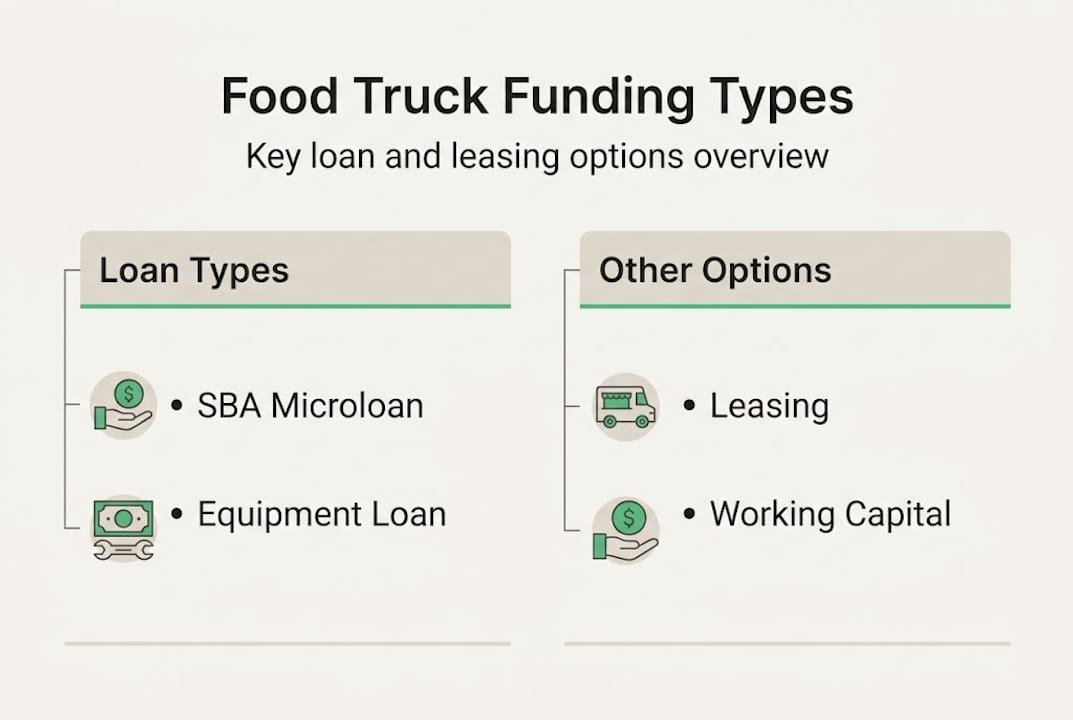
Before you apply for anything, it helps to see the full picture. Food truck funding does not come in a single form, and the right choice depends on your credit profile, how fast you need money, and what stage your business is in. Here is a breakdown of the most common food truck loan options available to entrepreneurs in 2026.
Common loan types for food truck businesses:
- SBA Microloans: Government-backed loans up to $50,000, designed for startups and small operators with moderate credit
- Equipment financing: Loans secured by the truck itself, making approval more accessible even without strong business history
- Merchant cash advances (MCAs): Lump-sum funding repaid through a percentage of daily sales, ideal for trucks already generating revenue
- Business lines of credit: Flexible, revolving credit you draw from as needed, useful for managing seasonal cash flow
- Traditional bank loans: Larger amounts with lower rates, but stricter requirements that many startups cannot meet
- Microfinance and nonprofit lenders: Community-focused lenders offering small loans with mentorship, often for underserved entrepreneurs
Each option has a different risk profile, approval speed, and cost. Comparing them side by side makes the decision much clearer.
| Loan Type | Max Amount | Min Credit Score | Approval Time | Rates |
|---|---|---|---|---|
| SBA Microloan | $50,000 | 580-620+ | 30-90 days | 8-13% |
| Equipment Financing | Varies | 600+ | 1-7 days | 6-25% |
| Merchant Cash Advance | Varies | 500+ | 24-72 hours | Factor rate |
| Business Line of Credit | Varies | 600+ | Days to weeks | 8-24% |
| Traditional Bank Loan | $500,000+ | 680+ | Weeks to months | 5-10% |
SBA Microloans up to $50,000 are ideal for food truck startups because they carry lower credit requirements (580-620+ FICO) and terms stretching up to 6-7 years, often bundled with business counseling through nonprofit intermediaries. For entrepreneurs who need speed, equipment financing uses the truck as collateral, requires a minimum credit score of 600, allows 0-20% down, and offers approval in as little as one to seven days.
Understanding the difference between a loan or leasing comparison also matters here. Leasing keeps monthly payments lower but means you never own the truck outright. Buying through financing costs more upfront but builds equity over time. For food truck operators planning to stay in the business long term, ownership usually wins. You can also explore restaurant funding options that overlap with food truck financing, since many lenders treat mobile food businesses similarly to brick-and-mortar restaurants.
With the landscape mapped, let's dig deeper into the details of each funding option.
SBA microloans and government funding: Eligibility and process
SBA microloans are one of the most practical tools for food truck startups, especially those that cannot qualify for conventional bank loans. The program works through nonprofit intermediary lenders, meaning you apply through a community organization rather than directly through the federal government. That structure also means you often get access to business counseling and planning support alongside the money.
Step-by-step guide to applying for an SBA microloan:
- Check your credit score. SBA Microloans require 580-620+ FICO, which is lower than most bank products but still requires preparation if your score is below that range.
- Write a solid business plan. Lenders want to see projected revenue, your target market, pricing strategy, and operating costs. This document carries serious weight.
- Gather your documents. The application requires a business plan, financial projections, two to three years of tax returns if available, and copies of any permits or licenses you hold.
- Find a nonprofit intermediary. The SBA maintains a list of approved microloan lenders by state. Search for one in your area that works with food and hospitality businesses.
- Submit your application and wait. SBA approval runs at around 52%, and the process typically takes 30-90 days from submission to funding.
- Use the funds strategically. SBA microloans can cover equipment, inventory, working capital, and even some startup costs, but they cannot be used to pay existing debt.
The 30 to 90 day timeline is the biggest drawback for entrepreneurs who need to move fast. If you have a seasonal window or a specific event you are targeting, plan your application well in advance. Some intermediaries process faster than others, so it pays to ask about their typical turnaround before you commit.
Pro Tip: Many nonprofit SBA intermediaries offer free business counseling as part of the loan package. Use it. A counselor can help you refine your financial projections and strengthen your application before it goes to underwriting, which directly improves your approval odds.
For entrepreneurs exploring multiple paths at once, reviewing startup loan applications can help you identify which products fit your current profile. Staying current on SBA loan updates also matters, since program terms and rates shift with federal policy changes.
SBA microloans can be powerful, but they aren't the only option. Next, let's explore equipment financing.
Equipment financing: Fast, accessible startup funding
Equipment financing is the fastest route to getting a food truck funded, and for good reason. The truck itself serves as collateral, which removes a major barrier for entrepreneurs who do not have real estate or other assets to pledge. Lenders are more willing to approve these loans because they can recover the asset if payments stop.

Here is a closer look at how the numbers break down:
| Feature | Details |
|---|---|
| Collateral | The food truck itself |
| Minimum credit score | 600+ |
| Down payment | 0-20% |
| Interest rates | 6-25% |
| Loan terms | 3-7 years |
| Approval time | 1-7 business days |
| Approval rate (620+ credit) | 65-70% |
Equipment financing accounts for roughly 45% of startup funding in the food truck space, and approval rates climb to 65-70% for applicants with a credit score of 620 or higher. That is a significantly better success rate than most other loan types at the startup stage.
"Equipment financing is one of the most accessible tools for food truck entrepreneurs because the asset itself reduces lender risk. Operators with a 620+ credit score have a strong chance of approval even without years of business history."
The speed advantage is real. While SBA microloans take weeks to months, equipment financing can close in as little as one business day for straightforward applications. That matters when you find the right truck at the right price and need to move quickly.
Pro Tip: Use equipment financing to lock in your truck fast, then layer on a working capital product later to cover your first few months of inventory and staffing. Trying to fund everything at once often slows the process down and reduces your approval odds on each product.
For a full breakdown of how this product works, the equipment financing guide at Capital for Business walks through each step in detail. If you are weighing ownership against renting, the small business loan vs equipment leasing comparison lays out the long-term cost differences clearly.
You've seen the advantages of equipment financing; now, let's consider combining funding sources.
Combining funding sources: A practical approach to larger builds
Most food truck entrepreneurs think about funding as a single decision: pick one loan, get approved, move on. But for larger builds, custom rigs, or trucks with full commercial kitchens, a single loan rarely covers everything. Combining funding sources is a legitimate and widely used strategy that improves both your financing flexibility and your overall odds of getting fully funded.
Common funding combinations that work well:
- SBA Microloan plus equipment financing: Use the microloan for working capital and permits, and equipment financing for the truck itself
- Equipment financing plus merchant cash advance: Finance the truck, then use an MCA to cover initial inventory and marketing once you start generating sales
- Business line of credit plus equipment financing: Keep the line of credit available for seasonal gaps while the equipment loan covers your primary asset
- Microfinance loan plus personal savings: Smaller nonprofit loans combined with personal capital can get a basic setup funded without taking on heavy debt
- Crowdfunding plus equipment financing: Platforms like Kickstarter or GoFundMe can cover soft costs while a lender handles the truck
Success hinges on location and revenue consistency more than credit score alone, and lenders who work with food trucks know this. A well-chosen location with documented foot traffic and a realistic revenue projection will often carry more weight than a perfect credit file with no supporting business data.
Beyond credit, lenders look at your business plan quality, your market research, and whether your concept has real demand in your target area. A taco truck in a dense urban neighborhood with no nearby competition is a fundamentally different risk than a specialty dessert truck in a market that is already saturated.
Working with a finance professional who understands the food service industry makes a real difference here. They can help you structure a funding stack that minimizes your total cost of capital while keeping monthly payments manageable. For a broader look at the startup journey, starting a food truck covers the operational side alongside the financial one. You can also review tips for business funding to sharpen your overall approach before you apply.
Pulling together different funding methods can be the key to unlocking your full vision. But what's our perspective on loan choices?
Getting real: What most guides miss about food truck loans
Most funding guides focus heavily on credit scores and documentation checklists. Those things matter, but they are not the whole story. We have worked with food truck entrepreneurs since 2009, and the ones who succeed are rarely the ones with perfect paperwork. They are the ones who chose the right location, built a loyal following fast, and kept their costs tight in the first year.
Here is the uncomfortable truth: chasing the lowest interest rate or the most prestigious loan product can actually slow you down. An entrepreneur who spends four months perfecting an SBA application might have been better served by getting an equipment loan in a week and starting to generate revenue. Real-world cash flow from actual customers is more valuable than a theoretically cheaper loan that took half a year to land.
The food truck loan landscape rewards speed and adaptability. If your credit is in the 600 to 650 range, equipment financing gets you moving. If you need working capital after launch, a merchant cash advance ties repayment to your actual sales, which reduces pressure during slow weeks. Blending products based on your real situation beats waiting for the perfect single solution.
Focus on your fundamentals: a high-traffic location, a menu with strong margins, and a marketing plan that builds repeat customers. Those factors will do more for your loan repayment ability than any financing structure on its own.
Food truck funding made simple with Capital for Business
You now have a clear picture of the funding options available, how they work, and how to combine them for the best results. The next step is finding a lender who actually understands the food truck industry and can move at the speed your business requires.
Capital for Business has been helping small business owners access the right funding since 2009. Whether you need easy small business loans to cover startup costs, equipment financing solutions to secure your truck quickly, or a combination of products tailored to your situation, we have the tools and the experience to help. Our application process is straightforward, our approvals are fast, and our team works with food truck entrepreneurs at every stage. Visit Capital for Business today and take the first step toward getting your truck funded and on the road.
Frequently asked questions
What credit score do I need for a food truck loan?
Most lenders require a minimum credit score of 600 for equipment financing and 580-620+ for SBA microloans. Equipment financing starts at 600+ with 0-20% down required.
How long does SBA loan approval take for a food truck?
SBA approval takes 30-90 days and carries a 52% approval rate, so applying early and with complete documentation gives you the best chance of success.
Can I use equipment financing to buy a used food truck?
Yes, most lenders allow equipment financing for used food trucks as long as the vehicle meets their age and condition standards. Approval rates reach 65-70% for applicants with a 620+ credit score.
Do I need a business plan for all loan types?
A business plan is required for SBA microloans and strongly recommended for most other lenders. A complete application includes projections, tax returns, and permits alongside the plan itself.
What factors impact food truck loan success besides credit?
Your location, revenue consistency, and the quality of your business plan carry significant weight. Location and revenue consistency often matter more to lenders than credit score alone.