What is purchase order financing?
Purchase order financing is a short-term funding method where a lender pays your supplier directly based on a confirmed customer purchase order, so you can fulfill large orders without tying up your own capital. The lender advances funds to your supplier, goods get produced and delivered, your customer pays the lender, and you receive the remaining margin after fees. It is a pre-shipment finance tool, meaning money moves before goods ever ship.
This type of funding is built for product-based businesses. Wholesalers, manufacturers, distributors, and importers are the most common users because they regularly face a gap between what a customer orders and what they can afford to produce upfront.
Here are the core components at a glance:
- The purchase order: A confirmed, creditworthy customer order that serves as the foundation for the financing request.
- The supplier payment: The lender pays your supplier directly. The funds never pass through your business bank account.
- Goods delivery: Your supplier produces and ships the goods to your customer.
- Customer payment: Your customer pays the lender, often through a lockbox arrangement.
- Your margin: After the lender deducts fees, you receive the remaining profit from the transaction.
How does purchase order financing work, step by step?
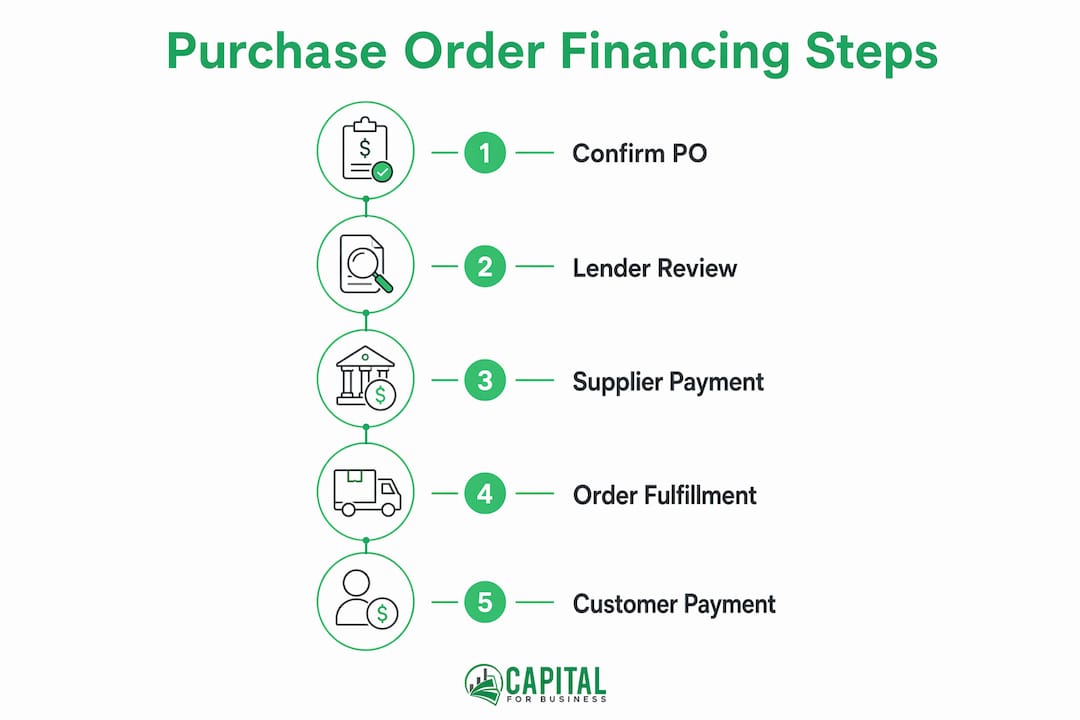
The PO financing process follows a clear sequence from the moment you receive a customer order to the moment you collect your margin. Timelines can range from 1 day to 21 or more days depending on lender speed and order complexity.
- Receive a confirmed customer order. Your customer places a firm, written purchase order for goods you sell.
- Get a supplier quote. Contact your supplier for a formal cost estimate to fulfill that order.
- Apply to a PO financing company. Submit your purchase order and supplier quote to a lender for review.
- Lender approves and pays your supplier. Once approved, the lender sends payment directly to your supplier. Your bank account is not involved at any point.
- Supplier produces and ships the goods. Your supplier fulfills the order and delivers goods to your customer.
- Customer pays the lender. Your customer remits payment directly to the lender, often through a lockbox account set up for that purpose.
- Lender deducts fees and pays you. The lender subtracts its fees from the collected payment and forwards your remaining margin.
Pro Tip: Ask your lender upfront whether they use a lockbox arrangement. If your customer is used to paying you directly, you will need to notify them of the new payment instructions before the order ships to avoid delays.
What does purchase order financing cost?

Costs are the most important factor to understand before committing to this type of funding. Typical fees run from 1% to 6% of supplier costs per month, which translates to annual percentage rates of roughly 20% to 50%. The longer your customer takes to pay, the higher your total cost climbs.
Lenders generally advance between 70% and 100% of the supplier invoice amount, depending on the deal structure and the creditworthiness of your customer.
| Fee Component | Typical Range |
|---|---|
| Monthly fee rate | 1%–6% of supplier invoice |
| Equivalent APR | 20%–50% |
| Advance rate | 70%–100% of supplier invoice |
| Repayment trigger | Customer payment to lender |
Several variables affect where your cost lands within those ranges:
- Customer payment terms: Net-30 customers cost less than Net-90 customers because the lender holds the advance for a shorter period.
- Order size: Larger orders may qualify for lower percentage rates with some lenders.
- Customer credit quality: A highly creditworthy customer reduces lender risk and can lower your fee.
- Supplier reliability: Lenders factor in whether your supplier has a track record of on-time delivery.
What are the pros and cons of purchase order financing?
Understanding the advantages and drawbacks helps you decide whether this tool fits your situation or whether another option makes more sense.
Advantages:
- Fulfill orders you otherwise couldn't. You can accept large contracts even when your cash reserves fall short of what the supplier requires upfront.
- Preserves working capital. Because the lender funds the supplier directly, your existing cash stays available for payroll, overhead, and other operating needs.
- Fast access to capital. Approval decisions often come within days, which matters when a customer order has a tight production deadline.
- Your business credit is less critical. Lenders focus primarily on your customer's creditworthiness, not your own credit score or business history.
- No equity given up. Unlike bringing in investors, PO financing does not require you to surrender ownership in your company.
Disadvantages:
- High cost. Monthly fees of 1%–6% add up quickly, especially on orders with long payment cycles. Thin-margin products can be wiped out entirely by financing costs.
- Customer default risk. If your customer fails to pay, you may still owe the lender depending on your agreement terms.
- Multi-party coordination. Three or more parties (you, the lender, the supplier, and your customer) must all communicate clearly. One miscommunication can delay the entire transaction.
- Limited to product-based businesses. Service businesses generally do not qualify because there is no physical goods transaction to secure the advance.
- Possible recourse obligations. Under a recourse arrangement, if your customer does not pay, the lender can come back to you for repayment.
Key risks and considerations before you choose PO financing
The single most important factor lenders evaluate is your customer's creditworthiness, not yours. Because the lender's repayment depends entirely on your customer paying the invoice, a customer with a weak payment history or shaky financials can disqualify your application regardless of how strong your own business looks.

One distinction that carries serious financial consequences is the difference between recourse and non-recourse arrangements. In a non-recourse deal, the lender absorbs the loss if your customer defaults. In a recourse deal, that liability falls back on you. Always clarify which structure applies before signing.
Key risks to evaluate:
- Customer default: Even reliable customers can face cash flow problems. Understand your exposure before committing.
- Thin margins: PO financing costs can consume your profit on low-margin products. Run the numbers before applying.
- Supplier delays: If your supplier misses the delivery window, your customer may cancel or delay payment, extending your fee period.
- Concentration risk: Relying on one large customer for PO financing creates vulnerability if that relationship changes.
Pro Tip: Use PO financing selectively for high-margin, large orders where the profit comfortably exceeds the financing cost. Treating it as a permanent funding source rather than a targeted tool for specific opportunities will erode your margins over time.
PO financing works best as a transactional tool for seizing specific sales opportunities, not as a standing line of credit. Businesses that use it strategically, on orders where the margin justifies the cost, get the most value from it.
What are the alternatives to purchase order financing?
PO financing is not the right fit for every situation. Several other funding options serve similar needs with different cost structures and timing requirements.
- Traditional small business loans: Lower interest rates than PO financing, but approval takes longer and requires stronger business credit. Best for businesses with established credit histories that can plan ahead.
- Invoice factoring: Sells your existing accounts receivable to a lender at a discount. Unlike PO financing, factoring applies after goods ship and an invoice exists. It does not help with pre-shipment costs.
- Business line of credit: Gives you a revolving credit facility to draw from as needed. More flexible than PO financing and often cheaper, but requires good credit and may have lower limits than a large order demands. Capitalforbusiness offers working capital solutions that include lines of credit for qualifying businesses.
- Merchant cash advances: Provide upfront capital repaid through a percentage of future sales. Fast to access, but expensive and better suited to retail or service businesses with consistent card revenue.
- Equipment financing: Covers the cost of machinery or tools needed to fulfill orders. If your production constraint is equipment rather than supplier payment, this may be the more direct solution.
Each alternative has a different entry point in the business cycle. PO financing is the only option that moves capital upstream to the supplier payment stage before goods are produced.
How to apply for purchase order financing
The application process is straightforward, but preparation makes a real difference in how quickly you get approved.
- Step 1: Confirm your customer order. The purchase order must be firm, written, and from a creditworthy customer. Verbal commitments do not qualify.
- Step 2: Get a formal supplier quote. Request a written cost estimate from your supplier covering the full order.
- Step 3: Research PO financing companies. Look for lenders that specialize in your industry and have experience with orders of your size, using this paso a paso solicitud en línea de préstamos en México guide to navigate the application process. For a broader view of small business loan types, reviewing your options before committing to one product is worth the time.
- Step 4: Prepare your application package. Gather the purchase order, supplier quote, customer credit information, and basic business financials.
- Step 5: Submit and await approval. Lenders will review your customer's credit, the supplier's reliability, and the transaction structure. Approval can come within 24–72 hours for straightforward deals.
- Step 6: Review and sign agreements. Read the fee structure, recourse terms, and lockbox instructions carefully before signing.
- Step 7: Lender pays supplier and the process begins. Once agreements are signed, the lender contacts your supplier and funds the order.
Eligibility typically requires a confirmed purchase order from a creditworthy commercial customer, a reliable supplier, and a product-based business model. Your own credit score matters less than your customer's payment history.
Capitalforbusiness expertise in small business financing
Capitalforbusiness has built its reputation by serving businesses that traditional lenders overlook. Whether a manufacturer needs capital to fulfill a large seasonal order or a distributor is facing a supplier payment deadline, the team at Capitalforbusiness understands the urgency and complexity of these situations. With funding solutions up to $500,000, the focus is on getting qualified businesses funded without unnecessary delays.
For businesses exploring PO financing alongside other options, Capitalforbusiness provides guidance on which product fits the specific order, margin, and timeline involved. The goal is always a funding structure that supports growth without creating a financial burden that outlasts the opportunity.
Key Takeaways
Purchase order financing gives product-based businesses a way to fulfill large orders by having a lender pay the supplier directly, with repayment coming from the customer's payment on delivery.
| Point | Details |
|---|---|
| Core definition | A lender pays your supplier directly based on a confirmed customer purchase order, before goods ship. |
| Cost range | Monthly fees run 1%–6% of supplier costs, equivalent to APRs of roughly 20%–50%. |
| Advance rate | Lenders typically fund 70%–100% of the supplier invoice amount. |
| Credit focus | Approval depends primarily on your customer's creditworthiness, not your own business credit. |
| Best use case | High-margin, large orders where profit clearly exceeds the financing cost. |
FAQ
What is purchase order financing in simple terms?
Purchase order financing is when a lender pays your supplier directly so you can fulfill a customer order you could not otherwise afford upfront. You repay the lender when your customer pays their invoice.
Who qualifies for purchase order financing?
Product-based businesses such as wholesalers, manufacturers, distributors, and importers typically qualify. The key requirement is a confirmed purchase order from a creditworthy commercial customer.
How much does purchase order financing cost?
Fees typically range from 1% to 6% of supplier costs per month, which translates to annual rates of roughly 20%–50%. Total cost depends on how long your customer takes to pay.
What is the difference between recourse and non-recourse PO financing?
In a non-recourse arrangement, the lender absorbs the loss if your customer defaults. In a recourse arrangement, the liability returns to your business, meaning you owe the lender even if your customer does not pay.
How is purchase order financing different from invoice factoring?
PO financing funds supplier payments before goods ship, while invoice factoring advances cash against invoices that already exist after delivery. PO financing operates earlier in the business cycle.