

A contractor line of credit is the right tool when your business has recurring short-term cash timing gaps between finishing work and getting paid. It suits general contractors, subcontractors, and specialty trades that carry payroll and materials costs weeks before a draw request clears. If that describes your business, the next move is simple: model your peak cash gap and pull together your financial documents before you approach a lender.
- Best fit: contractors with at least 1-2 years in business and revenue steady enough to show repayment ability
- First step: calculate your largest weekly payroll plus material costs, add a buffer
- Second step: gather two years of tax returns and 12 months of bank statements before applying
Key Takeaways
A contractor line of credit works best when it's sized to your actual peak cash gap and paired with a complete documentation package prepared before you apply.
| Point | Details |
|---|---|
| Match the tool to the problem | Use a line of credit for recurring timing gaps like payroll and materials, not long-term asset purchases. |
| Size it with a cash gap model | Add your peak payroll week, materials costs, and a buffer |
| Budget the standby fee | Unused portions typically carry a 0.25% to 0.5% annual fee, so oversizing costs real money. |
| Apply early | Start the process 60 to 90 days before you need funds to avoid underwriting slippage. |
| Consider Capital for Business | Offers lines of credit up to $250,000 for contractors alongside equipment financing and working capital loans. |
Table of Contents
- What Is a Contractor Line of Credit and How Does It Work?
- What Are the Best Uses for a Contractor Line of Credit?
- Which Lenders Offer Lines of Credit for Contractors?
- What Do Lenders Look for Before Approving a Contractor Line of Credit?
- How Do You Size a Contractor Line of Credit and Budget the Costs?
- How Do You Apply for a Contractor Line of Credit?
- When Should You Consider an Alternative to a Contractor Line of Credit?
- How Capital for Business Supports Contractors
- What Actually Matters When Choosing a Line of Credit
- Get a Contractor Line of Credit Sized Right for Your Business
- Sources
- FAQ
What Is a Contractor Line of Credit and How Does It Work?
A contractor line of credit works differently from a term loan in one key way: it's revolving, not a lump sum. You get approved for a maximum limit, then draw only what you need, when you need it, and interest accrues solely on the drawn balance. Pay it down, and that credit becomes available again without reapplying. A construction line of credit is built specifically to bridge the gap between project payments and payroll, which is exactly the rhythm most contracting businesses run on.
Here's how the mechanics typically break down:
- Draw period: you access funds as needed, often through an online portal or a call to your relationship manager.
- Interest calculation: charged only on what's outstanding, not the full approved limit.
- Fees: some lenders charge a draw fee per transaction, and nearly all charge a standby fee on the unused portion.
- Repayment phase: many lines carry a revolving structure for one to two years, then convert to a repayment-only period if not renewed.
- Renewal: most banks and online lenders will renew an LoC annually if your financials hold up.
The reusability is what separates this from a term loan. Once you pay down a draw, that capacity comes back.
What Are the Best Uses for a Contractor Line of Credit?
Contractors run into the same handful of cash-timing problems over and over, and a line of credit solves specific ones well. Payroll float tops the list. You've got a crew to pay every week or two, but your draw schedule on a project might not release funds for 30 to 45 days after milestones are hit. A line of credit closes that gap without you dipping into personal savings or delaying paychecks.
Materials purchases and mobilization costs are the second big use case. Before you break ground, you're often buying lumber, ordering fixtures, or renting equipment, and none of that waits for your first project payment. Seasonal smoothing matters too. Roofing, paving, and landscaping businesses often see revenue swing hard between spring/summer and winter, and a line of credit keeps operations funded through the slow months.
Where a line of credit is the wrong tool: buying a $150,000 excavator, financing a new office build, or covering chronic losses. Those need equipment financing, a term loan, or a hard look at your business model, not revolving credit.
- Payroll gaps between draw schedules
- Materials and mobilization before the first payment hits
- Seasonal revenue smoothing
- Small tool or equipment purchases under a few thousand dollars
Pro Tip: Track your cash gap by project, not just by month. A single large commercial job can create a bigger payroll float need than three residential jobs combined, and averaging them together hides the real number you need to plan around.
Which Lenders Offer Lines of Credit for Contractors?
The lender you choose shapes your speed, your rate, and how much paperwork you're signing. Community banks tend to offer moderate speed, mid-range pricing, and the advantage of an actual relationship manager who understands your business beyond the numbers on a spreadsheet. National banks can offer larger limits, but their underwriting is tighter and slower, often requiring stronger financials and more collateral.

SBA-backed lines, arranged through the SBA 7(a) and SBA Express programs, make credit access easier for borderline-qualified contractors. The tradeoff is longer processing time and guarantee fees layered on top of your rate. Online and alternative lenders move fastest, sometimes funding in days rather than weeks, but that speed comes at a real cost premium, and merchant cash advances in particular carry annualized costs far above a traditional LoC.
Community development programs deserve a mention too. Groups like the Small Contractor Line of Credit Program run by regional development authorities target contractors with modest revenue, often with underwriting more forgiving than a national bank's.
- Community banks: relationship-driven, moderate speed, mid-tier pricing
- National banks: larger limits, strict underwriting, slower approvals
- SBA-backed lines: easier qualification, added fees and processing time
- Online lenders: fastest funding, highest cost, best for bridge needs
What Do Lenders Look for Before Approving a Contractor Line of Credit?
Underwriters look past your revenue number and dig into whether you can actually service debt. Debt service coverage ratio, or DSCR, measures how much cash flow you generate relative to your debt obligations, and most lenders want to see a ratio above 1.25. Time in business matters almost as much. Two years is the common threshold, though some community and SBA-backed programs will work with newer contractors who show strong contracts on the books.
Personal credit still carries weight even for an established LLC, with most lenders looking for scores in the high 600s or better. Collateral requirements vary. Unsecured lines exist but usually come with lower limits and higher rates, while secured lines backed by equipment or receivables unlock bigger numbers at better pricing. Expect a personal guarantee regardless of entity structure in most cases.
Bring these documents to your first conversation with a lender:
- Two years of business tax returns
- Twelve months of business bank statements
- Year-to-date profit and loss statement
- Accounts receivable and accounts payable aging reports
- Current contracts or signed purchase orders
Building your business credit profile pays off over time. Establishing a Paydex score with Dun & Bradstreet and separating business credit from your personal profile can unlock larger limits and better pricing within 6 to 24 months, since lenders increasingly pull business credit reports alongside personal ones.
How Do You Size a Contractor Line of Credit and Budget the Costs?
A simpler rule of thumb some contractors use is peak cash gap plus one extra month of payroll as insurance against slow-paying clients.
Asking for more than you need isn't free. Larger approved limits often mean higher standby fees, and lenders may reassess your DSCR less favorably if your requested limit looks disproportionate to your revenue.
Standby fees on the unused portion of your line typically run between 0.25% and 0.5% annually. For a credit limit where you draw a portion, standby fees apply to the unused balance, representing a real cost even when not borrowing.
Pricing bands vary widely by lender type:
- Community banks: moderate rates, smaller standby fees, relationship-based pricing
- National banks: competitive rates for strong financials, stricter fee structures
- SBA-backed lines: added guarantee fees on top of the base rate
- Online lenders: fastest access, but rates run substantially higher
How Do You Apply for a Contractor Line of Credit?
Apply 60 to 90 days before you actually need the funds. Underwriting rarely moves as fast as anyone hopes, and documentation requests can add weeks you didn't budget for.
- Gather your financial documents and business records ahead of time.
- Run your cash gap model to know your target limit.
- Choose a lender category based on your speed and cost priorities.
- Submit a complete application package in one pass, not piecemeal.
Bottlenecks almost always come from incomplete paperwork or missing signed contracts, not from the lender dragging its feet on purpose. A relationship manager who already knows your business can shave real time off this process.
Approval windows vary by category: community banks often take two to four weeks, national banks and SBA-backed lines can run four to eight weeks, and online lenders frequently fund within a week.
Pro Tip: Submit your application package as one complete file rather than trickling documents in over several days. Underwriters process complete files faster because they don't have to pause and request what's missing.
When Should You Consider an Alternative to a Contractor Line of Credit?
A line of credit solves timing gaps, not permanent capital needs. If you're buying a piece of equipment you'll keep for years, equipment financing usually beats a revolving line on rate and structure, since the loan term matches the asset's useful life. A one-time expansion, like opening a second yard or bidding on a much larger project than usual, often fits better with a business term loan or a working capital loan sized for that specific need.
Watch for these warning signs that a line of credit isn't the right tool:
- You're maxing out the line every month with no paydown in sight
- Chronic operating losses, not timing gaps, are driving the borrowing
- You're using revolving credit to fund something with a multi-year payback
How Capital for Business Supports Contractors
Capital for Business has worked with small business owners across construction and dozens of other industries since 2009, offering business lines of credit up to $250,000 alongside working capital loans, equipment financing, and merchant cash advances. That range matters because contractors rarely have one financing need. A crew payroll gap this month might be a materials shortfall next month, and having several product types available through one lender saves you from restarting the qualification process every time.
Contractors evaluating any lender, including Capital for Business, should run the same checklist covered in this article: DSCR above 1.25, at least two years in business where possible, and a complete documentation package ready before the first conversation.
Approval timelines and underwriting criteria follow the same standards outlined throughout this piece. Lines up to $250,000 give contractors meaningful room to cover payroll float and materials costs without over-borrowing against a much larger, unused limit.
- Compare Capital's LoC terms against community banks and online lenders using DSCR, time in business, and documentation requirements
- Ask about standby fees on any unused portion before signing
Pro Tip: Request a breakdown of standby fees and draw fees in writing before you sign, regardless of which lender you choose. A line that looks cheap on the headline rate can cost more once fees on the unused balance are added in.
What Actually Matters When Choosing a Line of Credit
The conventional advice on contractor financing spends too much time comparing interest rates and not enough time on sizing discipline. A contractor who requests a $300,000 limit when their peak cash gap is $90,000 isn't being ambitious, they're inviting a bigger standby fee bill and a worse conversation with underwriters about why they need that much capacity.
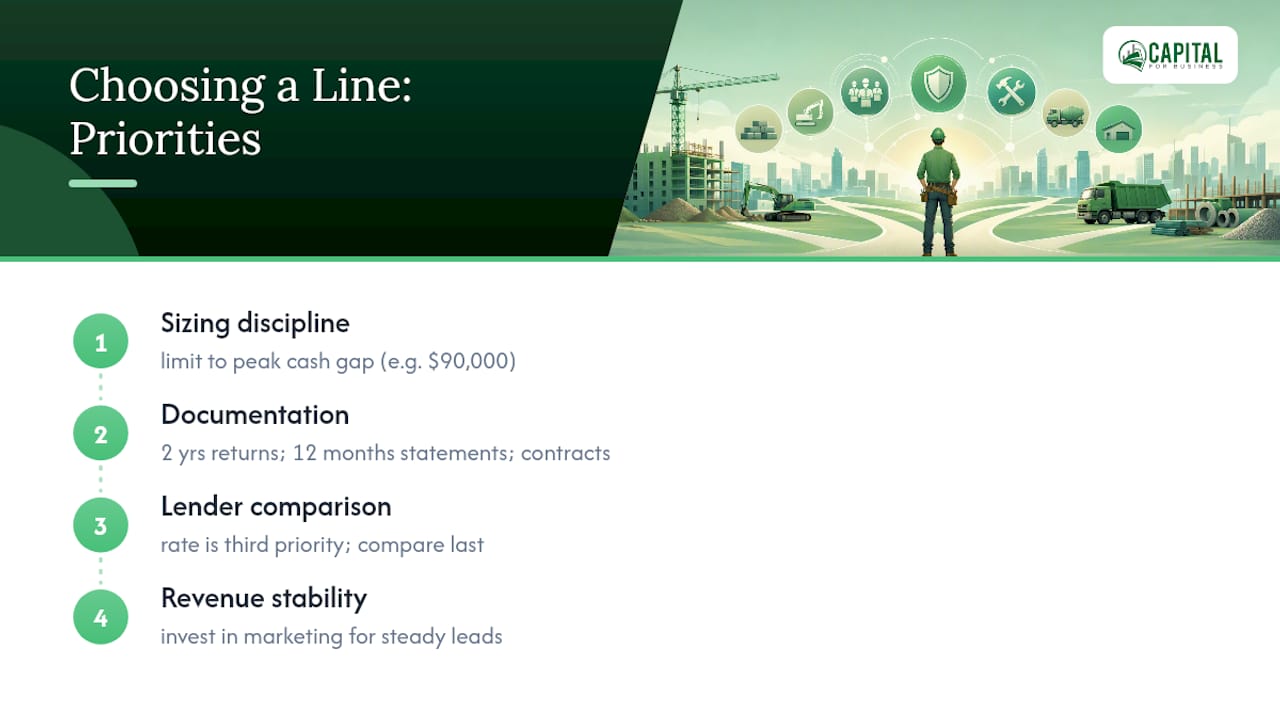
The documentation piece gets underrated too. Most delays in this process come from incomplete paperwork, not from lenders dragging their feet. A contractor who shows up with two years of returns, 12 months of statements, and current contracts already assembled moves through underwriting noticeably faster than one who submits piecemeal.
Prioritize the cash gap model first, the documentation checklist second, and the lender comparison last. Rate matters, but it's the third decision, not the first one. Get the sizing and paperwork right, and the lender conversation becomes far less stressful. Contractors serious about scaling their pipeline should also look at marketing investments that generate consistent lead flow, since steady revenue is what keeps a line of credit renewable year after year.
— Capital
Get a Contractor Line of Credit Sized Right for Your Business
Capital for Business offers lines of credit up to $250,000 built for contractors juggling payroll timing, materials costs, and seasonal swings, without the months-long underwriting cycle that national banks often require. Since 2009, Capital for Business has worked with small business owners across construction and dozens of other trades, matching the right product, whether that's a line of credit, working capital loan, or equipment financing, to the actual cash-timing problem a contractor is solving.

If you've run your peak cash gap model and you're ready to see what limit and terms you'd qualify for, explore Capital's business line of credit options and get a straightforward read on your fit before your next payroll crunch hits.
Sources
- Standby fee definition and guidance — Corporate Finance Institute
- Types of 7(a) loans — U.S. Small Business Administration
- Small Contractor Line of Credit Program — URA
- What is a construction line of credit — Nav
FAQ
How Do You Get a Construction Line of Credit?
Prepare two years of tax returns, 12 months of bank statements, a year-to-date profit and loss statement, and current contracts, then apply 60 to 90 days before you need funds so underwriting delays don't leave you short.
What's the Monthly Payment on a $200,000 Construction Loan?
Monthly payments depend heavily on the rate, term, and whether it's a revolving line versus a term loan, so get a specific quote from your lender rather than relying on a generic estimate; a revolving line only charges interest on what you've drawn.
What Is the Monthly Payment on a $50,000 Business Loan?
Like larger loans, this depends on your rate and repayment term, and a revolving line of credit at this size would only charge interest on the portion actually drawn rather than the full amount.
Can My LLC Get a Line of Credit?
Yes, LLCs regularly qualify for lines of credit, though most lenders still require a personal guarantee from the owner regardless of the entity structure, and building separate business credit through Dun & Bradstreet can improve your terms over time.