
A construction line of credit is a revolving business credit facility that lets contractors borrow only what a project needs, when it needs it, then repay and reuse the same limit. It works best for smoothing cash flow between draws, covering payroll, or bridging materials costs, not for financing an entire build from the ground up. The tradeoff is real: you get flexibility, but the rate usually runs higher than a dedicated construction loan.
TL;DR:
- A construction line of credit offers revolving borrowing capacity, typically tied to a contractor’s revenue and project backlog, not full project costs.
- Secured lines usually feature lower rates and higher limits, while unsecured lines often require personal guarantees and carry higher costs.
- Contractors use LOCs mainly for cash flow gaps like payroll, supplier payments, and small equipment purchases, not for financing entire projects.
- Approval depends on personal and business credit, time in business, debt coverage, existing contracts, and timely financial documentation submission.
- Using the line prudently as short-term bridge financing rather than a permanent fund maximizes its value and minimizes risk.
Table of Contents
- What Is a Construction Line of Credit?
- How Does a Construction Line of Credit Work Day to Day?
- Secured vs. Unsecured: Which Structure Fits Your Risk Tolerance?
- Where a Construction LOC Actually Earns Its Keep
- What Do Lenders Actually Check Before Approving You?
- Line of Credit or Construction Loan: Which One Do You Need?
- What Will a Construction Line of Credit Actually Cost You?
- How Do You Apply, and How Long Does It Take?
- Why Capital for Business Understands Contractor Cash Flow
- A Lender's Candid Take on Common Mistakes
- Get a Construction Line of Credit Sized to Your Backlog
- Where to Learn More
- Sources
- FAQ
What Is a Construction Line of Credit?
A construction line of credit differs from a term loan in one fundamental way: you're not handed a lump sum you repay on a fixed schedule. Instead, a lender approves a credit limit, and you draw against it as needed. Interest accrues only on the outstanding balance, not the full limit. Pay down what you've borrowed, and that capacity becomes available again. That revolving structure is why contractors use it for cash-flow gaps rather than full project funding.
Most construction LOCs come with strings attached. Lenders protect their position through several common mechanisms:
- UCC filings that give the lender a claim on business assets if the loan defaults
- Personal guarantees, which put the owner's personal assets on the hook alongside the business
- Covenants requiring minimum revenue, debt service coverage, or working capital levels
- Periodic reviews where the lender reassesses the limit based on updated financials
The AGC Guide to Construction Financing walks through these lender protections in detail, including recourse structures that determine how much personal liability a contractor actually carries. Understanding which protections apply to your line before you sign is worth the extra hour with your accountant.
How Does a Construction Line of Credit Work Day to Day?
The lifecycle of a construction LOC follows a predictable pattern, whether you're borrowing $30,000 or $200,000. Here's how it typically plays out:
- Application and underwriting. You submit financial statements, tax returns, and project details. The lender reviews credit history, revenue, and existing debt obligations.
- Limit setting. Based on that review, the lender assigns a credit ceiling, often tied to a multiple of monthly revenue or a percentage of receivables.
- Drawing funds. You request a draw, usually through an online portal or a call to your account manager, and funds land in your account within a day or two. 9 4. Repayment. You make minimum payments on the outstanding balance, with interest calculated daily or monthly depending on the lender.
- Reuse. As you pay down principal, that capacity reopens, letting you draw again without reapplying.
Nav's overview of construction lines of credit confirms this revolving nature is the core distinction from a one-time construction loan. For a contractor juggling three job sites, that reusability means one approved line can cover payroll on Monday and a materials order on Thursday without two separate loan applications.
Secured vs. Unsecured: Which Structure Fits Your Risk Tolerance?
A secured line ties your credit to specific collateral, equipment, receivables, or a UCC blanket lien on business assets. An unsecured line skips the collateral requirement but almost always demands a personal guarantee instead. Lenders manage risk either way; the question is what you're willing to put up.
- Secured lines typically carry lower rates and higher limits, since the lender has something to recover if you default.
- Unsecured lines close faster and protect specific assets, but the personal guarantee means your house or savings could be exposed in a worst case.
- Covenant negotiation matters more than most contractors realize. You can often negotiate the scope of a UCC filing, cap the guarantee amount, or set release triggers tied to revenue milestones.
Pro Tip: Ask your lender whether the personal guarantee can convert to a limited guarantee once your business hits 18 to 24 months of consistent revenue. Many will agree if you ask before signing, not after.
Where a Construction LOC Actually Earns Its Keep
Contractors reach for a line of credit in specific, recurring situations rather than as a substitute for full project financing:
- Payroll gaps between invoicing a client and actually receiving payment
- Supplier payments on materials when a draw from the general contractor is still weeks out
- Small equipment purchases, like a generator or compressor, that don't justify a separate equipment loan
- Bridging draws between construction milestones when the primary loan's next disbursement hasn't landed
- Covering change orders that weren't in the original project budget
A specialty product like Billd's Flex Line illustrates how lenders now build LOC features specifically around subcontractor payment cycles, underwriting against backlog rather than just credit score. Where an LOC falls short is financing an entire build or buying a piece of capital equipment you'll keep for a decade. That's a job for equipment financing or a dedicated construction business loan instead.
What Do Lenders Actually Check Before Approving You?
Every lender runs through a similar checklist, even if the paperwork format differs. Here's what typically gets reviewed:
- Personal and business credit scores, with most lenders wanting a personal score above 600 and a clean business credit file
- Time in business, generally two years or more, though some lenders work with newer contractors who show strong contracts
- Debt service coverage ratio (DSCR), which measures whether your cash flow can comfortably cover new debt payments
- Bank statements covering the last three to six months
- Signed contracts or a project pipeline showing backlog, which matters more for construction than almost any other industry
- Tax returns, usually the last two years, business and sometimes personal
Bonding capacity also matters. A contractor who can show an active surety relationship and a healthy backlog signals lower risk, even without perfect credit. Nav's underwriting overview notes that revenue consistency and existing credit relationships weigh heavily in how lenders size a limit. Strengthen your application by organizing these documents before you apply rather than scrambling once a lender asks.
Line of Credit or Construction Loan: Which One Do You Need?
These two products solve different problems, and mixing them up costs contractors time and money.
- Flexibility: A line of credit lets you draw and repay repeatedly; a construction loan disburses in stages tied to inspections.
- Collateral: Construction loans almost always require the property itself as collateral; LOCs vary between secured and unsecured.
- Cost: Construction loans often carry lower rates but stricter underwriting and larger down payments.
- Best use case: Use a construction loan to fund the actual build. Use a line of credit to manage the gaps around it.
Bankrate's construction loan breakdown explains that construction loans typically require four to six inspection-based draws and often demand a larger down payment than a conventional mortgage. Many contractors run both simultaneously: a construction loan for the build itself, an LOC for the operational cash flow around it.
What Will a Construction Line of Credit Actually Cost You?
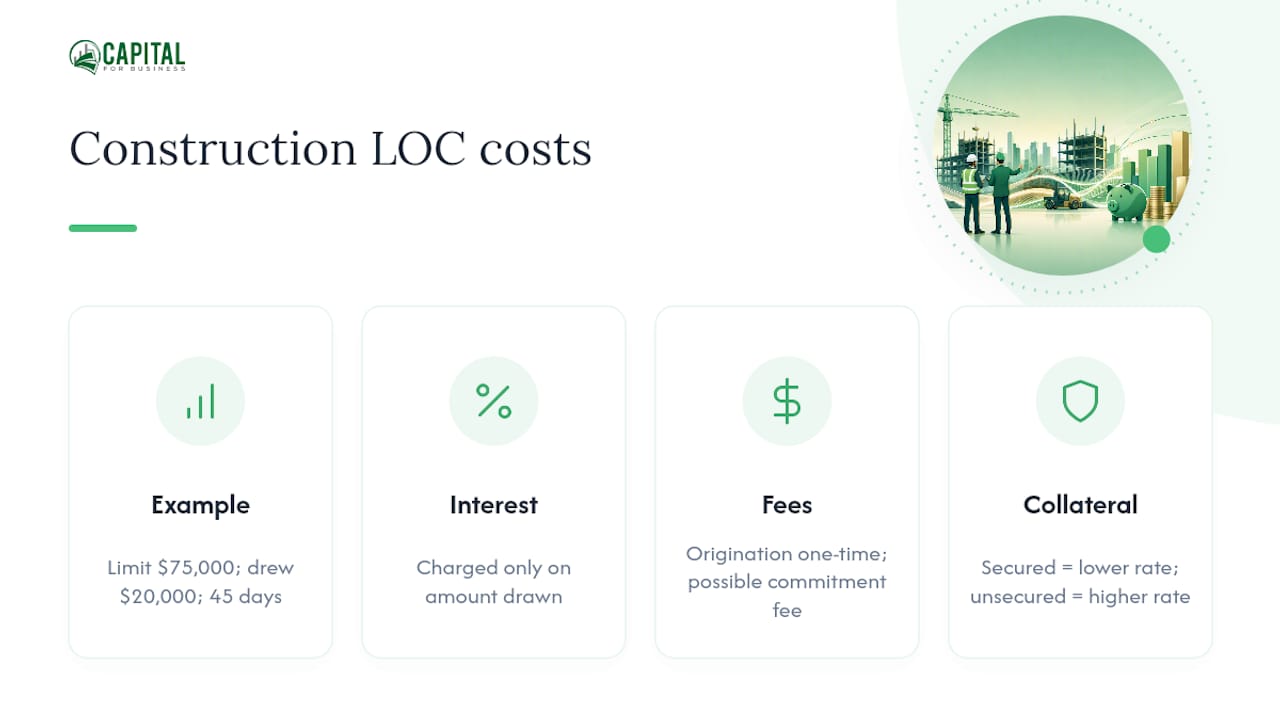
Rates vary sharply by structure. Unsecured lines commonly run higher than secured lines, since the lender takes on more risk without collateral backing the balance. Expect origination fees, sometimes a commitment fee on unused capacity, and a UCC filing fee if the line is secured.
Here's a worked example: say you draw $20,000 against a $75,000 secured line and carry that balance for 45 days before repaying it. You'd owe interest only on the $20,000 drawn, not the full $75,000 limit, which is the entire point of revolving credit. Origination fees typically get charged once at setup, not on every draw. Rate and fee structure depend heavily on your credit profile, time in business, and whether the lender takes UCC collateral, so get the exact terms in writing before you draw a dollar.
How Do You Apply, and How Long Does It Take?
Getting from application to first draw usually follows this sequence:
- Pre-qualification. Submit basic business information for a soft credit check and preliminary limit estimate.
- Document submission. Provide bank statements, tax returns, signed contracts, and business formation documents (often as PDF uploads through an online portal).
- Underwriting review. The lender verifies revenue, DSCR, and credit history, sometimes requesting clarification on specific contracts.
- Term negotiation. Confirm the limit, rate, fees, and any collateral or guarantee requirements before signing.
- Closing and first draw. Funds become available, often within 24 to 48 hours of signing.
Most contractors move from pre-qualification to first draw within a few weeks, assuming documents are ready upfront. The most common delay is incomplete bank statements or a mismatch between reported revenue and tax returns.
Pro Tip: Pull your last six months of bank statements before you start shopping lenders. Missing or inconsistent statements are the single biggest reason underwriting drags past two weeks.
Why Capital for Business Understands Contractor Cash Flow
Since 2009, Capital for Business has worked with small business owners across dozens of industries, including construction, to structure financing that fits how contractors actually get paid: unevenly, with gaps between invoicing and receipt. Our construction line of credit offerings are sized to project backlog and revenue rather than rigid formulas.
We typically request:
- Three to six months of business bank statements
- Proof of active contracts or project pipeline
- Basic business formation documents and tax returns
- A straightforward conversation about how you plan to use draws
If you've been turned down by a bank or credit union for being "too small" or "too new," that's often exactly the gap we work in.
A Lender's Candid Take on Common Mistakes
The biggest mistake we see: contractors treat a line of credit like free money instead of a tool with a repayment clock attached. Applicants often skip organizing bank statements until asked, which slows underwriting by days. We recommend a line of credit when cash-flow timing is the problem, not overall project cost. Use it prudently: draw for a specific, short-term need, repay quickly, and keep it as reserve capacity rather than a standing balance. A contractor who treats the line as a 60-day bridge, not a permanent crutch, gets the most value from it.
— Capital
Get a Construction Line of Credit Sized to Your Backlog
Capital for Business is the practical alternative when banks say no or take too long to say yes. Our construction line of credit product goes up to $250,000, sized against your revenue and project pipeline rather than a rigid formula, with funding that moves in days instead of weeks.

Picture a framing contractor waiting on a $40,000 draw from a general contractor while payroll is due Friday. A $50,000 line covers payroll now, gets repaid the following week when the draw lands, and stays open for the next gap. That's the exact scenario our business line of credit is built to solve. If you need equipment instead of working capital, our team can also walk you through equipment financing options up to $250,000 with same-day funding. Start by checking your eligibility online. It takes a few minutes and won't affect your credit score.
Where to Learn More
For official rules and deeper technical detail, these sources are worth bookmarking:
- SBA's guide to 7(a) loan types, for government-backed alternatives
- The AGC Guide to Construction Financing, for industry-standard mechanics
- Fannie Mae's construction-to-permanent guidance, for conversion financing
- Bankrate's construction loan primer, for a consumer-facing comparison
Sources
- AGC Guide to Construction Financing
- Types of 7(a) loans — SBA
- What is a construction line of credit and how does it work? — Nav
- Construction loans explained — Bankrate
FAQ
What's the Monthly Payment on a $200,000 Construction Loan?
Payments vary by rate, term, and whether the loan is interest-only during construction, which is common. Get a specific quote from your lender, since construction loans typically involve staged draws that change the outstanding balance monthly.
Is a Construction Loan or a HELOC Better?
A construction loan is built for staged, inspection-based disbursements tied to a specific build, while a HELOC or business line of credit offers more flexible, repeatable access to smaller amounts. Most contractors use a construction loan for the build itself and a line of credit for the cash-flow gaps around it.
Do I Need 20% Down for a Construction Loan?
Down payment requirements vary by lender and loan type, but construction loans often require a larger down payment than a conventional mortgage, according to Bankrate. A line of credit typically requires no down payment at all, since it's not tied to a specific property purchase.
Can I Use My LLC to Get a Construction Line of Credit?
Yes, most lenders, including Capital for Business, work directly with LLCs and other business entities, though a personal guarantee from the owner is common regardless of business structure. Lenders will still review your personal credit alongside business financials.