
TL;DR:
- Capitalforbusiness offers a flexible, fast alternative to AdvancePoint Capital with transparent costs for small business financing. It provides options including short-term loans, lines of credit, SBA loans, and equipment financing, all through a single application. Matching the right product to your cash flow needs ensures manageable repayment and cost efficiency.
If you're searching for advancepointcap.com alternatives, the short answer is this: Capitalforbusiness offers the most practical starting point for most small businesses, with working capital loans, short-term loans, and lines of credit that cover the same use cases AdvancePoint Capital targets, often at more transparent pricing. Beyond Capitalforbusiness, the strongest category-level alternatives are SBA 7(a) loans for lower-cost term financing, business lines of credit for revolving flexibility, invoice financing for B2B sellers, and equipment financing for asset purchases.
Here's a quick shortlist to orient your search:
- Capitalforbusiness working capital loans — Practical fit for most small businesses; funds up to $500k, fast approval, and a full product line under one roof.
- Business line of credit — Best for managing cash flow gaps without borrowing a lump sum; draw only what you need.
- SBA 7(a) loans / microloans — Lowest cost of capital available; slower approval but worth it for businesses that qualify.
- Non-recourse invoice financing — Ideal for B2B sellers; advances up to 100% of approved invoices and shifts collection risk off your books.
- Equipment financing — Purpose-built for asset purchases; the equipment itself serves as collateral, so credit requirements are often more accessible.
- Revenue-based financing — Repayments flex with monthly revenue, which helps during slow periods.
Pro Tip: If you need funds within 48 hours and can't wait for SBA processing, a short-term business loan from Capitalforbusiness is the fastest path that still gives you transparent, written cost disclosures.
AdvancePoint Capital is known primarily as a merchant cash advance specialist, with factor rates typically in the 1.25–1.50 range and funding available within 24–72 hours. That speed is real, but the cost is high. The alternatives below give you a map of what's available, what each costs, and which fits your situation.
Table of Contents
- How do the top AdvancePoint Capital alternatives compare?
- What are the best financing alternatives to AdvancePoint Capital?
- What does each financing option actually cost, and how fast does it fund?
- How do you choose the right financing alternative?
- What do 2026 lending trends say about MCA alternatives?
- Key Takeaways
- What the right funding decision actually looks like
- Capitalforbusiness covers the full range of alternatives in one place
- FAQ
How do the top AdvancePoint Capital alternatives compare?
| Option | Best for | Typical funding amount | Time to funding | Cost (factor rate / APR range) | Credit / revenue requirements | Collateral | Repayment structure |
|---|---|---|---|---|---|---|---|
| Capitalforbusiness short-term loans | Fast working capital, most industries | Up to a substantial amount | Typically within a couple of days | Factor rates vary depending on borrower profile | Credit scores and revenue levels that lenders typically consider | Often unsecured | Fixed daily or weekly payments |
| Business line of credit | Recurring cash flow gaps, seasonal businesses | Ranges suitable for many small business needs | Typically within a few days | APR varies widely depending on lender and credit profile depending on lender and profile | Credit score requirements vary by lender; 1+ year in business | Usually unsecured | Pay interest on drawn balance only |
| SBA 7(a) loan | Expansion, equipment, real estate, refinancing | Up to a high amount suitable for expansion and refinancing | Several weeks to a few months | Prime plus a few percentage points (current SBA APRs vary) | 680+ credit score; 2+ years in business | May require collateral for larger amounts | Fixed monthly payments |
| SBA microloan | Startups, very small businesses | Up to an amount suitable for startups and very small businesses | 30–60 days | Typical APRs for microloans | Lower thresholds; lender-specific | May require personal guarantee | Fixed monthly payments |
| Non-recourse invoice financing | B2B sellers with outstanding invoices | Up to the approved invoice value | 24 hours | Invoice fees vary within a low percentage range | Based on customer creditworthiness | Invoices serve as collateral | Repaid when customer pays |
| Revenue-based financing | Businesses with strong monthly revenue | Amounts supporting various business sizes and needs | 2–5 days | Factor rates depend on business revenue and credit | $15k+/mo revenue; flexible credit | None | % of monthly revenue |
| Equipment financing | Asset purchases (machinery, vehicles, tech) | Amounts appropriate for equipment purchases | Typically within a few days | APR rates vary depending on credit and lender | Credit score requirements vary by lender | Equipment itself | Fixed monthly payments |
| Merchant cash advance (baseline) | Emergency capital, poor credit | A range suitable for emergency capital needs | 24–72 hours | Factor rates typically in the 1.25–1.50 range | 500+ credit score; $10k+/mo revenue | None | Daily % of card sales |
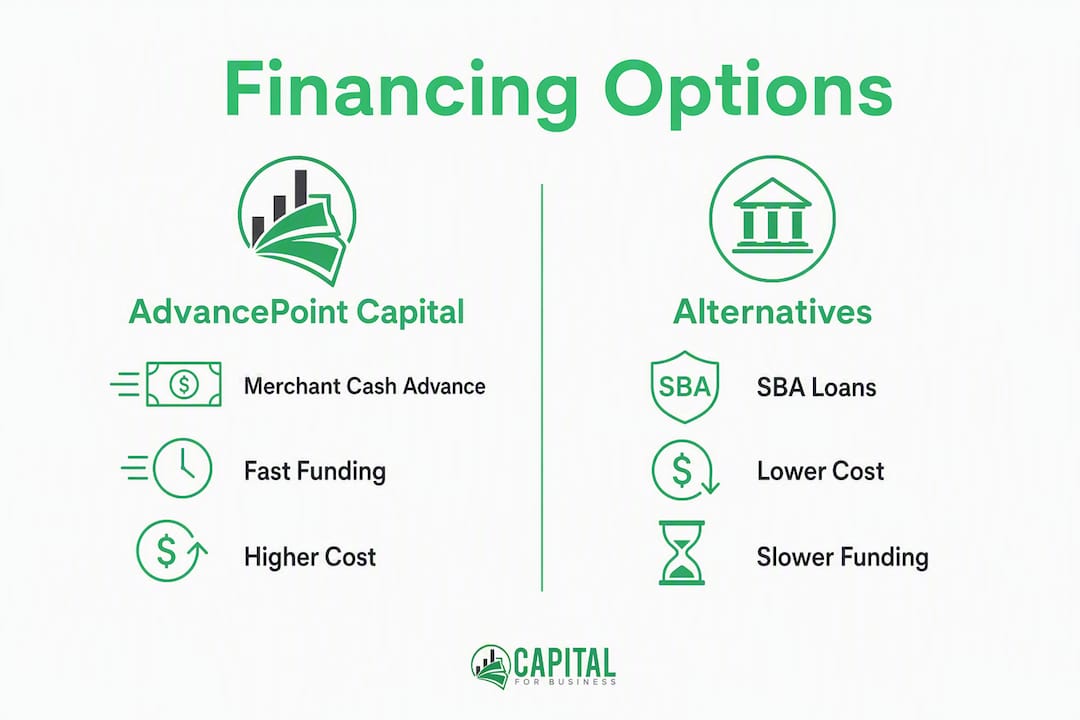
Quick guidance: If your primary concern is cost, SBA loans win. If you need speed and flexibility without daily payment pressure, a line of credit or revenue-based financing is a better fit than an MCA. If you have outstanding B2B invoices, non-recourse invoice financing removes the most risk.
What are the best financing alternatives to AdvancePoint Capital?
Each category below solves a different problem. Matching the product to your actual need is what keeps repayment manageable.

Capitalforbusiness short-term loans and working capital
Capitalforbusiness offers small business loan options covering short-term loans, working capital, merchant cash advances, equipment financing, and lines of credit, all under one application process. For most small business owners who want a real alternative to AdvancePoint Capital, this is the practical first call: the product range is comparable, the approval process is fast, and you get written cost disclosures upfront.
- What it is: Direct lending and brokerage across multiple product types
- Best for: Most industries; businesses needing $25k–$500k quickly
- Typical approval window: Typically within a couple of days
- Pro/con: Full product line, transparent terms; not the cheapest option for businesses that qualify for SBA
Business line of credit
A line of credit lets you draw funds as needed and pay interest only on what you use. It's the right tool for managing seasonal gaps, covering payroll during slow months, or keeping inventory stocked without taking on a fixed lump-sum loan.
- What it is: Revolving credit facility, typically Ranges suitable for many small business needs
- Best for: Recurring cash flow gaps, seasonal businesses
- Typical approval window: Typically within a few days
- Pro/con: Flexible and reusable; requires stronger credit than an MCA
SBA 7(a) loans and microloans
SBA loans carry the lowest interest rates available to small businesses, backed by the U.S. Small Business Administration's guarantee. The 7(a) program goes up to $5M; the microloan program caps at $50k and is specifically designed for startups and very small businesses. The trade-off is time: expect Several weeks to a few months from application to funding.
- What it is: Government-backed term loans with fixed monthly payments
- Best for: Expansion, equipment, refinancing existing high-cost debt
- Typical approval window: Several weeks to a few months
- Pro/con: Lowest cost of capital; slowest to fund, stricter eligibility
Non-recourse invoice financing
Non-recourse invoice financing advances cash against outstanding invoices and, critically, the financing company absorbs the loss if your customer doesn't pay. Non-recourse advances can reach up to 100% of approved invoice value within 24 hours, making this one of the fastest and lowest-risk alternatives for B2B sellers.
- What it is: Cash advance against B2B invoices; lender bears nonpayment risk
- Best for: B2B sellers with reliable customers but slow payment cycles
- Typical approval window: 24 hours
- Pro/con: Removes collection risk; only works if you have qualifying invoices
Revenue-based financing
Repayments are calculated as a percentage of your monthly revenue, so payments shrink automatically during slow months. This structure suits businesses with strong but variable revenue, such as restaurants, retailers, or service businesses with seasonal swings.
- What it is: Advance repaid as a fixed % of monthly revenue
- Best for: Businesses with variable monthly revenue
- Typical approval window: 2–5 days
- Pro/con: Flexible repayment; factor rates can still be high
Equipment financing
The equipment itself secures the loan, which means lenders take on less risk and can approve borrowers who might not qualify for unsecured products. Capitalforbusiness offers equipment financing up to $250,000 with same-day funding available on qualifying deals.
- What it is: Asset-backed loan or lease for business equipment
- Best for: Purchasing machinery, vehicles, technology, or fixtures
- Typical approval window: Typically within a few days
- Pro/con: Accessible credit requirements; funds are restricted to the asset purchase
Business credit cards
For smaller, recurring expenses under $25k, a business credit card with a 0% introductory APR period can be the cheapest short-term capital available. The limit is the credit line, and discipline is required to pay it down before the promotional period ends.
Pro Tip: OnDeck, BlueVine, Fundbox, Kabbage (now an American Express / WebBank-backed product), and Credibly are frequently cited as similar sites to advancepointcap.com. Each focuses on a specific product niche. Rather than applying to several separately, working with a multi-product partner like Capitalforbusiness lets you compare options through a single application.

What does each financing option actually cost, and how fast does it fund?
Understanding cost in comparable terms matters because factor rates and APR measure the same thing differently.
| Option | Typical cost | Time to fund |
|---|---|---|
| Capitalforbusiness short-term loan | Factor rate 1.15–1.45 | Typically within a couple of days |
| Business line of credit | APR varies widely depending on lender and credit profile | Typically within a few days |
| SBA 7(a) loan | Current APR ranges offered by SBA programs | Several weeks to a few months |
| SBA microloan | Typical APRs for microloans | 30–60 days |
| Non-recourse invoice financing | 1%–5% per invoice | 24 hours |
| Revenue-based financing | Factor rates depend on business revenue and credit | 2–5 days |
| Equipment financing | APR rates vary depending on credit and lender | Typically within a few days |
| Merchant cash advance (baseline) | Factor rates typically in the 1.25–1.50 range | 24–72 hours |
A note on factor rates vs. APR: A factor rate of 1.35 on a $50,000 advance means you repay $67,500 total. If that advance is repaid over 6 months, the effective APR is roughly 70%+. The shorter the term, the higher the annualized cost. Always convert factor rates to APR before comparing offers.
Example: $50,000 financing across three options
- MCA at factor rate 1.35, 6-month term: Total repayment = $67,500. Weekly payment ≈ $2,596. If your lean-month weekly revenue is $8,000, that's 32% of revenue going to repayment.
- Line of credit at 25% APR, 12-month draw: Total interest on $50,000 drawn for 12 months ≈ $12,500. Monthly payment ≈ $5,208. More manageable, and you can pay down early.
- SBA 7(a) at 11% APR, 5-year term: Monthly payment ≈ $1,087. Total interest over 5 years ≈ $15,200. Lowest monthly burden by far.
Always get these four cost components in writing before signing:
- Total repayment amount (not just the factor rate)
- Origination fee (flat dollar amount or percentage)
- Prepayment terms (penalty or discount for early payoff)
- Holdback percentage (for MCAs and revenue-based products)
How do you choose the right financing alternative?
The right product depends on three things: how fast you need the money, what your credit and revenue profile looks like, and whether your cash flow can sustain the repayment cadence. Use this framework before you apply.
Selection criteria checklist:
- Total cost of capital (factor rate converted to APR, not just the headline rate)
- Repayment cadence (daily vs. weekly vs. monthly — daily payments hit cash flow hardest)
- Impact on lean-month cash flow (model the worst month, not the average)
- Loan term (shorter terms mean higher annualized cost)
- Collateral requirements (unsecured vs. asset-backed)
- Covenants or restrictions (some lenders restrict additional borrowing)
Questions to ask any lender or marketplace:
- "What is the total repayment amount, in dollars?"
- "Do you charge an origination fee, and is it included in the factor rate or added separately?"
- "Will my application be shopped to multiple lenders simultaneously, or sequentially?" (Sequential shopping can trigger multiple hard credit pulls and require restarting documentation if a lender declines.)
- "How many hard credit inquiries will this process generate?"
- "Is there a prepayment discount or penalty?"
Red flags to watch for:
- Vague pricing ("rates vary" with no range given)
- Holdback percentages not disclosed until the contract stage
- Mandatory daily payments that exceed your lean-month daily receipts
- Broker fees embedded in the factor rate without disclosure
- Pressure to sign within hours
Decision flow:
- If you need funds in under 48 hours and have at least $10k/month in revenue, start with a short-term loan or working capital product from Capitalforbusiness.
- If you have strong credit (680+) and can wait Several weeks to a few months, apply for an SBA 7(a) loan first.
- If you have outstanding B2B invoices, get a non-recourse invoice financing quote before anything else.
- If your revenue is variable and you want payments that flex, look at revenue-based financing.
- If you're buying equipment, use equipment financing so the asset secures the deal.
What do 2026 lending trends say about MCA alternatives?
The 2026 lending environment has shifted meaningfully for small businesses. Two trends stand out.
Non-recourse invoice financing is gaining ground. For B2B sellers, the ability to advance against invoices without bearing the risk of customer nonpayment is a material improvement over a high-factor MCA. Traditional MCAs are recourse products: if your sales drop, you still owe the advance. Non-recourse invoice financing removes that exposure entirely. Platforms using AI-powered payments and invoice automation can advance funds within 24 hours while handling collections on your behalf.
The cheapest money is the money you don't borrow. Financial analysts consistently advise running conservative cash-flow models before accepting short-term, high-factor capital. A simple projection template should include: lean-month revenue estimate, daily or weekly repayment obligation, and minimum operating reserve. If the repayment obligation exceeds about one-fifth of your lean-month revenue, the product is likely too expensive for sustainable use.
Pro Tip: Before accepting any offer, model it against your three lowest-revenue months from the past year. If the weekly payment would have left you unable to cover payroll or rent in any of those months, the product is too aggressive for your cash flow.
A concrete example: a B2B distributor with $80,000 in outstanding invoices and a 60-day payment cycle could take a non-recourse advance at 3% per invoice and receive $77,600 within 24 hours. The same business taking a $77,600 MCA at factor rate 1.35 would owe $104,760 total, with daily payments regardless of whether customers paid on time. The non-recourse route costs roughly $2,400 in fees; the MCA costs $27,160 in total interest equivalent. The difference is not marginal.
Key signals that short-term, high-factor capital is appropriate:
- You have a confirmed purchase order or contract that will generate revenue within 60 days
- The advance bridges a gap between a known payable and a known receivable
- You've modeled the repayment against lean-month cash flow and it's sustainable
- You've exhausted lower-cost options or can't wait for SBA processing
The 2026 lending trends favor businesses that treat fast capital as a tactical tool, not a default funding strategy.
How we compared these options
Methodology:
- Comparison dimensions: cost (factor rate and APR equivalent), speed to fund, eligibility thresholds, collateral requirements, repayment structure, and product flexibility.
- Sources: marketplace reviews, lender rate cards, industry commentary, and SBA program disclosures.
- 2026 adjustments: incorporated non-recourse invoice financing trends and cash-flow modeling guidance from current analyst commentary.
- Publisher note: Capitalforbusiness offers the products discussed in this article and is presented as a practical, recommended option. That relationship influenced the recommendation to start with Capitalforbusiness for most small businesses, but the category-level comparisons reflect independent cost and eligibility data.
- Best fit for Capitalforbusiness: businesses generating $10,000+ per month in revenue, operating in most U.S. industries, needing $25,000–$500,000 in capital, and prioritizing speed and a single point of contact over the absolute lowest rate.
Key Takeaways
The most cost-effective path for most small businesses is to start with a multi-product lender like Capitalforbusiness, model every offer against your lean-month cash flow, and reserve MCA-style advances for short-term tactical gaps with a clear repayment source.
| Point | Details |
|---|---|
| Match product to use case | SBA loans cost least; short-term loans fund fastest; invoice financing suits B2B sellers. |
| Model lean-month cash flow | If weekly repayment exceeds 20–25% of your slowest month's revenue, the product is too aggressive. |
| Get four cost items in writing | Total repayment, origination fee, prepayment terms, and holdback percentage before signing. |
| Ask about application shopping | Sequential lender shopping can trigger multiple hard credit pulls; ask for parallel submission. |
| Capitalforbusiness as starting point | Capitalforbusiness covers working capital, short-term loans, lines of credit, and equipment financing up to $500k through a single application. |
What the right funding decision actually looks like
The most common mistake small business owners make when searching for advancepointcap.com alternatives is optimizing for speed when they should be optimizing for fit. Speed matters when you have a confirmed gap and a confirmed repayment source. Without both, a fast advance can create a repayment obligation that outlasts the problem it was meant to solve.
Working with businesses across hundreds of industries since 2009, Capitalforbusiness has seen this pattern repeatedly: a business owner takes the fastest offer available, the daily payments strain cash flow for months, and the business ends up back in the same position six months later. The better outcome, in most cases, comes from taking two extra days to compare a short-term loan against a line of credit and choosing the one whose repayment cadence matches actual revenue timing.
That said, a merchant cash advance is still the right tactical choice in specific situations: a confirmed purchase order arriving in 30 days, a seasonal inventory buy with a known sell-through window, or a bridge between a signed contract and first payment. The product is not inherently problematic. The problem is using it as a default when a lower-cost, better-fitting option was available and accessible.
Capitalforbusiness covers the full range of alternatives in one place
When you're comparing top alternatives to AdvancePoint Capital, the practical advantage of working with Capitalforbusiness is that you don't have to apply to five separate lenders to find the right product. Working capital loans, short-term business loans, lines of credit, equipment financing, and merchant cash advances are all available through a single application, with funding up to $500k and approvals typically within a couple of days.
The application process is straightforward: submit basic business and revenue information, receive offers with written total cost disclosures, and choose the product that fits your cash flow. For businesses that have been declined by banks or credit unions, Capitalforbusiness works across credit profiles and industries, including those that traditional lenders routinely pass on.
Ready to see what you qualify for? Apply for business funding and get a written offer with full cost disclosure, typically within one business day.
Useful sources and further reading
Before accepting any financing offer, verify the lender's current rate card, origination fee schedule, and a sample contract. Rates change, and the figures in any published review may not reflect current offers.
- SBA 7(a) Loan Program — Official program terms, eligibility, and approved lender directory
- SBA Microloan Program — Terms and intermediary lender list for loans up to $50k
- AdvancePoint Capital review and rate data — Third-party rate and fee profile
- Non-recourse invoice financing overview — Explains non-recourse structure and advance mechanics
- Marketplace comparison and lender footprint analysis — Context on marketplace vs. direct lender trade-offs
- CNBC Select: Best merchant cash advance companies — Independent editorial ratings for MCA providers
- Capitalforbusiness funding solutions — Product overview and eligibility guide
- Similar sites to advancepointcap.com — Directory of comparable platforms; vet each independently before applying
FAQ
What is the easiest small business loan to get approved for?
Merchant cash advances and short-term working capital loans from direct lenders like Capitalforbusiness typically have accessible approval requirements, often approving businesses with lower credit scores and short time in business.
Who will fund my business if banks have declined me?
Online lenders and multi-product funding partners like Capitalforbusiness specialize in businesses that don't meet traditional bank criteria, using revenue history and business performance rather than credit score alone as the primary approval factor.
What is the easiest cash advance to get for a small business?
A merchant cash advance is generally the fastest and most accessible form of short-term capital, with approvals based primarily on monthly card sales volume and funding available in 24–72 hours, though factor rates in the 1.25–1.50 range make it one of the more expensive options.
Are there financing options similar to AdvancePoint Capital but with lower costs?
Yes. Business lines of credit, revenue-based financing, and SBA loans all serve similar use cases at lower annualized costs. For B2B sellers, non-recourse invoice financing can be significantly cheaper than an MCA while also removing the risk of customer nonpayment.
How do I avoid hidden fees when comparing lenders?
Ask every lender for the total repayment amount in dollars, the origination fee as a separate line item, the holdback percentage, and the prepayment terms in writing before signing. Brokers that shop applications sequentially may embed commissions in the factor rate without disclosing them separately.
This article is general information, not financial or legal advice. Verify current rates, fees, and eligibility requirements directly with lenders or a qualified financial advisor before accepting any financing offer.