
For short-term cash gaps, like covering payroll, restocking inventory, or bridging a slow season, a working capital loan is the appropriate tool. For buying equipment, expanding a location, or funding a project with a payoff measured in years, a term loan fits better. The nuance: working capital products are priced and structured for speed and flexibility, not for stretching over a long horizon, so using one to fund a multi-year investment often costs more than it should.
Two quick signals point you in the right direction:
- If the need will resolve in a business cycle or two (a season, a slow month, a gap between invoices getting paid), lean toward working capital.
- If the need creates an asset or capacity that will pay off over several years (machinery, a new location, a fleet vehicle), a term loan almost always makes more financial sense.
Key Takeaways
Working capital loans solve short-term operational gaps in months, while term loans finance long-term investments over years, and matching tenor to need is what actually controls total cost.
| Point | Details |
|---|---|
| Match tenor to the gap | Use working capital for needs resolving within a year; use term loans for multi-year investments. |
| Watch the true cost | Short-term products can carry higher annualized rates, so convert factor rates before comparing offers. |
| Collateral changes pricing | Secured term loans typically get lower rates; unsecured working capital often requires a personal guarantee. |
| Speed varies by product | Working-capital funding can arrive in days; term loans require deeper underwriting and more time. |
| Capitalforbusiness maps products to need | Since 2009, Capitalforbusiness has matched seasonal retailers, contractors, and manufacturers to working capital, lines of credit, or term financing based on their actual cash cycle. |
Table of Contents
- Working Capital vs. Loan: What Working Capital Actually Covers
- What Is a Term Loan and When Does It Make Sense?
- Working Capital vs. Term Loan: A Side-by-Side Look
- How Do You Decide Between Working Capital and a Term Loan?
- What's the Application Process and Timeline?
- How Capital for Business Sees This Play Out
- Tax Treatment: Where Working Capital and Term Loans Actually Differ
- Sources
- FAQ
Working Capital vs. Loan: What Working Capital Actually Covers
Working capital is the cash a business has on hand to run its daily operations. It's the difference between current assets (cash, receivables, inventory) and current liabilities (bills due, payroll, short-term debt). When that gap gets too thin, a business needs financing that plugs the hole fast, not financing designed for a decade-long payoff.
Working capital loans are short-term borrowing options built for exactly that: covering payroll, rent, or inventory, typically repaid within a short-term period. But "working capital loan" is really an umbrella term. Several distinct products fall under it, and each fits a slightly different situation:
- Short-term business loans — lump-sum funding repaid over a few months to a couple of years, good for a defined, one-time gap.
- Business lines of credit — a revolving facility where you draw what you need and pay interest only on the balance used, which suits businesses with unpredictable timing on cash needs.
- Invoice factoring — selling unpaid invoices for immediate cash, a fit for B2B companies waiting 30 to 90 days on client payments.
- Merchant cash advances — an advance against future card sales, common for retailers and restaurants with steady daily transaction volume.
- Business credit cards — smaller, ongoing purchases and short float periods.
- Seasonal or warehouse financing — tied to inventory cycles, built for businesses that stock up ahead of a predictable sales surge.
Picture a retailer ordering holiday inventory in September with cash that won't arrive from sales until December. A short-term loan or a line of credit closes that gap. Or think of a contractor who's finished a phase of work but is waiting 45 days on a draw payment while payroll is due Friday. That's a textbook case for invoice factoring or a line of credit, not a five-year loan.
The tradeoff for that speed and flexibility is cost and risk. Many working-capital products carry higher rates than traditional term loans, shorter repayment windows that strain cash flow if revenue dips, and personal guarantees that put an owner's individual credit on the hook.
Pro Tip: Match the product to the length of the gap, not just the size of it. A $50,000 need that resolves in 60 days should never be financed with a product designed to be repaid over three years, and vice versa.
What Is a Term Loan and When Does It Make Sense?
A term loan is straightforward: you borrow a lump sum and repay it on a fixed schedule, usually monthly, over a set period that can run anywhere from two to ten years or more. The structure is predictable by design, which is exactly why it works well for investments with a long payoff horizon.
Term loans make sense when you're buying equipment that will generate revenue for years, expanding into a second location, renovating a facility, or making any capital expenditure where the return unfolds gradually rather than immediately. J.P. Morgan's guidance on commercial lending frames this distinction clearly: working capital loans function as tactical bridges, while term loans are the better tool for capital expenditures and growth financing.
Underwriting for a term loan tends to go deeper than for short-term products. Lenders typically want to see:
- Two to three years of financial statements and tax returns
- A clear business plan or use-of-funds explanation for larger amounts
- Collateral, particularly for loans tied to a specific asset like equipment or real estate
- A credit profile strong enough to support a multi-year repayment commitment
The upside is lower interest rates and payments spread thin enough to be manageable. The downside is a slower approval process and less flexibility if your revenue is seasonal or unpredictable, since the fixed schedule doesn't bend when cash flow does.
Working Capital vs. Term Loan: A Side-by-Side Look
The clearest way to separate these two financing paths is to line them up across the factors that actually change your monthly cash flow.
- Purpose: Working capital covers operational gaps like payroll, rent, and inventory. Term loans fund equipment, expansion, and other capital investments.
- Typical tenure: Working capital loans commonly run a short-term period. Term loans typically span two to ten years, sometimes longer for real estate.
- Repayment structure: Many working-capital products, like lines of credit and invoice financing, are revolving or charge interest only on the amount drawn, according to Investopedia's breakdown of working-capital structures. Term loans use fixed monthly installments for the life of the loan.
- Cost drivers: Short-term products often carry higher annualized rates because the cost is compressed into a shorter window. Term loans generally carry lower rates but accrue interest over more years.
- Collateral needs: Unsecured working-capital products are easier to get quickly but often rely on personal guarantees, while secured term loans typically require collateral in exchange for better pricing, per Experian's overview of secured versus unsecured lending.
- Typical amounts: Working capital financing tends to scale with monthly revenue or receivables. Term loans scale with the asset or project being funded, often running larger for equipment or real estate purchases.
- Speed: Working-capital products frequently fund within days; term loans take longer to close given the deeper underwriting involved.
Rate reality check: Small-business loan rates vary widely by product and borrower profile, and ValuePenguin's rate data shows why short-term products often carry a higher annualized rate even when the total dollar amount of interest paid ends up lower, simply because the repayment window is so much shorter.
Here's how that plays out. A boutique gym owner needs $30,000 to cover three months of payroll while a membership drive ramps up. A six-month working-capital loan or a line of credit gets the cash moving fast, and the short window keeps total interest paid manageable even at a higher rate. Compare that to a manufacturer buying a $200,000 CNC machine expected to run for a decade. Stretching that purchase over a five-year term loan at a lower rate keeps monthly payments proportional to the equipment's actual useful life.
How Do You Decide Between Working Capital and a Term Loan?
Run through five questions in order, and the right product usually becomes obvious by the third one.
- What's the need? Operational (payroll, inventory, a cash-flow gap) points to working capital. Investment (equipment, property, expansion) points to a term loan.
- What's the time horizon? If the gap resolves within a year, match it to a short-term product. If the benefit plays out over several years, match the loan term to it.
- How reliable is your cash flow? Seasonal or irregular revenue often fits better with a revolving line of credit than a fixed monthly payment.
- How much collateral are you willing to put up? Willing to secure the loan with equipment or property? You'll likely get a better rate on a term loan. Prefer to stay unsecured? Expect to pay more and possibly sign a personal guarantee.
- How sensitive are you to total cost versus monthly payment size? Short-term products often have a higher annualized rate but a lower total dollar cost; term loans spread cost thin but accumulate more interest over time.
Before signing anything, ask the lender these exact questions, since J.P. Morgan's guidance on cost transparency points to these as the ones that surface the real tradeoffs:
- What's the total cost of this financing, including every fee and any factor rate, expressed as a dollar figure and as an annualized rate?
- How often are payments due, daily, weekly, or monthly, and how does that match my revenue cycle?
- Is there a prepayment penalty if I pay this off early?
- Does this require a personal guarantee, and what happens to my credit if the business can't repay?
- Are payments pulled via ACH automatically, and what happens if a payment fails?
Red flags worth walking away from: fee structures the lender won't explain in plain numbers, a repayment schedule that doesn't match how your revenue actually arrives, and any lender pushing you to sign before you've had time to compare offers.
Pro Tip: *If a lender quotes you a "factor rate" instead of an interest rate, convert it before you compare.
What's the Application Process and Timeline?
The path to funding differs sharply between the two products, mostly because of how much documentation each one demands.
- Pre-qualify. Most lenders offer a quick eligibility check based on revenue, time in business, and credit profile before you submit a full application.
- Gather documents. Expect to provide bank statements (usually three to six months), tax returns, proof of business registration, personal ID, and, for term loans, more detailed financials or a business plan.
- Submit the application. Working-capital applications are often shorter and can be completed online in one sitting.
- Underwriting. Working-capital lenders often underwrite quickly based on revenue and receivables. Term loan underwriting goes deeper, examining credit history, collateral value, and long-term repayment capacity.
- Funding. Many working-capital products fund within a matter of days, while term loans typically take longer to close given the added documentation and review.
To speed things up on either path, keep your bookkeeping current, maintain clean bank statements without frequent overdrafts, and show a revenue pattern a lender can actually read at a glance.
How Capital for Business Sees This Play Out
Since 2009, Capitalforbusiness has worked with seasonal retailers stocking up before their busiest quarter, restaurants smoothing out slow months, contractors bridging payroll between draws, and small manufacturers financing equipment that will run for a decade. The pattern across all of them: the product has to match the timeline of the need, not just the size of it.
- Businesses with unpredictable timing on expenses often do better with a business line of credit they can draw on as needed.
- Manufacturers and contractors buying equipment typically fit a term loan structure built around the asset's useful life.
If you're not sure which category your situation falls into, a free assessment can map your specific numbers to the right product before you commit to anything.
Tax Treatment: Where Working Capital and Term Loans Actually Differ
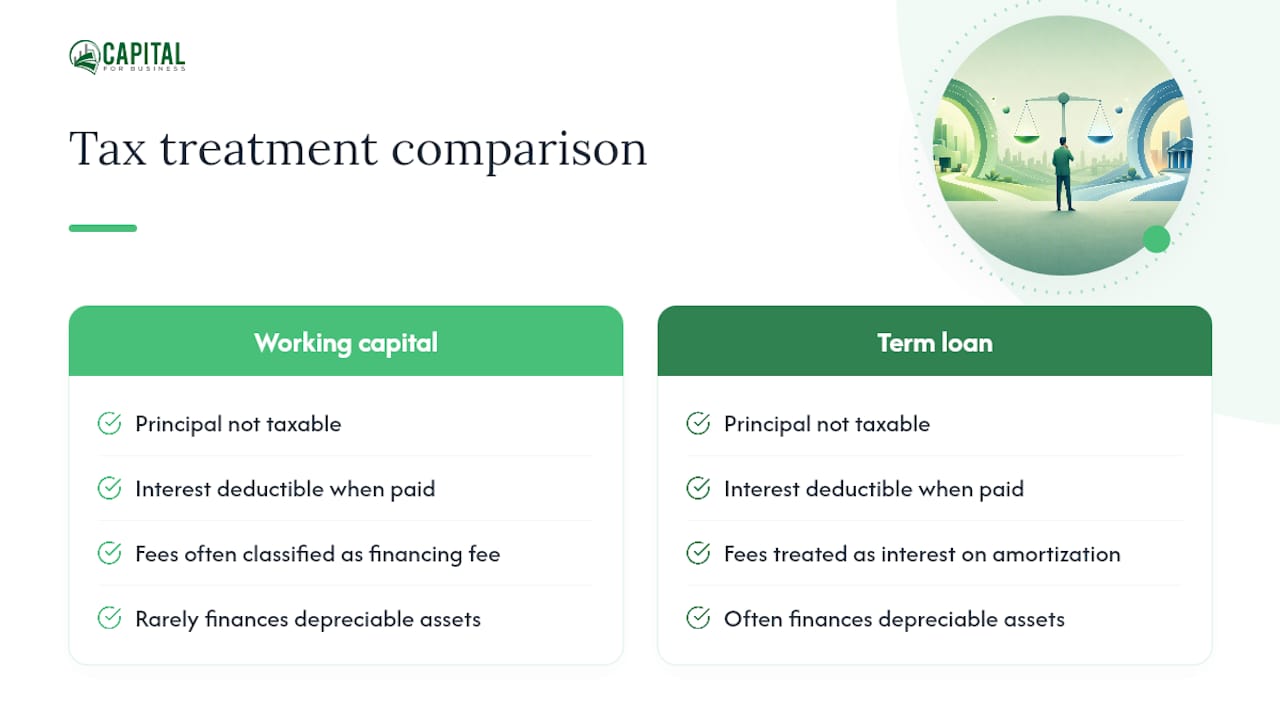
The loan principal itself isn't taxable income for either product, and loan proceeds don't show up as revenue on your income statement. Where the two diverge is in how the cost of borrowing gets treated.
Interest paid on both working-capital products and term loans is generally deductible as a business expense in the year it's paid, which is one reason the choice between them isn't purely a tax decision. The bigger accounting difference shows up in fees and structure. Factor rates used in merchant cash advances aren't technically "interest" in the traditional sense, and how a bookkeeper classifies that cost, as interest expense versus a financing fee, can affect how cleanly it shows up on your profit and loss statement. Term loans, by contrast, produce a straightforward amortization schedule that splits each payment into principal and interest, which most accounting software handles automatically.
Collateralized term loans also interact with depreciation. If you finance equipment with a term loan, the asset itself gets depreciated separately from the loan payments, following standard depreciation schedules, while the interest portion of each payment is deducted as it's paid. Working-capital products rarely finance a depreciable asset directly, since they're funding operating expenses that get expensed immediately rather than capitalized.
None of this replaces a conversation with your accountant, especially once loan amounts get large enough to matter on your year-end filing, but knowing the distinction helps you ask better questions before you sign.
A Practitioner's Rule of Thumb
Match the loan's tenor to your cash cycle, not to the biggest number a lender approves you for. The most common mistake: taking a multi-year term loan to solve a problem that will resolve in ninety days, which locks in payments long after the need has passed. Compare at least two offers side by side and read the fee schedule before either one becomes the answer.
How to Get Working Capital Fast Without Guessing on the Product
Capitalforbusiness maps each of the situations above to a specific product: working-capital funding for operational gaps, a line of credit for revolving needs, a merchant cash advance for revenue-based repayment, or a term loan structure for equipment and expansion.
Since 2009, Capitalforbusiness has worked with business owners across hundreds of industries, including many who'd already been turned down by a bank or credit union. That experience shapes how quickly applications move: working-capital decisions often happen in days, not weeks, and the product range means you're not forced into a term loan just because it's the only thing on offer. Whether the need is payroll this Friday or a piece of equipment that'll run for the next decade, there's a product built for the timeline you're actually working with.
Request a free assessment on the working-capital funding page to see which product fits your cash-flow situation before you apply anywhere else.
Sources
- Investopedia — Working Capital Loan definition and explanation
- J.P. Morgan insight on working capital loans and their role
- Experian — Secured vs unsecured loans overview
- ValuePenguin — Small-business loan interest rate data and ranges
FAQ
What Is the Difference Between Capital and a Loan?
Capital refers broadly to the money or assets a business has available to operate or invest, while a loan is one specific way to obtain that capital, borrowed funds that must be repaid with interest on a set schedule.
What Qualifies as Working Capital?
Working capital is the difference between a business's current assets, like cash, receivables, and inventory, and its current liabilities, such as bills due and short-term debt; financing that fills that gap is often called a working-capital loan.
What Is the Difference Between Working Capital and a Term Loan?
Working capital loans are short-term products, typically repaid within a few months, used for operational needs like payroll and inventory, while term loans are lump-sum loans repaid over two to ten years or more for equipment and expansion.
Are Working Capital Loans the Same as a Line of Credit?
Not exactly. A line of credit is one type of working-capital product, a revolving facility where you draw funds as needed and pay interest only on the amount used, while "working capital loan" also covers short-term lump-sum loans, invoice factoring, and merchant cash advances.