
Choosing the right financing solution can feel confusing when definitions and terms vary so much across banks in the United States and Canada. Flexible funding is vital for small business owners in retail and construction who need support for seasonal challenges or expansion. This article explains the basics of small business loans, breaks down common misconceptions, and highlights practical financing options so you can confidently access the capital your business needs.
Table of Contents
- Defining Small Business Loans and Misconceptions
- Types of Small Business Loans Explained
- How Loan Approval and Funding Work
- Key Benefits for Retail and Construction Owners
- Comparing Alternatives: Banks, Lines, and Advances
- Risks, Repayment, and What to Avoid
Key Takeaways
| Point | Details |
|---|---|
| Understanding Loan Types | Different small business loans serve various purposes and have unique eligibility criteria, impacting business growth strategies. |
| Exploring Alternatives | Entrepreneurs should compare traditional bank loans with alternative financing options to find the best fit for their financial needs. |
| Managing Risks | A proactive approach to loan management, incorporating financial planning and risk assessment, is essential for sustainable business development. |
| Researching Lenders | Evaluating multiple lending sources can provide more favorable loan terms and better funding options tailored to specific business circumstances. |
Defining Small Business Loans and Misconceptions
Small business loans represent strategic financial tools designed to provide capital for entrepreneurs and small business owners seeking growth opportunities. Small business lending standards vary significantly across financial institutions, creating a complex landscape for business financing.
Understanding the nuanced definitions of small business loans is crucial for entrepreneurs. Banks and financial institutions typically categorize these loans based on several key parameters:
- Loan Size: Generally ranging from $5,000 to $500,000
- Business Revenue: Often defined as companies with annual revenues under $10 million
- Employee Count: Typically businesses with fewer than 500 employees
- Industry Classification: Different standards across sectors like retail, construction, and professional services
Common misconceptions about small business loans can prevent entrepreneurs from accessing critical financial resources. Many business owners mistakenly believe that:
- Traditional banks are their only lending option
- Perfect credit is required to qualify
- Loan application processes are always complex and time-consuming
- Small loans are not worth pursuing for business growth
In reality, alternative lending platforms and specialized financial services have dramatically expanded financing options for small businesses. These modern lending solutions offer more flexible criteria, faster approval processes, and tailored financial products that accommodate diverse business needs.
Pro tip: Research multiple lending sources and compare their specific requirements to find the most suitable small business loan for your unique business circumstances.
Types of Small Business Loans Explained
Small businesses have access to diverse financing options tailored to different operational needs and growth strategies. Government-backed loan programs offer entrepreneurs multiple pathways to secure critical funding for their business objectives.
The most common types of small business loans include:
- SBA 7(a) Loans: Most popular program offering general business financing
- 504 Loans: Specifically designed for major fixed asset purchases and expansion
- Microloans: Smaller loans under $50,000 for startup and growth needs
- Equipment Financing: Loans dedicated to purchasing business machinery and technology
- Working Capital Loans: Short-term financing to cover operational expenses
Loan Characteristics to Consider:
- Interest rates
- Repayment terms
- Qualification requirements
- Collateral expectations
- Funding speed
Specialized loan options can support specific business scenarios, such as disaster recovery, export expansion, or minority-owned business development. These targeted programs provide flexible financing solutions that traditional bank loans might not offer.

Understanding the nuanced differences between loan types is crucial for making informed financial decisions. Each loan product comes with unique benefits, eligibility criteria, and potential restrictions that can significantly impact a business's financial strategy.
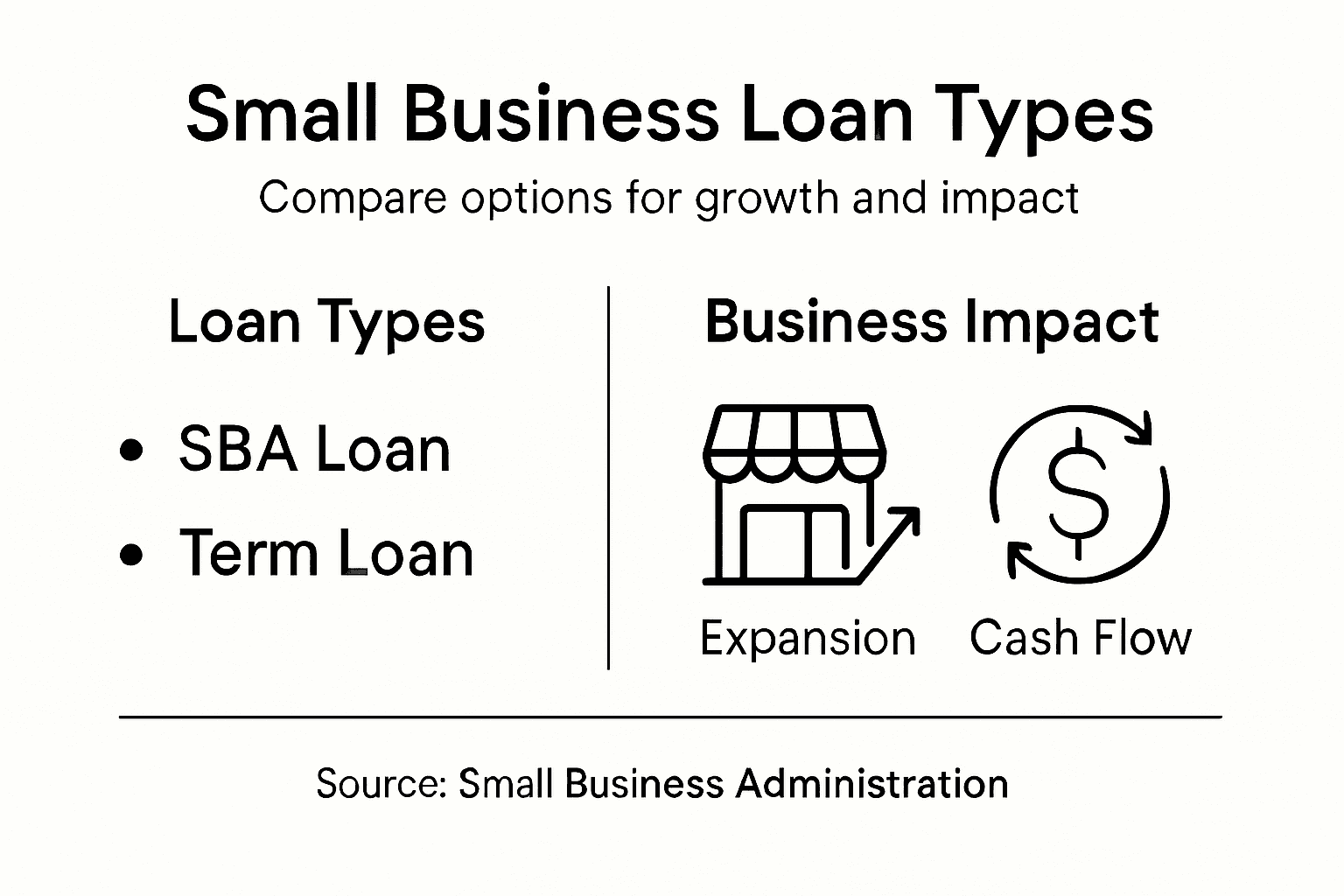
Here's a quick reference comparing common small business loan options and their business impact:
| Loan Type | Purpose | Ideal For | Business Impact |
|---|---|---|---|
| SBA 7(a) Loans | General financing | Expansion or operations | Enables broad funding for growth |
| 504 Loans | Asset purchases | Facilities, equipment | Supports major investments |
| Microloans | Small capital needs | Startups, micro firms | Kickstarts early stage business plans |
| Equipment Financing | Machinery and technology upgrades | Manufacturing, services | Boosts productivity and capability |
| Working Capital | Cash flow management | Seasonal operations | Maintains day-to-day business health |
Pro tip: Compare multiple loan options and carefully review the specific terms and conditions before committing to any business financing.
How Loan Approval and Funding Work
Small business loan approval involves a comprehensive assessment of a company's financial health, operational capabilities, and potential for success. Lenders conduct thorough evaluations to minimize risk and ensure the business can effectively utilize and repay the borrowed funds.
The typical loan approval process includes several critical stages:
- Initial Application: Submitting business documentation
- Financial Review: Analyzing revenue, credit history, and financial statements
- Business Plan Evaluation: Assessing growth strategy and market potential
- Collateral Assessment: Determining assets available for loan security
- Final Underwriting: Comprehensive risk and feasibility analysis
Key documents required for loan approval typically include:
- Business tax returns
- Personal and business credit reports
- Detailed financial statements
- Comprehensive business plan
- Proof of business ownership
Government-backed loan programs provide additional advantages for small businesses. These programs often offer more flexible qualification criteria and reduced risk for lenders, which can translate to better terms and higher approval rates for entrepreneurs.
Lenders typically look beyond simple credit scores, examining the overall financial narrative and growth potential of a business.
The funding process varies depending on the loan type, but most follow a standard timeline:
- Initial application submission
- Document verification
- Credit and financial review
- Loan committee approval
- Funding and disbursement
Pro tip: Prepare a comprehensive financial portfolio and be prepared to clearly articulate your business's unique value proposition and growth strategy before applying for a loan.
Key Benefits for Retail and Construction Owners
Small business financing strategies provide critical support for retail and construction businesses navigating complex market dynamics. These specialized loan solutions address unique industry challenges by offering targeted funding mechanisms designed to enhance operational flexibility and growth potential.
Key benefits for retail and construction owners include:
- Cash Flow Management: Smoothing out seasonal revenue fluctuations
- Equipment Acquisition: Financing critical machinery and tools
- Inventory Expansion: Supporting product stock and materials purchasing
- Project Scaling: Enabling larger contracts and business opportunities
- Risk Mitigation: Providing financial buffers during economic uncertainties
Specific advantages for each industry segment break down as follows:
Retail Benefits:
- Inventory purchasing power
- Seasonal working capital
- Store renovation financing
- E-commerce infrastructure development
- Marketing and expansion funding
Construction Benefits:
- Equipment leasing and purchasing
- Project mobilization costs
- Workforce expansion
- Material procurement
- Bonding and contract preparation
Targeted financing enables businesses to transform potential limitations into strategic growth opportunities.
Small business loans offer more than just monetary support. They provide entrepreneurs with the strategic resources necessary to compete effectively, innovate continuously, and adapt to rapidly changing market conditions.
Pro tip: Research industry-specific loan programs and prepare a comprehensive business plan that clearly demonstrates your growth potential and financial management capabilities.
Comparing Alternatives: Banks, Lines, and Advances
Bank financing options represent a critical funding landscape for small businesses, with multiple alternatives offering distinct advantages and challenges. Understanding the nuanced differences between traditional bank loans, lines of credit, and merchant cash advances can help entrepreneurs make strategic financial decisions.
Key financing alternatives include:
-
Traditional Bank Loans
- Lower interest rates
- Predictable repayment schedules
- Longer approval processes
- Strict qualification requirements
-
Business Lines of Credit
- Flexible fund access
- Pay interest only on used funds
- Revolving credit structure
- Faster approval compared to traditional loans
-
Merchant Cash Advances
- Quick funding
- Less stringent credit requirements
- Repayment tied to daily sales
- Higher cost of capital
Comparative Analysis:
-
Cost of Funds
- Bank Loans: Lowest interest rates
- Lines of Credit: Moderate rates
- Merchant Cash Advances: Highest rates
-
Approval Speed
- Bank Loans: Slowest (30-90 days)
- Lines of Credit: Moderate (1-2 weeks)
- Merchant Cash Advances: Fastest (24-48 hours)
The ideal financing solution depends on your business's specific cash flow needs, growth stage, and risk tolerance.
Choosing the right financing strategy requires a comprehensive understanding of your business's financial health, immediate requirements, and long-term growth objectives. Each option presents unique benefits and potential limitations that must be carefully evaluated.
Pro tip: Analyze your business's financial metrics and cash flow projections before selecting a financing alternative, and consider consulting a financial advisor to identify the most suitable option.
Risks, Repayment, and What to Avoid
Small business loan risks represent complex financial challenges that require careful strategic planning and thorough understanding. Entrepreneurs must approach business financing with a comprehensive perspective, evaluating potential pitfalls and developing robust mitigation strategies.
Key Financial Risks to Consider:
-
Interest Rate Volatility
- Unexpected rate increases
- Impact on monthly payments
- Long-term cost implications
-
Cash Flow Disruption
- Potential strain from fixed repayment schedules
- Reduced operational flexibility
- Risk of default during revenue fluctuations
-
Credit Score Implications
- Potential negative impact from missed payments
- Long-term borrowing capability
- Personal credit risk
Critical Factors to Avoid:
- Over-borrowing beyond realistic repayment capacity
- Ignoring comprehensive loan term details
- Failing to create precise financial contingency plans
- Underestimating potential revenue interruptions
- Neglecting alternative financing strategies
Successful loan management requires a proactive approach, thorough financial planning, and realistic assessment of business capabilities.
Understanding the nuanced risks associated with small business loans is crucial. Entrepreneurs must develop comprehensive financial strategies that balance growth opportunities with potential vulnerabilities, ensuring sustainable business development.
This summary outlines major risks and practical mitigation strategies for small business loan management:
| Risk Area | Example Scenario | Mitigation Strategy |
|---|---|---|
| Rate Changes | Loan payments increase suddenly | Choose fixed rates when possible |
| Cash Flow Pressure | Revenue dips, struggle to repay | Set flexible repayment terms |
| Credit Impact | Missed payments lower score | Automate payments, monitor credit |
| Over-borrowing | Debt exceeds income capacity | Forecast realistic repayment ability |
| Term Blind Spots | Overlook hidden costs | Review terms with advisor |
Pro tip: Develop a detailed financial model that stress-tests your loan repayment capabilities under multiple economic scenarios before committing to any financing agreement.
Unlock Your Small Business Growth Potential with the Right Loan Solution
The article highlights the challenges many small business owners face when seeking financing—confusing loan types, strict bank requirements, and slow approvals that stall your growth plans. If you are aiming to expand, manage cash flow, or upgrade equipment but feel held back by complex lending hurdles, Capital for Business understands these pain points and offers tailored financial solutions that work for you.
We specialize in fast and affordable small business loans designed to meet your unique needs when traditional banks say no. Whether you need working capital, equipment financing, or merchant cash advances, our expertise helps you navigate options like SBA loans and lines of credit without the delays or rigid credit demands. You do not have to settle for limited choices or long waiting periods.

Take control of your business’s future today with a financing partner that moves as quickly and strategically as you do. Visit Capital for Business now to explore how we can help you overcome growth barriers. Experience financing solutions shaped by years of helping entrepreneurs like you succeed across industries in the United States and Canada.
Discover the best fit for your business goals and apply with confidence.
Frequently Asked Questions
What are the benefits of small business loans?
Small business loans provide critical financial support, enabling business owners to manage cash flow, acquire equipment, expand inventory, and invest in growth opportunities. They help businesses maintain stability during seasonal fluctuations and enhance operational capabilities.
How do I qualify for a small business loan?
Qualification for a small business loan typically involves a thorough review of your business's financial health, including revenue, credit history, and financial statements. Lenders also evaluate your business plan and collateral availability. Requirements vary by lending institution and loan type.
What types of small business loans are available?
Common types of small business loans include SBA 7(a) loans for general financing, 504 loans for fixed asset purchases, microloans for startups, equipment financing for purchasing machinery, and working capital loans for covering operational expenses.
How long does it take to get approved for a small business loan?
The approval timeline for small business loans varies based on the type of loan. Traditional bank loans may take 30-90 days, while lines of credit can be approved in 1-2 weeks. Merchant cash advances usually have the quickest funding, often within 24-48 hours.