
TL;DR:
- Most restaurant owners view business credit as a necessary, yet often overlooked, aspect of financial health until a problem arises.
- Building strong credit improves loan terms, supplier relationships, and emergency funding options, which are vital in a tight-margin industry.
Most restaurant owners think about business credit the way they think about insurance. They know it exists, they know they probably need it, but it rarely gets the attention it deserves until there is a problem. The reality is that understanding why business credit matters for restaurants goes far beyond qualifying for a loan. It shapes how much you pay to borrow, how suppliers treat you, and whether you can cover payroll during a slow February. This guide breaks down what business credit actually does for restaurants, how the rules changed in 2026, and what you can do right now to put yourself in a stronger position.
Table of Contents
- Key takeaways
- Why business credit matters for restaurants
- How business credit drives restaurant growth
- Navigating 2026 SBA lending changes
- Building business credit as a restaurant owner
- My perspective on restaurant credit and what most owners miss
- Funding solutions for restaurant owners
- FAQ
Key takeaways
| Point | Details |
|---|---|
| Business credit is separate from personal credit | Lenders, suppliers, and bureaus evaluate your restaurant as its own financial entity. |
| Strong credit lowers borrowing costs | A solid business credit profile unlocks better loan terms and higher credit limits. |
| 2026 SBA rules changed the game | Manual credit analysis now replaces automated scoring, making a complete credit file non-negotiable. |
| Multiple financing models are available | Beyond bank loans, food credit and revolving credit lines offer faster, more flexible capital. |
| Building credit is a process you can start today | Separating finances, paying suppliers on time, and monitoring reports are practical first steps. |
Why business credit matters for restaurants
Business credit is a financial record tied to your restaurant as a legal entity, not to you personally. It tells lenders, suppliers, and landlords how reliably your business meets its financial obligations. Think of it as your restaurant's financial reputation, one that gets tracked independently by credit bureaus like Dun & Bradstreet, Experian Business, and Equifax Business.
The key difference between business credit and personal credit is who bears the risk. With personal credit, your Social Security number is on the line. With business credit, your Employer Identification Number carries the record. That separation matters enormously for restaurant owners, because it protects your personal assets when you borrow in your restaurant's name and allows your business to build a financial history that grows over time.
Several factors determine your business credit profile:
- Payment history: Whether your restaurant pays suppliers, vendors, and lenders on time or late
- Credit utilization: How much of your available credit you are actively using
- Company age and size: Newer, smaller operations typically start with thinner credit files
- Public records: Liens, judgments, and bankruptcies that appear on your business record
- Credit inquiries: How often lenders check your business credit when you apply for financing
One of the most common misunderstandings among restaurant owners is that good personal credit is enough. It is not. Banks and serious lenders want to see your restaurant's financial track record, not just yours. Another misconception is that only large restaurant groups need to worry about business credit. In fact, single-location operators benefit just as much, particularly when negotiating supplier terms or applying for an SBA loan.
Pro Tip: Register your business with Dun & Bradstreet to get a D-U-N-S number before you ever apply for financing. This number is the foundation of your commercial credit file, and many lenders and suppliers check it as a first step.
How business credit drives restaurant growth
Restaurants operate in one of the tightest-margin industries in the country. That reality makes access to affordable capital not a luxury but a practical necessity. 86% of small firms use financing on a regular basis, with 56% using it to cover operating expenses and 46% using it to fund expansion. For restaurant owners, those numbers reflect reality: you finance payroll gaps, bulk ingredient purchases, equipment replacements, and seasonal slow periods.
When your business credit is strong, the benefits multiply quickly. Good business credit leads to better loan terms, larger credit limits, and faster approvals. In practical terms, that means you spend less money on interest, you have more capital available when you need it, and you spend less time waiting for funding decisions.
Here is what strong business credit specifically enables for restaurants:
- Lower interest rates on loans and lines of credit: Lenders price risk. A strong profile signals lower risk, which translates directly to lower borrowing costs.
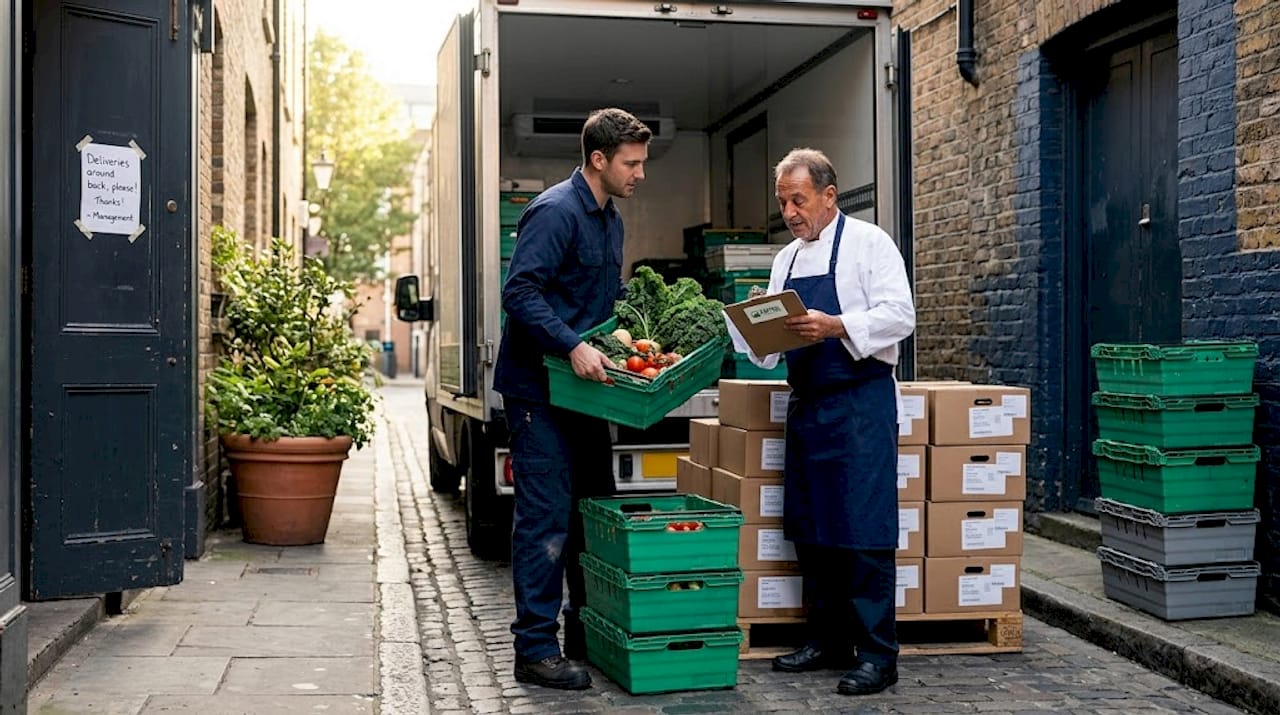
- Access to supplier credit lines: Many food distributors and equipment vendors extend net-30 or net-60 terms to established businesses. Those terms are effectively free short-term financing.
- Larger credit availability: When a kitchen emergency hits or a renovation is needed, a restaurant with strong credit can access larger amounts without jumping through hoops.
- Separation of personal liability: Financing under your business credit profile keeps your personal finances protected, especially relevant for sole proprietors and LLCs.
- Faster approvals in urgent situations: A well-documented credit history speeds up the approval process when timing matters.
The food industry context makes this even more specific. Restaurant revenue is notoriously uneven. A cold snap in January can cut foot traffic by 30%. A strong summer can drive the need to hire and stock up quickly. Without solid business credit, you are constantly reacting to those swings with whatever cash is on hand. With it, you have financing options ready before the crisis arrives.
It is also worth noting that online lender borrowers report higher costs and more difficulties compared to borrowers who work with banks or credit unions. Strong business credit gives you access to those better-priced lenders. Without it, you may be forced into higher-cost alternatives that compound your financial pressure.
Navigating 2026 SBA lending changes
The financing environment for restaurants shifted meaningfully in early 2026. As of March 1, the SBA eliminated automated credit scoring under its revised SOP 50 10 8 guidelines. What that means in practice is that SBA lenders must now conduct full manual credit analysis using actual bureau data rather than relying on the automated Small Business Scoring Service (SBSS) to approve or decline applications.
For restaurant owners, this change has a direct and significant consequence. A thin or inaccurate business credit file, which would have previously passed automated screening, can now block an SBA loan entirely. Lenders are reading your commercial credit report in detail, looking for patterns, gaps, and red flags that a scoring algorithm would have smoothed over.
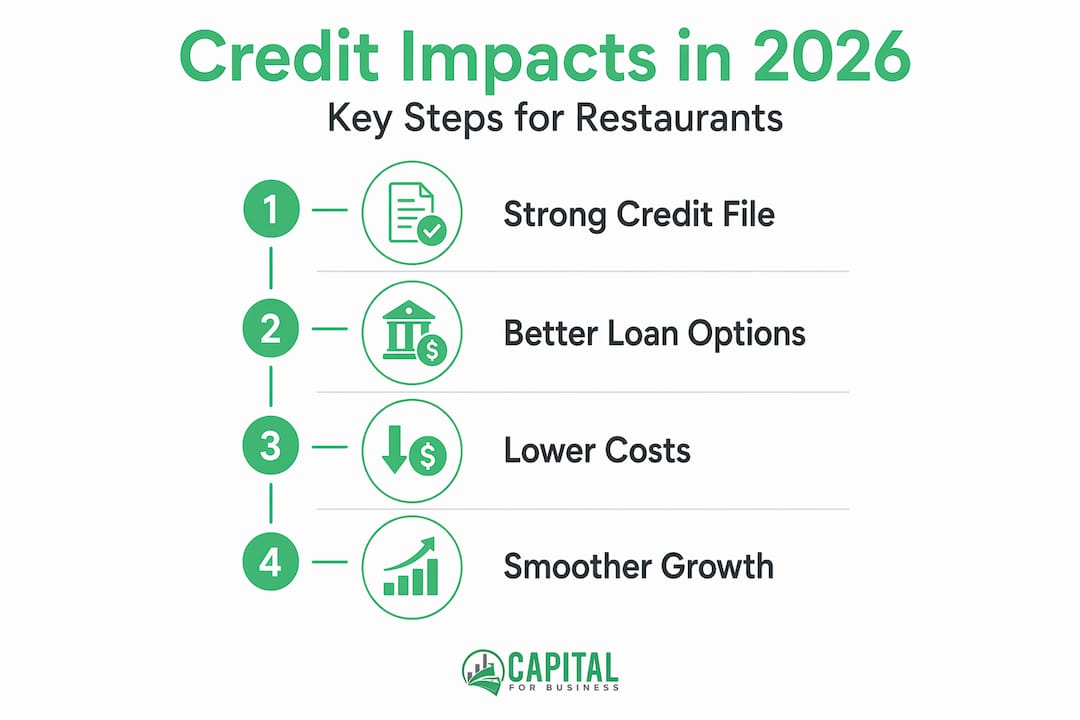
The SBA's updated requirements also specify that lenders must document and analyze a debt service coverage ratio (DSCR) of at least 1.1 to 1, meaning your cash flow must comfortably exceed your debt payments. Restaurant owners applying for SBA loans now need to provide historic cash flow statements and bank statements as part of a thorough documentation package.
Comparing traditional and emerging restaurant financing options
| Financing Type | Access Speed | Interest/Cost | Equity Impact | Credit File Dependency |
|---|---|---|---|---|
| SBA Loan | Weeks to months | Low to moderate | None | High (manual review) |
| Traditional bank loan | Weeks | Low | None | High |
| Revolving credit line | Days to one week | Moderate (on drawn amount only) | None | Moderate |
| Food/supplier credit | 24 to 72 hours | Zero to low | None | Low to moderate |
| Online alternative lender | 1 to 3 days | High | None | Low |
| Private equity | Weeks to months | None (equity cost) | High | Moderate |
The trend toward supplier-based financing is worth understanding in detail. Many restaurants are now leveraging vendor relationships for revolving capital in the form of food credit. This model allows restaurants to draw on credit tied to their existing supplier accounts, with access typically available within 24 to 72 hours, no equity dilution, and interest charged only on the amounts actually drawn.
This model works well specifically because it aligns with how restaurants spend money. Your largest variable costs are food and labor. When you can finance food purchases through supplier credit, you preserve cash for payroll and operations without taking on expensive debt.
Pro Tip: Before applying for any SBA loan in 2026, pull your business credit reports from Dun & Bradstreet, Experian Business, and Equifax Business. Dispute any inaccuracies in writing before your lender sees the file. A clean report reviewed manually carries far more weight than a file with unresolved errors.
Building business credit as a restaurant owner
You do not need a strong credit history to start building one. You need a clear process and the discipline to follow it consistently. Here are the steps that matter most for restaurant owners specifically.
-
Register your business and obtain an EIN. Your restaurant must be a formal legal entity, whether an LLC, S-corp, or corporation, with a federal Employer Identification Number. This separates your business identity from your personal one and is the prerequisite for everything else.
-
Open a dedicated business bank account. All restaurant revenue and expenses should flow through this account. Mixing personal and business finances is one of the most common ways restaurant owners weaken their credit profile and make lenders nervous.
-
Apply for a business credit card and use it responsibly. Even a secured business card helps establish a payment history. Use it for recurring restaurant expenses like small supply purchases, keep utilization below 30%, and pay the balance in full each month.
-
Build supplier relationships that report to credit bureaus. Not every supplier reports payment history to business credit bureaus. Prioritize vendors that do, and negotiate net-30 terms once your relationship is established. Paying those invoices early, not just on time, builds your record fast. Separating personal and business finances combined with disciplined credit usage is the foundation of strong business credit.
-
Monitor and correct your business credit reports regularly. Check your files at Dun & Bradstreet, Experian Business, and Equifax Business at least quarterly. Errors on commercial credit reports are more common than most owners realize, and they can block financing when you need it most.
-
Prepare the financial documentation lenders expect. Maintain at least 12 months of business bank statements, profit and loss statements, and cash flow projections. This documentation is not just helpful for SBA applications. Any serious lender will want to see it.
-
Use credit lines strategically, not as a last resort. Business credit lines work like credit cards with flexible draws, and you only pay interest on what you use. Drawing on a credit line during a planned seasonal gap, then paying it down during a strong period, demonstrates financial management and keeps your restaurant operating smoothly.
Pro Tip: When you pay a supplier invoice five to ten days early, call or email to ask if they report early payments to commercial credit bureaus. Some suppliers will update their reporting practices for customers who ask. This is one of the fastest ways to accelerate your business credit file.
Learning how to improve your business credit score is an ongoing process, not a one-time task. The restaurants that handle financing well treat credit management as part of regular operations, the same way they manage food cost percentages and labor hours.
My perspective on restaurant credit and what most owners miss
I have worked with restaurant owners across hundreds of financing situations since 2009, and the pattern is consistent. The owners who struggle most with financing are not the ones with bad credit. They are the ones who have no credit history at all. They ran their restaurant on cash, mixed personal and business finances, never opened a business account with a supplier, and then showed up to a lender with nothing to show except personal tax returns.
In 2026, that approach is more costly than ever. The SBA change to manual credit analysis means a thin file is no longer just a disadvantage. It can be a disqualifier. I have seen restaurant owners with solid revenue and strong cash flow get turned down simply because their commercial credit file did not reflect the health of their actual business.
What I have found is that restaurant owners who treat building credit for restaurant owners as part of their long-term operations strategy do not just get better loans. They get better supplier terms, smoother equipment financing, and more options in general. When you have a strong credit profile, you can choose your lender. When you do not, the lender chooses the terms.
My honest recommendation is this: stop thinking of business credit as something you build when you need money. Build it consistently, the same way you build a loyal customer base. When the opportunity or emergency arrives, and in restaurants it always does, you will be ready to act instead of scrambling to qualify.
— Capital
Funding solutions for restaurant owners
Capitalforbusiness has worked with restaurant owners since 2009, and one thing has not changed: the owners who access the best financing are the ones who took the time to build their credit profile before they needed it. Whether you are looking for a restaurant business loan to fund a renovation, a working capital line to cover seasonal gaps, or equipment financing for a kitchen upgrade, the strength of your business credit directly affects the terms you will qualify for.
Capitalforbusiness offers a range of small business loan options designed for restaurant owners at different stages of credit development. If your credit profile is still growing, there are paths forward. If your profile is strong, you can access larger amounts at better rates. Explore your options and get matched with the right financing for where your restaurant is today.
FAQ
What is business credit and why do restaurants need it?
Business credit is a financial record tied to your restaurant as a legal entity, tracked by bureaus like Dun & Bradstreet, Experian Business, and Equifax Business. Restaurants need it because it determines access to capital, loan terms, and supplier payment conditions that directly affect daily operations and growth.
How does business credit affect restaurant loan approvals?
Lenders use your business credit profile to assess risk, set interest rates, and determine loan amounts. Since March 2026, SBA lenders conduct full manual credit analysis, meaning an incomplete or inaccurate business credit file can block approval regardless of your revenue.
How long does it take to build business credit for a restaurant?
Most restaurants can establish a foundational business credit file within six to twelve months by opening a business bank account, using a business credit card responsibly, and building supplier relationships that report to commercial credit bureaus.
What is the difference between food credit and a traditional restaurant loan?
Food credit is a supplier-based revolving credit model that provides capital in 24 to 72 hours with no equity dilution and interest charged only on amounts drawn. Traditional bank loans take weeks to process and require a full credit and documentation review.
Can a restaurant get financing with no business credit history?
Yes, but the options are narrower and the costs are typically higher. Restaurants with limited credit history may qualify for merchant cash advances or alternative financing, though building a proper credit profile remains the most cost-effective long-term approach.