
Small businesses make up 99.9% of U.S. businesses, yet nearly one-third of loan applications face bank denials. If you've been turned down, you're not alone. Banks evaluate risk through strict criteria, and many viable businesses don't fit their narrow requirements. This guide explains why banks say no, what factors drive their decisions, and how you can improve your financing success going forward.
Table of Contents
- Why banks decline small business loans: an overview
- How banking industry consolidation influences lending decisions
- Common misconceptions about bank loan declines
- Alternatives and practical steps after bank decline
- Conclusion: Navigating the financing landscape
- Explore smart financing solutions for your small business
Key takeaways
| Point | Details |
|---|---|
| Banks decline loans primarily due to credit risk, insufficient collateral, and regulatory constraints | Understanding these factors helps you prepare stronger applications |
| Bank consolidation has reduced community lending options by over 70% since 1984 | Fewer local banks mean less personalized service and stricter policies |
| Loan denials rarely stem from a single factor like poor credit alone | Banks assess multiple risks including cash flow, collateral, and industry conditions |
| Alternative lenders offer faster approvals but at higher costs | Online platforms and merchant cash advances fill gaps when banks decline |
| Building financial profiles and lender relationships improves future success | Proactive preparation and relationship banking increase approval odds |
Why banks decline small business loans: an overview
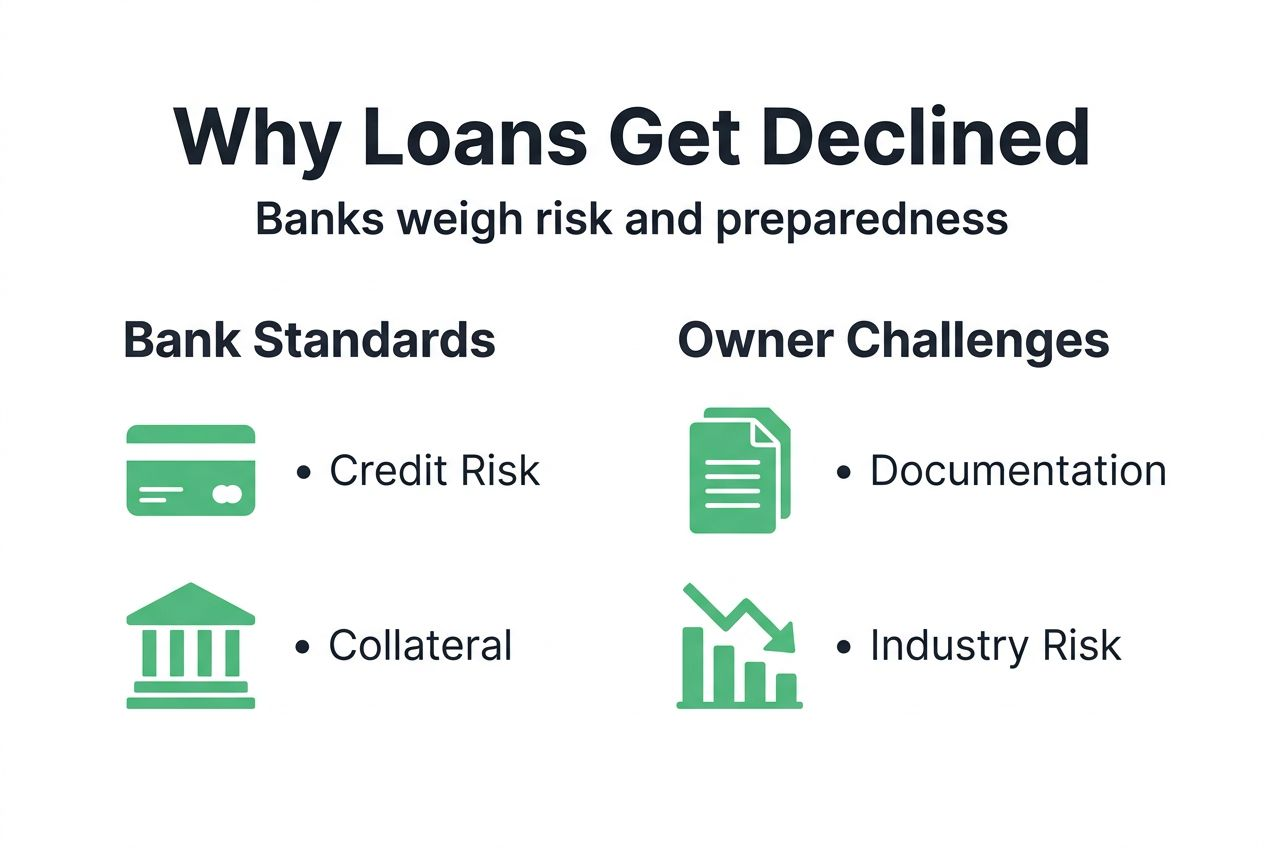
Banks operate as risk managers first, lenders second. When evaluating your application, they assess credit history, cash flow stability, and collateral availability. Small businesses often lack comprehensive financial documentation, making it harder to prove creditworthiness.
Regulatory capital rules implemented after the 2008 financial crisis tightened lending standards significantly. Banks view small business loans as higher risk relative to regulatory capital requirements, making these loans less attractive financially. This creates a structural barrier for business owners seeking traditional bank financing.
Collateral requirements add another hurdle. Banks often require personal guarantees and business assets to secure loans, which many small businesses cannot provide adequately. If your business is new or operates in a volatile industry, banks see additional risk that personal collateral must offset.
Understanding the difference between business loans vs personal loans helps clarify why banks apply these strict requirements. Business lending carries different risk profiles than personal lending, requiring specialized evaluation criteria.
Common bank requirements versus typical small business profiles:
| Bank Requirement | Typical Small Business Reality |
|---|---|
| 2+ years audited financials | Many lack formal accounting systems |
| Credit score 680+ | Average small business owner score is 620-650 |
| 20-30% down payment | Limited cash reserves for substantial deposits |
| Significant collateral | New businesses have minimal assets |
| Proven cash flow stability | Revenue fluctuates seasonally or by contract |
Pro Tip: Preparing thorough financial documentation months before applying significantly improves approval chances. Start building your credit profile and organizing records now, not when you need funding urgently.
The 2025 Small Business Credit Survey reveals that preparation gaps, not just creditworthiness, drive many denials. Banks want to say yes, but only when their risk criteria are met.

How banking industry consolidation influences lending decisions
The banking landscape has transformed dramatically over four decades. Over 70% of banks have merged or closed branches since 1984, fundamentally changing how small businesses access capital. This consolidation eliminated thousands of community banks that specialized in relationship lending.
Community banks understand local market conditions, industry nuances, and individual business owner circumstances. They rely on relationship lending rather than purely algorithmic credit scoring. When these institutions disappear, small businesses lose advocates who could approve loans based on character and local knowledge.
Larger consolidated banks apply standardized underwriting criteria across all markets. They lack the flexibility to evaluate context-specific factors that community bankers consider routine. This one-size-fits-all approach disadvantages businesses in underserved markets or emerging industries.
Effects of bank consolidation on small business lending:
- Fewer local decision makers who understand regional economic conditions
- Increased reliance on automated underwriting systems
- Stricter credit policies with less room for exceptions
- Loss of personalized service and ongoing business relationships
- Reduced lending to startups and businesses in transition
Consolidation creates financing deserts in rural and low-income urban areas. When the last community bank closes, entire regions lose accessible small business credit. The remaining large banks often don't find small loans profitable enough to justify local presence.
Since 1984, America has lost over 70% of its banks through mergers and closures, leaving small businesses with fewer relationship lending options and more stringent credit requirements.
Understanding these small business loan considerations becomes more critical as banking options narrow. You need strategies beyond traditional bank relationships to secure adequate financing.
Relationship lending isn't dead, but it requires more effort to find. Credit unions and remaining community banks still practice it. Building these relationships before you need money creates financing options unavailable through large bank applications.
Common misconceptions about bank loan declines
Many business owners believe bank denials stem solely from poor personal credit scores. Reality is far more complex. Banks consider operational challenges like revenue volatility and industry risk alongside credit history when making decisions.
Over half of declined applicants don't fully understand why banks rejected them. This knowledge gap creates frustration and prevents owners from addressing real issues. Banks sometimes provide vague explanations, leaving owners guessing about actual denial reasons.
Small business owners often mistakenly assume fault lies entirely with personal credit rather than bank risk policies and economic conditions. Economic downturns, industry-specific challenges, and regulatory pressures all influence lending decisions independent of individual creditworthiness.
Misconceptions versus reality:
- Myth: Bad credit guarantees denial. Reality: Strong collateral and cash flow can offset moderate credit issues.
- Myth: Banks deny loans randomly or unfairly. Reality: Denials follow risk assessment models based on data and regulations.
- Myth: One denial means no bank will approve you. Reality: Different banks have different risk appetites and specializations.
- Myth: Fixing your credit score solves everything. Reality: Cash flow documentation and collateral matter equally or more.
- Myth: Banks don't want to lend to small businesses. Reality: Banks want profitable lending opportunities that meet risk criteria.
Understanding these distinctions helps you avoid small business financing mistakes that compound approval challenges. Banks aren't adversaries; they're institutions with specific risk tolerances shaped by regulations and market conditions.
Some industries face higher denial rates regardless of individual business performance. Restaurants, retail, and service businesses often struggle more than professional services or established manufacturers. Banks view certain sectors as inherently riskier based on historical default data.
Pro Tip: Requesting detailed written feedback from lenders clarifies true denial causes. Most banks will explain specific deficiencies if asked directly, giving you actionable improvement targets.
Geographic factors also play roles often overlooked. Businesses in economically struggling regions face additional scrutiny even with strong individual metrics. Understanding these external factors prevents personalizing systemic challenges.
Alternatives and practical steps after bank decline
Bank denial doesn't end your financing options. Online and alternative lenders fill critical gaps, though usually at higher costs. Many small businesses turn to online lenders because they perceive bank processes as slower and less accessible.
Online platforms use different underwriting models that emphasize recent revenue and transaction history over traditional credit metrics. Approvals happen in days rather than weeks or months. This speed costs more in interest and fees, but provides capital when timing matters.
Community banks and credit unions offer middle ground between large banks and online lenders. They maintain relationship lending practices while offering competitive rates. Building these relationships takes time but pays dividends across your business lifecycle.
Practical steps to improve financing success:
- Organize comprehensive financial documentation including tax returns, bank statements, and profit/loss statements for the past two years.
- Build collateral by acquiring equipment, inventory, or property that can secure future loans.
- Establish relationships with community banks and credit unions before needing financing.
- Explore alternative lenders including online platforms, CDFIs, and merchant cash advance providers.
- Improve personal and business credit scores by paying bills on time and reducing outstanding debt.
- Seek feedback from declined applications to understand specific improvement areas.
Learning how to increase your chances of securing a business loan involves addressing multiple factors simultaneously. No single fix guarantees approval, but systematic improvement across credit, documentation, and relationships builds financing capacity.
Comparing financing options:
| Lender Type | Approval Speed | Interest Rates | Flexibility | Documentation Required |
|---|---|---|---|---|
| Traditional Banks | 3-8 weeks | Lowest (6-9%) | Rigid criteria | Extensive |
| Community Banks | 2-4 weeks | Moderate (7-11%) | Some flexibility | Moderate to extensive |
| Online Lenders | 1-5 days | Higher (12-40%) | High flexibility | Minimal to moderate |
| Credit Unions | 2-6 weeks | Low to moderate (7-12%) | Member-focused | Moderate |
| Merchant Cash Advance | 1-3 days | Highest (factor rates) | Maximum flexibility | Minimal |
Using a small business loan checklist ensures you gather necessary documentation before applying. Preparation prevents delays and demonstrates professionalism to lenders.
Pro Tip: Applying to multiple lenders simultaneously broadens funding opportunities and provides comparative feedback. Each application offers insights into how different institutions view your business.
Alternative financing includes invoice factoring, equipment financing, and revenue-based financing. Each serves specific needs better than general business loans. Match financing type to your actual capital needs rather than seeking generic loans.
Conclusion: Navigating the financing landscape
Understanding why banks decline loans transforms frustration into strategic action. Banks assess multiple risk factors including credit, collateral, cash flow, and industry conditions. Their decisions reflect regulatory requirements and risk management policies, not personal judgments about your business potential.
Bank consolidation has reduced relationship lending options, making financing more challenging for businesses outside traditional credit profiles. However, alternative lenders, community banks, and strategic preparation create viable paths forward. Building strong financial documentation and lender relationships improves future approval odds significantly.
Persistence matters in financing. One bank's decline doesn't define your business's creditworthiness or potential. Use denials as learning opportunities to strengthen applications, explore alternatives, and build the financial foundation supporting long-term growth. The financing landscape offers more options than ever for prepared business owners willing to look beyond traditional banks.
Explore smart financing solutions for your small business
Facing a bank decline doesn't mean giving up on growth. Capital for Business specializes in serving businesses that traditional banks turn away. We understand that credit challenges, limited collateral, or unconventional business models don't reflect your potential for success.
Our range of easy small business loan types provides options matching diverse financing needs and credit profiles. From working capital to equipment financing, we've helped thousands of businesses since 2009. Our business funding solutions deliver capital quickly when banks can't or won't.
Consider merchant cash advance options for fast, flexible funding based on your revenue rather than traditional credit metrics. We work with businesses nationwide and in Canada, providing the financing support you need to expand, upgrade, and grow.
FAQ
Why do banks often require personal guarantees for small business loans?
Banks use personal guarantees to reduce lending risk when business collateral is insufficient. This ensures owners are personally responsible if the business defaults, providing additional security for the lender.
Can poor credit score alone cause a small business loan denial?
Loan declines usually result from combined issues including credit, cash flow, collateral, and bank policies. Poor credit alone is rarely the sole reason for denial, though it significantly influences the overall risk assessment.
What are the fastest alternatives if my bank loan is declined?
Online lenders and merchant cash advances offer quicker approvals than traditional banks, often within 1-5 days. They have higher costs but provide critical short-term capital when timing matters more than price.
How can building relationships with community banks improve loan chances?
Community banks consider qualitative factors through relationship lending, helping businesses with limited credit history. Building trust over time can improve approval odds and secure better future financing terms based on demonstrated reliability.
Does bank consolidation affect small business lending in rural areas more severely?
Yes, rural areas suffer disproportionately from bank consolidation as they lose community banks without gaining large bank branches. This creates financing deserts where businesses have extremely limited local lending options and must rely on distant or online lenders.