Many small business owners assume they need to pay cash upfront for expensive equipment, delaying critical upgrades that could boost productivity. This misconception keeps businesses stuck with outdated tools while competitors move ahead. Equipment financing offers an affordable path to acquiring essential assets without draining your cash reserves. This guide explains what equipment financing is, the types available, how to qualify and apply, and why it's a smart strategy for growth.
Table of Contents
- Key Takeaways
- What is equipment financing and how does it work?
- Different types of equipment financing options
- How to qualify and apply for equipment financing
- Benefits of equipment financing for small businesses
- Explore tailored equipment financing solutions with Capital For Business
- Frequently asked questions about equipment financing
Key Takeaways
| Point | Details |
|---|---|
| Cash flow preservation | Equipment financing lets you use the asset now and pay over time, preserving cash for other needs. |
| Multiple financing options | Loans, leases, and lines of credit provide options depending on ownership intent and how long you will use the equipment. |
| Approval factors | Credit history, time in business, and the equipment value influence approval and the terms you receive. |
| Collateral benefits | The equipment itself often serves as collateral, reducing lender risk and improving loan terms. |
| End of term choices | Leases commonly offer end of term choices such as return, purchase, or upgrade. |
What is equipment financing and how does it work?
Equipment financing enables businesses to spread out equipment costs over time rather than paying upfront, easing cash flow challenges. Instead of depleting your bank account to buy machinery, vehicles, or technology, you make manageable monthly payments while using the equipment to generate revenue. The equipment itself typically serves as collateral, reducing lender risk and often resulting in better terms than unsecured loans.
This financing approach works for virtually any business asset with a useful lifespan. Common examples include:
- Manufacturing machinery and production equipment
- Commercial vehicles and transportation fleets
- Restaurant kitchen appliances and food service equipment
- Medical devices and diagnostic technology
- Construction tools and heavy machinery
- Office technology and computer systems
The mechanics are straightforward. You identify equipment your business needs, apply for financing through a lender or equipment dealer, and receive approval based on your creditworthiness and the equipment's value. Once approved, the lender purchases the equipment and you repay the amount plus interest over an agreed term, usually ranging from one to seven years depending on the asset's expected lifespan.
The major advantage is cash flow preservation. Your business keeps working capital available for inventory, payroll, marketing, and unexpected expenses while still accessing the tools needed to operate efficiently. You also gain immediate access to current technology rather than waiting years to save enough cash, helping you stay competitive in your industry.
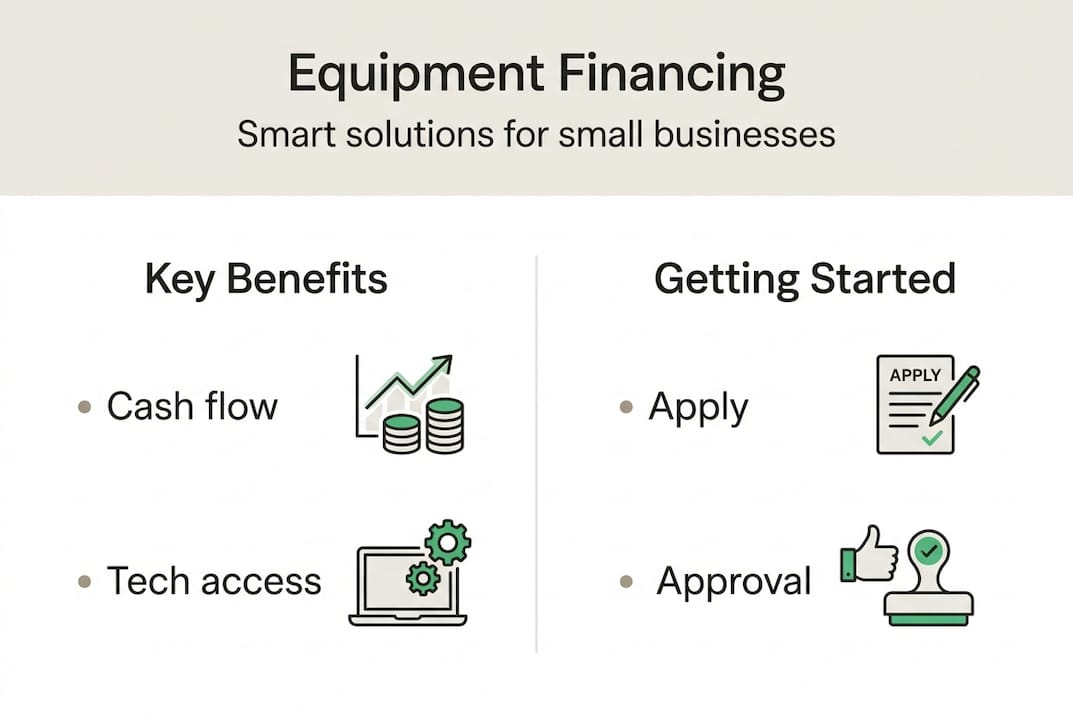
Lenders evaluate several factors before approval. Your personal and business credit scores demonstrate repayment reliability. Time in business shows stability, with most lenders preferring at least two years of operation. The equipment's resale value matters because it serves as collateral. Finally, your business's profitability and cash flow indicate your ability to make consistent payments. Understanding these requirements helps you prepare a stronger application and secure better terms for your small business loan needs.
Different types of equipment financing options
Small business owners can choose among equipment loans, leases, lines of credit, and alternative financing, each with distinct advantages. Selecting the right option depends on whether you want to own the equipment, how long you'll use it, and your cash flow situation.
Equipment loans function like traditional financing where you borrow money to purchase equipment outright. You own the asset from day one and build equity with each payment. These loans typically require a down payment of 10 to 20 percent and feature fixed interest rates over terms matching the equipment's useful life. This option works best when you plan to use the equipment long term and want to claim depreciation tax benefits. The equipment serves as collateral, so if your business defaults, the lender can seize the asset.
Equipment leasing lets you pay for using equipment without owning it. Monthly payments are often lower than loan payments because you're essentially renting rather than buying. At lease end, you typically have three choices: return the equipment, purchase it at fair market value, or upgrade to newer models. Leasing makes sense when technology changes rapidly or when you want to avoid obsolescence. Many leases include maintenance and repair coverage, reducing unexpected costs. However, you never build equity and may pay more over time compared to purchasing.
Equipment lines of credit provide flexible access to funds up to a predetermined limit. You draw what you need when you need it, pay interest only on the amount borrowed, and repay to free up the credit line again. This option excels when you have multiple equipment needs throughout the year or want flexibility to seize opportunities as they arise. Lines of credit typically require stronger credit profiles and established business history but offer unmatched versatility for ongoing equipment purchases.
Here's how these options compare:
| Feature | Equipment Loan | Equipment Lease | Line of Credit |
|---|---|---|---|
| Ownership | You own immediately | Lender owns, option to buy | You own after purchase |
| Upfront cost | 10-20% down payment | First/last month payment | Minimal to none |
| Monthly payment | Higher, builds equity | Lower, no equity | Varies by usage |
| Tax benefits | Depreciation deduction | Lease payments deductible | Interest deductible |
| Best for | Long-term assets | Frequently upgraded tech | Multiple purchases |
Pro Tip: Match your financing term to the equipment's useful life. Financing a computer over seven years means you're still paying for outdated technology long after it needs replacement. Choose shorter terms for technology and longer terms for durable assets like vehicles or machinery.
Your choice should reflect your business model and growth plans. Manufacturing businesses buying heavy machinery benefit from loans that build equity. Tech companies needing the latest software and hardware often prefer leasing flexibility. Service businesses with varying equipment needs throughout the year find lines of credit most practical. Review equipment financing examples specific to your industry to see what works best.
How to qualify and apply for equipment financing
Lenders evaluate your credit score, business history, equipment details, and financial health before approving financing. Understanding these criteria and preparing thoroughly increases your approval odds and helps you secure favorable terms.
Credit requirements vary by lender and loan amount. Traditional banks typically want personal credit scores above 680 and business credit scores demonstrating reliable payment history. Alternative lenders may approve scores as low as 600 but charge higher interest rates to offset risk. Time in business matters significantly, with most lenders requiring at least two years of operation and consistent profitability. Startups face tougher scrutiny but can still qualify with strong personal credit, substantial down payments, or business plans showing clear revenue potential.
The equipment itself influences approval. Lenders prefer assets with strong resale value that can be easily liquidated if you default. Specialized equipment for niche industries may require larger down payments because it's harder to resell. The equipment's age and condition also matter since older assets offer less collateral value. Most lenders finance up to 100 percent of new equipment costs but only 70 to 80 percent for used equipment.
Follow these steps to navigate the application process successfully:
-
Assess your equipment needs and financing options. Determine exactly what equipment you need, its cost, and expected lifespan. Research whether a loan, lease, or line of credit best fits your situation. Calculate how the monthly payment affects your cash flow and whether the equipment will generate enough revenue to justify the expense.
-
Prepare comprehensive financial documents. Gather at least two years of business tax returns, recent bank statements showing cash flow patterns, profit and loss statements, and balance sheets. Include your business plan if you're a newer company. Prepare a personal financial statement showing assets and liabilities. Having documents organized demonstrates professionalism and speeds up approval.
-
Submit your application with detailed equipment information. Complete the lender's application form accurately, providing business details, ownership information, and financial data. Include specific equipment information like make, model, year, condition, and vendor quotes. Explain how the equipment will be used and how it supports your business operations and growth.
-
Review loan or lease terms carefully before acceptance. Once approved, examine the interest rate, payment schedule, term length, prepayment penalties, and any fees. Understand what happens if you need to modify terms or if your business faces temporary hardship. Compare offers from multiple lenders to ensure you're getting competitive terms.
-
Complete the agreement and receive funding. Sign the financing agreement, provide any required down payment, and coordinate delivery or purchase of the equipment. Most lenders fund directly to the equipment vendor rather than giving you cash, ensuring the money goes toward its intended purpose.
Pro Tip: Strengthen your application by improving your credit score before applying. Pay down existing debts, correct any credit report errors, and avoid new credit inquiries in the months before application. A 50-point credit score increase can mean thousands of dollars in interest savings over the loan term.
Understand that approval isn't guaranteed. If denied, ask the lender for specific reasons. Common issues include insufficient time in business, poor credit history, weak cash flow, or equipment that doesn't hold value well. Address these concerns before reapplying. Consider working with alternative lenders who specialize in financing for specific business types or situations. Some equipment dealers offer in-house financing with more flexible requirements, though often at higher rates. Startups should explore business loans designed for newer companies that understand the unique challenges of early-stage businesses.
Benefits of equipment financing for small businesses
Equipment financing preserves cash flow, enables access to modern technology, and offers potential tax advantages for small businesses. These benefits combine to create opportunities for growth that would be difficult to achieve through cash purchases alone.
Preserving working capital ranks as the primary advantage. When you finance equipment instead of buying it outright, you keep cash available for daily operations, emergency reserves, and growth opportunities. A $50,000 equipment purchase paid in cash drains your bank account immediately. Financed over five years, that same equipment costs roughly $1,000 monthly, leaving $49,000 available for inventory, marketing, hiring, or unexpected expenses. This flexibility often means the difference between seizing opportunities and watching them pass by.
Key benefits include:
-
Access to current technology and equipment. Financing lets you acquire the latest models and most efficient tools without waiting years to save enough cash. Newer equipment often operates more efficiently, reduces waste, lowers energy costs, and improves product quality. Staying current with technology keeps you competitive against rivals who might otherwise gain advantages through superior equipment.
-
Tax incentives and deductions. Equipment purchases often qualify for Section 179 deductions, allowing you to deduct the full purchase price in the year you buy and start using the equipment, up to annual limits. Bonus depreciation provides additional first-year deductions. Lease payments are typically fully deductible as business expenses. These tax benefits reduce your effective equipment cost significantly. Consult your accountant to maximize these advantages.
-
Flexible terms matching your cash flow. Lenders structure payments to align with your revenue cycles. Seasonal businesses can arrange payments during high-revenue months. Companies with steady income prefer consistent monthly payments. Some agreements include deferred payment options, giving you time to generate revenue from the equipment before payments begin.
-
Credit profile improvement. Successfully managing equipment financing builds your business credit score. Each on-time payment demonstrates financial responsibility to future lenders. Strong business credit opens doors to better terms on future financing, higher credit limits, and access to additional capital as your business grows.
-
Inflation hedge. Fixed-rate equipment financing locks in today's payment amount even as inflation increases costs elsewhere. You repay the loan with future dollars that are worth less than today's dollars, effectively reducing the real cost of the equipment over time.
"Equipment financing transformed our ability to compete. We upgraded to automated systems that doubled our production capacity while reducing labor costs. The monthly payment was less than we saved in efficiency gains, so the equipment essentially paid for itself while we kept our cash reserves intact for other growth initiatives."
These advantages compound over time. The productivity gains from better equipment generate additional revenue. The preserved cash flow funds marketing that brings in new customers. The improved efficiency lets you take on more work without proportionally increasing costs. The tax savings reduce your overall tax burden. Together, these benefits create a growth multiplier that accelerates your business development far beyond what cash purchases would allow. Equipment financing isn't just about acquiring assets, it's a strategic tool for building a stronger, more competitive business.
Explore tailored equipment financing solutions with Capital For Business
Now that you understand how equipment financing works and its benefits, finding the right partner makes all the difference. Capital For Business offers equipment financing options up to $250,000 with same-day funding to help you acquire essential tools quickly. Since 2009, we've helped small business owners across the U.S. and Canada access the equipment they need when traditional banks say no.
Our team understands that every business has unique needs. We work with you to find small business loan options that match your cash flow, growth plans, and equipment requirements. Whether you need manufacturing machinery, commercial vehicles, restaurant equipment, or technology upgrades, we provide expert guidance and flexible terms. Explore our complete range of business funding solutions designed specifically for small businesses ready to grow.
Frequently asked questions about equipment financing
What credit score do I need for equipment financing?
Most traditional lenders require personal credit scores above 680 and established business credit. Alternative lenders may approve scores as low as 600, though with higher interest rates. Stronger credit scores unlock better terms, lower rates, and higher approval amounts.
Should I lease or finance equipment for my small business?
Lease if you need equipment with short useful lives or rapidly changing technology, want lower monthly payments, and prefer flexibility to upgrade regularly. Finance through loans if you plan long-term use, want to build equity and claim depreciation, and prefer eventual ownership. Your choice depends on the equipment type and how long you'll use it.
How quickly can I get approved for equipment financing?
Approval timelines vary by lender and application completeness. Alternative lenders often approve applications within 24 to 48 hours with same-day funding available. Traditional banks typically take one to two weeks. Having organized financial documents and complete equipment details speeds the process significantly.
Can startups qualify for equipment financing?
Yes, though requirements are stricter. Startups typically need strong personal credit scores above 700, substantial down payments of 20 to 30 percent, detailed business plans showing revenue potential, and sometimes personal guarantees. Equipment with strong resale value improves approval odds. Some lenders specialize in startup financing and understand early-stage business challenges.
What happens if I can't make equipment financing payments?
Missed payments damage your business and personal credit scores, trigger late fees, and may result in default. Since equipment serves as collateral, the lender can repossess the asset to recover their investment. Contact your lender immediately if you anticipate payment difficulties. Many offer temporary hardship programs, payment deferrals, or restructuring options to help you avoid default.
Are equipment financing payments tax deductible?
Yes, with different benefits depending on your financing type. Equipment loan interest is tax deductible, and you can claim depreciation deductions on owned equipment including Section 179 deductions up to annual limits. Lease payments are typically fully deductible as operating expenses. Consult your tax advisor to maximize these benefits based on your specific situation.