
Over 60% of small businesses report improved cash flow within six months of using a business line of credit. This powerful financing tool offers flexibility that traditional loans can't match. In this guide, you'll discover exactly what a business line of credit is, how it works, what it costs, and whether it's right for your business. We'll also compare it to other financing options and show you how to qualify.
Table of Contents
- What Is A Business Line Of Credit?
- How A Business Line Of Credit Works
- Costs, Interest Rates, And Qualification Criteria
- Common Misconceptions About Business Lines Of Credit
- Business Line Of Credit Vs Other Financing Options
- Use Cases: Managing Cash Flow And Supporting Growth
- Financial Management And Risks Of Business Lines Of Credit
- Access Speed, Application Process, And Choosing The Right Lender
- Explore Flexible Financing With Our Business Lines Of Credit
- Frequently Asked Questions About Business Lines Of Credit
Key takeaways
| Point | Details |
|---|---|
| Revolving credit structure | Business lines of credit allow repeated borrowing and repayment up to a set limit, offering ongoing access to funds. |
| Interest on drawn amounts only | You pay interest solely on the funds you withdraw, not the entire credit limit. |
| Flexible qualification standards | Typical requirements include credit scores of 600+ and demonstrated revenue, with criteria varying between U.S. and Canadian lenders. |
| Different from loans and cards | Lines of credit offer lower interest rates than credit cards and more flexibility than term loans. |
| Strategic use supports growth | Responsible management helps smooth cash flow fluctuations and fund short-term operational needs. |
What is a business line of credit?
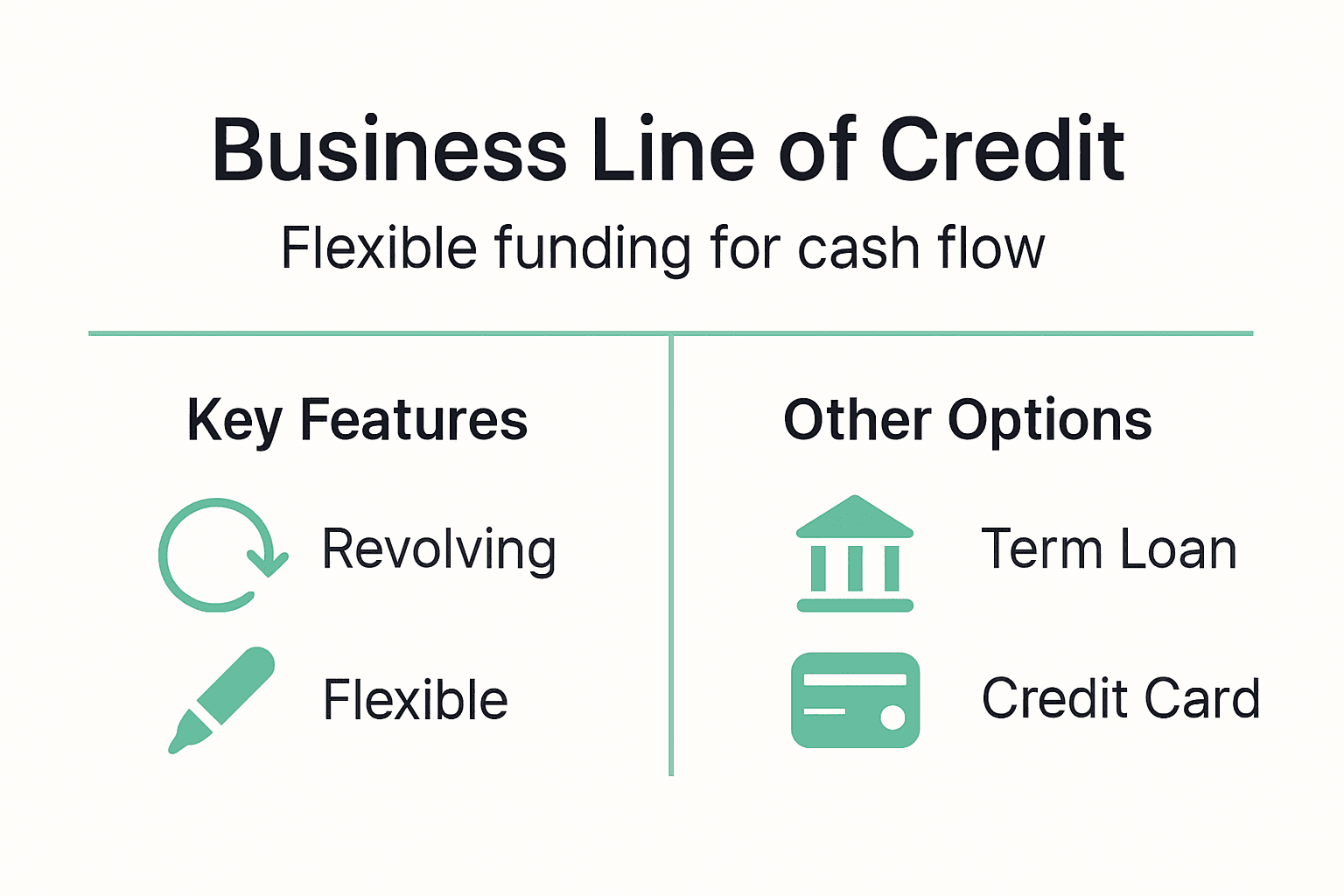
A business line of credit is revolving credit that allows you to borrow, repay, and borrow again up to a predetermined limit. Unlike a traditional loan that gives you a lump sum upfront, you draw only what you need when you need it. Interest accrues only on the amount you actually use, not the full credit limit available to you.
Credit limits typically range from $10,000 to $250,000, though some lenders offer higher amounts for established businesses with strong financials. The exact limit depends on your business size, revenue, credit history, and the lender's assessment of your financial health.
Think of it as a financial safety net. When unexpected expenses arise or seasonal revenue dips, you tap your line of credit to cover the gap. Once you repay what you borrowed, that amount becomes available again for future use.
Key features that distinguish business lines of credit:
- Access funds repeatedly without reapplying each time
- Pay interest only on withdrawn amounts, not unused credit
- Flexible repayment schedules that adapt to your cash flow
- Quick access to capital for time-sensitive opportunities
- No collateral required for unsecured lines (though secured options exist)
Understanding the science behind business line of credit helps you leverage this tool effectively. Capital For Business offers various business line of credit options tailored to different business needs. For a deeper dive into how these products work, explore understanding business lines of credit.
How a business line of credit works
The operational mechanics are straightforward. Once approved, you receive access to your credit line through online banking, checks, or transfer requests. You withdraw funds as needed, whether that's $500 for inventory or $20,000 for payroll during a slow month.

Interest accrues daily on your outstanding balance. If you borrow $5,000 from a $50,000 line of credit, you pay interest only on that $5,000. The remaining $45,000 sits available without costing you anything. This differs dramatically from term loans where you receive and pay interest on the full amount immediately.
Repayment flexibility sets lines of credit apart. Most lenders require minimum monthly payments covering at least the interest due, though you can pay more to reduce your balance faster. As you repay, your available credit replenishes automatically. If you borrowed $10,000 and paid back $4,000, you now have that $4,000 available to draw again.
This revolving structure makes lines of credit ideal for managing fluctuating cash flow. Retail businesses use them to stock inventory before peak seasons. Service companies tap them to cover payroll gaps between client payments. Construction firms draw funds for materials while waiting on project payments.
Operational advantages include:
- Immediate response to cash flow gaps without loan applications
- Interest savings by paying down balances quickly during strong revenue periods
- Preserved cash reserves for strategic opportunities
- Predictable cost structure based on actual usage
- Seamless access through multiple channels
Learn more about how business lines of credit work to maximize their strategic value for your operations.
Costs, interest rates, and qualification criteria
Interest rates on business lines of credit typically range from 7% to 25%, though rates vary based on your creditworthiness, business financials, and whether the line is secured or unsecured. Most lines carry variable rates tied to prime or another benchmark, meaning your rate adjusts with market conditions.
Secured lines require collateral like equipment, inventory, or real estate. They generally offer lower rates because the lender's risk decreases. Unsecured lines need no collateral but come with higher rates and stricter qualification standards.
Beyond interest, watch for additional costs:
- Annual fees ranging from $50 to $500
- Draw fees charged each time you access funds
- Maintenance fees for keeping the line open
- Origination fees during initial setup
- Early closure penalties if you cancel before the term ends
Qualification requirements vary by lender, but common benchmarks include:
- Personal credit score of 600 or higher (some lenders require 680+)
- Minimum annual revenue of $50,000 to $100,000
- At least six months to two years in business
- Positive cash flow demonstrated through bank statements
- No recent bankruptcies or major delinquencies
Canadian businesses face similar criteria, though specific requirements may differ by province and lender. Both U.S. and Canadian lenders evaluate your debt service coverage ratio, which measures whether your business generates enough income to cover debt payments comfortably.
For detailed guidance on business line of credit qualification criteria, consult resources specific to your location. Explore various business line of credit options to find rates and terms that match your financial profile.
Common misconceptions about business lines of credit
Many business owners confuse lines of credit with credit cards or assume they work like traditional loans. These misunderstandings can lead to costly mistakes.
First, lines of credit differ significantly from business credit cards. While both offer revolving credit, lines typically charge lower interest rates and provide higher limits. Credit cards often require minimum monthly payments regardless of usage, while line of credit payments flex with your drawn balance. Cards also come with preset payment cycles, whereas lines offer more customized repayment schedules.
Second, not all lines of credit require minimum monthly payments. Some lenders allow interest-only payments during draw periods, giving you maximum flexibility. Others require principal and interest payments from the start. Always clarify payment terms before accepting a line of credit.
Third, business lines of credit are not suitable for long-term purchases. Using revolving credit for equipment purchases or real estate ties up your credit line and costs more than a term loan designed for such investments. Lines of credit excel at managing short-term operational expenses like inventory, payroll, and seasonal cash flow gaps.
Fourth, qualification isn't automatic. Even established businesses need solid credit scores, consistent revenue, and clean financial histories. Startups often struggle to qualify without personal guarantees or collateral.
Common myths include:
- "I can use my line of credit for anything" – stick to short-term operational needs
- "Lines of credit are always cheaper than loans" – not for long-term financing
- "Approval is guaranteed if I have good credit" – lenders evaluate multiple factors
- "I must use my line regularly" – draw only when needed to minimize interest
- "All lines of credit work the same way" – terms vary dramatically by lender
Pro Tip: Before applying, clarify whether interest-only payments are allowed during the draw period. This feature provides crucial flexibility during tight cash flow months.
For clarity on misconceptions about lines of credit, review educational resources that break down real versus perceived benefits.
Business line of credit vs other financing options
Choosing the right financing depends on your specific needs, timeline, and financial situation. Here's how business lines of credit stack up against alternatives:
| Feature | Line of Credit | Term Loan | Credit Card | Merchant Cash Advance |
|---|---|---|---|---|
| Interest Rate | 7%-25% | 6%-30% | 15%-25% | 40%-350% APR equivalent |
| Best Use | Short-term cash flow | Long-term investments | Small purchases | Emergency funding |
| Repayment | Flexible, revolving | Fixed schedule | Monthly minimum | Daily/weekly from sales |
| Approval Speed | 1-5 days | 1-4 weeks | Minutes-hours | 1-3 days |
| Collateral | Optional | Often required | Not required | Not required |
Term loans work best for specific projects with predictable payback periods. Buying equipment, renovating your space, or acquiring another business are ideal term loan scenarios. You receive a lump sum, pay it back over months or years, and know exactly what you'll pay in total.
Credit cards suit small, frequent expenses where convenience matters. They offer rewards programs but carry higher interest rates than lines of credit. Reserve them for purchases under $5,000 that you can repay quickly.
Merchant cash advances provide fast money but at extreme cost. Lenders take a percentage of your daily credit card sales until the advance is repaid. While alternative to expensive merchant cash advances, they should be your last resort due to effective annual rates that can exceed 100%.
Key comparison points:
- Lines of credit offer the best balance of cost and flexibility for recurring short-term needs
- Term loans provide the lowest rates for large, one-time purchases
- Credit cards excel at convenience but cost more for carried balances
- Merchant cash advances solve immediate emergencies but devastate cash flow long-term
The unsecured line of credit advantages become clear when you need quick access without risking assets. When comparing line of credit vs merchant cash advance, the cost difference is stark. For major asset purchases, compare line of credit and loans to find the most cost-effective option.
Use cases: managing cash flow and supporting growth
Business lines of credit shine in real-world scenarios where timing and flexibility matter. Consider these practical applications.
Seasonal businesses face predictable revenue cycles. A landscaping company earns heavily in summer but faces lean winter months. Rather than taking an expensive loan or depleting savings, they draw from their line of credit to cover winter payroll and maintenance. When spring revenue arrives, they repay the balance and avoid interest on unused funds.
Unexpected expenses hit every business. Your delivery van breaks down, a key supplier demands payment upfront for a time-sensitive order, or a major client delays payment by 60 days. A line of credit covers these gaps without forcing you into high-cost alternatives or missing opportunities.
Growth projects often require quick action. A retail store finds a below-market lease in a prime location but needs first and last month's rent plus security deposit within a week. A line of credit provides immediate funds, and as the new location generates revenue, you repay the draw systematically.
Reducing reliance on expensive financing becomes possible with a line of credit in place. Businesses that previously used merchant cash advances for every shortfall can transition to lower-cost line of credit draws, saving thousands in interest annually.
Practical scenarios include:
- Bridging accounts receivable gaps when clients pay net 30 or net 60
- Stocking inventory before peak sales periods without depleting cash reserves
- Covering payroll during contract delays or project payment holdbacks
- Funding marketing campaigns to capitalize on seasonal opportunities
- Maintaining operations during economic downturns or industry slowdowns
For strategies on managing cash flow effectively, consider how lines of credit integrate with your broader financial planning. Explore working capital funding options that complement your line of credit for comprehensive cash management.
Financial management and risks of business lines of credit
While business lines of credit offer tremendous flexibility, misuse can damage your financial health. Understanding risks helps you maximize benefits while avoiding pitfalls.
Timely repayments protect your credit score and keep your line accessible. Late payments trigger fees, rate increases, and potential credit line reductions. Set up automatic minimum payments to avoid missing deadlines, then make additional payments during strong revenue periods to reduce your balance faster.
Overborrowing is tempting when funds are readily available. Drawing on your line for non-essential expenses or long-term purchases creates an expensive debt cycle. Establish clear internal guidelines for when drawing from your line is appropriate versus when other financing makes more sense.
Your business credit score suffers when you consistently max out your line or carry high balances relative to your limit. Lenders view high utilization as a red flag indicating financial stress. Aim to keep utilization below 30% of your limit when possible.
Separating operational expenses from capital investments clarifies your financing strategy. Use your line of credit for inventory, payroll, and short-term receivables gaps. Finance equipment, vehicles, and real estate with term loans designed for long-term asset acquisition.
Risk management practices:
- Monitor your balance weekly to avoid surprises and adjust spending accordingly
- Pay more than minimums during profitable months to reduce interest costs
- Never use your line for personal expenses or non-business purchases
- Maintain a cash reserve separate from your line for true emergencies
- Review your line terms annually to ensure they still fit your needs
Pro Tip: Create a simple spreadsheet tracking every draw and repayment with notes on the purpose. This audit trail helps you identify usage patterns and optimize your borrowing strategy over time.
For best practices in financial management, consult resources that address responsible credit use and long-term financial planning.
Access speed, application process, and choosing the right lender
Getting approved for a business line of credit involves several straightforward steps. Understanding the process helps you prepare documentation and set realistic timelines.
Most lenders require:
- Personal and business tax returns from the past two years
- Bank statements covering the last three to six months
- Profit and loss statements and balance sheets
- Business licenses and registration documents
- Detailed list of business debts and obligations
Traditional banks typically take two to four weeks for approval and funding. Alternative lenders move faster, with business lines of credit issued by alternative lenders often funding applications in under 48 hours. This speed advantage matters when opportunities require immediate action or cash flow gaps threaten operations.
Secured versus unsecured lines affect both approval speed and terms. Secured lines require collateral appraisals and legal documentation, adding days or weeks to the process. Unsecured lines move faster but demand stronger credit profiles and financials.
Choosing the right lender involves evaluating multiple factors beyond just interest rates:
- Transparent fee structures with no hidden charges
- Flexible repayment terms that match your cash flow cycles
- Responsive customer service available when you need assistance
- Positive reviews from businesses in your industry
- Technology platforms that make draws and payments convenient
Prepare your application by organizing financial documents in advance, ensuring your credit reports are accurate, and calculating how much credit you genuinely need. Requesting more than necessary may hurt your approval odds, while requesting too little limits your flexibility.
Application tips:
- Clean up outstanding credit issues before applying
- Provide thorough explanations for any financial anomalies or gaps
- Demonstrate consistent revenue through multiple bank statements
- Show existing debt management by listing all obligations clearly
- Ask about draw fees and prepayment penalties before committing
To start your business line of credit application, gather documentation and review lender requirements carefully. Canadian businesses can find specific guidance on applying for business credit in Canada. For a broader view of financing options, explore choosing lenders that match your specific business needs.
Explore flexible financing with our business lines of credit
Capital For Business specializes in fast, flexible business lines of credit designed for small business owners who need working capital without the hassle of traditional bank processes. Since 2009, we've helped businesses across the U.S. and Canada access funding quickly, often within 48 hours of application.

Whether you need to manage seasonal cash flow, cover unexpected expenses, or seize growth opportunities, our business line of credit application process is straightforward and transparent. We also offer a variety of easy small business loans including term loans, equipment financing, and working capital solutions tailored to your industry and financial profile. Explore our complete range of business funding solutions and discover how we can support your business goals with expert guidance and competitive rates.
Frequently asked questions about business lines of credit
Can I use a business line of credit for any business expense?
While technically you can draw funds for various purposes, lines of credit work best for short-term operational expenses like inventory, payroll, or accounts receivable gaps. Avoid using them for long-term asset purchases like equipment or real estate, which are better suited for term loans with lower rates and structured repayment.
How quickly can I access funds after approval?
Once approved, most lenders provide access within 24 to 48 hours through online portals, checks, or direct transfers. Some traditional banks may take longer for initial setup, but subsequent draws are typically instant once your account is established.
What happens if I don't use my business line of credit?
You pay no interest on unused portions of your credit line. Some lenders charge annual maintenance fees regardless of usage, but many waive fees if you draw funds at least once during the year. Your line remains available whenever you need it.
Do business lines of credit require personal guarantees?
Most lenders require personal guarantees from business owners, especially for unsecured lines or newer businesses. This means you're personally liable if the business cannot repay. Established businesses with strong financials may qualify for lines without personal guarantees, though these are less common.
Can I increase my credit limit after approval?
Yes, many lenders review credit limits annually or upon request. Demonstrating consistent revenue growth, timely repayments, and improved credit scores can justify limit increases. Some lenders automatically offer increases to businesses that manage their lines responsibly over time.
How does a business line of credit affect my credit score?
Opening a line of credit creates a hard inquiry that may temporarily lower your score by a few points. However, responsible use with on-time payments and low utilization typically improves your business credit score over time by demonstrating creditworthiness and financial management skills.