
Cash flow gaps and growth opportunities wait for no one. Many North American business owners hesitate to pursue funding because of myths about loans and strict qualification standards. Understanding the difference between small business loans and personal loans opens a path to solutions you can actually use for payroll, inventory, and expansion. This guide sheds light on loan features, approval myths, and the flexible options available through programs like the Small Business Administration.
Table of Contents
- Defining Small Business Loans and Common Myths
- Comparing Major Types of Business Loans
- Key Loan Features and Application Requirements
- Real-World Uses and Industry Examples
- Costs, Risks, and Choosing the Right Loan
Key Takeaways
| Point | Details |
|---|---|
| Understanding Small Business Loans | Small business loans are tailored for operational needs and growth, unlike personal loans. Various options exist depending on the business's specific requirements. |
| Common Myths Debunked | Misconceptions about credit requirements, loan types, and approval timelines can hinder funding opportunities for business owners. Knowing the truth allows better access to financing. |
| Loan Types and Use Cases | Different loan types serve varying purposes, such as equipment financing or working capital, depending on a business's situation and strategy. Selecting the right loan is crucial for success. |
| Evaluate Costs and Risks | Understanding the costs and risks associated with borrowing is essential to avoid over-leveraging and ensure manageable repayment. A comprehensive approach should be taken when choosing a loan type. |
Defining Small Business Loans and Common Myths
A small business loan is borrowed money specifically designed to help business owners fund operations, manage cash flow, or expand their ventures. Unlike personal loans, these are structured around your business's needs and repayment capacity.
The Small Business Administration (SBA) works to make small business financing more accessible by supporting lenders and reducing their risk. This backing makes it easier for business owners to qualify for funding when traditional banks might decline them.
Here's what small business loans actually cover:
- Working capital to pay employees and suppliers
- Equipment purchases and upgrades
- Real estate or facility improvements
- Inventory expansion
- Debt consolidation or cash flow management
Myths That Keep Business Owners from Getting Funded
Many small business owners believe false narratives about loans that prevent them from even applying. Let's clear these up.
Myth 1: You need perfect credit. Reality: Lenders work with business owners across different credit profiles. While excellent credit helps, many lenders consider your business revenue, cash flow, and industry as well.
Myth 2: Banks are your only option. Reality: Alternative lenders, credit unions, and specialized financing companies often move faster and have more flexible qualification standards than traditional banks.
Myth 3: The process takes months. Reality: Some lenders approve applications and fund accounts within days, not months. Speed depends on the lender type and your application completeness.
Myth 4: You can't get approved with bad cash flow. Reality: Businesses experiencing temporary cash flow challenges can still qualify. Lenders evaluate your overall business health, not just one month's numbers.
Myth 5: Loans are too expensive. Reality: Interest rates vary widely based on loan type, lender, and your profile. Working capital loans or merchant cash advances often cost less than emergency lines of credit.
Small business loans exist specifically because traditional financing fails many hardworking business owners. The right loan type can change your trajectory.
Pro tip: Before applying anywhere, calculate exactly how much you need and how you'll use the funds. Lenders respond better to clear, purposeful requests than vague ones.
Comparing Major Types of Business Loans
Not all business loans are created equal. The right choice depends on your timeline, credit profile, and how you plan to use the funds. Understanding the differences helps you avoid expensive mistakes.

When evaluating business financing options, consider whether you need short-term cash flow relief or long-term growth capital. Secured loans require collateral but typically offer lower rates. Unsecured loans approve faster but cost more.
Here's how the major loan types stack up:
Here's a side-by-side comparison of major business loan types and their typical best use case:
| Loan Type | Typical Approval Speed | Best For |
|---|---|---|
| Term Loan | 2-6 weeks | Long-term asset purchases and growth |
| Line of Credit | 2-7 days | Ongoing cash flow and seasonal needs |
| Merchant Cash Advance | 1-2 days | Urgent expenses with high credit sales |
| Equipment Financing | 3-10 days | Purchasing or upgrading machinery |
| SBA Loan | 2-6 weeks | Major expansions with strong profiles |
- Term loans: Fixed amount, fixed term, predictable monthly payments
- Lines of credit: Draw funds as needed, pay interest only on what you use
- Merchant cash advances: Quick funding against future credit card sales
- Equipment financing: Borrow specifically for machinery, vehicles, or tech
- SBA loans: Government-backed, lower rates, longer terms
Speed vs. Cost Tradeoff
Faster approval typically means higher interest rates. A merchant cash advance funds in 24-48 hours but costs more than a traditional bank term loan.
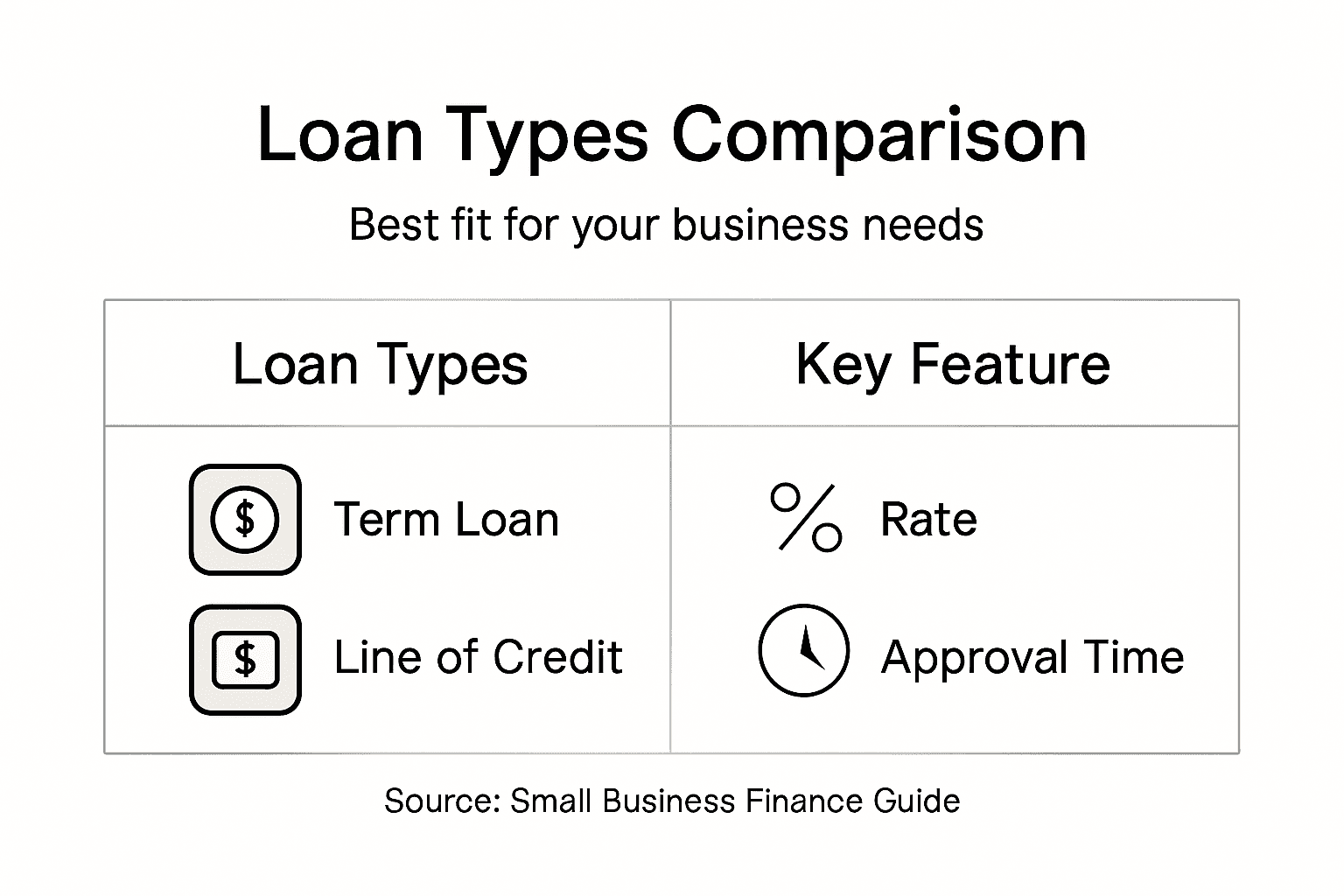
Traditional bank loans take 4-6 weeks but offer the lowest rates. Alternative lenders split the difference, approving in 3-5 business days with moderate rates.
Your cash flow situation determines what you can actually afford. If you need funds in 2 days, the cheapest option won't help you.
Collateral Requirements Matter
Secured loans use your equipment, property, or inventory as protection. Lenders feel safer, so they charge less. You lose the collateral if you can't repay.
Unsecured loans don't require collateral but come with higher rates because lenders absorb more risk. They're ideal if you can't pledge assets.
Qualification Differences
Each loan type looks at different things:
- Bank term loans focus heavily on credit scores and time in business
- Merchant cash advances prioritize monthly credit card revenue
- Equipment financing values the equipment itself, not your credit
- Lines of credit depend on business revenue and cash flow patterns
The best loan type isn't always the cheapest one. It's the one you qualify for that matches your cash flow and timeline.
Pro tip: Calculate your monthly repayment capacity before applying. Lenders want to see you can service the debt comfortably, so knowing your number strengthens your application and prevents over-borrowing.
Key Loan Features and Application Requirements
Lenders evaluate dozens of details before approving your application. Knowing what they look for increases your chances of approval and helps you negotiate better terms.
Every loan comes with specific features that directly affect your bottom line. Interest rates, repayment periods, fees, and collateral requirements vary dramatically between lenders and loan types.
Here's what you need to understand about the core features:
- Interest rates: Range from 5% to 30%+ depending on loan type and your profile
- Repayment terms: From 3 months to 10 years
- Fees: Origination, prepayment penalties, or annual maintenance charges
- Collateral: Required, optional, or not needed
- Loan amounts: From $2,000 microloans to $5+ million
What Lenders Actually Evaluate
Lenders assess SBA loan eligibility requirements which include your ability to repay, business viability, and credit history. But they look at more than just your credit score.
Your business revenue matters most. Can your cash flow actually support monthly payments? Lenders calculate this by reviewing 2-3 years of tax returns.
Your credit history shows how you handle obligations. Both personal and business credit scores factor in. A score below 620 limits options, but alternatives still exist.
Your time in business demonstrates stability. Startups face steeper barriers than established companies. Most lenders want at least 6-12 months of operating history.
Documentation You'll Need
Applicants must prepare complete business documentation showing financials, ownership structure, and business viability. Have these ready:
- Personal and business tax returns (2-3 years)
- Bank statements (3-6 months)
- Profit and loss statements
- Balance sheet
- Business plan with financial projections
- Personal identification
- Business licenses and permits
- Loan agreement and use of funds explanation
The Application Process Itself
Prepare to answer detailed questions about your business, finances, and how you'll use the funds. Incomplete applications get rejected or delayed.
Lenders typically request a business plan outlining your vision, market analysis, and 2-3 year financial projections. This doesn't need to be fancy, just realistic.
Be specific about how you'll use the funds. "Expansion" is vague. "Purchase three new assembly machines totaling $125,000" is clear.
Lenders approve applications because they believe you'll repay successfully. Your job is proving that belief with solid documentation and a credible plan.
Pro tip: Gather all documentation before applying anywhere. Having everything ready cuts your approval timeline by half and shows lenders you're organized and serious about borrowing.
Real-World Uses and Industry Examples
Small business loans aren't one-size-fits-all. Across industries, successful business owners use different loan types to solve specific problems. Here's how real companies put these loans to work.
Retail stores need inventory. Restaurants require kitchen equipment. Manufacturers need production machinery. Each situation calls for a tailored financing solution.
Small business loans support various purposes including buying real estate, purchasing equipment, covering operating expenses, refinancing existing debt, and funding expansion projects. The loan type matches the actual business need.
Common Business Uses
Here's what we see most often:
- Working capital: Pay employees, buy supplies, cover payroll gaps
- Equipment purchases: Manufacturing machines, restaurant ovens, delivery vehicles
- Real estate: Buying a building, renovating a warehouse, upgrading your storefront
- Debt consolidation: Combine high-interest loans into one manageable payment
- Expansion: Open a new location, hire more staff, scale production
Industry-Specific Examples
Construction and trades borrow heavily for equipment and vehicle purchases. A contractor might finance trucks, excavators, or specialized tools. These loans often use the equipment itself as collateral.
Restaurants and food service need working capital constantly. Monthly payroll, ingredient costs, and utility bills consume cash fast. A line of credit solves this perfectly.
Professional services (accounting, consulting, legal firms) typically borrow for real estate, office upgrades, or hiring. Their predictable cash flow makes traditional bank loans feasible.
Retail stores use loans for inventory, store fixtures, and seasonal cash gaps. A growing technology sector increasingly finances software platforms and equipment upgrades.
Healthcare practices borrow for medical equipment, renovations, and working capital. Dentists and clinics often use equipment financing for new technology.
Timing Matters for Different Uses
Urgent needs require speed. If your roof leaks and you need repairs fast, a merchant cash advance funds in 2 days.
Planned expansion allows time. If you're opening a second location next year, apply for a traditional bank term loan now and lock in lower rates.
Seasonal businesses face cyclical needs. Landscapers borrow in winter to survive slow months, then repay during the busy season.
The best loan isn't just the cheapest one. It's the one that matches when you need the money and how you'll use it.
Pro tip: Match the loan term to how long the purchase will benefit your business. Equipment lasting 7 years shouldn't be financed over 3 years, or you'll still owe after it's replaced.
Costs, Risks, and Choosing the Right Loan
Borrowing money isn't free. Every loan carries costs and risks that can impact your business profitability and personal finances. Understanding these upfront prevents costly surprises later.
The visible costs are interest and fees. But hidden costs exist too—opportunity costs, cash flow strain, and the risk of over-leverage. Smart borrowers account for all of them.
Breaking Down the Real Costs
Here's what you actually pay:
- Interest: Your primary cost, ranging from 5% to 30%+ annually
- Origination fees: Upfront charges (0.5% to 5% of loan amount)
- Prepayment penalties: Fees if you pay off early
- Annual or maintenance fees: Yearly charges on lines of credit
- Late payment penalties: Charges if you miss a payment
A $50,000 loan at 12% annual interest costs you $6,000 per year in interest alone. Add a 2% origination fee ($1,000) and you've spent $7,000 before the first payment.
The Real Financial Risks
Entrepreneurs face significant risks including cash flow challenges, unexpected costs, and revenue uncertainties. Taking on debt amplifies these pressures.
If your revenue drops 20%, can you still make loan payments? Many business owners overlook this question until it's too late.
Over-borrowing is the biggest trap. Just because a lender approves you for $100,000 doesn't mean you need it all. Borrow what you can comfortably repay.
Personal liability matters. Many lenders require personal guarantees, meaning you're responsible if your business can't pay. This puts your personal assets at risk.
This summary table highlights key risks of small business borrowing and how to mitigate them:
| Risk Type | Potential Impact | Mitigation Strategy |
|---|---|---|
| Over-borrowing | Cash flow stress, default | Borrow only what you can repay |
| High Interest Costs | Lower profits, debt spiral | Compare total APR and fees |
| Personal Liability | Loss of personal assets | Review guarantee terms carefully |
| Revenue Drop | Loan payment difficulties | Use conservative revenue estimates |
| Incomplete Planning | Approval delays, rejection | Prepare full documentation upfront |
How to Choose the Right Loan
Don't chase the lowest rate alone. Match the loan to your actual situation:
- Calculate what you need (not what you want)
- Project realistic repayment capacity based on conservative revenue estimates
- Compare total costs including all fees and interest
- Check approval timeline against when you need funds
- Understand personal liability terms before signing
- Verify you can weather a 20% revenue drop while making payments
A slightly higher-rate loan that you qualify for beats the "perfect" loan you can't afford.
The right loan fits your cash flow and timeline, not your ego or growth ambitions. Overborrowing kills more businesses than underfunding.
Pro tip: Model your loan repayment as a percentage of monthly revenue. If your payment exceeds 10% of average monthly income, it's too aggressive for most businesses.
Find the Perfect Small Business Loan for Your Needs Today
Understanding the many types of small business loans can feel overwhelming, especially when speed, cost, and qualification vary so much. If you are struggling with choosing between a term loan, line of credit, or equipment financing, you are not alone. Many business owners face the challenge of matching loan types to their cash flow, timeline, and repayment ability. At Capital for Business, we recognize these pain points and offer tailored financial solutions designed to help you overcome common hurdles like strict credit requirements and lengthy approval processes.
Take control of your business future with fast, affordable access to funds that fit your unique situation. Since 2009, we have partnered with small business owners across hundreds of industries to provide working capital, merchant cash advances, equipment loans, and lines of credit when traditional banks fail. Visit Capital for Business to explore small business loan options customized for your growth. Act now to secure financing that supports your cash flow and expansion goals before opportunities pass you by.
Frequently Asked Questions
What are the main types of small business loans?
There are several main types of small business loans, including term loans, lines of credit, merchant cash advances, equipment financing, and SBA loans. Each type serves different business needs and has varying approval timelines and costs.
How do I determine which small business loan is right for me?
To find the best loan type for your business, consider your specific needs, such as the purpose of the loan, how quickly you need funds, your credit profile, and how long you need to repay the loan. Match these factors to the characteristics of each loan type.
What factors do lenders evaluate when I apply for a small business loan?
Lenders typically evaluate factors such as business revenue, credit history, time in business, and your ability to repay the loan. They also look at the specific documentation you provide, like tax returns and financial statements.
What are typical repayment terms and interest rates for small business loans?
Repayment terms for small business loans can range from as short as three months to as long as ten years, depending on the loan type. Interest rates may vary widely from around 5% to over 30%, influenced by the loan type, lender, and the borrower’s credit profile.