
Every small business owner knows the struggle of watching exciting growth opportunities pass by when bank doors keep closing. As American and Canadian entrepreneurs in retail and services look to 2026, understanding small business funding becomes vital with so many traditional lenders tightening their standards. With small businesses making up around 90 percent of global enterprises and generating over half of all employment, finding new, flexible financing paths could change everything for your business future.
Table of Contents
- Defining Small Business Funding In 2026
- Comparing Key Funding Types And Models
- Eligibility And Requirements For Funding
- Alternative Financing: Merchant Advances, Rbf, Crowdfunding
- Costs, Risks, And Common Pitfalls
- How To Choose The Best Funding Solution
Key Takeaways
| Point | Details |
|---|---|
| Diverse Funding Options | Small businesses in 2026 have access to a variety of funding sources, including traditional loans, government grants, and innovative financing methods like crowdfunding and merchant cash advances. |
| Eligibility Evaluation | Entrepreneurs must assess eligibility criteria, including business size, financial health, and operational duration before applying for funding. |
| Importance of Strategy | Developing a comprehensive financial strategy that combines different funding sources is crucial for maximizing growth potential and minimizing financial risks. |
| Risks and Costs Awareness | Understanding hidden costs, strict reporting requirements, and repayment pressures is vital for maintaining financial stability when selecting funding options. |
Defining Small Business Funding in 2026
Small business funding represents the critical financial resources entrepreneurs utilize to launch, sustain, and expand their enterprises. In 2026, understanding these funding mechanisms has become increasingly complex yet essential for growth. Global SME financing ecosystems highlight that access to capital remains a significant challenge for many small businesses.
Funding options for small businesses in 2026 encompass diverse financial instruments designed to meet varying operational needs:
- Traditional bank loans with evolving qualification criteria
- Government-backed small business grants
- Alternative lending platforms
- Venture capital investments
- Crowdfunding mechanisms
- Angel investor networks
The global landscape reveals that small businesses represent a critical economic segment. According to World Bank research, these enterprises account for approximately 90% of businesses worldwide and generate over half of total employment. This underscores the profound importance of accessible, flexible funding strategies.
Modern small business funding has transformed dramatically, moving beyond conventional banking models. Digital platforms, fintech innovations, and alternative lending sources have expanded financing opportunities, enabling entrepreneurs to secure capital through more flexible, technology-driven channels.
Pro tip: Research multiple funding sources simultaneously and develop a comprehensive financial strategy that combines different capital access methods.
Comparing Key Funding Types and Models
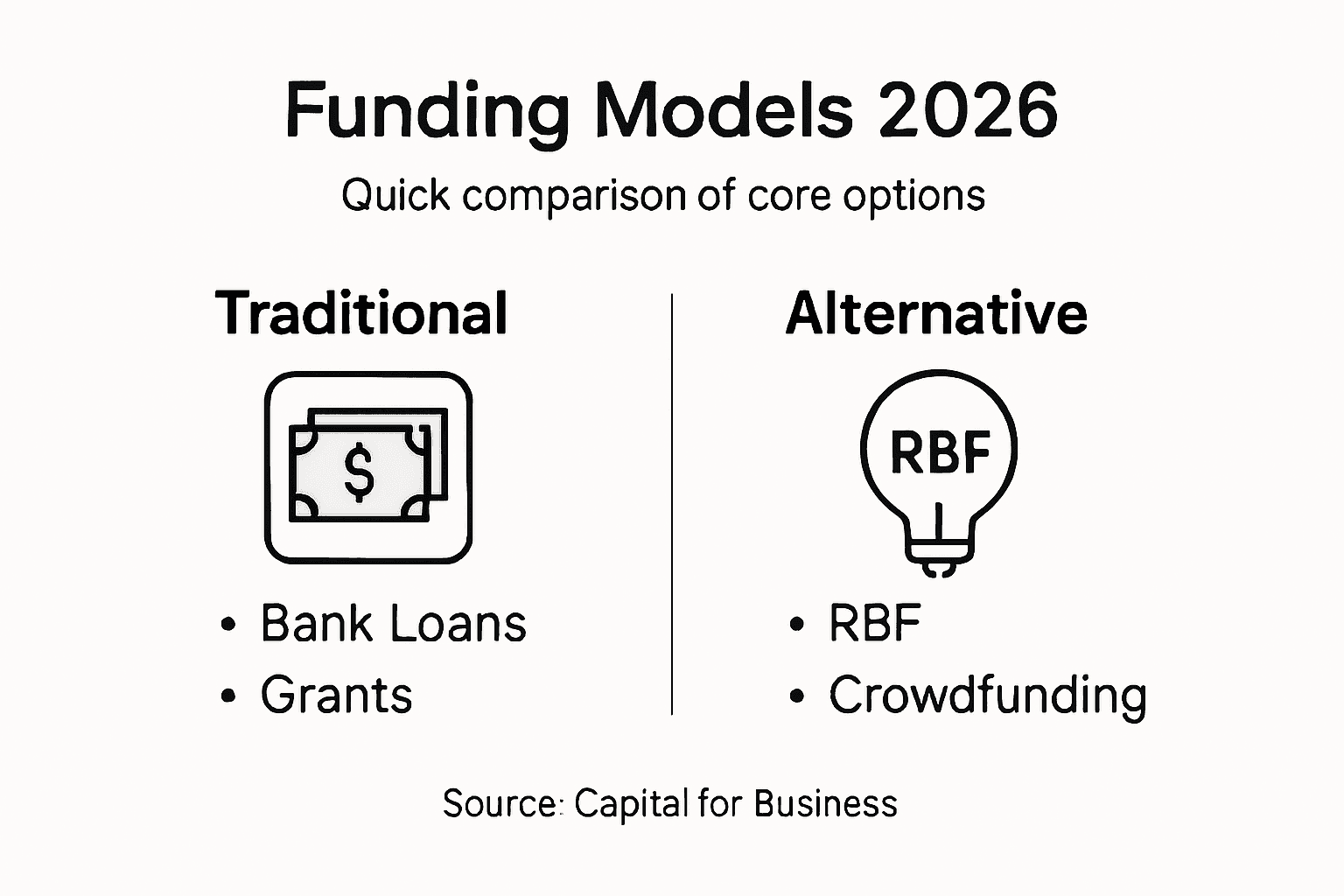
Small businesses in 2026 face a diverse and dynamic funding landscape that demands sophisticated financial strategy. Business funding models increasingly blend traditional and innovative approaches to meet complex entrepreneurial needs. The modern funding ecosystem has evolved far beyond simple bank loans, offering entrepreneurs multiple pathways to secure critical capital.
Key funding types for small businesses include:
Here's a side-by-side comparison of key small business funding types highlighting their typical use, speed, and ownership impact:
| Funding Type | Typical Use Case | Speed of Access | Impact on Ownership |
|---|---|---|---|
| Traditional Bank Loan | Equipment or real estate purchase | Slow (weeks/months) | No change in equity |
| Government Grant | Innovation or targeted projects | Medium (weeks) | No equity or repayment |
| Venture Capital | Rapid scaling and growth | Medium (weeks) | Partial ownership given |
| Crowdfunding | Product launch, marketing | Fast (days/weeks) | No equity for donations |
| Angel Investors | Early-stage development | Fast (weeks) | Small equity stake |
| Merchant Cash Advance | Immediate cash flow needs | Very fast (days) | No equity, but higher cost |
- Traditional Bank Loans: Structured financial products with established lending criteria
- Government Grants: Targeted financial support for specific business sectors
- Venture Capital: High-risk, high-reward investments for scalable enterprises
- Crowdfunding Platforms: Community-driven funding mechanisms
- Angel Investor Networks: Private investment from high-net-worth individuals
- Merchant Cash Advances: Alternative financing based on future revenue projections
Government schemes play a pivotal role in small business financing. These programs often provide critical support through mechanisms like credit guarantees, direct loans, and tax incentives. Technological advancements and policy reforms have made these funding sources more accessible and tailored to diverse business needs.

Digital transformation has significantly reshaped funding models, introducing more flexible, data-driven approaches to capital acquisition. Fintech platforms now utilize advanced algorithms to match businesses with appropriate funding sources, dramatically reducing traditional barriers to entry and democratizing access to financial resources.
Pro tip: Develop a comprehensive funding strategy that combines multiple financial instruments to maximize your business's capital potential and minimize risk.
Eligibility and Requirements for Funding
Navigating the complex landscape of small business funding requires a strategic understanding of eligibility criteria that vary across different financial platforms. Small business funding eligibility depends on multiple interconnected factors that entrepreneurs must carefully evaluate before applying.
Key eligibility requirements typically include:
- Business Size: Meeting specific small business definition parameters
- Financial Health: Demonstrating stable revenue and positive financial indicators
- Credit History: Maintaining a strong personal and business credit profile
- Industry Sector: Aligning with preferred or targeted business categories
- Operational Duration: Showing minimum operational track record
- Growth Potential: Presenting a scalable and innovative business model
Different funding sources impose unique qualification standards. Government programs often prioritize businesses with innovative technologies, potential for job creation, and contributions to regional economic development. Venture capitalists focus intensely on scalability, market potential, and the founding team's expertise.
Documentation plays a critical role in establishing funding eligibility. Successful applicants must typically prepare comprehensive packages including detailed business plans, financial statements, tax returns, legal registrations, and projected financial models. Thorough preparation and transparent financial reporting significantly enhance approval probabilities.
Pro tip: Conduct a comprehensive self-assessment of your business's funding readiness before applying, identifying potential gaps and strengthening your application strategy.
Alternative Financing: Merchant Advances, RBF, Crowdfunding
Small businesses in 2026 are increasingly turning to innovative financing solutions beyond traditional bank loans. Merchant cash advances represent a flexible funding mechanism that allows businesses to access capital quickly by leveraging future revenue streams. These alternative financing models provide entrepreneurs with unprecedented opportunities to support growth and manage cash flow challenges.
Key alternative financing options include:
- Merchant Cash Advances (MCA): Immediate funding based on projected credit card sales
- Revenue-Based Financing (RBF): Repayment tied directly to business revenue percentages
- Crowdfunding Platforms: Community-driven capital acquisition through online networks
- Peer-to-Peer Lending: Direct borrowing from individual investors
- Invoice Factoring: Converting outstanding invoices into immediate working capital
- Equipment Financing: Specialized loans secured against business equipment
Merchant cash advances offer unique advantages for businesses with inconsistent revenue streams. Unlike traditional loans with fixed monthly payments, these advances adjust repayment based on actual sales performance. This flexible structure provides businesses with breathing room during slower financial periods, making it an attractive option for retail, service, and seasonal industries.
Digital platforms have democratized alternative financing, enabling businesses to access capital through sophisticated algorithms and streamlined application processes. Entrepreneurs can now leverage technology to match their specific funding needs with appropriate financial instruments, reducing traditional barriers to capital acquisition.
Pro tip: Compare multiple alternative financing options, analyzing total cost of capital and repayment flexibility before selecting the most appropriate funding strategy for your business.
Costs, Risks, and Common Pitfalls
Small business funding involves navigating a complex landscape of financial opportunities and potential challenges. Government funding risks often include hidden complexities that can significantly impact a business's financial strategy and operational flexibility.
Key risks and potential pitfalls in business funding include:
- Misaligned Funding: Selecting capital sources incompatible with business needs
- Hidden Costs: Overlooking additional fees, interest rates, and compliance expenses
- Reporting Obligations: Failing to meet strict documentation and performance requirements
- Compliance Challenges: Navigating complex legal and tax implications
- Repayment Stress: Underestimating the impact of funding commitments on cash flow
- Restrictive Conditions: Accepting funding with overly limiting operational constraints
Financial experts emphasize the importance of comprehensive due diligence when exploring funding options. Each funding mechanism carries unique financial implications that extend beyond the initial capital infusion. Businesses must carefully analyze the total cost of capital, including direct monetary expenses and indirect costs such as time investment, reporting requirements, and potential operational restrictions.
This summary outlines key risk factors and potential consequences for small businesses seeking funding:
| Risk Factor | Description | Possible Consequence |
|---|---|---|
| Misaligned Funding | Funding does not fit business model | Cash flow issues, lost opportunities |
| Hidden Costs | Unclear fees or high interest rates | Unexpected expenses |
| Strict Reporting | Extensive, ongoing documentation needed | Resource drains, penalties |
| Repayment Pressure | Inflexible repayment schedules | Financial strain |
| Restrictive Terms | Operational or strategic constraints | Limited business flexibility |
Modern funding landscapes demand a strategic approach to risk management. Entrepreneurs must develop robust financial models that account for potential variations in revenue, unexpected expenses, and the specific conditions attached to different funding sources. Understanding the nuanced risks helps businesses make more informed decisions and maintain financial stability.
Pro tip: Create a comprehensive financial risk assessment matrix that evaluates potential funding sources against your specific business goals and operational constraints.
How to Choose the Best Funding Solution
Selecting the optimal funding solution requires a strategic approach that aligns financial resources with specific business objectives. Business funding strategies demand comprehensive analysis of multiple factors beyond simple capital availability.
Key considerations for choosing the best funding solution include:
- Business Stage: Matching funding to current operational phase
- Capital Requirements: Precisely defining funding amount needed
- Repayment Capacity: Analyzing realistic revenue projection and cash flow
- Risk Tolerance: Understanding financial risk appetite
- Growth Objectives: Aligning funding with strategic expansion plans
- Control Preferences: Balancing investment against equity dilution
Entrepreneurs must conduct thorough due diligence by examining each funding option's unique characteristics. This involves evaluating not just the immediate financial infusion, but also long-term implications such as reporting requirements, potential restrictions, and impact on future fundraising capabilities. Successful funding selection requires a holistic view that considers both immediate financial needs and future business trajectory.
Modern funding selection has become increasingly sophisticated, leveraging advanced assessment tools and personalized recommendation platforms. Businesses can now utilize digital resources that provide nuanced matching between funding sources and specific organizational characteristics, dramatically improving the probability of securing appropriate financial support.
Pro tip: Create a detailed funding matrix comparing potential capital sources across multiple dimensions, including cost, flexibility, and strategic alignment with your business goals.
Find the Right Funding Solution to Unlock Your Business Growth
Navigating the complex world of small business funding in 2026 can feel overwhelming. The article highlights common challenges such as misaligned funding, hidden costs, and repayment pressures that stall many entrepreneurs' progress. If you are seeking flexible capital options like merchant cash advances, equipment financing, or a business line of credit tailored to your unique needs, you are not alone. Understanding terms like revenue-based financing and alternative lending is crucial to securing funds that truly support your growth goals without sacrificing control or cash flow.
At Capital for Business, we specialize in helping small businesses across the nation and Canada overcome these hurdles. Since 2009, we have enabled hundreds of businesses to expand, upgrade, and thrive by offering quick, affordable small business loans and working capital solutions when traditional banks say no. Whether you need immediate cash flow assistance or long-term financing strategies, our experienced team works with you every step of the way.
Explore our funding options to discover a reliable partner that understands the complexities of modern small business financing.
Stop waiting and start growing today by connecting with Capital for Business. Visit us now at Capital for Business and take control of your business’s financial future.
Frequently Asked Questions
What are the main types of small business funding available in 2026?
Funding options in 2026 include traditional bank loans, government-backed grants, alternative lending platforms, venture capital, crowdfunding, and angel investor networks.
How do I determine if I am eligible for small business funding?
Eligibility typically depends on factors such as business size, financial health, credit history, industry sector, operational duration, and growth potential. Each funding source has unique requirements to consider.
What are the risks associated with alternative financing options like merchant cash advances?
Risks include misaligned funding that may not fit your business model, hidden costs, strict reporting obligations, repayment stress, and potentially restrictive conditions tied to the funding.
How can I choose the best funding solution for my small business?
To choose the best funding solution, consider your business stage, capital requirements, repayment capacity, risk tolerance, growth objectives, and control preferences. Conduct thorough due diligence on each option's implications for your business.