
Many small business owners believe all financing options deliver equal benefits, but that's far from true. Choosing the wrong financing type can drain cash flow, limit operational flexibility, and ultimately stall growth instead of accelerating it. This article breaks down how different financing methods impact business expansion, which options align with specific growth stages, and how to select the financing strategy that truly fuels sustainable success in 2026.
Table of Contents
- How Financing Influences Small Business Growth
- Types Of Financing And Their Roles In Growth Stages
- Financial Risks And Considerations In Choosing Financing
- Improving Financing Access And Managing Credit For Growth
- Explore Financing Solutions Tailored For Your Business Growth
- Frequently Asked Questions
Key takeaways
| Point | Details |
|---|---|
| Financing fuels growth velocity | Small businesses with access to adequate financing grow 20-30% faster, with SBA loans boosting revenue by 25% in two years. |
| Different stages need different funding | Debt financing suits asset acquisition while equity financing supports long-term growth but reduces ownership control. |
| Risk assessment is critical | High denial rates reflect stringent eligibility criteria, making informed financing choices essential to avoid pitfalls. |
| Credit improvement expands options | Better credit scores unlock more favorable loan terms and increase approval likelihood in a competitive lending environment. |
| Strategic planning maximizes impact | Aligning financing mix with business goals and risk tolerance creates sustainable growth pathways. |
How financing influences small business growth
Access to capital isn't just helpful for business expansion, it's transformative. Small businesses with adequate financing grow 20-30% faster than those operating on limited funds, with SBA loan recipients seeing revenue increases of 25% within two years. That's not marginal improvement, that's exponential acceleration.
Financing enables critical growth activities that self-funded businesses simply can't execute at scale. You can hire specialized talent, invest in technology that multiplies productivity, expand into new markets, or upgrade equipment that increases output capacity. These aren't luxuries, they're competitive necessities in 2026.
The employment impact tells an equally compelling story. Businesses with access to funding create two to three times more jobs than their capital-constrained counterparts. When you secure the right financing, you're not just growing your business, you're building economic momentum in your community.
"Insufficient access to capital remains one of the most significant barriers preventing small businesses from reaching their full growth potential." - U.S. Small Business Administration
Yet many business owners struggle to secure funding precisely when they need it most. Understanding why small businesses need financing and how to access it strategically separates businesses that plateau from those that scale successfully.
The barriers are real but surmountable:
- Limited credit history or suboptimal credit scores
- Insufficient collateral for traditional loan requirements
- Inability to meet strict debt service coverage ratios
- Lack of awareness about alternative financing options
Recognizing these obstacles early allows you to address them proactively rather than discovering them during a critical growth window.
Types of financing and their roles in growth stages
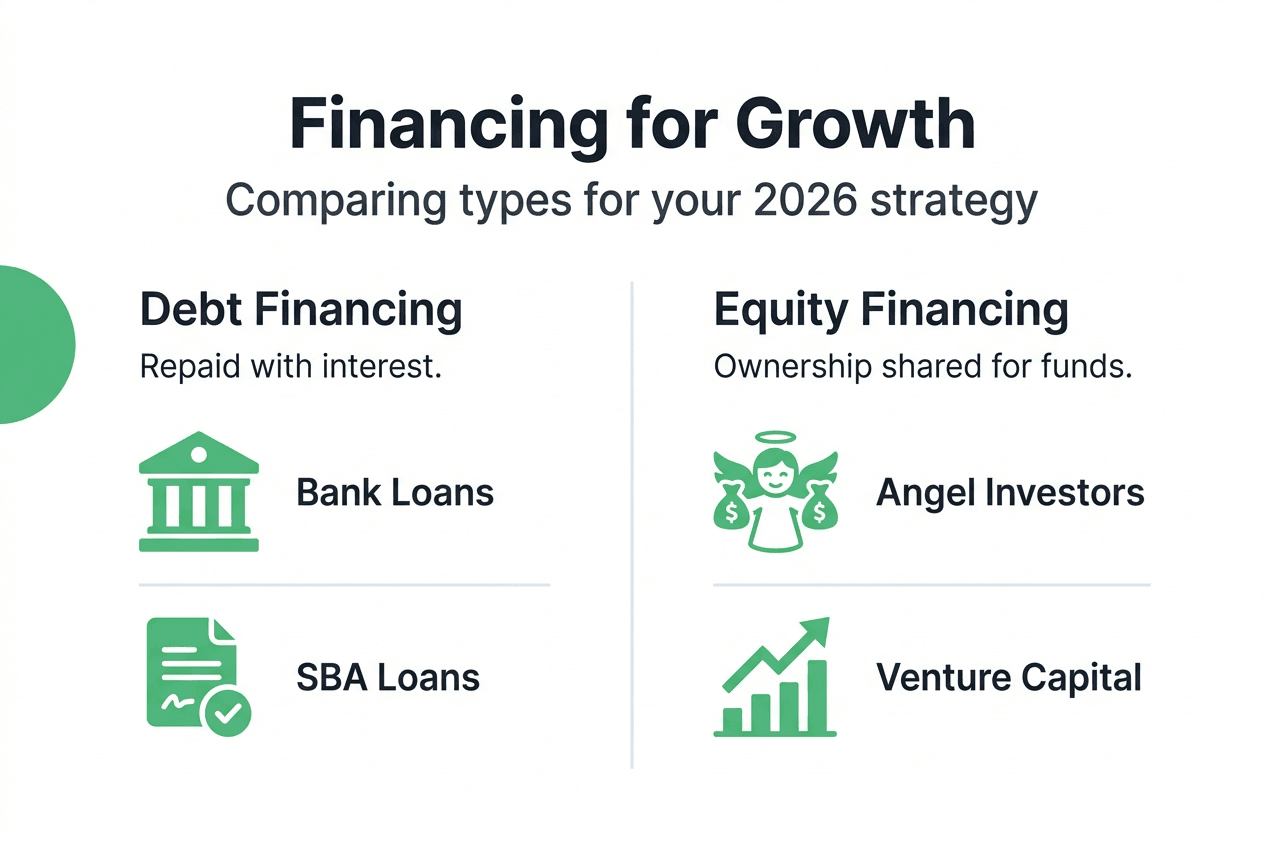
Not all capital is created equal. The financing type you choose fundamentally shapes your business trajectory, cash flow obligations, and ownership structure. Debt financing suits asset acquisition and expansion, while equity financing supports long-term growth but dilutes ownership stakes.
Debt financing provides immediate capital without surrendering ownership. You borrow money, use it to grow, and repay it with interest over time. This approach works brilliantly when you have predictable revenue streams and need to acquire tangible assets like equipment or real estate. The leverage amplifies returns when business performs well, but it also increases default risk if cash flow falters.

Equity financing flips the equation. Instead of repayment obligations, you exchange ownership stakes for capital. This reduces immediate financial pressure and aligns investor interests with long-term success. However, you permanently dilute control and share future profits with new partners.
The optimal choice depends entirely on your growth stage and strategic objectives:
| Financing Type | Best For | Key Consideration |
|---|---|---|
| SBA 7(a) loans | Real estate, equipment, working capital | Strict eligibility requirements but favorable terms |
| SBA 504 loans | Fixed asset purchases, facility expansion | Long-term, fixed-rate financing for major investments |
| Microloans | Modest capital needs under $50,000 | Accessible for startups with limited credit history |
| Venture capital | High-growth potential startups | Requires substantial equity exchange |
| Equipment financing | Specific equipment purchases | Asset serves as collateral, simplifying approval |
Matching financing to your specific situation maximizes effectiveness. A retail business expanding to a second location might benefit from an SBA 504 loan for real estate, while a tech startup seeking rapid scale might pursue venture capital despite ownership dilution.
Pro Tip: Before committing to any financing, calculate your all-in costs including interest, fees, and opportunity costs of dilution. The cheapest option on paper isn't always the smartest strategic choice.
Understanding types of easy small business loans available helps you compare options efficiently and select the financing vehicle that truly accelerates your specific growth objectives.
Financial risks and considerations in choosing financing
Every financing decision carries inherent tradeoffs between risk, cost, and control. Debt financing increases leverage, which magnifies both gains and losses. Equity financing dilutes ownership but lowers debt burden, reducing default risk by eliminating mandatory repayment schedules.
The eligibility hurdles for traditional financing are substantial and rising. Many SBA loan applicants are denied due to inability to meet debt service coverage ratios and other strict requirements. In 2024, SBA loan denial rates reached 45%, reflecting increasingly stringent underwriting standards as lenders manage risk in uncertain economic conditions.
Understanding these criteria before applying saves time and protects your credit score from multiple hard inquiries. Key factors lenders evaluate include:
- Debt service coverage ratio, typically requiring 1.25x or higher
- Personal and business credit scores above minimum thresholds
- Time in business, usually two years minimum
- Collateral value relative to loan amount
- Industry risk profile and market conditions
Debt obligations create fixed cash flow requirements regardless of business performance. During growth phases with irregular revenue, these payments can strain operations. Conversely, equity financing provides flexibility but permanently reduces your ownership percentage and future profit share.
Pro Tip: Model multiple scenarios including worst-case revenue drops before committing to debt financing. Can you sustain payments if revenue falls 30% for six months? If not, consider alternatives.
Careful loan considerations and risk assessment prevent financial distress. Improving credit scores before applying can dramatically shift your options from high-cost alternatives to favorable traditional loans. Even modest credit improvements translate to thousands in interest savings over loan terms.
Exploring business financing tips for 2026 helps you navigate the evolving lending landscape strategically.
Improving financing access and managing credit for growth
Your credit profile determines which financing doors open and which remain locked. Diversifying credit accounts and timely payments improve credit scores, resulting in better loan terms, lower interest rates, and higher approval probabilities. These improvements compound over time, expanding your strategic options precisely when growth opportunities emerge.
The lending environment has tightened considerably. Only 41% of small business applicants received all requested financing in 2024, down sharply from 62% in 2019. This increased competition makes credit optimization essential rather than optional for businesses seeking capital.
Implement these proven strategies to strengthen your credit position:
- Monitor both personal and business credit reports quarterly for errors and dispute inaccuracies immediately.
- Maintain credit utilization below 30% across all revolving accounts to signal responsible management.
- Establish trade credit relationships with suppliers and ensure they report payment history to business credit bureaus.
- Pay all obligations on or before due dates, as payment history constitutes the largest credit score factor.
- Gradually increase credit limits on existing accounts to improve utilization ratios without adding debt.
- Avoid closing old accounts, as credit history length positively impacts scores.
These actions directly impact your financing costs and approval likelihood:
| Credit Score Range | Typical Interest Rate | Approval Likelihood |
|---|---|---|
| 720+ | 6-8% | High |
| 680-719 | 8-12% | Moderate |
| 640-679 | 12-18% | Lower |
| Below 640 | 18%+ or declined | Very limited |
Pro Tip: Request credit limit increases every six months on cards you manage well. Higher limits improve utilization ratios even if spending remains constant, boosting scores without behavioral changes.
Preparing comprehensive loan applications increases success rates even in competitive environments. Lenders want to see detailed financial projections, clear growth strategies, and evidence of market demand. The more thoroughly you document your business case, the more confidence you inspire.
Dive deeper into improving your business credit score with specific tactical steps that deliver measurable results within months. Strategic credit management transforms financing from a limitation into a growth accelerator.
Explore financing solutions tailored for your business growth
You've learned how financing accelerates growth, which options suit different stages, and how to strengthen your credit position. Now it's time to explore solutions designed specifically for businesses like yours.
Capital For Business specializes in flexible financing that banks often decline, offering various small business loan types from working capital to merchant cash advances.
Whether you need equipment financing to upgrade operations or comprehensive business funding solutions to fuel expansion, we provide fast approvals and competitive terms tailored to your industry and growth trajectory. Since 2009, we've helped thousands of business owners access the capital they need when traditional lenders say no.
Frequently asked questions
How does financing directly impact small business growth rates?
Financing provides capital for expansion activities that self-funded businesses cannot execute at scale, including hiring talent, technology investments, and market expansion. Businesses with adequate financing grow 20-30% faster and create two to three times more jobs than capital-constrained competitors.
What is the main difference between debt and equity financing for growth?
Debt financing requires repayment with interest but preserves full ownership, making it ideal for asset purchases and predictable revenue businesses. Equity financing exchanges ownership stakes for capital without repayment obligations, reducing financial pressure but permanently diluting control and future profits.
Why do so many SBA loan applications get denied?
Lenders impose strict eligibility requirements including minimum debt service coverage ratios, credit score thresholds, collateral requirements, and time-in-business standards. Approximately 45% of SBA loan applications were denied in 2024 due to applicants not meeting these increasingly stringent criteria.
How can I improve my chances of loan approval in 2026?
Focus on strengthening your credit profile through timely payments, maintaining low credit utilization, and correcting report errors. Prepare comprehensive applications with detailed financial projections and clear growth strategies. Consider improving your debt service coverage ratio by reducing existing obligations or increasing revenue before applying.
Which financing option works best for equipment purchases?
Equipment financing offers optimal terms for asset acquisition because the equipment itself serves as collateral, simplifying approval and often providing better rates than unsecured loans. SBA 504 loans also work well for major equipment investments when combined with real estate or facility improvements.
How does credit score affect my financing options and costs?
Credit scores directly determine approval likelihood and interest rates, with scores above 720 accessing rates of 6-8% while scores below 640 face rates exceeding 18% or outright denial. Even modest score improvements of 20-40 points can save thousands in interest over loan terms.
Recommended
- Business financing tips 2026: smart strategies
- Small Business Funding Options 2026: Unlock Growth
- Why Small Businesses Need Financing for Growth
- Business credit: Unlock financing for Canadian SMEs in 2026
- Innovative tech strategies for business leaders 2026
- Typer av tillväxtstrategier för nordiska techföretag 2026 | Growth Nordic