
Over 60% of restaurant owners admit they don't fully understand the financing options available to them, leading to expensive mistakes and missed growth opportunities. Securing the right funding can mean the difference between thriving expansion and operational stress. This guide breaks down equipment financing, securitization risks, SBA loan types, and practical selection strategies tailored for restaurant owners in 2026.
Table of Contents
- Understanding Equipment Financing For Restaurants
- Risks And Realities Of Securitization Financing
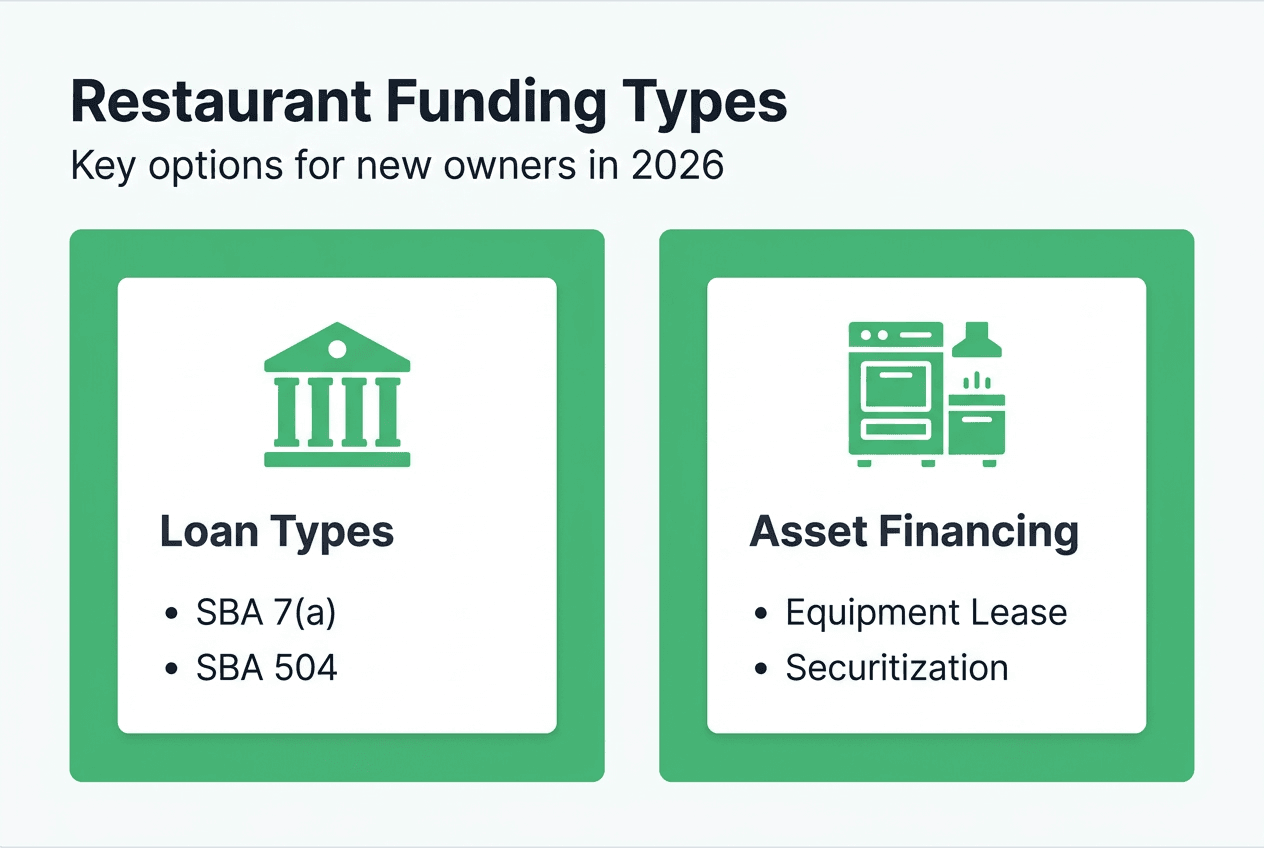
- Comparing SBA 7(a) And 504 Loans For Restaurant Funding
- Practical Tips To Choose The Best Restaurant Financing Option
- Explore Tailored Business Funding Solutions
Key takeaways
| Point | Details |
|---|---|
| Equipment financing transforms capital expenditure | Spread costly kitchen equipment purchases into manageable monthly payments while preserving working capital. |
| Securitization financing carries hidden risks | Revenue instability can trigger severe penalties and operational distress, as shown by recent industry failures. |
| SBA 7(a) and 504 loans serve distinct purposes | 7(a) offers flexible funding for diverse needs while 504 targets fixed assets like real estate. |
| Strategic selection prevents costly mistakes | Matching financing type to your restaurant's cash flow and growth stage avoids penalties and supports sustainable expansion. |
Understanding equipment financing for restaurants
Restaurant kitchens demand specialized, often expensive gear to stay competitive and meet health standards. Equipment financing solves this challenge by converting large upfront costs into predictable monthly payments. This approach preserves your working capital for inventory, payroll, and marketing while you acquire ovens, refrigeration units, POS systems, and other essential tools.
The global equipment finance industry is expected to hit a staggering $3.1 trillion by 2032, with options specifically built for restaurant business cycles. You can choose between traditional loans, leasing arrangements, or dedicated equipment financing lines of credit. Each structure offers different benefits depending on whether you plan to own the equipment long term or upgrade frequently.
Key advantages include:
- Maintaining cash reserves for unexpected repairs or seasonal fluctuations
- Acquiring updated technology to meet evolving customer expectations
- Spreading tax benefits across multiple years through depreciation
- Qualifying for financing even with limited business history by using the equipment itself as collateral
Pro Tip: Match your financing term to the equipment's useful life. A five year loan for a three year technology investment creates unnecessary payment obligations after the gear becomes obsolete.
Risks and realities of securitization financing
Securitization financing packages revenue generating assets like franchise royalties or real estate rental income into bonds sold to investors. This method can deliver cheaper debt costs than traditional loans, making it attractive for multi-unit restaurant operators seeking expansion capital. The structure works well when revenue streams remain stable and transparent, but introduces serious risks when projections miss reality.
Fat Brands faced potential bankruptcy due to securitization financing issues including $1.3B debt and $158M net loss. The company's struggles highlight how quickly securitization can turn destructive. When actual royalty flows fell short of projections used to secure the bonds, the company triggered covenant violations and payment defaults.
The consequences proved severe:
- Missed payments in securitization structures cause significant penalties, as Fat Brands paid $72M in penalty interest since 2022
- Whole business securitization covered only expansion costs, leaving operational cash flow stressed
- Bond investors gained priority over operational needs, squeezing working capital
- Franchise relationships deteriorated as corporate financial instability became public
One industry analyst observed the operational impact:
The financial distress doesn't stay in the boardroom. Store managers and franchisees feel it first when support systems break down and vendor payments slow. By the time investors hear about problems, the damage is already spreading across the operation.
Before pursuing securitization, assess whether your revenue streams can withstand economic downturns, competitive pressures, and seasonal variations. Conservative projections and maintaining buffer cash reserves become critical. Many restaurant owners find that simpler restaurant business loan options provide adequate capital without the structural complexity and default penalties inherent in securitization.
Comparing SBA 7(a) and 504 loans for restaurant funding
Small Business Administration backed loans offer government guaranteed financing with favorable terms for qualified restaurant owners. The two primary programs serve different purposes and understanding these distinctions helps you select the right fit for your project.

SBA 7(a) loans offer up to $5M for real estate, acquisitions, working capital, refinancing, or equipment. This flexibility makes 7(a) loans ideal for diverse restaurant needs from purchasing an existing location to covering seasonal cash flow gaps. Banks provide the full loan amount with SBA guaranteeing a portion, reducing lender risk and enabling approval for borrowers who might not qualify for conventional financing.
SBA 504 loans focus specifically on major fixed assets, particularly owner occupied commercial real estate and heavy equipment purchases. The financing structure splits between three parties: you contribute 10%, a Certified Development Company provides 40%, and a traditional lender covers the remaining 50%. This arrangement delivers lower down payments and favorable rates for substantial capital projects.
| Feature | SBA 7(a) Loan | SBA 504 Loan |
|---|---|---|
| Maximum amount | Up to $5 million | Up to $5.5 million |
| Typical uses | Working capital, equipment, real estate, acquisitions, refinancing | Owner occupied real estate, heavy equipment, major renovations |
| Down payment | Typically 10% | 10% borrower contribution |
| Financing partners | Single bank lender | Bank, CDC, and borrower |
| Best for | Flexible funding needs, newer businesses | Large fixed asset purchases, established operations |
Both programs require that the property or business be at least 51% owner occupied, ensuring the financing supports active business operations rather than passive investment. Interest rates remain competitive compared to conventional loans, and repayment terms can extend up to 25 years for real estate purchases.
Pro Tip: If your restaurant concept requires both real estate acquisition and working capital for buildout and initial operations, consider combining a 504 loan for the property with a separate 7(a) loan or SBA loan options for startups covering operational needs.
Practical tips to choose the best restaurant financing option
Selecting appropriate financing requires honest assessment of your restaurant's current position and realistic growth projections. Follow these steps to make informed decisions:
- Calculate your true funding need by itemizing all project costs including contingency reserves for unexpected expenses
- Analyze your cash flow patterns across seasonal cycles to determine comfortable payment amounts
- Compare total borrowing costs including interest, fees, and potential penalties across different financing types
- Evaluate collateral requirements and personal guarantee obligations for each option
- Review repayment flexibility including prepayment options if your revenue exceeds projections
- Seek professional financial advice before committing to complex structures like securitization or multiple loan combinations
Watch for warning signs that financing might strain your operation:
- Monthly payments exceeding 15% of projected revenue create vulnerable cash positions
- Balloon payments or variable rate increases that could spike during economic downturns
- Covenant requirements that limit operational flexibility or trigger penalties for normal business variations
- Personal guarantees extending beyond your risk tolerance or endangering personal assets
Aggressive securitization financing use is a concern; stable revenue and clear management reduce risks. The most successful restaurant owners match financing complexity to their management bandwidth. A single location startup benefits from straightforward equipment financing or a 7(a) loan. Multi-unit operators with proven systems can consider more sophisticated structures, but should maintain conservative leverage ratios.
When evaluating small business loan vs equipment leasing options, consider your technology refresh cycle and ownership preferences. Fast casual restaurants relying on digital ordering systems may prefer leasing to enable frequent upgrades, while fine dining establishments investing in signature kitchen equipment benefit from ownership and depreciation advantages.
Pro Tip: Create monthly cash flow forecasts extending 18 months beyond your loan term. This practice reveals potential stress points and helps you build reserves before problems emerge, not after payment difficulties begin.
Explore tailored business funding solutions
Capital for Business specializes in helping restaurant owners navigate financing decisions with clarity and confidence. Since 2009, we've partnered with hundreds of restaurant operators across North America, providing fast approvals and competitive rates when traditional banks say no. Our team understands the unique cash flow patterns and capital needs of food service businesses.
Whether you need equipment financing for a kitchen upgrade, working capital for seasonal inventory, or expansion funding for a second location, we offer easy small business loan types structured around your operation's reality. Explore our specialized restaurant business loans designed for startup costs, renovations, and growth opportunities. Get expert guidance on equipment financing options that preserve your working capital while acquiring the tools you need to compete and thrive in 2026.
FAQ
What is equipment financing and how does it benefit my restaurant?
Equipment financing lets you acquire essential kitchen gear through manageable monthly payments instead of large upfront purchases. This approach preserves working capital for inventory, payroll, and marketing while enabling you to upgrade technology and maintain competitive service standards.
How risky is securitization financing for restaurant businesses?
Securitization financing delivers lower interest rates but introduces severe risks when revenue streams prove unstable. Missed payment triggers can result in substantial penalty interest, as demonstrated by operators who paid tens of millions in penalties after covenant violations. Most single and small multi-unit restaurants find simpler financing structures more appropriate.
What are the main differences between SBA 7(a) and 504 loans?
SBA 7(a) loans provide flexible funding up to $5M for working capital, equipment purchases, real estate, or business acquisitions. SBA 504 loans focus specifically on owner occupied commercial real estate and heavy equipment, using a three party financing structure with lower down payments for major fixed asset investments.
Can restaurant owners use loans for renovations and expansions?
Yes, both SBA and conventional loans support renovation projects and expansion initiatives. The optimal choice depends on your project scope, available collateral, and cash flow capacity. Equipment focused renovations often work well with dedicated equipment financing, while major buildouts may benefit from SBA 504 programs or traditional construction loans.
Recommended
- Business financing tips 2026: smart strategies
- Small Business Funding Options 2026: Unlock Growth
- 6 Examples of Equipment Financing Options for Small Businesses
- 80+ Business Funding Options in Canada: 2026 Guide
- Top Affordable Financial Services for Boca Renters in 2025 - Luxury Apartments for Rent in Boca Raton | Premium Boca Raton Apartments | Aapartments Boca Raton