
Only 39% of small business loan applications received full or partial approval from US banks in recent years, leaving thousands of entrepreneurs searching for viable funding. For small business owners in the US and Canada facing rejection or lengthy approval timelines, alternative financing has become more than a backup plan. This guide breaks down the 2026 loan approval landscape, explores government-backed programs and private lending options, and shows how new technology is making creditworthiness assessments more accurate and accessible for businesses that don't fit traditional lending criteria.
Table of Contents
- Key takeaways
- Understanding the loan approval landscape in 2026
- Alternative financing options: programs and solutions for small businesses
- How technology is transforming the loan approval process
- Practical steps to improve your loan approval chances in 2026
- Explore tailored funding solutions for your small business
- Frequently asked questions
Key Takeaways
| Point | Details |
|---|---|
| Bank loan approvals | Only about 39 percent of US bank applications are approved fully or partially. |
| Alternative financing fills gap | Alternative lenders approve roughly 40 percent of applications declined by banks, with partial funding more common than full loans. |
| Faster funding timelines | Online lenders can fund in hours to 48 hours, while traditional banks take one to four weeks and SBA loans 30 to 90 days. |
| Canada government programs | Canada offers government backed programs including the Small Business Financing Program which guarantees up to 85 percent of lender losses and loans up to 1.15 million for eligible firms. |
| Technology improves creditworthiness | New credit scoring models are expanding access by improving the accuracy of credit assessments for startups and small businesses with limited histories. |
Understanding the loan approval landscape in 2026
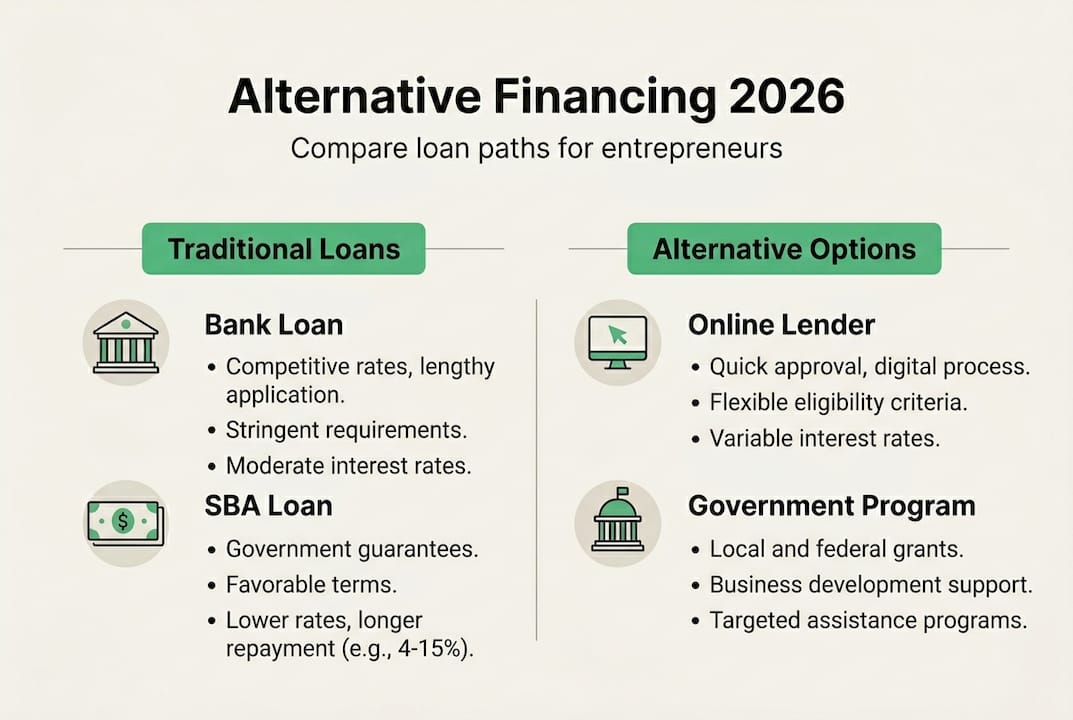
Securing traditional bank financing continues to challenge small business owners across North America. Bank approval rates remain stubbornly low, with US institutions approving roughly 39% of applications either fully or partially. Canadian banks maintain equally strict standards, leaving many qualified entrepreneurs without the capital they need to expand operations or manage cash flow gaps.
Alternative lenders have stepped in to fill this void, approving approximately 40% of applications that traditional banks declined. However, these approvals often come with a catch: partial funding is far more common than full loan amounts. While small banks approve 57% of their applications fully, online lenders approve only 38% at the requested amount. This reality means business owners frequently need to piece together financing from multiple sources or adjust their growth plans to match available capital.
The timeline for securing funds varies dramatically depending on your chosen lender type. Online lenders in Canada can fund applications within hours to 48 hours, making them ideal for urgent cash needs. Traditional banks typically require one to four weeks for approval and disbursal. US SBA loans, while offering favorable terms, demand 30 to 90 days for processing. Revenue-based financing stands out as the fastest option, with approvals possible in just one to five days.
"The shift toward alternative financing isn't just about speed. It reflects a fundamental change in how lenders assess risk and how small businesses access the capital they need to compete."
This challenging environment has pushed entrepreneurs to explore SBA and bank term loan updates alongside non-traditional options. Understanding these dynamics helps you set realistic expectations and build a financing strategy that combines multiple sources rather than relying on a single approval.
Key factors driving the current landscape include:
- Tighter lending standards following economic uncertainty
- Increased competition for limited bank capital
- Growing acceptance of alternative credit scoring models
- Rising demand from startups lacking extensive credit histories
- Regulatory requirements that make small loans less profitable for banks
Alternative financing options: programs and solutions for small businesses
Government-backed programs offer crucial support for businesses that struggle to meet traditional lending criteria. Canada's Small Business Financing Program guarantees up to 85% of lender losses, making it easier for startups and businesses with limited collateral to secure funding. This program provides loans up to $1.15 million to eligible for-profit firms with annual revenues under $10 million, covering equipment purchases, leasehold improvements, and real estate acquisitions.
The BDC Small Business Loan offers another strong option for Canadian entrepreneurs, providing up to $350,000 in financing. Applicants need at least 24 months of revenue history and good credit standing. Smaller loan requests under $100,000 benefit from expedited processing, with approvals often completed in under 10 days. This speed makes BDC particularly attractive for businesses needing quick access to working capital or equipment financing.
US businesses continue to leverage SBA loan programs, though approval timelines remain longer than alternative options. The trade-off comes in favorable interest rates and extended repayment terms that reduce monthly payment pressure. Alternative lenders fill the gap for businesses that can't wait months for funding or need more flexible qualification criteria.
| Loan Type | Maximum Amount | Eligibility | Approval Time | Collateral Required |
|---|---|---|---|---|
| Canada CSBFP | $1.15M | For-profit, <$10M revenue | 2-4 weeks | Partially backed |
| BDC Small Business | $350K | 24+ months revenue, good credit | <10 days (<$100K) | Varies |
| US SBA 7(a) | $5M | Varies by program | 30-90 days | Usually required |
| Online Term Loan | $500K | 6+ months operation | 1-5 days | Often unsecured |
| Merchant Cash Advance | $250K | Credit card sales | 24-48 hours | Future receivables |
Pro Tip: Applying for government-backed loans like CSBFP can strengthen your profile with traditional lenders even if you ultimately choose a different financing route. The due diligence process helps you organize documentation and demonstrates your commitment to securing proper funding.
Exploring business funding options in Canada reveals additional specialized programs for specific industries and demographics. Diversifying your financing approach across multiple loan types increases your chances of securing adequate capital:
- Term loans provide lump sum funding with fixed repayment schedules
- Business lines of credit offer flexible access to capital as needed
- Invoice financing unlocks cash tied up in outstanding receivables
- Equipment financing spreads the cost of machinery and technology purchases
- Merchant cash advances provide quick funding based on future credit card sales
Understanding different types of easy small business loans helps you match financing products to specific business needs rather than forcing your requirements into a single loan structure.
How technology is transforming the loan approval process
Advanced algorithms are reshaping how lenders evaluate creditworthiness, creating opportunities for businesses that don't fit traditional lending boxes. Machine learning ensembles using Random Forest and XGBoost techniques achieve approximately 82% accuracy in approval predictions by integrating both financial metrics and non-financial data points. This holistic approach captures business potential that conventional credit scores miss.

Fuzzy-TOPSIS methodology represents another breakthrough in credit assessment. This system combines qualitative factors like management experience and market position with quantitative data such as revenue trends and debt ratios. The result is a more complete picture of business health that benefits SMEs lacking perfect credit histories but demonstrating strong operational fundamentals and growth potential.
Technology delivers tangible benefits throughout the lending process:
- Faster processing reduces approval times from weeks to hours
- Reduced bias removes subjective judgment from initial screening
- Flexible criteria accommodate non-traditional business models
- Personalized offers match loan products to specific business profiles
- Predictive analytics identify default risk more accurately than static credit scores
The typical tech-driven approval workflow follows a streamlined path:
- Data input captures financial statements, bank connections, and business information through secure portals
- Automated scoring analyzes hundreds of variables simultaneously using machine learning models
- Decision logic applies lender-specific criteria and risk thresholds to generate preliminary decisions
- Offer generation creates customized loan terms based on assessed risk and business capacity
- Disbursal automation transfers approved funds directly to business accounts within hours
This transformation particularly benefits businesses in technology-enabled lending environments where traditional credit files tell an incomplete story. Startups with limited credit history, seasonal businesses with fluctuating revenues, and companies in emerging industries gain access to capital that would have been unavailable under conventional underwriting.
Pro Tip: Seek out lenders that explicitly use advanced credit models and alternative data in their decision process. These institutions are more likely to approve applications from businesses with thin credit files or non-traditional revenue patterns.
Staying informed about business financing trends in 2026 helps you identify lenders at the forefront of technological innovation. These early adopters often offer better terms and faster decisions because their systems process risk more accurately than legacy underwriting approaches.
The shift toward data-driven lending also means your digital footprint matters more than ever. Maintaining accurate accounting records, consistent bank account activity, and positive online reviews contributes to the non-financial data points that modern algorithms evaluate. This expanded view of creditworthiness rewards operational excellence even when traditional credit metrics fall short.
Practical steps to improve your loan approval chances in 2026
Preparation separates successful loan applications from rejected ones. Gather comprehensive financial documentation before approaching any lender: tax returns for the past two to three years, monthly bank statements covering at least six months, profit and loss statements, balance sheets, and a detailed business plan explaining how you'll use the funds and generate returns. Complete documentation signals professionalism and reduces processing delays.
Your business credit score directly impacts both approval likelihood and loan terms. Check your score through major business credit bureaus and address any errors immediately. Make all vendor and supplier payments on time, reduce outstanding debts where possible, and avoid maxing out existing credit lines. Even small improvements in your credit profile can shift you into a better risk category and unlock more favorable interest rates.
Partial funding has become the norm rather than the exception. Approval timelines and documentation requirements vary significantly, but accepting a smaller loan amount or combining multiple financing sources often proves more practical than waiting for a single large approval. This approach also diversifies your funding relationships and creates backup options if one lender tightens requirements.
Follow these steps to maximize your approval odds:
- Research lenders that specialize in your industry or business stage
- Prepare documents in the exact format each lender requires
- Tailor your application narrative to address specific lender criteria
- Clearly articulate how funds will generate revenue or reduce costs
- Follow up promptly on any requests for additional information
- Maintain open communication throughout the review process
Pro Tip: Building relationships with loan officers and alternative lenders before you need capital creates trust and familiarity. When you do apply, you're a known entity rather than just another application in the queue. Programs like Canada's CSBFP also enhance your credibility with traditional lenders by demonstrating government confidence in your business model.
Implementing smart financing strategies requires understanding your cash flow cycles and timing applications accordingly. Apply when your revenue is strong and your bank balances are healthy. Lenders review recent account activity closely, and applications submitted during seasonal low points face higher scrutiny.
Canadian businesses should familiarize themselves with the specific requirements for applying for business loans in Canada, as provincial regulations and program eligibility vary. US businesses benefit from understanding SBA program nuances and state-specific lending resources that supplement federal options.
Consider working with a financial advisor or accountant to review your application materials before submission. Professional guidance helps identify weaknesses in your presentation and suggests improvements that strengthen your case. The cost of this advice typically pays for itself through better loan terms or higher approval amounts.
Explore tailored funding solutions for your small business
Navigating the complex landscape of business financing requires expertise and options that match your specific situation. Capital For Business specializes in helping small business owners secure the capital they need when traditional banks say no. We offer fast approvals, flexible terms, and loan products designed for businesses at every stage of growth.
Whether you're exploring different types of small business loans or need immediate working capital, our team understands the challenges you face. We work with businesses across hundreds of industries, providing comprehensive funding solutions including term loans, lines of credit, equipment financing, and merchant cash advances. Our streamlined process delivers decisions quickly so you can focus on running your business rather than chasing financing.
Frequently asked questions
What is the typical timeline for loan approval in 2026?
Timelines vary dramatically by lender type and loan amount. Online lenders in Canada fund applications within hours to 48 hours, while traditional banks require one to four weeks. US SBA loans take 30 to 90 days due to extensive documentation and review processes. Revenue-based financing offers the fastest option at one to five days from application to funding.
How can small businesses improve their chances if traditional banks decline their loans?
Explore government-backed programs like Canada's CSBFP and BDC that reduce lender risk through guarantees. Alternative lenders approve approximately 40% of applications that banks decline, often offering partial funding that can bridge immediate capital needs. Consider combining multiple smaller loans rather than pursuing a single large approval, and focus on lenders using technology-driven credit models that evaluate factors beyond traditional credit scores.
What role does technology play in loan approvals today?
Technology uses advanced data analytics and machine learning to evaluate creditworthiness faster and more accurately than conventional methods. Machine learning models achieve 82% accuracy by integrating financial metrics with non-financial data like management experience and market conditions. This benefits small businesses with limited credit history by capturing operational strengths that traditional credit scores overlook, leading to more approvals and better-matched loan products.
What documents do lenders typically require for business loan applications?
Most lenders require two to three years of business tax returns, six months of bank statements, current profit and loss statements, and balance sheets. You'll also need a detailed business plan explaining fund usage and repayment strategy, personal tax returns for business owners, and legal documents like articles of incorporation. Government-backed programs may require additional certifications proving eligibility criteria such as revenue thresholds or industry classification.
Are partial loan approvals worth accepting or should I wait for full funding?
Partial approvals often make practical sense given current market conditions where online lenders approve only 38% of applications at the full requested amount. Accepting partial funding provides immediate capital to address urgent needs while you pursue additional financing sources. This approach also builds lending relationships and demonstrates your ability to manage debt responsibly, potentially improving terms on future applications. Waiting for a single full approval may cost you growth opportunities or force you to miss time-sensitive investments.