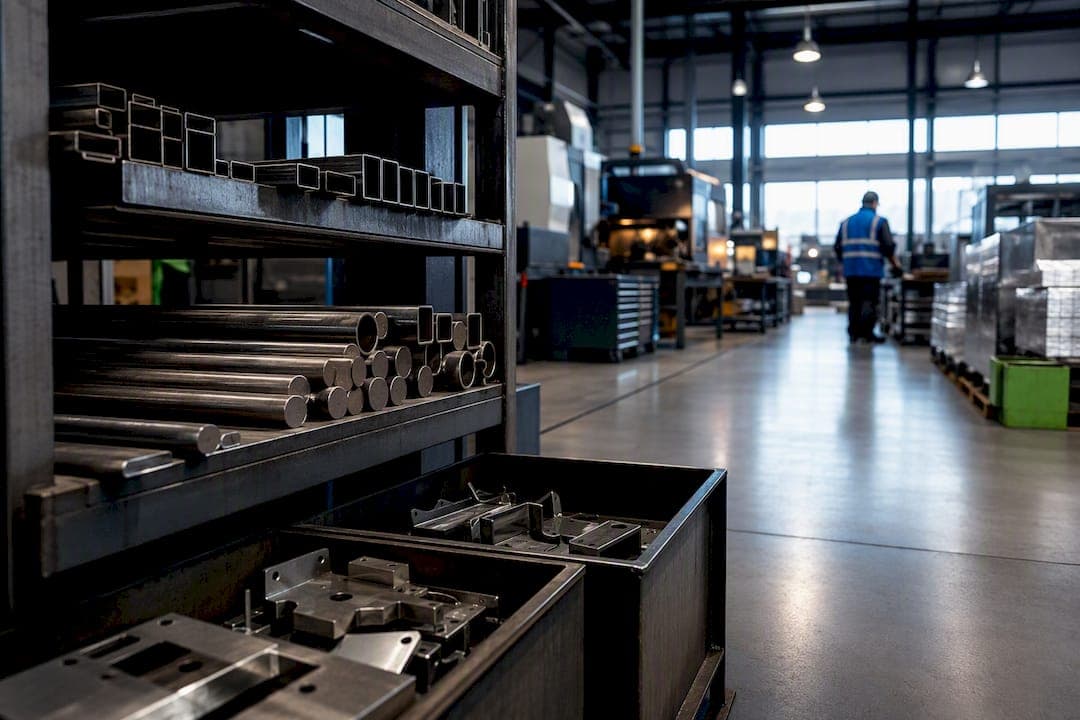
A manufacturing line of credit is the right tool when your cash gets tied up in raw materials, work-in-process, and slow-paying customers before you ever collect on a job. The SBA's new MARC program, launched for NAICS 31 to 33 manufacturers, now backs revolving credit up to $5 million with a fee-waiver window running through FY2026. Before applying anywhere, confirm your NAICS eligibility and estimate your cash-cycle exposure, since that number drives everything else.
TL;DR:
- The SBA's MARC program backs revolving credit up to $5 million for NAICS 31-33 manufacturers, with fee waivers available through FY2026, but eligibility depends on a thorough NAICS verification and cash-cycle analysis.
- Manufacturers typically use this line of credit to cover temporary gaps such as raw material purchases, payroll costs during production, bulk discounts, and seasonal or emergency expenses, not for permanent capital needs.
- Qualifying for a manufacturing line requires financial documentation like tax returns, balance sheets, and aged receivables, along with collateral and personal guarantees, while longer cash cycles demand larger credit limits.
- The application process can take two to six weeks with a bank line, or longer with SBA backing, and approval is most often slowed by inaccurate receivables data or high customer concentration.
- SBA-backed revolvers are most suitable when banks cannot provide sufficient coverage or when a federal guarantee helps establish new lender relationships; otherwise, faster and simpler bank lines might better serve shorter cycles.
Table of Contents
- What Is the SBA MARC Program, and How Is It Different From a Bank Line of Credit?
- How Do Manufacturers Actually Use a Line of Credit?
- What Do Lenders Require to Qualify You for a Manufacturing Line of Credit?
- How Lenders Size a Manufacturing Line of Credit
- What Does the Application Timeline Look Like?
- What Are the Real Risks of a Manufacturing Line of Credit?
- When Does an SBA-Backed Revolver Make More Sense Than a Bank Line?
- Get a Manufacturing Line of Credit Sized Right for Your Production Cycle
- Where to Verify Current Program Terms
- Sources
- FAQ
What Is the SBA MARC Program, and How Is It Different From a Bank Line of Credit?
MARC stands for Manufacturers' Access to Revolving Credit, and it's a new delivery method under the SBA's 7(a) program built specifically for producers, not a repackaged version of the SBA's existing CAPLines product. It's open only to businesses classified under NAICS codes 31 through 33, and it offers a revolving draw period of up to ten years followed by a term-out period of up to ten more, for a maximum structure of 20 years. Maximum loan size is consistent with the broader 7(a) family, and pricing typically runs at Prime plus a spread that varies, though your lender sets the final rate based on risk.
Here's how the three main SBA tools tend to divide up manufacturer needs:
- MARC: revolving working capital for inventory, raw materials, and production cycles.
- 7(a): term financing for equipment purchases, acquisitions, or general business expansion.
- 504: long-term, fixed-rate financing for owner-occupied real estate or major fixed assets.
A conventional bank line of credit can move faster and carries less paperwork, but it's usually smaller and shorter-term than an SBA-backed revolver. The SBA's SOP guidance spells out lender procedures for MARC in detail, and it's worth reading before you approach a lender, since underwriting expectations differ from a standard 7(a) file. Fee waivers on certain manufacturing loans are active through FY2026, but confirm the exact dates directly on SBA pages before you assume you qualify.
How Do Manufacturers Actually Use a Line of Credit?
A revolving line solves a specific problem: the gap between when you spend money to make something and when the customer pays you for it. Manufacturers draw on that gap in a handful of predictable ways.
- Buying raw materials and inventory to fulfill a signed contract before the customer's payment lands.
- Bridging payroll and work-in-process costs during production runs that stretch weeks or months.
- Taking advantage of bulk-purchase discounts on materials, or covering unexpected freight and capacity costs.
- Covering seasonal production swings or emergency equipment repairs that can't wait for a term loan approval.
Notice what's common across all four: none of them are permanent capital needs. They're temporary, cyclical, and they repeat. That's exactly what a revolving credit for production is designed to absorb, and it's why using a line of credit for a one-time equipment purchase is usually the wrong call, a point worth remembering before you sign anything.
What Do Lenders Require to Qualify You for a Manufacturing Line of Credit?
Lenders start with NAICS verification and SBA size standards to confirm you actually fit the program, since manufacturing accounts for a meaningful share of small-business employers nationally and size rules vary by sub-sector. From there, they look at financial fundamentals: consistent revenue, profitability trends, a debt-service coverage ratio that shows you can carry the payment, and enough time in business to prove the pattern isn't a fluke.
Expect to hand over:
- Two to three years of business tax returns
- Profit and loss statements and a current balance sheet
- Aged accounts receivable and inventory reports
- An equipment list and copies of major customer contracts
Collateral matters too. Lenders often want a blanket UCC lien on business assets, and most SBA-backed and bank lines require a personal guarantee from owners with significant equity stakes.
Pro Tip: Clean up your aged AR report before you apply. Lenders read a messy receivables ledger as a red flag for collection risk, even when your actual customers pay reliably.
How Lenders Size a Manufacturing Line of Credit
The sizing math comes down to one formula: raw material lead time, plus production time, plus accounts receivable days, equals your draw exposure. The longer that combined cycle runs, the bigger the line you need to cover it.
Cash-conversion cycles vary enormously by sub-sector. Cash-conversion cycles vary widely: food manufacturers may turn inventory and collect payment in a shorter time, while machinery manufacturers can have significantly longer cycles from raw material to final payment. On a rough per $10 million revenue basis, that difference alone can mean a food producer needs a line a fraction the size of what a machinery shop requires to cover the same revenue base.
Two other factors shift the number:
- Customer concentration: a handful of large buyers on 60 or 90 day terms stretches your exposure further than diversified customers paying faster.
- Inventory turn rate: slow-turning inventory ties up more cash for longer, pushing your required line size up.
What Does the Application Timeline Look Like?
The process follows a predictable sequence, though the pace differs sharply depending on the product.
- Prepare documentation — tax returns, financials, AR aging, and contracts, organized before you approach any lender.
- Lender pre-check — a quick review of NAICS eligibility, revenue, and credit profile to confirm fit.
- Underwriting — full financial and collateral review, including verification of receivables and inventory value.
- Approval and closing — final terms, personal guarantee execution, and UCC lien filing.
A conventional bank line of credit can close in two to six weeks. An SBA MARC loan generally takes longer, since it runs through additional guarantee processing, and timing depends heavily on your specific lender's SBA volume. Fee waivers on qualifying manufacturing loans are currently scheduled through September 30, 2026, based on published guidance, though you should verify the exact window on SBA's own pages before assuming it applies to your deal. The most common friction points that slow underwriting down: inaccurate or stale aged AR reports, disputed inventory valuations, and heavy customer concentration that makes a lender nervous about repayment if one buyer walks.
What Are the Real Risks of a Manufacturing Line of Credit?
Renewal risk is the one owners underestimate most. Lenders can reduce your limit or decline to renew at the annual review if your covenant compliance slips or your industry outlook sours, so managing that lender relationship year-round matters as much as the initial approval.
A few other cautions worth flagging:
- UCC liens filed against your business assets can complicate future financing rounds or slow down a sale if a buyer has to untangle them first.
- Term mismatch is a common and costly mistake: using a revolving line to fund a piece of equipment that will last ten years leaves you refinancing short-term debt against a long-term asset.
- Better-fit alternatives exist: a term loan, equipment financing, or asset-based lending often makes more sense for anything that isn't a recurring cash-cycle need.
Renewal risk and unused-line fees are standard features of most lines of credit, not a sign of a bad lender, so build that variability into your planning from day one.
Pro Tip: If you're drawing on your line for the same fixed expense every renewal cycle, that's usually a signal you actually need a term loan instead.
When Does an SBA-Backed Revolver Make More Sense Than a Bank Line?
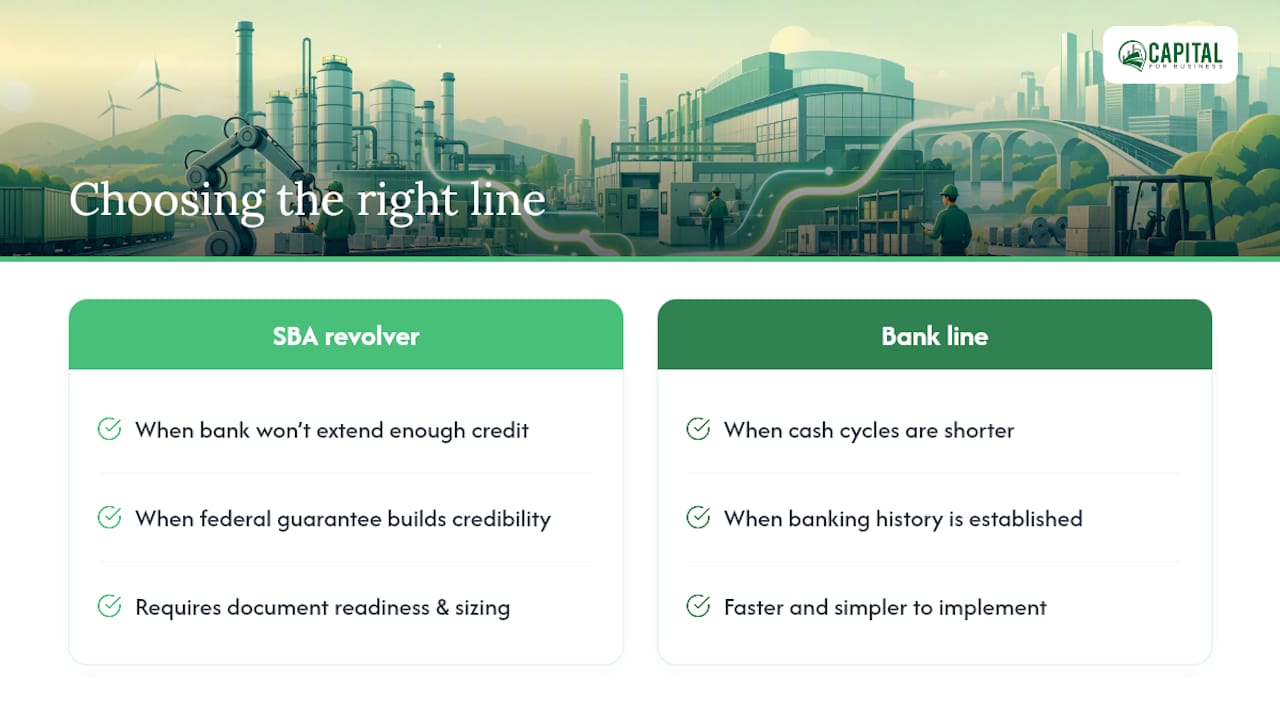
Some lenders generally point manufacturers toward an SBA-backed revolver like MARC when a bank simply won't extend a line large enough to cover the actual cash-cycle gap, or when a business needs a federal guarantee to establish credibility with a new lender relationship. A conventional bank line still wins on speed and simplicity for manufacturers with shorter cycles and established banking history.
Preparing a stronger application usually comes down to document readiness and realistic sizing before you ever submit paperwork, which is where most files stall or get rejected outright.
— Capital
Get a Manufacturing Line of Credit Sized Right for Your Production Cycle
Capital for Business gets manufacturers funded faster than the multi-month SBA timeline discussed above, with a business line of credit up to $250,000 that skips the federal guarantee paperwork entirely.
If your cycle runs shorter than a machinery shop's or you need capital before an SBA file could ever close, that speed matters more than a bigger ceiling. Alongside the line of credit, Capital for Business offers SBA loan support for manufacturers who want to pursue MARC or 7(a) with help preparing the file, plus working capital loans and equipment financing for needs that don't fit a revolving structure. Before you apply, pull together your last two years of tax returns, a current balance sheet, and your aged AR report. Then visit the funding solutions page to see which product fits your production cycle and start your application.
Where to Verify Current Program Terms
Confirm MARC eligibility and fee-waiver dates directly on the SBA's program announcement and its official SOP guidance. Program terms and waiver windows can shift, so check the publish date on any SBA page before relying on it.
Sources
- SBA Launches First-Ever Loan Program Dedicated to American Manufacturers
- MARC Loan by Manufacturing NAICS: Working Capital Strategy | PeerSense
FAQ
How Do You Get a $100,000 Business Line of Credit?
Most lenders require two to three years in business, consistent revenue, and clean financials to support a line at that size. A business line of credit from Capital for Business goes up to $250,000, so smaller amounts typically fall within reach for an established manufacturer with solid aged receivables and a reasonable debt-service position.
What Disqualifies You From Getting an SBA Loan?
Common disqualifiers include a business classified outside the eligible NAICS codes, insufficient time in business, weak or inconsistent cash flow, and derogatory items on personal or business credit history. Certain industries and uses of funds are also excluded under SBA rules, so it's worth confirming your NAICS classification and use case before applying.
What Is the Monthly Payment on a $50,000 Business Loan?
The payment depends entirely on the rate, term, and product structure, since a revolving line, a term loan, and an SBA-backed loan all amortize differently. Capital for Business lists current rates and terms for its business term loans and other products directly on its site, since a specific payment figure requires a specific rate and term to calculate accurately.
How Does a $10,000 Line of Credit Work?
A line of credit at that size functions the same way a larger one does: you're approved for a maximum limit, you draw only what you need, and you pay interest solely on the outstanding balance rather than the full limit. Once you repay a draw, that amount becomes available again, which makes a smaller line useful for covering short, recurring gaps like a single material purchase or a payroll cycle.