
TL;DR:
- Manufacturing businesses can access diverse financing options like SBA 7a, MARC, equipment loans, and invoice factoring.
- Strategic cash flow management through operational improvements can reduce reliance on external financing.
- Proactive financial planning and early lender involvement enhance growth and asset lifecycle alignment.
Manufacturing businesses face a unique financial reality: large capital requirements, long production cycles, and customers who often take 40 to 60 days to pay their invoices. Many small manufacturers assume that traditional bank financing is their only option, or that government-backed loans are too complex to pursue. That assumption is costing them real growth opportunities. In fact, SBA loans grew 16.7% for manufacturers last year, delivering $3.65 billion through 7(a) and 504 programs alone. The financing landscape for manufacturers is more accessible and varied than most owners realize. This guide breaks down the options, compares them clearly, and gives you practical strategies to put capital to work in your business.
Table of Contents
- Understanding core manufacturing financing types
- Solving working capital gaps: Invoice financing and factoring
- Equipment acquisition: Financing, leasing, and optimizing terms
- Optimizing working capital management for manufacturers
- What most business owners miss about manufacturing financing
- Find your manufacturing financing solution
- Frequently asked questions
Key Takeaways
| Point | Details |
|---|---|
| Loan options explained | Manufacturing businesses can access SBA, MARC, equipment financing, or invoice-based solutions depending on their needs. |
| Solving cash flow gaps | Invoice factoring and financing help manufacturers overcome slow payments and maintain operational stability. |
| Optimize working capital | Automation and inventory strategies can cut DSO by up to 30%, improving liquidity and growth capacity. |
| Pro tips for equipment | Align equipment loan terms with asset lifespan and consider refinancing for consolidation and flexibility. |
| Expert perspective | Most owners miss out by mismatching terms to life cycles; involve your finance team early for the best outcomes. |
Understanding core manufacturing financing types
When you start looking at financing options for your manufacturing operation, the sheer number of products available can feel overwhelming. SBA loans, equipment financing, invoice factoring, revolving lines of credit — each one serves a specific purpose, and choosing the wrong type can create unnecessary costs or cash flow problems down the road. Understanding how these products are structured, and what they are designed to do, is the foundation for making smarter financial decisions.
SBA 7(a) loans
The SBA 7(a) loan is one of the most versatile financing tools available to small manufacturers. According to the SBA, 7(a) loans go up to $5 million and can be used for working capital, equipment purchases, real estate, and even business acquisitions. Terms can extend up to 10 years for working capital and 25 years for real estate, which makes monthly payments manageable for businesses that are growing steadily but not yet generating large cash surpluses.
The SBA guarantees a portion of the loan, which reduces the lender's risk and makes it possible for small manufacturers to qualify even without perfect credit or significant collateral. Interest rates are negotiated between the borrower and the lender but are capped by the SBA, keeping them competitive. For a small manufacturer investing in a production expansion or a new facility, the SBA 7(a) is often the most cost-effective long-term option.
MARC loans for manufacturers
The Manufacturing Assistance and Resource Center (MARC) loan program is a lesser-known but valuable option specifically designed for manufacturing businesses. Unlike standard SBA loans that require traditional collateral like real estate, MARC loans accept inventory and receivables as collateral. This is a significant advantage for manufacturers who have substantial working assets tied up in raw materials, work-in-progress inventory, and outstanding customer invoices.
MARC loans are particularly useful for manufacturers in growth phases, where most of their assets are not fixed property but operational assets. If your balance sheet is heavy on inventory and receivables rather than real estate, a MARC loan may offer better access to capital than a conventional SBA loan.
Equipment financing
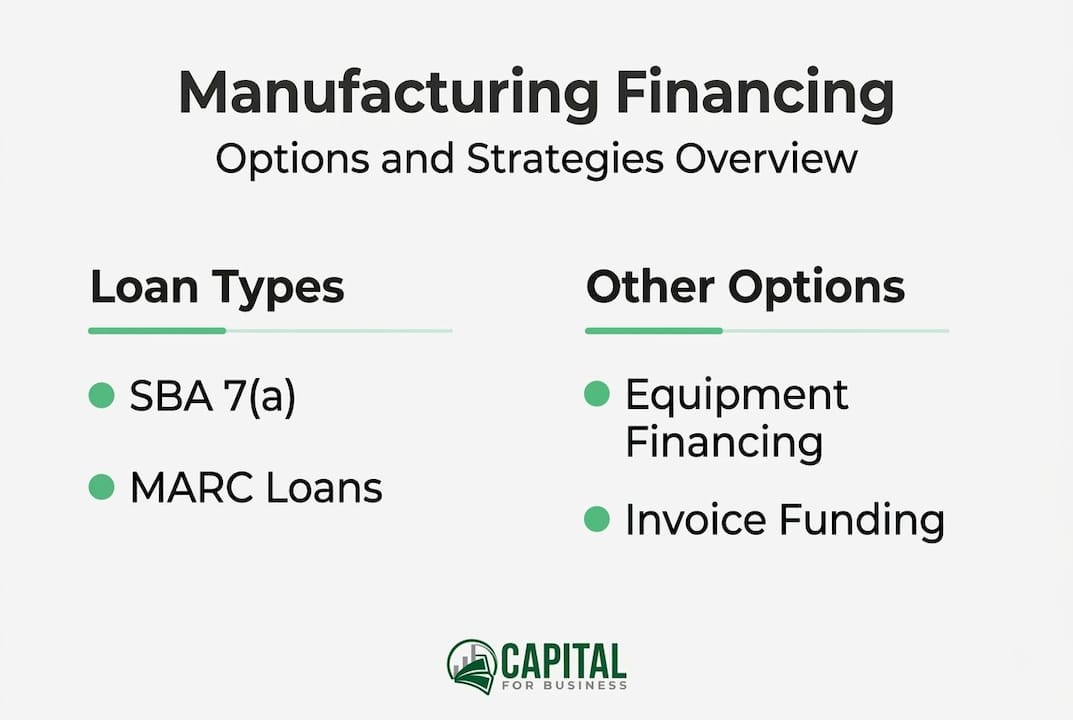
Equipment financing is purpose-built for purchasing machinery, production lines, vehicles, and other physical assets. The equipment itself serves as collateral, which simplifies the approval process and often allows for faster funding than traditional loans. Equipment financing terms range from 3 to 10 years, with interest rates typically falling between 6% and 20% depending on credit history, time in business, and equipment type. For manufacturers with strong credit profiles, 100% financing is achievable, meaning no down payment is required.
You can explore specific manufacturing business loans structured for equipment needs, working capital, and growth through lenders who specialize in the manufacturing sector.
Invoice-based financing
Invoice factoring and invoice financing both help manufacturers access cash tied up in outstanding receivables, but they work differently. With factoring, you sell your invoices to a third party at a discount in exchange for immediate cash. With invoice financing, you borrow against the value of your invoices and repay the advance once your customer pays. Both solutions are fast, flexible, and do not require traditional collateral.
Here is a quick comparison of the main financing types available to manufacturers:
| Financing type | Amount available | Collateral | Typical terms | Best use case |
|---|---|---|---|---|
| SBA 7(a) | Up to $5 million | Real estate, equipment, business assets | 10 to 25 years | Working capital, facility expansion |
| MARC loan | Varies by lender | Inventory, receivables | 7 to 10 years | Growth capital for asset-heavy manufacturers |
| Equipment financing | Up to $500,000+ | The equipment itself | 3 to 10 years | Machinery, production equipment, vehicles |
| Invoice factoring | Based on AR | Outstanding invoices | 30 to 90 days | Immediate cash flow, bridging payment gaps |
| Invoice financing | Up to 90% of invoice value | Outstanding invoices | 30 to 120 days | Short-term working capital without selling invoices |
Key takeaways for choosing the right financing type:
- Use SBA 7(a) loans for long-term capital needs with lower monthly payments
- Choose MARC loans when your collateral is inventory and receivables rather than real estate
- Opt for equipment financing when you need to purchase a specific asset and want the asset to secure the loan
- Use invoice-based solutions when you need immediate cash and have strong receivables
For more information on business loans for manufacturers, it helps to work with a lender who understands the specific cash flow patterns and capital needs of production-based businesses.
Solving working capital gaps: Invoice financing and factoring
Even profitable manufacturers can run into serious cash flow problems. You have delivered the product, the customer has accepted it, and you are owed payment. But your invoice is sitting in their accounts payable queue for 45 days while you still need to pay your workers, restock raw materials, and cover overhead. This gap between delivery and payment is one of the most common and most damaging financial challenges in manufacturing.
Manufacturers typically carry a DSO of 40 to 50 days, which means the average time between issuing an invoice and collecting payment stretches well over a month. That may not sound extreme, but when you layer multiple customers across multiple payment cycles, the cumulative shortfall can stall production, delay supplier payments, and prevent you from taking on new orders.
How invoice factoring works in practice
Invoice factoring converts your outstanding invoices into immediate cash. A factoring company purchases your receivables at a discount, typically advancing 80% to 95% of the invoice value upfront. Once your customer pays, the factoring company releases the remaining balance minus their fee. The key advantage is speed. You can have cash in hand within 24 to 48 hours of submitting invoices.
Non-recourse factoring offers an additional layer of protection. With non-recourse factoring for manufacturers, if your customer fails to pay due to insolvency or financial failure, the factoring company absorbs the loss rather than coming back to you for repayment. This is a meaningful risk management tool for manufacturers with large single-client exposures.
Invoice financing vs. factoring: Choosing the right approach
The right tool depends on your customer relationships and how you want to manage collections. Consider these scenarios:
- Invoice factoring is best when you want to outsource collections and need fast access to cash without worrying about managing the follow-up process. It works well for manufacturers with a broad customer base and consistent invoicing volume.
- Invoice financing is better when you want to maintain direct relationships with your customers and manage your own collections. You borrow against the invoice value and repay the advance once payment arrives. Reviewing an invoice financing comparison can help you understand which structure fits your operation better.
Both options improve working capital without adding traditional term debt to your balance sheet, which can be important for businesses watching their debt-to-equity ratios.
"Non-recourse factoring gives manufacturers a safety net when dealing with new or larger clients. It separates the risk of customer non-payment from your operational cash flow, letting you grow without overexposure to a single account."
Key benefits of invoice-based solutions:
- Fast access to cash, often within 24 to 48 hours
- No need for traditional collateral like real estate or equipment
- Scalable: the more you invoice, the more you can access
- Non-recourse options reduce credit risk from customer insolvency
- Does not create long-term debt obligations
Pro Tip: Match your financing method to your customer's payment behavior. If you work with large enterprise clients who reliably pay but on long cycles, invoice financing may be sufficient. If you have mixed credit quality across your customer base, non-recourse factoring through invoice factoring solutions provides valuable protection while keeping cash moving.
Equipment acquisition: Financing, leasing, and optimizing terms
For most small manufacturers, equipment is both the most valuable asset and the most significant capital expenditure. Whether you are purchasing a CNC machining center, an industrial press, a packaging line, or a fleet of delivery vehicles, the way you structure that acquisition has a direct impact on your cash flow, tax position, and balance sheet.
The two primary paths are equipment financing and equipment leasing, and each comes with distinct trade-offs.
Comparing equipment financing and leasing
With equipment financing, you borrow money to purchase the equipment outright. The equipment belongs to you, and once the loan is paid off, the asset is yours free and clear. With leasing, you pay for the right to use the equipment over a set period. At the end of the lease, you may have the option to purchase the equipment at residual value, renew the lease, or return the equipment.
Equipment financing rates range from 6% to 20% with terms of 3 to 10 years, and 100% financing is available for businesses with strong credit. Leasing, on the other hand, often requires little to no down payment and keeps monthly costs lower, but you do not build equity in the asset.
| Option | Down payment | Rate range | Term | Ownership at end |
|---|---|---|---|---|
| Equipment financing | 0 to 20% | 6% to 20% | 3 to 10 years | Full ownership |
| Operating lease | 0 to 10% | Varies by lessor | 2 to 5 years | Return or buyout |
| Finance/capital lease | 0 to 10% | Fixed monthly | 3 to 7 years | Ownership option |
| SBA 504 (equipment) | 10% | Below market | Up to 10 years | Full ownership |
You can use loan calculators to run payment scenarios before committing to a structure, which helps you compare total cost of ownership across options.
Steps to optimize your equipment acquisition
- Assess your equipment needs carefully. Determine whether the equipment will be used for 3 years or 15 years, because that directly informs whether financing or leasing is more cost-effective. Short-term needs favor leasing. Long-term production assets favor financing.
- Evaluate your cash position and credit profile. If you have strong credit, pursue 100% financing to preserve cash reserves. If cash is tighter, a lease structure with lower monthly payments protects liquidity.
- Compare total cost, not just monthly payment. A lower monthly lease payment may look attractive, but the total cost over the term including fees, maintenance obligations, and buyout costs may exceed a financing arrangement.
- Finalize the agreement with clear terms. Confirm prepayment penalties, early buyout clauses, and any balloon payments before signing. These details significantly affect your flexibility later.
Pro Tip: Match the loan or lease term to the usable life of the asset. A 10-year term on equipment with a 5-year productive life creates a financing mismatch. You will still be paying for equipment that is no longer serving your production at full capacity. Exploring leasing vs financing in detail helps you identify which structure fits both your budget and your operational timeline.
For manufacturers looking at multiple equipment needs, consolidating through equipment financing options can simplify repayment and potentially lower your blended interest rate across purchases.
Optimizing working capital management for manufacturers
Securing financing is one piece of the puzzle. Managing the cash you have, and minimizing the gaps in your cash cycle, is equally important. Many manufacturers focus heavily on acquiring capital but underinvest in the operational practices that keep that capital working efficiently. The result is a business that consistently needs external financing for problems that better internal management could have prevented or reduced.
JIT inventory and AP/AR automation can reduce DSO by 25 to 30%, which is a significant improvement for any manufacturing business. To put that in context, if your current DSO is 50 days and you reduce it by 30%, you are collecting your money nearly 15 days faster. For a business generating $5 million in annual revenue, that improvement translates to roughly $200,000 in additional liquidity without borrowing a single dollar.
Practical working capital optimization strategies
Here is a concrete example. A mid-size manufacturer producing custom metal components had a consistent DSO of 52 days. Their receivables team sent invoices via mail and followed up manually. After switching to electronic invoicing with automated payment reminders, their DSO dropped to 38 days within six months. That single operational change freed up enough working capital to fund a modest equipment upgrade without taking on additional debt.
Key working capital optimization tactics:
- Automate accounts receivable. Electronic invoicing, automated reminders, and online payment portals reduce the time between invoice issuance and payment. Customers pay faster when the process is easy and frictionless.
- Negotiate better accounts payable terms. Extending your payment terms with suppliers from 30 to 45 or 60 days creates a buffer between when you pay for materials and when you collect from customers. Even a 15-day extension can meaningfully improve your cash position.
- Implement just-in-time inventory practices. Holding excess inventory ties up cash that could be working elsewhere in your business. JIT purchasing means you order raw materials closer to when they are needed, reducing storage costs and freeing up capital.
- Review your pricing and payment terms with customers. Offering a small early payment discount, such as 1% for payment within 10 days, can accelerate cash collection significantly when working with large buyers who have cash available but no incentive to pay early.
- Use a working capital loans facility strategically. A revolving credit line allows you to draw funds during seasonal demand spikes and repay when cash flow improves, rather than taking a lump sum loan with fixed payments.
Managing supporting working capital through small business loans is most effective when paired with operational improvements. The loan fills the short-term gap, while process improvements reduce how large and frequent those gaps become over time. For additional guidance on the mechanics of managing cash flow day to day, practical cash flow management resources provide useful frameworks that translate across industries.
The goal is not to become dependent on external financing for routine operations. It is to use financing as a strategic tool for growth while running a business that generates and retains cash efficiently.
What most business owners miss about manufacturing financing
After working with manufacturers across dozens of industries, one pattern stands out consistently: most owners think about financing reactively rather than proactively. They look for a loan when they are already in a cash crunch, when a piece of equipment breaks down unexpectedly, or when they have just lost a large customer. By that point, their options are narrower and their negotiating position is weaker.
The smarter approach is to align your financing structure with both your asset life cycles and your cash flow cycles before the need becomes urgent. A 10-year loan on a machine with a 7-year productive life is not just a financial mismatch. It means you are still making payments on equipment that is no longer competitive, while also needing to fund a replacement. That compounding pressure is avoidable with better upfront planning.
Refinancing is another tool that most manufacturers underuse. Business owners tend to think of refinancing as something you do in a crisis. In practice, refinancing when your credit profile has improved, when interest rates have shifted, or when you want to consolidate multiple equipment loans into a single payment is a legitimate and smart financial move. It does not signal weakness. It signals that you are actively managing your cost of capital.
Perhaps the most overlooked lesson is this: bring your finance team or accountant into the loan decision before you sign, not after. Most business owners consult their accountant when they are filing taxes, not when they are structuring a $400,000 equipment loan. The terms of that loan, including amortization schedule, balloon payments, and prepayment penalties, have direct implications for your tax position and your balance sheet. Early involvement pays off. A beginner's equipment loan guide is a useful starting point for understanding what questions to ask before you sit down with a lender.
Find your manufacturing financing solution
Manufacturing businesses have more financing options today than at any point in recent history. Whether you need to fund a major equipment purchase, bridge a cash flow gap caused by slow-paying customers, or build a working capital reserve for growth, there is a product designed for your situation.
At Capital for Business, we have spent over 15 years helping manufacturers access the capital they need to grow, upgrade, and compete. From types of small business loans tailored to production businesses to equipment financing up to $250k and flexible working capital loans, we offer solutions built around how manufacturing businesses actually operate. We move quickly, keep requirements clear, and work with business owners who may not qualify through traditional banks. If you are ready to explore your options, we are ready to help you find the right fit.
Frequently asked questions
What is the difference between SBA 7(a) and MARC loans for manufacturers?
SBA 7(a) loans offer flexible terms with amounts up to $5 million and can be used for working capital, equipment, and real estate, while MARC loans are specifically designed for manufacturers and accept inventory or receivables as collateral rather than requiring traditional fixed assets.
How does equipment financing work for small manufacturers?
Equipment financing uses the purchased machinery or asset as collateral, with terms of 3 to 10 years and rates between 6% and 20%, and businesses with strong credit can qualify for 100% financing without a down payment.
What are average payment terms and DSO for manufacturers?
Manufacturers typically experience a DSO of 40 to 50 days, meaning it takes between six and seven weeks on average to collect payment after invoicing, which creates recurring gaps between expenses and incoming cash.
What strategies can reduce DSO and improve cash flow?
Implementing AP/AR automation and just-in-time inventory practices can reduce DSO by 25 to 30%, which accelerates cash collection and reduces the need for external financing to cover operational gaps.
Are non-recourse factoring options available, and why choose them?
Yes, non-recourse factoring is available and protects manufacturers from loss when a customer fails to pay due to insolvency, because the factoring company absorbs the risk rather than passing it back to the business that sold the invoice.