
If you need a faster approval, a lower cost, or a product type Kapitus does not offer, the best alternatives are fintech lines of credit for revolving access, online term lenders for lump-sum capital, SBA loans for long-term low-cost financing, and merchant cash advances for revenue-based repayment. Capitalforbusiness covers all those categories and serves businesses across the US and Canada.
Quick picks by need:
- Fast working capital (under 48 hours): Merchant cash advance or fintech line of credit
- Lump-sum expansion capital: Online term loan or SBA 7(a) loan
- Invoice-heavy cash flow gaps: Invoice factoring
- Equipment purchase: Equipment financing
- Revolving flexibility: Business line of credit
- Lowest long-term cost: SBA-backed loan
| Use case | Best financing path | One-line verdict |
|---|---|---|
| Immediate cash flow gap | Merchant cash advance | Fastest approval; higher cost, use for high-ROI needs |
| Planned expansion | Term loan or SBA loan | Lower rates; requires stronger docs and more time |
| Recurring short-term needs | Line of credit | Draw only what you need; interest on balance used |
| Unpaid invoices piling up | Invoice factoring | Converts receivables to cash; factor fee applies |
| Asset purchase | Equipment financing | Asset secures the loan; preserves working capital |
Capitalforbusiness offers merchant cash advances, working capital loans, lines of credit, and equipment financing, making it a strong single-source option for most of these paths.
Table of Contents
- How do Kapitus alternatives compare at a glance?
- What do the top alternative financing categories actually offer?
- How do you choose between Kapitus and its alternatives?
- What does each financing instrument actually do?
- How we evaluated these alternatives
- Which lenders and providers are the top alternatives to Kapitus?
- What do user reviews say about these alternative lenders?
- How does customer service compare across these providers?
- How complex is the application process, and how transparent is approval?
- Key Takeaways
- Why the "last resort" framing around alternative lending is wrong
- Capitalforbusiness has the products to match your next funding need
- Useful sources and further reading
- FAQ
How do Kapitus alternatives compare at a glance?
Kapitus offers term loans up to $750,000 and MCA products up to $5 million, with multiple product types under one roof. That breadth is useful, but it does not mean Kapitus is the right fit for every business. The table below maps the major financing paths against the dimensions that matter most when you are choosing.
| Financing path | Product types | Typical max funding | Approval speed | Cost signal | Min. credit / time in business |
|---|---|---|---|---|---|
| Kapitus | Term loan, MCA, line of credit, SBA | Up to $5M (MCA) | 1–3 business days | Factor rate or APR; varies by product | 625+ FICO; 2+ years |
| Online term lenders | Term loan | $500K–$1M | 1–5 business days | Higher APR than bank | — |
| Fintech lines of credit | Revolving line | $250K–$500K | Same day to 48 hrs | Variable APR; draw fees | — |
| Invoice factoring | Factoring / discounting | Up to $2M+ | 24–48 hours | Factor fee (1–5% per invoice) | Invoice quality matters more than credit |
| Merchant cash advance | Revenue-based advance | $500K | Same day to 48 hrs | Factor rate (1.1–1.5x) | 500+ FICO; 3+ months revenue |
| SBA loans | 7(a), 504, microloan | Up to $5M | Weeks to months | Lowest APR; competitive terms | — |
| Equipment financing | Secured equipment loan | Up to $250K+ | 1–5 business days | Moderate APR; asset-secured | — |
Speed vs. cost tradeoff: Alternative lenders consistently deliver faster approvals and simpler applications than banks, but that convenience comes with higher APRs or shorter repayment terms. The faster the funding, the higher the cost, almost without exception.
All providers listed operate nationally across the US. Funding speed is measured from completed application to funds in account, not from initial inquiry. APR and factor rates vary by borrower profile; the ranges above are illustrative, not guaranteed.
What do the top alternative financing categories actually offer?
Understanding what each category does, and who it fits, saves you from applying to the wrong product and wasting time.
Online term loans
Online term lenders provide a fixed lump sum repaid over a set schedule, typically weekly or monthly. Approval timelines run one to five business days, and maximum amounts usually reach up to several hundred thousand dollars. The ideal borrower has at least one year in business, sufficient annual revenue, and a moderate credit score. The main advantage over Kapitus is that some online term lenders specialize in specific industries or credit profiles, which can mean better pricing for the right borrower.
Fintech lines of credit
A revolving line of credit lets you draw funds as needed and repay only what you use. Providers like Bluevine and Fundbox operate in this space, offering lines with funding limits suited to many small businesses and approval times ranging from same day to 48 hours. These work well for businesses with seasonal cash flow swings or recurring short-term needs. Draw fees and variable APRs apply, so the true cost depends on how often and how much you draw.
Invoice factoring
Invoice factoring converts outstanding invoices into immediate cash. The factoring company advances a percentage of the invoice value (typically 70–90%) and collects payment directly from your customer. The remaining balance, minus a factor fee, is released once the customer pays. Invoice factoring and invoice discounting differ in one key way: with discounting, you retain collections responsibility. Both work best for B2B businesses with reliable customers and slow-paying accounts. Providers like FundKite and Funding Circle operate in this space.
Merchant cash advance
A merchant cash advance is not a loan. It is a purchase of future receivables, repaid as a fixed percentage of daily or weekly sales. Repayment flexes with revenue, which helps during slow periods. Factor rates typically range from 1.1x to 1.5x the advance amount. Capitalforbusiness offers MCAs up to $500K with same-day to 48-hour funding. This product fits businesses with strong card or bank deposit volume but limited credit history. See the full MCA workflow for a step-by-step breakdown.
SBA loans
SBA-guaranteed loans offer the most competitive rates and longest terms of any option in this comparison. The 7(a) program goes up to $5 million; the microloan program serves startups needing under $50K. The tradeoff is time: approval can take weeks to months, and documentation requirements are substantial. SBA loans are the right call for businesses with strong financials that can wait for funding and want the lowest long-term cost.
Equipment financing
Equipment loans use the purchased asset as collateral, which lowers lender risk and often results in more accessible approval terms. Capitalforbusiness offers equipment financing up to $250,000 with same-day funding available. This product fits any business buying machinery, vehicles, or technology where the asset directly generates revenue.
Pro Tip: Match the financing instrument to the purpose of the funds. Using a merchant cash advance to buy equipment that takes 18 months to generate ROI is an expensive mismatch. Use short-term, higher-cost capital only for needs that pay back quickly.
"Selecting financing should be treated as assembling a capital stack: combine lower-cost, long-term debt with faster, flexible capital for seasonal or immediate needs." — Alternative Financing: The Complete Guide
Common alternative options include invoice factoring, merchant cash advances, revenue-based financing, equipment loans, and more. Each fits a distinct use case, and the right choice depends on your timeline, credit profile, and how the funds will be deployed.
How do you choose between Kapitus and its alternatives?
The decision comes down to five practical dimensions. Work through them before you fill out a single application.
Decision criteria checklist:
- Funding speed: Do you need capital in 24–48 hours, or can you wait weeks for a lower rate?
- Cost tolerance: Can your margins absorb a factor rate of 1.2x–1.5x, or do you need APR-based pricing under 20%?
- Loan purpose: Is this for a one-time purchase (term loan or equipment), recurring needs (line of credit), or a cash flow gap (MCA or factoring)?
- Cash flow impact: Does a fixed daily repayment work for your revenue pattern, or do you need flexible draws?
- Collateral and personal guarantee: Are you willing to pledge assets or sign a personal guarantee to access lower rates?
Questions to ask any lender or broker before signing:
- What is the total repayment amount, not just the advance or principal?
- Is there a prepayment discount, and how is it calculated?
- How do you report payments to business credit bureaus?
- What triggers a default, and what happens to my account if I miss a payment?
- Are there origination fees, draw fees, or maintenance fees not included in the quoted rate?
- Does this product have an auto-renewal or rollover clause?
Red flags to walk away from:
- A lender who cannot or will not disclose the APR or factor rate in writing before you sign
- Rollover or stacking clauses that automatically renew the advance before you have repaid the first one
- Pressure to sign within hours, with no time to review the contract
- Vague fee language like "administrative costs" with no dollar amount attached
Before applying anywhere, review the key considerations for small business loans and prepare your application to improve your approval odds and potentially your pricing.
Pro Tip: Preparing a formal funding request that describes the exact use of funds and includes a break-even analysis materially improves approval odds and can influence the rate you are offered, even with alternative lenders.
What does each financing instrument actually do?
A quick reference on how each product works and where it fits your balance sheet.
| Instrument | How it works | Best for | Cash flow impact |
|---|---|---|---|
| Term loan | Fixed lump sum, fixed repayment schedule | Expansion, renovation, one-time purchase | Predictable fixed payments |
| Line of credit | Revolving draw-and-repay; interest on balance used | Payroll bridge, inventory, recurring gaps | Flexible; only pay when drawn |
| Merchant cash advance | Advance on future receivables; % of daily sales repaid | High-volume card/deposit businesses, fast needs | Variable; tied to revenue |
| Invoice factoring | Advance on outstanding invoices; factor collects | B2B businesses with slow-paying customers | Immediate; reduces A/R balance |
| Equipment loan | Asset-secured loan for machinery or vehicles | Equipment purchase; asset generates revenue | Moderate fixed payments |
| SBA loan | Government-guaranteed; competitive rates, long terms | Long-term growth, real estate, refinancing | Low monthly payments |
| Broker/marketplace | Matches borrower to multiple lenders in one application | Borrowers unsure which product fits | Varies by matched product |
The right financing option depends on your time in business, credit score, funding timeline, and whether you are willing to give up equity or pledge collateral. For most small businesses, a combination of a low-cost long-term instrument and a flexible short-term line produces the best outcome.
Factor rates and APRs measure cost differently. A factor rate of 1.3x on a $100,000 advance means you repay $130,000 total, regardless of how fast you pay. An APR of 30% on the same amount means the interest accrues over time, so early repayment reduces total cost. Always convert factor rates to an approximate APR before comparing products side by side.
For real-estate-focused businesses evaluating capital structure, a practical loan structure guide can help map financing options to specific use cases.
How we evaluated these alternatives
The evaluation criteria for this article covered eight dimensions: product types offered, maximum funding amounts, typical approval speed, pricing transparency (APR or factor rate disclosure), eligibility requirements (credit score, time in business, revenue), geographic availability within the US, customer support quality, and application process complexity.
Sources used include the SBA's official loan program pages, NerdWallet's lender review database, QuickBooks' business funding guide, Re-cap's alternative financing overview, LivePlan's funding options breakdown, BILL's alternative financing explainer, and CB Insights' competitive landscape data for Kapitus. Capitalforbusiness product pages were used for Capitalforbusiness-specific claims.
This article does not include original APR testing or live application data. All pricing ranges are drawn from publicly disclosed figures and reputable third-party guides. Rates and terms change; verify current offers directly with any lender before applying.
Pro Tip: Third-party review platforms like CB Insights track competitive landscapes for lenders including Kapitus and its peers. Use them as a starting point for market context, then verify specifics on each lender's product page.
This article was produced by the editorial team at Capitalforbusiness, a direct lender and broker serving small businesses across the US and Canada since 2009. The evaluation reflects publicly available information as of 2026.
Which lenders and providers are the top alternatives to Kapitus?
CB Insights and third-party review sources identify a broad competitive set around Kapitus. The providers below represent the most commonly cited alternatives, organized by what they do best.
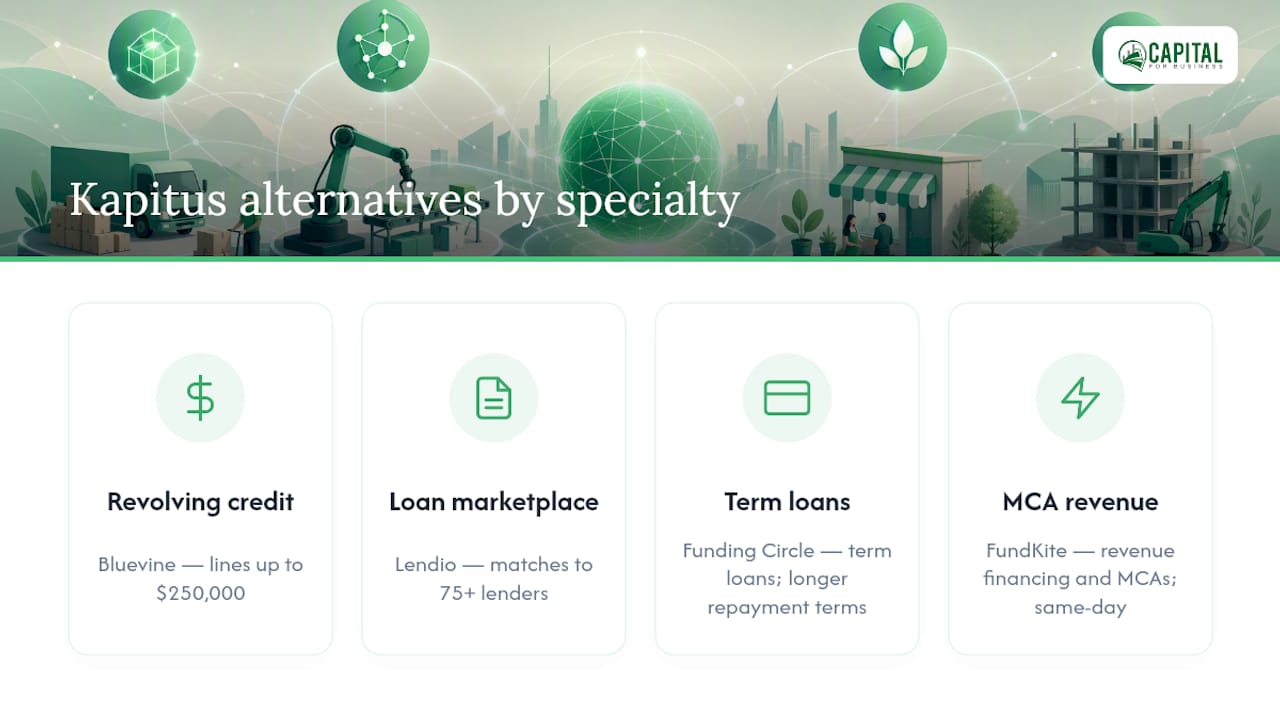
Fundbox specializes in revolving lines of credit for small businesses with limited credit history. Approvals are fast, often same-day, and the application connects directly to accounting software. Best for businesses under two years old that need recurring short-term capital.
Bluevine offers lines of credit up to $250,000 and has built a reputation for transparent pricing and a clean digital experience. It suits established small businesses with consistent revenue that want revolving access without a traditional bank relationship.
Lendio operates as a marketplace, matching borrowers to over 75 lenders through a single application. It does not lend directly but is useful for borrowers who want to compare multiple offers at once. The tradeoff is that you may receive calls from multiple lenders after applying.
OnDeck focuses on term loans and lines of credit for businesses with at least one year in operation. It reports payments to business credit bureaus, which helps build business credit over time.
Credibly covers term loans, MCAs, and working capital loans, with a focus on businesses that may not qualify for bank financing. Approval timelines are typically one to three business days.
Fundera (now part of NerdWallet) functions as a loan marketplace, connecting borrowers to SBA loans, term loans, and lines of credit. It is a research and comparison tool as much as a lending platform.
Kabbage (now part of American Express) offers lines of credit to small businesses and integrates with business bank accounts for underwriting. It suits businesses that want a fully digital experience.
Funding Circle focuses on term loans for established small businesses, with a reputation for transparent pricing and longer repayment terms than most online lenders.
FundKite specializes in revenue-based financing and MCAs, with a fast application process and same-day funding available for qualifying businesses.
Capitalforbusiness covers merchant cash advances, working capital loans, lines of credit, equipment financing, SBA loans, and business term loans. It serves businesses across the US and Canada and has operated since 2009, making it one of the more experienced direct lenders in this group.
What do user reviews say about these alternative lenders?
Reputation signals matter when you are handing over bank account access or signing a personal guarantee. Across major review platforms, a few consistent patterns emerge.
Fundbox and Bluevine consistently earn strong marks for transparency and ease of use. Borrowers frequently cite clear fee disclosure and a straightforward digital application as the main reasons for positive reviews. OnDeck receives mixed feedback: strong scores for speed and reliability, but some borrowers note that renewal offers can carry higher factor rates than the original advance.
Credibly and FundKite draw positive reviews from borrowers who were declined elsewhere, particularly those with credit scores below 620. The common complaint across both is cost: factor rates can be high for lower-credit applicants, and some reviewers note that the total repayment amount was not clearly communicated upfront.
Lendio and Fundera, as marketplaces, receive praise for breadth of options but criticism for the volume of follow-up calls from matched lenders. If you use a marketplace, expect to manage multiple conversations simultaneously.
Kabbage reviews since its acquisition by American Express have been more mixed, with some users noting changes to product availability and customer service responsiveness.
Capitalforbusiness maintains a strong reputation for responsive service and product flexibility, particularly among businesses that need both speed and product variety from a single lender.
How does customer service compare across these providers?
Customer service quality separates a good financing experience from a frustrating one, especially when you need to modify a repayment schedule or ask about a fee.
Direct lenders like Capitalforbusiness, OnDeck, and Credibly typically offer dedicated account managers or loan specialists who stay with you through the process. That continuity matters when your situation is complex or when you need to renegotiate terms. Marketplaces like Lendio and Fundera hand you off to the matched lender after the initial application, so the service quality depends on who you are matched with, not the marketplace itself.
Fintech-first providers like Bluevine and Fundbox lean heavily on digital self-service. Their platforms are well-designed, but live support can be slower to reach during high-volume periods. For straightforward draws on a line of credit, that is rarely a problem. For a complex situation, it can slow things down.
The practical test: before you commit, call the lender's support line during business hours and ask a specific question about fees. How quickly they answer and how clearly they respond tells you more than any review score.
How complex is the application process, and how transparent is approval?
Application complexity varies significantly across these providers, and transparency about approval criteria is not uniform.
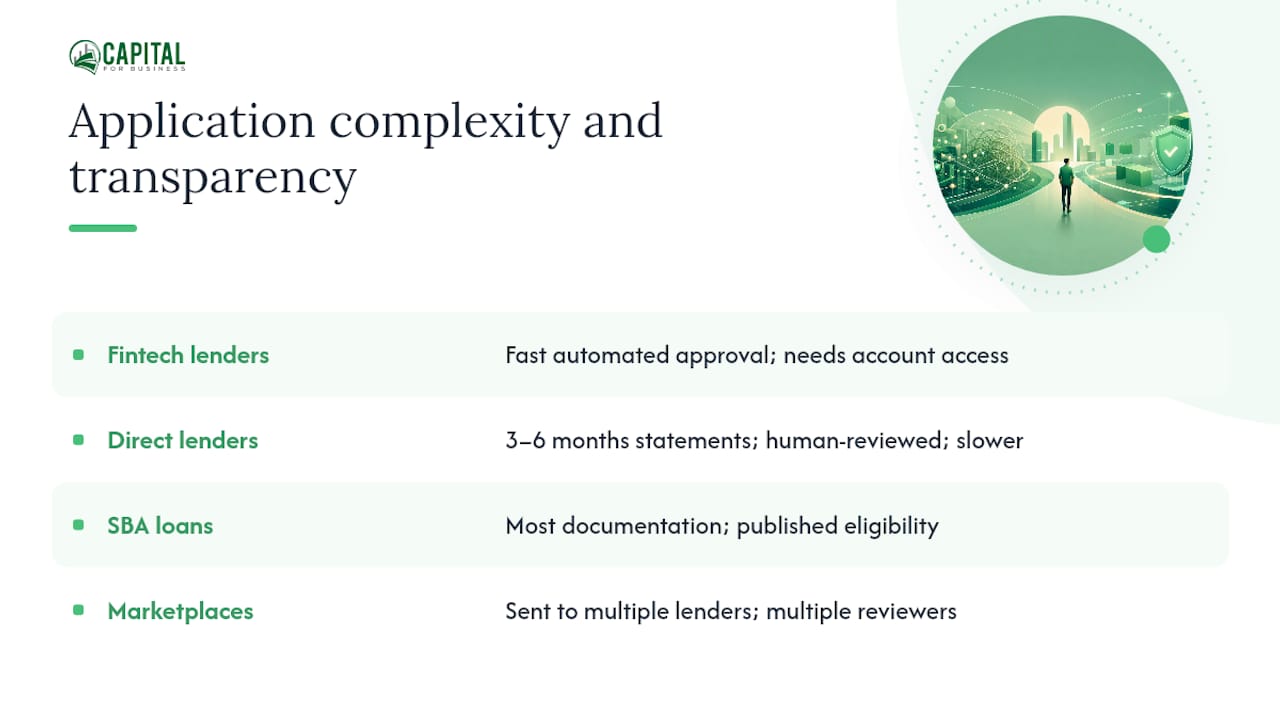
Most fintech lenders (Bluevine, Fundbox, Kabbage) use bank account integrations and accounting software connections to underwrite in minutes. You connect your accounts, and the platform generates an offer. The process is fast, but it requires sharing financial data access, which some business owners prefer to avoid.
Direct lenders like Capitalforbusiness and OnDeck typically ask for three to six months of bank statements, a completed application, and basic business documentation. The process takes longer than a fully automated platform, but you get a human review, which can work in your favor if your financials tell a story that raw data does not capture.
SBA loans require the most documentation: tax returns, financial statements, a business plan, and often a formal funding request describing the use of funds. The payoff is the lowest cost and longest terms available. Approval transparency is higher with SBA lenders because the program has published eligibility standards.
Marketplaces like Lendio submit your application to multiple lenders simultaneously, which speeds up comparison but means multiple lenders are reviewing your file. Some borrowers find this efficient; others prefer to control who sees their financial data.
For a step-by-step guide to preparing your application packet, the tips before applying for a business loan resource from Capitalforbusiness covers the practical steps in plain language.
Key Takeaways
The best Kapitus alternative depends on your funding speed, cost tolerance, and product type, with Capitalforbusiness covering the widest range of those needs from a single direct lender.
| Point | Details |
|---|---|
| Match product to purpose | Use MCAs for fast, revenue-tied needs; SBA loans for long-term, low-cost capital. |
| Speed costs more | Faster approvals consistently carry higher APRs or factor rates across all providers. |
| Transparency is a filter | Any lender who will not disclose total repayment cost in writing before signing is a red flag. |
| Application prep matters | A formal funding request with use-of-funds detail improves approval odds and can influence pricing. |
| Capitalforbusiness covers multiple paths | MCAs, working capital loans, lines of credit, and equipment financing are all available in one place. |
Why the "last resort" framing around alternative lending is wrong
The conventional framing of alternative financing as a fallback for businesses that banks rejected misses the practical reality of how capital works. A business with strong bank relationships still benefits from a revolving line of credit for payroll gaps, or an MCA to fund a marketing push ahead of peak season, because those instruments are faster and more flexible than a bank loan for short-term needs.
The real question is not "can I get a bank loan?" but "which instrument fits this specific need?" A term loan for a three-year equipment purchase makes sense. Using that same term loan to bridge a 30-day invoice gap is an expensive mismatch. Treating alternative financing as a capital-stack tool, not a consolation prize, is what separates businesses that manage capital well from those that pay too much for it.
Capitalforbusiness fits into that stack as a direct lender with product breadth: if you need an MCA this quarter and equipment financing next year, you can work with one lender who knows your business rather than starting over with a new provider each time. That continuity has real value, particularly for businesses that borrow repeatedly.
The one scenario where shopping broadly makes sense is when you are applying for an SBA loan and want to compare guarantee fees and terms across multiple SBA-approved lenders. For everything else, a direct lender with multiple products is usually more efficient than a marketplace.
Capitalforbusiness has the products to match your next funding need
Small businesses comparing Kapitus alternatives often find that the real gap is not just rate or speed. It is having one lender who can fund a merchant cash advance today and a working capital loan six months from now without making you start from scratch.
Capitalforbusiness has served small businesses across the US and Canada since 2009, offering merchant cash advances up to $500K, working capital loans, business lines of credit, and equipment financing under one roof. The application is straightforward, funding can arrive in as little as 24 hours for qualifying businesses, and you work with a team that understands your industry.
To see which products you qualify for and get a personalized quote, visit the business funding solutions page and submit a short application. No obligation, no pressure, just a clear picture of your options.
This section is produced by Capitalforbusiness. Product availability and terms vary by applicant profile. This is general information, not financial advice. Confirm current rates and eligibility directly with any lender before applying.
Useful sources and further reading
- Plan your business - Small Business Administration
- Alternative Lending: What It Is, Best Companies - NerdWallet
- Kapitus Business Loans Review 2026 - NerdWallet
- Business funding: 2026 guide to get financing | QuickBooks Blog
- Alternative Financing: The Complete Guide
- 8 Alternative Funding Options for Small Businesses | LivePlan
- Alternative Financing: Meaning, Pros and Cons
- Top Kapitus Alternatives, Competitors
For regulatory details and program specifics, always verify with the SBA directly or consult a qualified financial advisor.
FAQ
Is Kapitus a legitimate lender?
Yes. Kapitus is a licensed commercial lender offering term loans, MCAs, and lines of credit to small businesses across the US.
What credit score do you need for Kapitus?
Kapitus typically requires a minimum FICO score of around 625 for term loans, though MCA products may accept lower scores depending on revenue strength.
Who offers the easiest approval for a small business loan?
Merchant cash advance providers and fintech line-of-credit lenders generally have the most accessible approval criteria, often accepting credit scores from 500 and as little as three to six months in business. Capitalforbusiness offers MCAs with a fast, straightforward application process.
What is the maximum funding amount available through Kapitus?
Kapitus offers term loans up to $750,000 and MCA products up to $5 million, with multiple product types under one roof.
How do factor rates compare to APR when evaluating loan cost?
A factor rate (e.g., 1.3x) gives you the total repayment amount upfront regardless of payoff speed, while APR accrues over time, so early repayment on an APR-based loan reduces total cost. Always convert both to a total dollar cost before comparing offers.