
Securing the right funding can feel like a maze for small business owners in the United States and Canada, especially when cash flow is unpredictable and traditional loans are hard to access. The pressure to cover payroll, order supplies, or upgrade equipment makes the process even more urgent. By understanding your exact financial needs and matching them with the best funding solutions, you set yourself up for smarter, faster growth—without risking your stability.
Table of Contents
- Step 1: Assess Financial Needs and Eligibility
- Step 2: Research and Compare Funding Solutions
- Step 3: Prepare Essential Documentation
- Step 4: Apply for Funding and Track Progress
- Step 5: Review Offers and Confirm Funding Terms
Quick Summary
| Key Point | Explanation |
|---|---|
| 1. Assess Financial Needs Accurately | Calculate exact funding requirements for equipment, working capital, expansion, and debt repayment to avoid borrowing too little or too much. |
| 2. Research Funding Eligibility | Understand the eligibility criteria for various funding options to streamline applications and save time on unqualified programs. |
| 3. Prepare Comprehensive Documentation | Organize essential business documents in advance to improve application efficiency and increase approval chances. |
| 4. Apply to Multiple Lenders Simultaneously | Submit applications to your top lenders at the same time to enhance funding opportunities and reduce waiting periods. |
| 5. Thoroughly Review Funding Offers | Carefully compare loan terms, interest rates, and fees to avoid unfavorable conditions that could impact your business's future. |
Step 1: Assess Financial Needs and Eligibility
Before approaching lenders, you need to understand exactly how much money your business requires and whether you qualify for specific funding options. This step prevents you from seeking too little capital and stunting growth, or borrowing more than you can realistically repay.
Start by calculating your actual funding needs across these categories:
- Equipment and supplies if you're upgrading tools or inventory
- Working capital to cover operating expenses for the next 6-12 months
- Expansion costs like hiring staff, opening a new location, or launching a new service line
- Debt repayment if you're consolidating existing obligations
Write down specific numbers for each category. A retail owner might need $50,000 for inventory plus $30,000 for payroll reserves. A construction business might require $100,000 for heavy equipment. Be precise rather than vague.
Next, evaluate what funding options match your eligibility. Your business structure, industry, credit profile, time in operation, and annual revenue all factor into which programs accept your application. Some lenders prioritize veterans or women business owners. Others focus on minority-owned enterprises or rural operations. Understanding these eligibility requirements saves you time applying for programs you don't qualify for.
Gather key financial documents now. Lenders will request:
- Personal and business tax returns (typically last 2 years)
- Bank statements showing cash flow and balances
- A basic profit and loss statement
- Proof of business registration and ownership
- Your personal credit report
If your business is newer than two years old, prepare a business plan outlining your revenue projections and use of funds. Lenders want confidence you'll use the money strategically.
Knowing your exact numbers and eligibility before applying dramatically increases your approval odds and reduces application rejection delays.
Check your personal credit score before submitting applications. Most traditional lenders require a score of 620 or higher, though some alternative lenders work with lower scores. If your credit needs work, address obvious issues first, like paying down high credit card balances or correcting errors on your report.
Pro tip: Create a simple spreadsheet listing each funding source you're considering, along with their minimum credit score requirements, processing timelines, and application deadlines, so you can prioritize which lenders to contact first.
Step 2: Research and Compare Funding Solutions
Now that you understand your financial needs, you need to explore which funding sources match your situation. Different lenders offer different terms, rates, and approval timelines. Comparing your options prevents you from settling for unfavorable conditions.
Start by identifying the main funding categories available to your business:
- Bank loans offering competitive rates but stricter qualification requirements
- Small business loans from alternative lenders with faster approval processes
- Merchant cash advances if your business has strong credit card sales
- Equipment financing if you're purchasing machinery or vehicles
- Lines of credit for flexible access to working capital
- SBA loans backed by the Small Business Administration with favorable terms
Research how different funding sources compare on terms and effectiveness. Interest rates vary significantly between lenders. Approval timelines range from same-day decisions to 30+ days. Some require collateral; others don't. Understanding these differences helps you prioritize which options to pursue first.
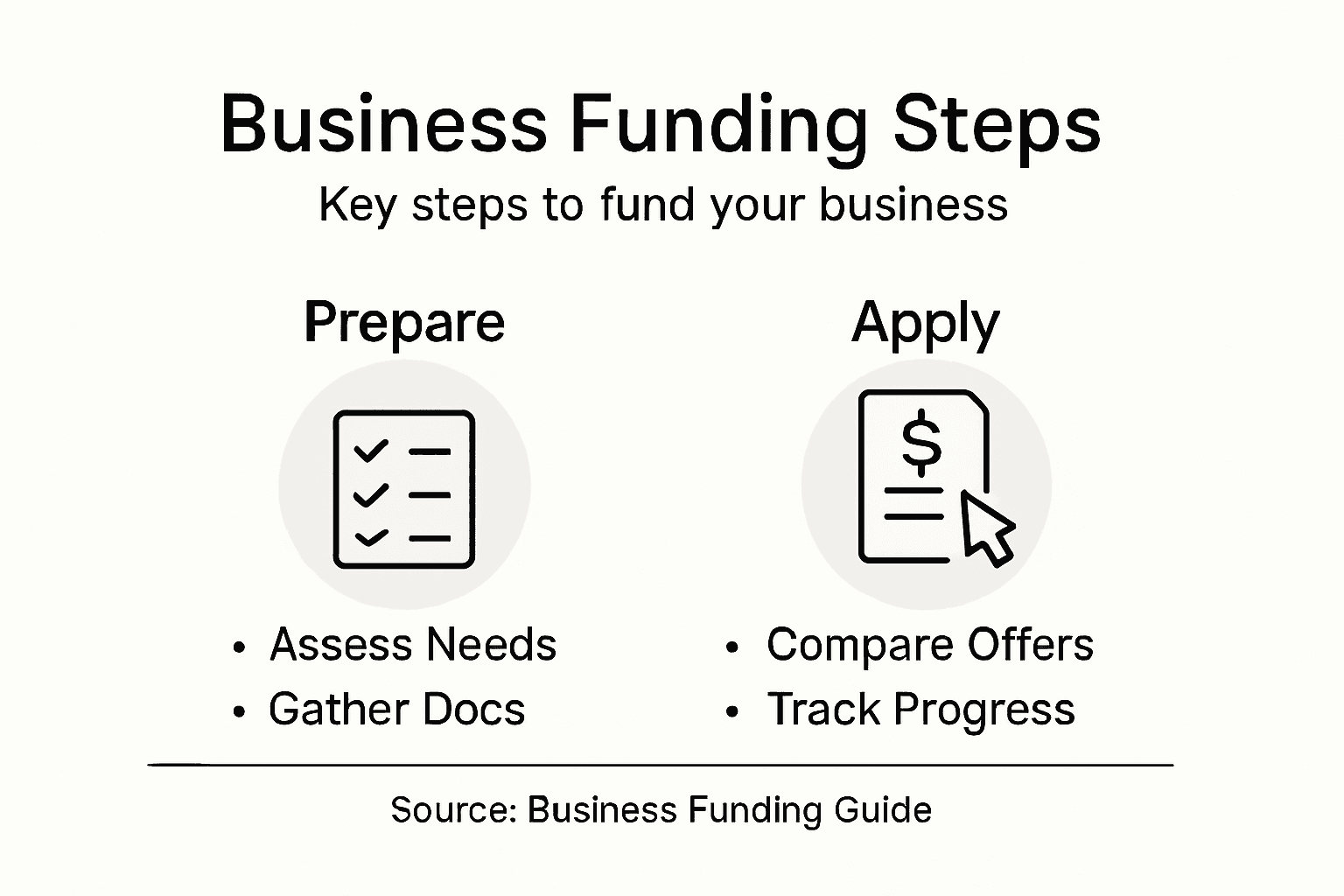
Here's a quick overview of how different funding sources typically compare on key factors for small businesses:
| Funding Source | Typical Approval Time | Credit Requirement | Best For |
|---|---|---|---|
| Bank Loans | 2-6 weeks | 680+ credit score | Established businesses |
| SBA Loans | 4-8 weeks | 650+ credit score | Favorable rates, high stability |
| Alternative Lenders | 1-5 days | 550+ credit score | Fast funding, flexible criteria |
| Merchant Cash Advance | 1-3 days | Based on sales data | High credit card sales volume |
| Equipment Financing | 2-10 days | 600+ credit score | Purchasing new business equipment |
| Business Line of Credit | 1-7 days | 600+ credit score | Ongoing capital needs |
Create a comparison spreadsheet with these columns:
- Lender or program name
- Loan amount range available
- Interest rate or cost structure
- Approval timeline
- Monthly payment estimate
- Special requirements or eligibility criteria
For construction businesses or retail operations seeking specific equipment solutions, construction funding examples can illustrate how real businesses structured their financing.
Check at least three to five lenders before deciding. This gives you negotiating power and prevents you from overlooking better options. Contact each lender's application team with specific questions about your situation.
Comparing just two lenders leaves you vulnerable to unfavorable rates; thorough research across multiple sources typically reveals 2-5% cost differences.
Document your findings in writing. Note interest rates, fees, repayment terms, and any conditions that concern you. This documentation prevents confusion later and helps you make a confident decision.
Pro tip: Track the application deadline for each lender in a calendar, since some programs have quarterly cutoffs or funding caps that close once allocated, so timing your applications strategically can improve your approval chances.
Step 3: Prepare Essential Documentation
Lenders need proof that your business is legitimate, financially sound, and capable of repaying borrowed funds. Preparing documentation upfront streamlines your application and significantly improves approval odds.
Gather these core documents before submitting any applications:
- Business registration documents like articles of incorporation or LLC formation papers
- Employer Identification Number (EIN) from the IRS, even if you're a sole proprietor
- Business licenses and permits specific to your industry and location
- Personal and business tax returns for the last two years
- Bank statements showing 3-6 months of account activity
- Profit and loss statements or income statements
- Balance sheets listing your assets and liabilities
- Business plan outlining your use of funds and growth strategy
Understand what documentation lenders require for qualifying. Different funding sources have different expectations. Bank loans typically demand more extensive financial records. Alternative lenders may accept less documentation but charge higher rates. Knowing these requirements prevents wasted effort gathering unnecessary paperwork.

For businesses applying for federal funding or grants, complete the entity registration checklist that outlines compliance certifications and business information needed for government awards. This includes your legal business name, physical address, state of incorporation, and size classification.
Organize everything in a folder, either digital or physical. Create a checklist marking off each document as you collect it. This prevents last-minute scrambling when a lender requests something you haven't prepared.
Missing even one required document can delay approval by weeks or result in application rejection entirely.
Review your documents for accuracy before submitting. Inconsistencies between tax returns and bank statements raise red flags. Spelling errors on business registration documents can disqualify applications. Double-check dates, numbers, and signatures for completeness.
Pro tip: Prepare two versions of your documentation package—one for traditional lenders and one for alternative lenders—since some require extensive financials while others prioritize recent revenue and cash flow over historical records.
Step 4: Apply for Funding and Track Progress
With your documentation organized and lenders identified, you're ready to submit applications. The key is submitting quality applications and actively tracking their status to stay ahead of any issues.
Begin your application process strategically. Submit to your top three lenders simultaneously rather than waiting for rejections. This parallel approach increases your chances of securing funding while reducing overall timeline. Most lenders take 5-30 days to review applications, so timing matters.
Follow the procedural steps when applying for business funding carefully. Complete every field accurately. Incomplete applications get rejected or delayed. Double-check that your numbers match across all documents. If your application mentions $50,000 in inventory costs, ensure your business plan and financial statements reflect this consistently.
Submit all required supporting documents with your application. Don't assume lenders will ask for what they need. Proactively provide everything requested plus anything that strengthens your case. Include a one-page summary of your business, funding amount needed, and specific use of proceeds.
Understand pre-award application timelines and agency review processes if applying for federal grants or SBA programs. These programs move slower than private lenders but offer better terms. Know the expected review period so you can plan accordingly.
Track your applications in a spreadsheet with these details:
- Lender name and contact person
- Application submission date
- Expected decision date
- Current status (submitted, under review, approved, denied)
- Any follow-up items needed from you
- Notes from conversations with loan officers
Follow up proactively every 5-7 days. A simple email asking for a status update keeps your application visible and demonstrates serious intent. If a lender requests additional information, respond within 24 hours.
Applications sitting unanswered for weeks often get deprioritized; consistent follow-up keeps momentum and speeds decisions.
When you receive approvals, compare the final terms against your spreadsheet. Verify interest rates, monthly payments, and repayment periods match what was quoted. Don't celebrate until funds hit your account.
Pro tip: Maintain a running log of which lenders asked specific questions about your business, then use those insights when following up—personalizing communication ("You asked about our seasonal revenue patterns") shows you're engaged and serious about the partnership.
Below is a summary of ways small businesses can improve their funding application approval odds:
| Strategy | Purpose | Impact on Approval Odds |
|---|---|---|
| Prepare all documents in advance | Demonstrates readiness to lenders | Reduces processing delays and rejections |
| Check personal/business credit | Addresses potential red flags early | Prevents surprises during review |
| Apply to multiple lenders | Increases overall chances | Provides backup options for funding |
| Match funding type to needs | Ensures proper use of capital | Higher likelihood of lender acceptance |
| Double-check for consistency | Avoids conflicting information | Improves lender trust and confidence |
Step 5: Review Offers and Confirm Funding Terms
Receiving funding offers is exciting, but accepting the wrong terms can hurt your business for years. Take time to carefully review each offer before making a final decision.
Start by creating a side-by-side comparison of all offers you've received. List these key elements for each lender:
- Interest rate (annual percentage rate or APR)
- Loan amount available
- Repayment period (how many months or years)
- Monthly payment amount
- Total cost of borrowing (interest plus fees)
- Prepayment penalties if you pay early
- Collateral requirements or personal guarantees needed
- Origination fees or closing costs
When you thoroughly review funding offers before acceptance, pay special attention to hidden costs. Some lenders bury fees in fine print. A loan with a 7% interest rate but 3% origination fee plus monthly service charges might actually cost more than an 8% loan with no additional fees.
Calculate the real monthly cost, not just the advertised rate. A $50,000 loan at 10% interest over three years costs roughly $1,541 monthly. The same loan at 12% costs $1,620 monthly. That $79 difference adds up to $2,844 over the loan term. Small rate differences compound into significant money.
Read the fine print completely. Look for clauses about what happens if you miss a payment, how the lender calculates interest, and whether interest rates are fixed or variable. Variable rates might start low but increase over time, making future payments unpredictable.
Contact each lender with questions before signing. Ask about flexibility if business slows down. Some lenders allow payment deferrals or restructuring. Others don't. Understanding these options matters when cash flow gets tight.
Signing documents without fully understanding terms is the fastest way to regret your funding choice and damage your business relationships.
If you're uncertain about any language or conditions, have a trusted advisor or attorney review the documents. The small cost of professional review pales compared to being locked into unfavorable terms.
Pro tip: Request everything in writing before signing—verbal promises about flexibility or rate adjustments mean nothing if they're not documented in your loan agreement, so insist on amendments if the lender agrees to special terms.
Secure the Right Funding to Grow Your Business Today
Understanding how to assess your financial needs and matching funding options with your business goals is crucial for success. If you want to avoid the delays and frustrations that come with incomplete applications or unsuitable loan terms, consider turning to a trusted partner who specializes in small business lending. Capital for Business understands the unique challenges you face, whether you need working capital, equipment financing, or a merchant cash advance tailored to your industry and credit profile.
Take control of your business funding journey now by working with a lender who moves quickly and offers clear, affordable options. Visit Capital for Business to explore flexible small business loans, merchant cash advances, and lines of credit that help you secure the capital you need without unnecessary obstacles. Don't wait for banks to say no. Act today and position your business for growth and stability with financing designed for your success.
Frequently Asked Questions
What are the first steps to assess my business funding needs?
Before seeking funding, calculate exactly how much capital your business requires across categories like equipment, working capital, and expansion costs. Create a detailed budget to ensure you pursue the right amount of funding to support your growth.
How can I determine my eligibility for different funding options?
Evaluate your business structure, credit profile, and revenue to see which funding sources align with your qualifications. Gather necessary documents like tax returns and a credit report to better understand what lenders expect.
What types of funding solutions are available for small businesses?
Small businesses can explore various funding solutions such as bank loans, SBA loans, merchant cash advances, and lines of credit. Research these options to find the best match for your specific financial situation and needs.
How do I prepare essential documentation for funding applications?
Gather key documents including tax returns, bank statements, and your business plan to present a complete financial picture to lenders. Organize these documents systematically to streamline your application process and boost approval odds.
What should I do if I receive multiple offers for funding?
Carefully compare each offer side-by-side, considering factors like interest rates, repayment terms, and any hidden fees. Take your time to fully understand the terms before making a decision to ensure you're choosing the most favorable option for your business.
How can I ensure my funding applications are successful?
Submit high-quality applications with accurate information and all required documents on time. Track your application status proactively and follow up regularly to demonstrate your commitment and keep your application moving forward.